
Youse KNAYOSE we'll all be hearin' dis owin de raydiayo awll Dezember, hons.* From the WMPT show "Crabs" circa 1984.
* Translation from the Bawlamerese: You all KNOW we'll all be hearing this on the radio all December, everybody.
Saturday, November 28, 2009
AO, ah want craaaabs fer Chrismiss
Friday, November 27, 2009
Because it's Eid Al-Adha
Adam "Amateur Gourmet" Roberts explores the Islamic holiday of Eid Al-Adha, the Sacrificial Feast. And he finds out just how much of a foodie holiday it truly is! It's a nice read. And ya gotta love the shots of delicious Pakistani food.
Thursday, November 26, 2009
Thanksgiving in Baltimore, Hon
Someone should nominate Avalon as Baltimore's official Thanksgiving movie.
Thanksgiving Chairs
May your Thanksgiving go smoother than Snoopy's starts, and end as well as Snoopy's ends.
Wednesday, November 25, 2009
Food Ethnography on a Budget: Eastern Woodlands II: Wild Rice and Maple Syrup
My next sample of Eastern Woodlands food - in this case, something clearly from the northern reaches of the Northeastern Woodlands - was a dessert. In her New Native American Cooking, Dale Carson does not have a recipe for "Wild Rice and Maple Syrup," per se. Why should she? It's ridiculously simple to do. All she advises is to take cold wild rice and slather it with maple syrup. She says it is one of the tastiest and most simple desserts one can eat.
But it sounds gross! Doesn't it?
Before attempting this very simple recipe, I had to remind myself that there are various examples of rice used in a dessert context in Asia (yes, I know wild rice is technically not rice but a different grain altogether). Anyone who has sampled the kheer rice porridge at your local Indian buffet knows that rice and sweetness work together. In fact, there are lots of grains that taste great when covered in something sweet and sticky. Oatmeal most readily comes to mind. Still, it sounded weird at first. It shouldn't have, but for someone with little experience consuming either wild rice or maple syrup, I just had to reorient myself to the concept.
I had both ingredients just lying around from the previous night's venison stew, so it cost me absolutely nothing extra.
It was just as easy as Carson made it sound: scoop wild rice in a bowl, cover it with maple syrup to your liking, done.
I am a convert. It was actually quite tasty! It went even better with whipped cream on top.
Because it's Thanksgiving Eve
I posted this last year. You can't find this particular Debbie Downer video that easily on NBC's website but the embed code still seems to work! Thankful for very small favors - since that seems to be the only thing going right these days :\
WHAAA' WWWWWWWWWHHHAAAAAAAAAAAAAAAAAAAA....
Tuesday, November 24, 2009
Food Ethnography on a Budget: Eastern Woodlands I: Venison Stew
The next stop on my Food Ethnography quest takes me right to our own backyard, and the foods and cuisines that have existed on this continent for thousands of years. That would be the many food traditions of the native peoples of North America, which of course influenced what the first Europeans and Africans in what is now the Eastern United States ate sooooo much later. Since we are talking about Thanksgiving, I will focus specifically on what anthropologists refer to as the Eastern Woodlands cultures. The original Thanksgiving took place in the Northeastern Woodlands. I won't focus there exclusively, but I will focus there mostly.
Native American Northern Eastern Woodlands Cultures Located in: North America, spanning from Ontario and Minnesota in the northwest to Illinois in the southwest, and from North Carolina in the southeast to New Brunswick in the northeast. Maryland, by the way, is part of this region.
Number of cultures: many, many, many of them. Some of the native nations in Maryland include the Piscataway-Conoy. Sadly, none of Maryland's native nations are federally recognized as of 2009.
Some important ingredients: venison, fish (specifically around water), corn, beans, squash, hickory, cranberry (northern), maple (northern), wild rice (northern)
Number of Northern Eastern Woodlands restaurants in the Baltimore area: 0, although powwows occasionally happen throughout the year
Number of Northern Eastern Woodlands restaurants in the DC area: 1 - the Mitsitam Café in the National Museum of the American Indian. The café also has foods from indigenous peoples in many regions of North, South and Mesoamerica. "Mitsitam" means "Let's eat!" in the Delaware and Piscataway languages.
Kind of like: very, very local, without ingredients that are native to Europe, Africa, Asia or other parts of the Americas.
There is no one, monolithic "Native American cuisine" - that would be like saying there's just one, monolithic "European cuisine." It just doesn't exist. Instead, there are many, varied Native American cuisines, probably as varied as the indigenous nations that exist in what is now the United States. But it is easier to find common foods within each "culture area" of Native America - such as "Southwest" or "Great Plains" or "(Northern) Eastern Woodlands." Let's take the Northern Eastern Woodlands region - an area that stretches from New Brunswick, Québec and Ontario in the north to Illinois, Kentucky and North Carolina in the south. Foods that were indigenous to this area before the 1500's include foods that were always found here - such as venison, fish, hickory nuts, acorns and our own blue crabs, hon. It also includes foods that found their way from farther south - such as corn, beans and squash, which journeyed from Mesoamerica (where the Aztecs and the Maya live) through the Southwest and into the Eastern Woodlands. Even though there is no one "Native American cuisine," that has not stopped Abenaki chef Dale Carson from starting to compile a type of Native American cuisine with her book New Native American Cooking. Carson relies heavily on the traditions of her own heritage, while creating, updating and introducing to all Americans the foods and recipes of Native America for the modern kitchen. I will be relying heavily on Carson's book for various recipes for the next few posts.
Carson is the first person to point out that Native Americans readily embraced techniques and ingredients introduced by Europeans and Africans. As she notes:
Purists might argue that the inclusion of dairy products, eggs, refined sugars, and wheat flours make this collection somewhat less than authentic. To be sure, our ancestors would not have eaten wild blueberry ice cream or incorporated cream cheese into their sunchoke dunk. But neither did the European colonists who came to these shores and brought these "alien" ingredients with them. We've all evolved; like other Americans, Native people shop at supermarkets, buy butcher shop meats, and stock canned and frozen fruits and vegetables on the pantry shelves of modern kitchens, where family dinners are prepared on electric and gas-fired stoves and leftovers are covered in plastic wrap and stored in refrigerator-freezers. (p. xiii)Keeping this in mind, I will probably be integrating some of these very same ingredients that Carson incorporates into her recipes. But for the recipe in this post, I will make things hard for myself by doing the "purist" thing. I will try to use only ingredients that people in the Eastern Woodlands were using 500 years ago. This won't be completely possible, but I'll do it whenever I can.
The meal: venison stew
One of the most common game animals in the Eastern Woodlands was deer. Just look at all the deer running around today and you'll see just how plentiful a resource deer is. Many cooks would have made stews out of deer in this part of the world. Fortunately, I had some venison in the freezer, shot, killed and dressed by my sister's father-in-law. If you have none laying around, you can buy some, but it'll be pricey. Bison and rabbit are other animals you would have found in North America - though bison did not really roam around the East Coast 500 years ago. These meats are also pretty damn pricey, so if you're broke you might just want to make a regular old stew with non-native ingredients, like beef or chicken.
For this venison stew, I'm hewing more to a generic "stew" outline. What to put in it comes from a few sources: the excellent Carson cookbook, for inspiration; a Basic Venison Stew recipe from the Hunting Society website (which is heavy on the taters and carrots); and a page on the Native Tech.org website that teaches about the different lifeways of native peoples of the Eastern Woodlands before Europeans came. From this last source, I get a mental picture of the types of foods that might have been thrown into your average stew in a place like New England 500 years ago (from the Native Tech page "Cooking our food we gather..."):
The mother adds some things to a venison stew she will be cooking soon, and the son brings to her some wild onions he has just gathered. The fire has not been started yet, but after the dried corn (which hangs to the left of the wigwam door) has been added to the mixture, the clay pot will be suspended over the fire and the stew will simmer slowly for hours. To the stew she will add some of the maple sugar in the birchbark makak container behind the hearth. The woman will use the long wooden paddle to stir the stew occasionally, and when it is finally done, she will serve the food in the birch bark dishes which sit on the woven mat in front of the hearth, using the carved wooden ladle which sits now in the other clay pot to the left.Since I don't have the time to stand around and stir all day, I'll be using that incredibly modern convenience, the slow cooker.

All ingredients are either native to North America or (like the onions) filling in for ingredients that are
Of the things I have on hand, venison is the key ingredient. I have about a pound and a half of it in my freezer. Added to that are things I have bought recently: some shallots and green onions I bought for the Cambodia project (since I have no wild onions on hand, these will have to do), and dried lima beans. Added to that are some other Native American foodstuffs I bought for this and the next few recipes: an acorn squash ($1), sunchokes - at the root of the sunflower ($3 per lb at Wegman's; I got about 1/2 lb), a bag of frozen corn ($2 - everyone is out of corn on the cob), some cranberries ($3 for a 2 lb box - I'm using most of these for Thanksgiving but I will experiment with a handful of these), and the kicker - maple syrup.
Okay, get the "EWWWWW's" out. Maple syrup? In a stew?
Having not grown up anywhere near New England, maple syrup was not exactly a staple in my home growing up. In fact, I think I've only ever bought one bottle of maple syrup in my life. And maple sugar and syrup was not really used much farther south than New England and southern Canada. Still, I am intrigued at the prospect of using it in place of refined sugar. And I only need a little bit. At $8 for a 12 oz bottle, it is easily the most expensive ingredient, but I'll be using this stuff in a few different ways. So it's worth the expense, I think.
Every recipe I have read suggests that I brown the venison in a skillet before transferring it to the slow cooker. After doing that, I just dumped it in the slow cooker. To that, I added the acorn squash - which really went far - 1/2 lb sunchokes, 1/2 bag frozen corn, 3 green onions, 2 shallots, and 3/4 cup each of dried lima beans (I didn't presoak them) and cranberries. Finally, I added some salt for flavor, and the special ingredient, 3 tablespoons of maple syrup (Grade A, in this case). I covered it all in water and about 4 cups of roasted chicken broth I had in the freezer (again, a nod to modern conveniences), and slow cooked it on HIGH for 6 hours. This is despite the Basic Venison Stew advisory that in the slow cooker, you get a stew that tastes like it has "already been reheated several times."
Six hours later, I come back in from work, and the apartment smells too good. My first thought is: no, this probably won't taste like it's been reheated several times.
 Venison stew in a bowl
In fact, this venison stew, which was very much thrown together on my part, had a very nice venison flavor, even though there were so many vegetables that it was easy to lose the venison in between them. The least good part about this stew was the acorn squash, which was a little mushy, but I expected that with squash. It was a nice, hearty stew of (predominantly) native North American ingredients. The cranberries added a nice tartness, and took on the color of the venison. The lima beans, thrown in unsoaked, ended up perfectly firm yet not hard. The maple syrup, unfortunately, got completely lost in the stew, as I could hardly find it even though I was looking for it. In the future, if I want any kind of maple aftertaste, I will need to add at least twice the amount that I did.
The perfect accompaniment for this stew is wild rice. Technically not "rice" as we think of it, it's the only grain that is indigenous to the Eastern Woodlands (maize was brought in from Mesoamerica, so it's not exactly "native" to this area). I had never prepared it before, and it's quite easy: just dump 1 part rice to four parts water in a pot, boil, cover and simmer for 45 minutes. It didn't even burn to the bottom like regular rice. Just a note: I got mine from Trader Joe's, who sells two types of wild rice. One is organic, from Saskatchewan, and sells for $3. The other, which is the exact same amount of wild rice and is not organic, ends up costing $5. And the cheaper one has a ziploc top! I have no idea how this slipped by the powers-that-be at Trader Joe's. I hope they don't read this post, find out their mistake, and jack up the price of the organic bag.
 With wild rice
I have enough stew to last me a week. I can only imagine how far a much larger pot of stew, with a whole deer, would've lasted an entire family or village!
Fraa-Jee-Lay... It must be Italian!

Wendi at Bon Appetit, Hon! has started a(n annual?) award-giving practice of just recognizing some area blogs that she likes and has great things to say about. But in true Pay It Forward fashion, whoever receives a "Major Award" has to award other blogs with the distinction. And so on and so on. HowChow slipped me a Major Award, and since I accepted it, I have to award it forward, so to speak.
You can give an award for any reason whatsoever. As long as you have a reason to give it some sort of accolade. Wendi has the basic rules for the "It's a Major Award!" (IAMA!):
1. Post an entry on your blog that displays the IAMA! logo and links back to the person who gave you the award.I assume you can award non-local blogs, but I'll give someone else the honor. I also expect that at some point, somebody is going to be re-awarded! Sorry if you're getting another major award - or should you be sorry?2. Name as many other blogs as you like that are deserving of an IAMA! award. But in doing so, you’ll need to say a word or two (or more) about what makes them awesome.
3. Include links to the blogs you are giving the IAMA! award.
4. Leave a comment in the newly awarded blogs letting them know that they have been recognized with an IAMA! award.
5. That’s it.
Dining Dish - Because Dara is so busy I don't know how she has the time to still write a blog at all, much less one as good as hers. And her promotion and advocacy of woman chefs & restauranteurs is especially important in a field that is still overly male.
The Hungover Gourmet - Because Dan just celebrated the final print issue of THG, and because what he writes on THG blog still makes me chuckle.
Minx Eats - Because her hilariously smart-alecky Top Chef and Next Food Network Star recaps never cease to amuse me.

And I stopped watching Top Chef in September!
Pigtown Pigout - Yes, Meg, you're getting another major award. But this one is for the food half of your blogging enterprise. Anyone brave enough to try durian should get this award. I have yet to try durian.
Raspberry Eggplant - Yes, Roopa moved back to Brooklyn - the one in New York - last year, but she's still a local in spirit. Did you know she appeared on Jeopardy! recently?
Strawberries in Paris - Because Elizabeth delivers delicious recipes in such cheerful way! And her angel food cake will certainly turn out better than mine.
Sweet Mary - Because she makes one mean cupcake. And she's understanding the whole job search thing I'm going through.
Just because I didn't nominate you doesn't mean you're not worthy of a nomination. These are just a handful of blogs that deserve the mention. Hey, this isn't a bad idea, Wendi.
Wednesday, November 18, 2009
An Original Thanksgiving, Pilgrim-Style
I don't even have to wonder what the first Thanksgiving feast was like. Guinea Pig Diaries author A.J. Jacobs has found out for us! It had no factory-processed turkeys, and was probably held in September or October. And the Wampanoag came on their own. And instead of sweet potatoes, stuffing, mashed potatoes and pumpkin pie, there were turnips, deer, lobster and eel, as Jacobs notes:
The lobster, boiled in red-wine vinegar, was a big hit. Although our lobsters are shrimpy compared to those of 1621, when the crustaceans commonly weighed 20 pounds and had claws the size of a human arm.Why does strike me as fodder for his next book?
As for deer, a friend had venison in his freezer. (Bonus: He’s a descendant of Miles Standish!) We cooked it in a stew thickened with ground walnuts to mixed reviews. Next up were grits, turnips and a boiled salad (yes, boiled) of spinach and currants.
We saved the eel for last, boiled in white wine and sprinkled with fennel seed. But maybe I should have called the Butterball Eel Hotline, because it was downright nasty—a mix of rubbery eel flesh and hard bone. As my friend Shannon said, “My gag reflex is getting quite a workout.”
This can only help me in my next Food Ethnography post, which will have something to do with the first Thanksgiving - either what the Pilgrims ate or what the indigenous peoples of Eastern North America were already eating before that.
Tuesday, November 17, 2009
Baltimore City needs to support its A-rabbers, dammit!

Something is sticking in my craw right now. It's soapbox time!!!
I am listening to the Mid Day with Dan Rodricks show on WYPR right now. As you may know, the city has dealt its next blow in its quest to end the A-rabber tradition in Baltimore, by having the horses seized for living in inhumane conditions. According to the A-rabber spokespersons on the show today, the city really hasn't bothered to help them find a place to keep the horses in cleaner conditions. Of course, they never intended to.
This frustrates me, because sometimes the A-rabbers - who now may have much more difficulty paying the bills - are the only source of fresh food to some communities in Baltimore. The horses need to be treated humanely, but the City has an obligation so far as I am concerned to help the A-rabbers do this. These folks aren't independently wealthy, and I can only assume that most of them probably cannot house their horses on their own. The intentions of the humane society in seizing them are noble so far as keeping the horses healthy, but a little racist as far as disregarding the livelihood of the A-rabbers, who are disproportionately African-American. Again, I blame this more on the city than the humane society, who are just doing their job to keep the horses healthy.
So that's my opinion: the city should be stepping in to help the A-rabbers find a place to keep their horses in clean and safe areas, perhaps find a way to give training or even create a few jobs in this bad economy by hiring a handful of people to care for the horses. Optimistic on my part, but I feel this is the only way to protect this tradition, the A-rabbers, the horses and the consumers who may rely on the A-rabber carts for produce.
What do y'all think? What should happen with the A-rabbers and their horses, and this important city tradition?
Picture linked from the Arabber Preservation Society homepage.
Sunday, November 15, 2009
Food Ethnography on a Budget: Cambodia III - Amok Trey
My mini "excursion" to Cambodia is almost done, and I couldn't finish it without trying my hand at what (so I've read) is to Cambodia as the hamburger is to the US: the coconut milk, fish sauce and galangal-coated steamed fish dish known as amok trey. Known in Laos as mók pa and in Thai as haw mòk plaa (if I read that Wikipedia entry correctly), it gets its name from the method of cooking it: wrapping it in banana leaves (mok or amok). I couldn't find more than a mention of it in the Elephant Walk Cookbook so I turned to the internet, where I found a few recipes for it. The one I used is from AsiaRecipe.com's Cambodia page. The recipe calls for the following ingredients (look at the recipe for exact amounts):
- fish sauce (natch - a few tablespoons)
- coconut milk (duh - a whole can is needed)
- garlic (not nearly as much as for the nataing - only a clove)
- red onion (a whole onion)
- galangal (a bigger, tougher member of the ginger family)
- lemon grass (dried or fresh - I got the fresh variety)
- turmeric, paprika and a wee bit of sugar
- also a wee bit of salt (optional since you have the fish sauce)
- a pound of some sort of white fish
- and, of course, banana leaves
- garlic - Normally I have this on hand, but since I had just used it all on the nataing I needed more (50 cents at the farmers' market for a head)
- lemongrass, at H-Mart - about $2 per lb. I got two pieces that weighed about 1/4 lb. I still have 1 1/2 stalks left. Not quite sure what to do with them yet. Can I freeze it?
- big ass package of banana leaves - only sold at H-Mart by the package, $3 (Wait - no banana leaves? Are you tired of having them break all the time? Just use big green cabbage leaves and soften them in water.)
- galangal - hands down, the most expensive item. It sells at H-Mart for $7 per lb (and at Wegman's for $9 per lb)! Do what I and the woman next to me did, and break off a smaller piece. Mine was only about 1/4 lb. You do the math.
- catfish, $6 per lb at Wegman's - yes, US farmed, and according to the helpful folks at the Monterey Bay Aquarium (thanks again to Eric & Alan for the heads-up) it's one of the best seafood choices that Marylanders and others in the "Southeast Seafood Region" can make.
Of course, during the process there were a few tedious things that popped up with foods I had not really used before.
- About the lemongrass: Don't bother using your knife. Just use your cooking shears. They work wonders, I'll tell you what.
- Ouch, it's galangal: Galangal (or Thai ginger) is like ginger only harder. It is very difficult to cut into. Take your time and use a knife with a very strong blade.
- Why do these damn banana leaves keep breaking!?!? I've used them but once, for the Yucatec Maya dish cochinita pibil, and with that I wrapped a whole pork butt in it and put it in the slow cooker. Didn't have to be so neat. For this, I had to wrap each piece of catfish neatly in its own banana leaf parcel (about 8" / 20 cm square). Each f****ing piece. When you've gone through your third 8" / 20 cm square parcel because it keeps on ripping, you really just want to assault someone with a package of banana leaves.
The meal: amok trey
The first step is the sauce. For this, you need every ingredient listed above save for the fish and the banana leaves. Throw every sauce ingredient but the coconut milk into the food processor - and thank God I have a working one because my blender would not have liked this part - and grind them down to as much of a paste as possible. My light-duty processor could not break down every little chunk of lemongrass down very much, but for the most part it was successful. Next add the entire can of coconut milk, continue to purée, and then transfer to a pot to simmer for about 10 minutes.

It'll look like this.
Reserve half the sauce for later.
Your next step is to create the little banana leaf parcels that your fish will sit in. You need at least four of those 8" / 20 cm square pieces of banana leaf. In practice, you'll probably need about twice as much just to wrap the fish when the last one you used busts open and oozes its contents out everywhere.

Note to anyone who has used banana leaves more often than I have: please give me some tips on how to make these damn things more pliable. Mine kept on splitting open!
Once you have the catfish in the center of the square, top each of the catfish pieces with 1/4 of the remaining sauce (or 1/8 of the total sauce). Lumber through wrapping the banana leaf parcels up, and then place them in your steamer. Remember to line your steamer with parchment paper before putting the fish down! Since I had all those extra banana leaves, I just used some of those.

Using a bamboo steamer is much simpler than I thought it could be, and I thought it would be simple as it was. Just use however many baskets as you need, stack them in your wok (preferably on a steamer tray or stand, like the one above), and fill the wok with water up to the bottom of the steamer. Boil it, and then start the time. The amok trey needs to steam for an hour, and in that time I only had to refill the boiling water once. About ten minutes before serving, reheat the coconut milk sauce slowly. Serve with jasmine or basmati rice.

The result: I have eaten a lot of catfish before. Cajun catfish. Fried catfish. Stir-fried catfish. Catfish tacos. I have never had steamed catfish, especially when steamed by me. It takes on a whole 'nother texture! It's wonderfully soft and silky, and melds nicely with the coconut milk sauce. As for the sauce: it's not as rich as the nataing but it is rich, with sweet, salty and savory all battling for attention. With that, it's a nice surprise just how smooth the sauce is, apart from the bits of lemongrass that you just can't grind up completely. The sauce also goes great over the rice that you eat with it. For a vegetable, again it's good to go with a simple pickle, like the jícama-tomato one I made before, or the red pepper one that I based it off of.
So ends my first foodie "field work" in my Food Ethnography project. I now know a little more about an important Southeast Asian cuisine that I didn't really know anything about before. And that's the whole point of this exercise, isn't it? To teach myself - and y'all - about a cuisine you may not have been exposed to very much.
I haven't finished planning my next installment yet. Expect it come before or around Thanksgiving week. That should be a hint as to what it might be.
Sources of recipes -
Asia Recipe.com: Cambodia - amok trey
The Elephant Walk Cookbook: The Exciting World of Cambodian Cuisine from the Nationally Acclaimed Restaurant, by Longteine De Monteiro and Katherine Neustadt (1998: Houghton Mifflin, New York) - jasmine rice, crispy rice cakes, nataing, jícama pickle
Foodie Potluck at Dara's House on Friday
Who says Friday the 13th has to be unlucky? It was quite a good night for a food blogger potluck dinner. And I have to thank Dara Fromm-Bunjon from Dining Dish for hosting this event that brought a lot of us together to talk and eat and drink and talk and eat. Sadly, I could not stay the whole time, since I teach on Saturday mornings (I'm underemployed, but at least I'm not unemployed). But I sure as hell got an eyeful of Dara's extensive cookbook collection (I saw only more than half of it), and my fill of conversation and food and food and food.
Photo courtesy of Sweet Mary
Since I'm still in a Food Ethnography mood, I made another helping of nataing, this time dispensing with the crispy jasmine rice cakes and just toasting up some French bread.
Everything was good, of course. There was nothing I didn't enjoy. Plus, Dara gave me a head's up about Szechuan peppercorns, which I might not have bothered to buy at yesterday's Waverly Farmers' Market. Seriously, they smell so wonderful it was like I was taking "hits" off of them.
Here is one more account of Friday evening's events from Mary over at the Sweet Mary blog. The photo is also hers. My dish is the Corningware dish in the back on the right, next to the French bread on the green plate. Mary has links to the blogs of everyone who came. I also think she's hosting the next one in January. More cupcakes, yes!!!
Thursday, November 12, 2009
It's just two weeks away...
I think I linked to this a few years ago. Still funny. Just don't up and blame the cat. Happy two weeks before Thanksgiving!
Wednesday, November 11, 2009
The Internet Food Association hates those galldarned fancy cupcakes
I had no idea there even was a blog called the Internet Food Association, authored by people from all walks of the web-osphere (from educators to political pundits). It's kinda smart-assed. Funny enough that I'd sure hate to be a "faincy" cupcake caught in their crosshairs.
Mmmm. Cupcake.
Food Ethnography on a Budget: Cambodia II - Nataing, Crispy Rice Cakes and Jícama Pickle
My quest to discover new cuisines at bargain basement prices continues. Already, I've spent more than I had expected or wanted to spend, but a lot of that has been mitigated by my choosing recipes that used ingredients I mostly have lying around. That's an important part in saving money on grocery shopping: figure out what the hell you already have in your pantry. Mine looks a little stranger than most people's pantries, since I have so much variety in it. So to help narrow down the "budget" part for people, I'll try to quantify what I got and how much it cost, and what I already have that most people may need to buy.
Back to Cambodia: Located in: Southeast Asia
Some common ingredients: jasmine rice, coconut milk, fish sauce, prahok, yucca, pork, papaya, mango, lemongrass
Number of Cambodian restaurants in the Baltimore area: 0
Number of Cambodian restaurants in the DC area: maybe 1
Kind of like: Halfway between Thai & Vietnamese, with a smidge of French
In just a fortnight, I've already learned a good bit more about Cambodian (Khmer) cuisine than I ever did. Of course, I'll never be an expert at this rate - one cookbook and a few websites doesn't make you an "expert" in anything. But I am surprised at the ideas I have already picked up.
From reading the Elephant Walk Cookbook and various websites about Cambodian cuisine, I have found out the following very basic facts about the cuisines of Cambodia:
- One of the most typical ingredients and flavors of Cambodia is prahok, or fish paste, which takes a long and complicated process to make. It's like ketchup here - it's everywhere. However, different classes will approach it in different ways: the lower classes may be more willing to eat it uncooked, while the upper classes would never think to do such a "gauche" thing.
- Many tropical flavors are also common in Cambodia, particularly lemongrass, pepper and coconut milk.
- Most everything is served with some format of rice - whether it's the jasmine rice I just made or the crispy jasmine rice cakes that I tried to make, with varying results.
- If prahok is the condiment of choice, then amok trey is the dish of choice. It's a fish in coconut milk and steamed in banana leaves. Is it a coincidence that amok is also the Indonesian word for "mad with rage"?
Both De Monteiro and Cambodian food websites I've explored mention that prahok is one of the most common flavors in Cambodian cuisine. It is a bitch to find in Baltimore. Not even the uber-well-stocked H-Mart carries it. They carry pastes made out of just about everything: crab, shrimp, beef, pork, onions, tofu, beans, chilies, on and on and on. But oddly, no fish paste. 700 varieties of fish sauce, but no fish paste. Go fig.
Another common food item is the pickle. These pickles aren't like in the US or India where they sit for a few days and are meant to preserve food. Instead, they are meant to give a quick tang when some is needed.
The meal: nataing
To save money, I tried to find recipes that mostly featured ingredients I had lying around. One recipe, nataing, is a rich pork dish made with ground chili (or paprika), coconut milk, garlic and shallots, among other things. I have no idea if this is a traditional dish or something the chef at Elephant Walk created from flavors and textures that reminded her of home. It was meant as an appetizer in the cookbook but it was a centerpiece of the meal (I used a pickle as my vegetable). And fortunately for me, I had most of the ingredients on hand.
I usually avoid posting recipes from cookbooks, but so many others have already done this with this recipe. Still I will merely link to online recipes, and describe roughly what I put in it (check here, for example).

Basically, you sauté about 1/2 pound of ground pork in either ground dried New Mexico chili or paprika, oil and a cup of coconut milk. Eventually, you add ground peanuts (roasted, unsalted), thinly sliced shallot and garlic (lots of it), sugar and fish sauce. Continue to cook about 10 minutes and serve warm over crispy deep fried rice cakes.
The nataing was an especially rich dish, very sweet with a heavy coconut flavor (duh). I couldn't really taste the saltiness of the fish sauce. De Monteiro suggests this as an appetizer, but about a quarter of this dish with rice cakes and a pickle was very filling for me. It's something I would make again.
I had most of the ingredients already, only needing pork (about $2 for a .6 lb package), a shallot (40 cents - because I ran out) and peanuts ($2.50 for the bag - no, I didn't have any roasted peanuts, but at least I have a nice big bag to use later). So I only shelled out about $5 for new ingredients, with about $2.50 of that being an investment in an ingredient I can keep on using for a while. Most people will have most of these ingredients. If you don't have the coconut milk or fish sauce, expect to shell out another $5 for those. The fish sauce will get you a good bit of mileage if you make things that use it.
The meal: crispy rice cakes

The recipe suggests serving nataing on deep fried crispy rice cakes, filling in and of themselves. These things are made out of pre-cooked jasmine rice, and are quite tedious to make. The recipe suggests laying a flat layer of jasmine rice barely submerged in water in a large pan, and continue to cook and press together until you can remove the whole thing as one piece. This should take about 20 minutes. It took me twice as long. I think I had too thick a layer of rice. And it didn't come out in one piece - more like one piece that broke into two or three smaller ones. Not a problem: I fit it all on a cookie sheet and baked at 200 degrees for about 45 minutes. The middle was still a little soft so I left it in a little longer.
Still not completely dry, I tried to fry them in small pieces in hot oil. They still turned out beautifully - crispy, crunchy and a little nutty. True, the nataing sometimes fell off, but they were a nice and extremely filling combination. One word of advice: don't fry it all up at once. You will not be able to get pre-fried rice cakes back to their original crispiness.
If you don't have jasmine rice, a 1 lb bag will cost around
The meal: jícama pickle

I decided to make a quick pickle for a side dish, to cut through all that meat and grease. Since the Elephant Walk Cookbook says that jícama is enjoyed in Cambodia, and since I had one laying around, I went ahead and pickled that with some tomatoes, basing it off the recipe for De Monteiro's red pepper pickle relish. I was uneasy about this at first, but it turned out to be the best part of an already delicious meal.
I replaced the two roasted red peppers in her recipe with two small Roma tomatoes and a small diced jícama. I marinated that for just a half hour with about eight thinly sliced cloves of garlic, in white vinegar, water, fish sauce and sugar. The result was crunchy and tangy, sweet and sour, and a lovely accompaniment to the nataing. Once again, I have another recipe in my arsenal to use in the future!

My exploration of Cambodian food is not quite done yet. I couldn't find a recipe in the cookboook for what even De Monteiro calls a dish that is as ubiquitous as the hamburger is here: amok trey. There are a few recipes floating around on the internet, and it will be the last one I tackle in my crash course in Cambodian cuisine.
Wednesday, November 04, 2009
Food Ethnography on a Budget: Cambodia I - Rice
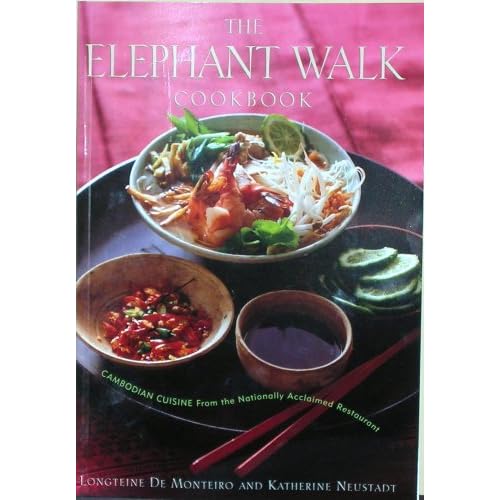 My first excursion into this foodie self-education is an excursion to Cambodia, by way of the Elephant Walk Cookbook. The authors, Katherine Neustadt and Longteine de Monteiro, compose a cookbook that is a primer both on the recipes served at the three Elephant Walk restaurants in the Boston area, and on the cuisine of Cambodia itself. One of the very most important aspects of Cambodian - nay, of Southeast Asian - cooking is rice. You need a lot of it. And the rice of choice in Cambodia is jasmine rice.
I save a whole post just for jasmine rice because jasmine rice and I have sort of a love-hate relationship. I've been able to cook most rice perfectly, particularly basmati rice, which has since become my favorite variety. Jasmine rice, however, always manages to betray me (or I it). If it's not turning out mushy because I tried to cook it in my breadmaker (where my basmati rice always turns out beautifully), then it's turning out hard and crunchy. If it's doing neither, it's burning.
Today I can finally say that I had a perfect pot of jasmine rice. Well, almost perfect. There was still a wee burned blotch on the bottom of my pot, but for the most part the rice was fluffy, not hard and not mushy, and not burned. Again, except for that little blotch.
It's not like the Elephant Walk Cookbook is urging me to do anything different than I normally do. In fact, they urge you to do the same thing that the instructions on the bag urge you to do, more or less:
- Use about 1 cup rice for every 1 1/4 to 1 1/2 cup water. The cookbook suggests that you don't need to rinse it over and over, but just once.
- Put your rice and water in a pot (with or without salt), and boil it uncovered. Here's the catch: don't stir it. I am always in the habit of stirring my rice when I cook it on the stove top. I read this elsewhere. It was good advice.
- Once it comes to a boil - mine was just barely boiling - turn down the heat to a simmer, cover, again not stirring at all, and cook it for 15 minutes.
- After this, remove from heat and leave covered and still not stirred for 10 minutes.
 Rice Rice Baby. Yes, you did know that was coming, didn't you?
That's what I did to get it to turn out beautifully. I'm saving this for a crispy rice recipe to make tomorrow. Right now, though, I am eating some jasmine rice with oven-roasted broccoli, thin fresh tomato slices and half of a thinly sliced fried shallot.
As for the "budget" part: a bag of jasmine rice can last you for a very long time, especially if you don't just have a rice-based diet. My big-ass bag of basmati rice, for example, cost me $12 but has lasted me well over a year. This bag of Trader Joe's jasmine rice was about $4, and I've gotten some mileage out of it. I would've gotten even more had it turned out all those other times.
Monday, November 02, 2009
Starting a new project...
Just an update between too infrequent posts. Despite very supportive family and friends (thanks, everybody), the stress, disappointment and frustration of job searches and whatnot is getting to me. Because of that, I haven't had a lot of money to spend eating out lately.
Nevertheless, I am starting a new project to get the stress of this allegedly-finished recession and underemployment off my mind. Every week or two, I will try to acquaint myself with the cuisine of a culture or region that I am mostly unfamiliar with. I will be seeing how little I can spend while teaching myself more about the foods of the world. I'm calling this "Food Ethnography on a Budget". It's the least silly name I could think of. Sue me. Scratch that - don't sue me.
Stay tuned later this week, as I start to acquaint myself with the cuisine of Cambodia.
Subscribe to:
Posts (Atom)


