Showing posts with label Cambodian. Show all posts

Sunday, November 15, 2009

Food Ethnography on a Budget: Cambodia III - Amok Trey

My mini "excursion" to Cambodia is almost done, and I couldn't finish it without trying my hand at what (so I've read) is to Cambodia as the hamburger is to the US: the coconut milk, fish sauce and galangal-coated steamed fish dish known as amok trey. Known in Laos as mók pa and in Thai as haw mòk plaa (if I read that Wikipedia entry correctly), it gets its name from the method of cooking it: wrapping it in banana leaves (mok or amok). I couldn't find more than a mention of it in the Elephant Walk Cookbook so I turned to the internet, where I found a few recipes for it. The one I used is from AsiaRecipe.com's Cambodia page. The recipe calls for the following ingredients (look at the recipe for exact amounts):

  • fish sauce (natch - a few tablespoons)
  • coconut milk (duh - a whole can is needed)
  • garlic (not nearly as much as for the nataing - only a clove)
  • red onion (a whole onion)
  • galangal (a bigger, tougher member of the ginger family)
  • lemon grass (dried or fresh - I got the fresh variety)
  • turmeric, paprika and a wee bit of sugar
  • also a wee bit of salt (optional since you have the fish sauce)
  • a pound of some sort of white fish
  • and, of course, banana leaves
Again, some of this I had on hand, and some I had to go buy:
  • garlic - Normally I have this on hand, but since I had just used it all on the nataing I needed more (50 cents at the farmers' market for a head)
  • lemongrass, at H-Mart - about $2 per lb. I got two pieces that weighed about 1/4 lb. I still have 1 1/2 stalks left. Not quite sure what to do with them yet. Can I freeze it?
  • big ass package of banana leaves - only sold at H-Mart by the package, $3 (Wait - no banana leaves? Are you tired of having them break all the time? Just use big green cabbage leaves and soften them in water.)
  • galangal - hands down, the most expensive item. It sells at H-Mart for $7 per lb (and at Wegman's for $9 per lb)! Do what I and the woman next to me did, and break off a smaller piece. Mine was only about 1/4 lb. You do the math.
  • catfish, $6 per lb at Wegman's - yes, US farmed, and according to the helpful folks at the Monterey Bay Aquarium (thanks again to Eric & Alan for the heads-up) it's one of the best seafood choices that Marylanders and others in the "Southeast Seafood Region" can make.
Total out of pocket (4 servings): about $11 - or $2.75 per serving, not counting the ingredients I already had laying around.

Of course, during the process there were a few tedious things that popped up with foods I had not really used before.
  • About the lemongrass: Don't bother using your knife. Just use your cooking shears. They work wonders, I'll tell you what.
  • Ouch, it's galangal: Galangal (or Thai ginger) is like ginger only harder. It is very difficult to cut into. Take your time and use a knife with a very strong blade.
  • Why do these damn banana leaves keep breaking!?!? I've used them but once, for the Yucatec Maya dish cochinita pibil, and with that I wrapped a whole pork butt in it and put it in the slow cooker. Didn't have to be so neat. For this, I had to wrap each piece of catfish neatly in its own banana leaf parcel (about 8" / 20 cm square). Each f****ing piece. When you've gone through your third 8" / 20 cm square parcel because it keeps on ripping, you really just want to assault someone with a package of banana leaves.
I must confess that this was also my first use of a bamboo steamer. That's right: prior to this I had never used one before. Now I know not only how to use one (one other thing to use banana leaves for: lining the bottom of your bamboo steamer), but also what that "steamer stand" is in my second hand wok. I've never had occasion to use it before now.

The meal: amok trey

The first step is the sauce. For this, you need every ingredient listed above save for the fish and the banana leaves. Throw every sauce ingredient but the coconut milk into the food processor - and thank God I have a working one because my blender would not have liked this part - and grind them down to as much of a paste as possible. My light-duty processor could not break down every little chunk of lemongrass down very much, but for the most part it was successful. Next add the entire can of coconut milk, continue to purée, and then transfer to a pot to simmer for about 10 minutes.


It'll look like this.

Reserve half the sauce for later.

Your next step is to create the little banana leaf parcels that your fish will sit in. You need at least four of those 8" / 20 cm square pieces of banana leaf. In practice, you'll probably need about twice as much just to wrap the fish when the last one you used busts open and oozes its contents out everywhere.


Note to anyone who has used banana leaves more often than I have: please give me some tips on how to make these damn things more pliable. Mine kept on splitting open!

Once you have the catfish in the center of the square, top each of the catfish pieces with 1/4 of the remaining sauce (or 1/8 of the total sauce). Lumber through wrapping the banana leaf parcels up, and then place them in your steamer. Remember to line your steamer with parchment paper before putting the fish down! Since I had all those extra banana leaves, I just used some of those.


Using a bamboo steamer is much simpler than I thought it could be, and I thought it would be simple as it was. Just use however many baskets as you need, stack them in your wok (preferably on a steamer tray or stand, like the one above), and fill the wok with water up to the bottom of the steamer. Boil it, and then start the time. The amok trey needs to steam for an hour, and in that time I only had to refill the boiling water once. About ten minutes before serving, reheat the coconut milk sauce slowly. Serve with jasmine or basmati rice.


The result: I have eaten a lot of catfish before. Cajun catfish. Fried catfish. Stir-fried catfish. Catfish tacos. I have never had steamed catfish, especially when steamed by me. It takes on a whole 'nother texture! It's wonderfully soft and silky, and melds nicely with the coconut milk sauce. As for the sauce: it's not as rich as the nataing but it is rich, with sweet, salty and savory all battling for attention. With that, it's a nice surprise just how smooth the sauce is, apart from the bits of lemongrass that you just can't grind up completely. The sauce also goes great over the rice that you eat with it. For a vegetable, again it's good to go with a simple pickle, like the jícama-tomato one I made before, or the red pepper one that I based it off of.

So ends my first foodie "field work" in my Food Ethnography project. I now know a little more about an important Southeast Asian cuisine that I didn't really know anything about before. And that's the whole point of this exercise, isn't it? To teach myself - and y'all - about a cuisine you may not have been exposed to very much.

I haven't finished planning my next installment yet. Expect it come before or around Thanksgiving week. That should be a hint as to what it might be.

Sources of recipes -

Asia Recipe.com: Cambodia - amok trey

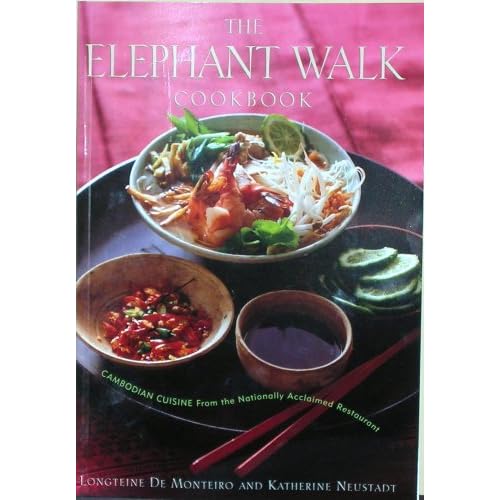
The Elephant Walk Cookbook: The Exciting World of Cambodian Cuisine from the Nationally Acclaimed Restaurant, by Longteine De Monteiro and Katherine Neustadt (1998: Houghton Mifflin, New York) - jasmine rice, crispy rice cakes, nataing, jícama pickle

Wednesday, November 11, 2009

Food Ethnography on a Budget: Cambodia II - Nataing, Crispy Rice Cakes and Jícama Pickle

My quest to discover new cuisines at bargain basement prices continues. Already, I've spent more than I had expected or wanted to spend, but a lot of that has been mitigated by my choosing recipes that used ingredients I mostly have lying around. That's an important part in saving money on grocery shopping: figure out what the hell you already have in your pantry. Mine looks a little stranger than most people's pantries, since I have so much variety in it. So to help narrow down the "budget" part for people, I'll try to quantify what I got and how much it cost, and what I already have that most people may need to buy.

Back to Cambodia:

Located in: Southeast Asia
Some common ingredients: jasmine rice, coconut milk, fish sauce, prahok, yucca, pork, papaya, mango, lemongrass
Number of Cambodian restaurants in the Baltimore area: 0
Number of Cambodian restaurants in the DC area: maybe 1
Kind of like: Halfway between Thai & Vietnamese, with a smidge of French

In just a fortnight, I've already learned a good bit more about Cambodian (Khmer) cuisine than I ever did. Of course, I'll never be an expert at this rate - one cookbook and a few websites doesn't make you an "expert" in anything. But I am surprised at the ideas I have already picked up.

From reading the Elephant Walk Cookbook and various websites about Cambodian cuisine, I have found out the following very basic facts about the cuisines of Cambodia:

  • One of the most typical ingredients and flavors of Cambodia is prahok, or fish paste, which takes a long and complicated process to make. It's like ketchup here - it's everywhere. However, different classes will approach it in different ways: the lower classes may be more willing to eat it uncooked, while the upper classes would never think to do such a "gauche" thing.
  • Many tropical flavors are also common in Cambodia, particularly lemongrass, pepper and coconut milk.
  • Most everything is served with some format of rice - whether it's the jasmine rice I just made or the crispy jasmine rice cakes that I tried to make, with varying results.
  • If prahok is the condiment of choice, then amok trey is the dish of choice. It's a fish in coconut milk and steamed in banana leaves. Is it a coincidence that amok is also the Indonesian word for "mad with rage"?
As I've said before, my education in Cambodian cuisine starts with the Elephant Walk Cookbook (partially on Google Books no less), by Cambodian-American chef Longteine "Nyep" De Monteiro and Yankee Magazine writer Katherine Neustadt. A diplomat's wife, De Monteiro was born into an upper class family but loved to eat the food of the much poorer folks that worked in the house. Fortunately for De Monteiro, she and her husband were abroad when the Khmer Rouge seized power in Phnom Penh in 1975; sadly, many in her family were not. In happier times, De Monteiro later found her way to France and eventually to Massachusetts where she opened her Elephant Walk restaurants.

Both De Monteiro and Cambodian food websites I've explored mention that prahok is one of the most common flavors in Cambodian cuisine. It is a bitch to find in Baltimore. Not even the uber-well-stocked H-Mart carries it. They carry pastes made out of just about everything: crab, shrimp, beef, pork, onions, tofu, beans, chilies, on and on and on. But oddly, no fish paste. 700 varieties of fish sauce, but no fish paste. Go fig.

Another common food item is the pickle. These pickles aren't like in the US or India where they sit for a few days and are meant to preserve food. Instead, they are meant to give a quick tang when some is needed.

The meal: nataing

To save money, I tried to find recipes that mostly featured ingredients I had lying around. One recipe, nataing, is a rich pork dish made with ground chili (or paprika), coconut milk, garlic and shallots, among other things. I have no idea if this is a traditional dish or something the chef at Elephant Walk created from flavors and textures that reminded her of home. It was meant as an appetizer in the cookbook but it was a centerpiece of the meal (I used a pickle as my vegetable). And fortunately for me, I had most of the ingredients on hand.

I usually avoid posting recipes from cookbooks, but so many others have already done this with this recipe. Still I will merely link to online recipes, and describe roughly what I put in it (check here, for example).


Basically, you sauté about 1/2 pound of ground pork in either ground dried New Mexico chili or paprika, oil and a cup of coconut milk. Eventually, you add ground peanuts (roasted, unsalted), thinly sliced shallot and garlic (lots of it), sugar and fish sauce. Continue to cook about 10 minutes and serve warm over crispy deep fried rice cakes.

The nataing was an especially rich dish, very sweet with a heavy coconut flavor (duh). I couldn't really taste the saltiness of the fish sauce. De Monteiro suggests this as an appetizer, but about a quarter of this dish with rice cakes and a pickle was very filling for me. It's something I would make again.

I had most of the ingredients already, only needing pork (about $2 for a .6 lb package), a shallot (40 cents - because I ran out) and peanuts ($2.50 for the bag - no, I didn't have any roasted peanuts, but at least I have a nice big bag to use later). So I only shelled out about $5 for new ingredients, with about $2.50 of that being an investment in an ingredient I can keep on using for a while. Most people will have most of these ingredients. If you don't have the coconut milk or fish sauce, expect to shell out another $5 for those. The fish sauce will get you a good bit of mileage if you make things that use it.

The meal: crispy rice cakes


The recipe suggests serving nataing on deep fried crispy rice cakes, filling in and of themselves. These things are made out of pre-cooked jasmine rice, and are quite tedious to make. The recipe suggests laying a flat layer of jasmine rice barely submerged in water in a large pan, and continue to cook and press together until you can remove the whole thing as one piece. This should take about 20 minutes. It took me twice as long. I think I had too thick a layer of rice. And it didn't come out in one piece - more like one piece that broke into two or three smaller ones. Not a problem: I fit it all on a cookie sheet and baked at 200 degrees for about 45 minutes. The middle was still a little soft so I left it in a little longer.

Still not completely dry, I tried to fry them in small pieces in hot oil. They still turned out beautifully - crispy, crunchy and a little nutty. True, the nataing sometimes fell off, but they were a nice and extremely filling combination. One word of advice: don't fry it all up at once. You will not be able to get pre-fried rice cakes back to their original crispiness.

If you don't have jasmine rice, a 1 lb bag will cost around

The meal: jícama pickle


I decided to make a quick pickle for a side dish, to cut through all that meat and grease. Since the Elephant Walk Cookbook says that jícama is enjoyed in Cambodia, and since I had one laying around, I went ahead and pickled that with some tomatoes, basing it off the recipe for De Monteiro's red pepper pickle relish. I was uneasy about this at first, but it turned out to be the best part of an already delicious meal.

I replaced the two roasted red peppers in her recipe with two small Roma tomatoes and a small diced jícama. I marinated that for just a half hour with about eight thinly sliced cloves of garlic, in white vinegar, water, fish sauce and sugar. The result was crunchy and tangy, sweet and sour, and a lovely accompaniment to the nataing. Once again, I have another recipe in my arsenal to use in the future!


My exploration of Cambodian food is not quite done yet. I couldn't find a recipe in the cookboook for what even De Monteiro calls a dish that is as ubiquitous as the hamburger is here: amok trey. There are a few recipes floating around on the internet, and it will be the last one I tackle in my crash course in Cambodian cuisine.

Wednesday, November 04, 2009

Food Ethnography on a Budget: Cambodia I - Rice

My first excursion into this foodie self-education is an excursion to Cambodia, by way of the Elephant Walk Cookbook. The authors, Katherine Neustadt and Longteine de Monteiro, compose a cookbook that is a primer both on the recipes served at the three Elephant Walk restaurants in the Boston area, and on the cuisine of Cambodia itself. One of the very most important aspects of Cambodian - nay, of Southeast Asian - cooking is rice. You need a lot of it. And the rice of choice in Cambodia is jasmine rice.

I save a whole post just for jasmine rice because jasmine rice and I have sort of a love-hate relationship. I've been able to cook most rice perfectly, particularly basmati rice, which has since become my favorite variety. Jasmine rice, however, always manages to betray me (or I it). If it's not turning out mushy because I tried to cook it in my breadmaker (where my basmati rice always turns out beautifully), then it's turning out hard and crunchy. If it's doing neither, it's burning.

Today I can finally say that I had a perfect pot of jasmine rice. Well, almost perfect. There was still a wee burned blotch on the bottom of my pot, but for the most part the rice was fluffy, not hard and not mushy, and not burned. Again, except for that little blotch.

It's not like the Elephant Walk Cookbook is urging me to do anything different than I normally do. In fact, they urge you to do the same thing that the instructions on the bag urge you to do, more or less:

  • Use about 1 cup rice for every 1 1/4 to 1 1/2 cup water. The cookbook suggests that you don't need to rinse it over and over, but just once.
  • Put your rice and water in a pot (with or without salt), and boil it uncovered. Here's the catch: don't stir it. I am always in the habit of stirring my rice when I cook it on the stove top. I read this elsewhere. It was good advice.
  • Once it comes to a boil - mine was just barely boiling - turn down the heat to a simmer, cover, again not stirring at all, and cook it for 15 minutes.
  • After this, remove from heat and leave covered and still not stirred for 10 minutes.
Rice Rice Baby. Yes, you did know that was coming, didn't you?

That's what I did to get it to turn out beautifully. I'm saving this for a crispy rice recipe to make tomorrow. Right now, though, I am eating some jasmine rice with oven-roasted broccoli, thin fresh tomato slices and half of a thinly sliced fried shallot.

As for the "budget" part: a bag of jasmine rice can last you for a very long time, especially if you don't just have a rice-based diet. My big-ass bag of basmati rice, for example, cost me $12 but has lasted me well over a year. This bag of Trader Joe's jasmine rice was about $4, and I've gotten some mileage out of it. I would've gotten even more had it turned out all those other times.