
In like a lion and out like a cold, wet lamb: that's March for you. Just a few items as we ease slowly into spring.
1) I recently boiled peanuts (you'll read about it in a few weeks). It's hard to find raw peanuts in this area, though you can find them at Giant. I have decided to try growing them myself. I've rented a second garden plot in the city, which I hope to start clearing this weekend. Most of it will be for straightforward vegetable and herb planting, while a section of it will be purely experimental. We are about as far north as one can go and still hope for some success in growing peanuts. Let's see how it goes.
2a) I spent this past weekend in Rehoboth with a large group of friends (Some of you are reading - thank you again for a fun weekend! I'm already looking forward to next year). I ate out at a few places. One place where the cupcake trend hopefully continues is the Cake Break on First Street. For $6 (each for $3) I got two fascinating cupcakes.
My favorite one was their Guinness cupcake: a cupcake with Guinness Stout baked into the batter, and topped with frosting infused with Bailey's Irish Cream. This was evil. Evil, I tell you. And so good. The other cupcake was their Rehoboth Beach cupcake which I must only describe as "adorable" (oh God, I hate myself for saying that). It was made to look like a crab crawling out of the surf onto the sand. The crab tasted good too. 2b) While the best food was that which my friends made (again, kudos on the gumbo, Jim & Ralf), the best restaurant food I had came on my way out of Reho. La Tonalteca (note: their website is less than impressive) is a southern Delaware franchise of Mexican restaurants that had some pretty good Mexican food, some of the best I have had this side of the Mississippi. I got one of many of their lunch specials, an enchiladas poblanas, two enchiladas covered in mole poblano.
Everything about the enchiladas was delicious - these were no warmed over sorry excuses for enchiladas. As for the rice and beans: even in California, it is rare for me to find rice and beans that are worth eating, much less finishing. The rice was fluffy and soft and the beans were smooth, and neither was too salty. This may be a go-to stop on my way out of Rehoboth the next time I head down, especially at $6 for the whole thing.
3) A few weeks ago I saw the cleverly named Naanwich from Sukhi's, at Whole Foods. The one I got was a simple helping of tandoori chicken inside a folded-over piece of naan bread. While I wouldn't buy this all the time, it is convenient and tasty, the chicken soft and flavorful enough to not be a waste of time, and the naan pleasantly soft and chewy.
4) And finally, this from Churchville, Harford County:
And remember: Haste makes Waste Waist... get bigger!
Wednesday, March 30, 2011
A few random bites: late March edition
Monday, March 28, 2011
Co?! Nr Festiwal Polskich!?
It's true: The Sun reports that after 40 years there just isn't enough money to fund it this year. Now where'm I get my pierogi fix on? Seriously though, it's a sad sign of how the economy is hitting local governments, as the city, strapped for cash, raised fees for the organizers of this and all other festivals in the "Showcase of Nations" series. FestAfrica also opted out.
But even though all is lost for 2011, there may be a Festival next year - at the Fairgrounds. Hopefully it can come back to Patterson Park and the Pulaski Monument at some point in the future, accordion in tow.
Sunday, March 27, 2011
Snacking State-by-State: Florida Part 1B (The Northern Half) - It's the only kind of tea that matters
As I said in the last post, the barbecued shrimp goes well with a certain ubiquitous Southern beverage that you simply can never find unsweetened. But it's just "tea" in the South. Official Name: State of Florida
State Nicknames: The Sunshine State
Admission to the US: March 3, 1845 (#27)
Capital: Tallahassee (8th largest city)
Other Important Cities: Jacksonville (largest city), Miami (2nd largest), Tampa (3rd largest), St. Petersburg (4th largest), Orlando (5th largest)
Region: South, Gulf Coast; South Atlantic (US Census)
RAFT Nations: Cornbread & BBQ, Crabcake, Gumbo
Bordered by: Alabama (northwest), Georgia (north), Atlantic Ocean (east), Caribbean Sea (south), Gulf of Mexico (west)
Official State Foods and Edible Things: Key lime pie (pie), orange (fruit)
Some Famous & Typical Foods: Cuban food (southern Florida), Key lime pie, seafood (stone crab, shrimp, conch, crawfish, etc), alligator (northern Florida) typical Deep Southern foods (northern Florida), foods of New York/New Jersey especially Italian & Jewish (southern Florida)
I admit two things: 1) I hate drinking unsweetened iced tea; 2) Diabetes runs on both sides of my family. So usually I just grab some Splenda or Sweet & Low and put that in my tea. But once in a while you just have to have the real stuff. This recipe is even easier than the last, and takes far less time.
The Recipe: Iced (Sweet) Tea
For (sweet) tea, you'll need:
* quart size tea bags (I used Luzianne, but any tea bag will do.)
* sugar - I added a cup for a little more than 3 quarts.
* water - lots of water (I started with about 3 quarts, and then added a little more at the end to top it off)
Boil the water and steep the tea bags as usual.
 Wow. This is hard.
 Even harder.
 But here’s the important thing: add the sugar while the tea is still hot. Also note that most recipes call for much more sugar per quart than this. Some recipes I’ve seen call for a cup of sugar for every 2 to 4 cups of water.

This is the sweet stuff here, a dessert you can drink.
Next we head south with the snowbirds, retirees and Golden Girls to explore what the southern half of the state has in store food-wise.
Sources:
Voltz, Jeanne, and Caroline Stuart. The Florida Cookbook: From Gulf Coast Gumbo to Key Lime Pie. Random House: New York, 1993.
Some information about the diversity of Floridian cuisine comes from the following websites, in addition to the Voltz and Stuart book:
Essman, Elliot. “Florida Cuisine”. Life in the USA, 2010. Copyright Elliot Essman 2010.
Rattray, Diana. “Florida Cuisine - The many flavors of Florida”. Southernfood.About.com, publication date unknown. Copyright 2011 About.com
Some information also obtained from Wikipedia's "Florida" page and other pages, and theFood Timeline State Foods link to "Florida".
Snacking State-by-State: Florida Part 1A (The Northern Half) - It's shrimp! But is it barbecue?
Next on my armchair trip around the country is the Sunshine State. Florida is the southernmost state in the Lower 48, an eclectic mix of Dixie, Yankee and so many immigrant cultures and cuisines (notably Cuban). It will be difficult to limit myself to just a few recipes this time if I want to truly represent the diversity of this state.Official Name: State of Florida
State Nicknames: The Sunshine State
Admission to the US: March 3, 1845 (#27)
Capital: Tallahassee (8th largest city)
Other Important Cities: Jacksonville (largest city), Miami (2nd largest), Tampa (3rd largest), St. Petersburg (4th largest), Orlando (5th largest)
Region: South, Gulf Coast; South Atlantic (US Census)
RAFT Nations: Cornbread & BBQ, Crabcake, Gumbo
Bordered by: Alabama (northwest), Georgia (north), Atlantic Ocean (east), Caribbean Sea (south), Gulf of Mexico (west)
Official State Foods and Edible Things: Key lime pie (pie), orange (fruit)
Some Famous & Typical Foods: Cuban food (southern Florida), Key lime pie, seafood (stone crab, shrimp, conch, crawfish, etc), alligator (northern Florida) typical Deep Southern foods (northern Florida), foods of New York/New Jersey especially Italian & Jewish (southern Florida)
Like California, Florida has a varied and unique blend of cuisines that reflect the history and diversity of the state.
- There are various regions, influenced by their long history of Native American, Spanish, African and English foodways.
- The northern part of the state is the more traditionally Southern part of the state, with notable Creole and Cajun influences from further west.
- The central and southern parts of the state aren't really considered "Southern-with-a-capital-S" anymore, thanks to the massive influx of emigres from the Northeast (Perhaps there are but a few New Yorkers who haven't made a joke about their uncle in Boca Raton.) That doesn't mean Florida's food traditions have gone out the window, but they have been influenced.
- The Florida Keys have a food tradition all their own (and Jimmy Buffet to boot). Some of that tradition has spread statewide and even nationally (Key lime pie, for instance). Others, for practical reasons, have not (the mighty conch - I tried to get a hold of some but I just never could get around to it, and it is not the cheapest seafood to buy when you do find it in the Mid-Atlantic).
- Florida also has a diverse set of immigrant cuisines, notably from its Cuban, Haitian, Dominican and Puerto Rican communities, as well as traditions from all over Latin America (Mexican, Nicaraguan, etc) and Asia (Cambodian, Vietnamese, etc).
- Florida is one of the great seafood destinations of the country - again, the aforementioned conch is but one of its famous delicacies. There’s the stone crab, which unlike our own blues do not have to be killed in order to enjoy them. Instead, the legs are harvested and the crabs are thrown back to grow new ones. And then there’s red snapper, mackerel, oyster, clam, etc.
- Finally, Florida is one of the important centers of citrus production in the US, specifically in terms of its oranges. But note again the famous Key lime. [bulleted information compiled in part from Voltz and Stuart 1993, Elliott 2010 and Rattray 2011]
There is enough diversity (and stuff to write about) in the foods of Florida that I am going to go the same route I did with California: one post this week, another post next week. This week I am focusing on northern Florida, the "Southern" half.
Northern and Central Florida - the Panhandle, Jacksonville and into Orlando - is generally agreed to be Dixie’s southern frontier. You can see this in the food: many (Deep) Southern classics are common in this part of Florida, from barbecued oysters and shrimp to cheese grits and straws, and from iced tea - the assumed-to-be-sweet kind - to blackened alligator to boiled peanuts (look for this last one in a future post), One recipe that jumped out at me was a barbecued shrimp recipe that smacked of one I ate last year at Mr. B’s Bistro in New Orleans. They gave me a bib to keep from splattering myself, but little do they realize I’ve been peeling shrimp for years, and I know how not to make a mess. I don’t like mess. This recipe was a more Floridian take on this Gulf Coast classic. Or at least it should be a classic if it isn’t already.
The recipe: Florida Barbecued Gulf Shrimp
Barbecued shrimp is by no means “grilled” shrimp - but we all know the difference between “barbecue” and “grill”. It is shrimp that is cooked for a while in a barbecue sauce that you make yourself. Voltz and Stuart discuss the recipe, titled “Linda’s Barbecued Shrimp”
Peel-your-own shrimp recipes are popular all over the South, but nowhere more than in the Florida Panhandle, where you’;re never far from the Gulf. Caroline [Stuart]’s sister and brother-in-law, Linda and Bill Virgin, worked this one out for easy entertaining. The advantage of this recipe is that the sauce can be made ahead of time; the shrimp are then added to the sauce and cooked in the oven, rather than on top of the range, freeing the cook to join the party. [Voltz and Stuart p. 81]Hopefully I do justice to the author’s sister’s work.

What I needed for the recipe (which I halved):
* 2 ½ lb raw shrimp (mine were Texas Gulf shrimp, smallish and pink but, yes, raw, that I bought at Cross Street Market in Federal Hill for about $7 a pound - in the end, an expense of $17, easily my priciest expense for this project thus far)
* 2 sticks butter (had, but didn’t realize this and rushed out to buy some anyway. Duh. An extra $3 I don’t have to spend on butter in the future)
* 1 onion (about 60¢)
* 2 cloves garlic (had it)
* salt, pepper, paprika (smoked in this case), chili powder, brown sugar (had all of them)
* Worcestershire sauce (same)
* ketchup (I was out, so I had to buy a bottle - $2 from Trader Joe’s, without the corn syrup)
* liquid crab boil (First off, I had to stop shuddering from the idea of boiling a crab, anathema to anyone from these parts. Once I did that, I sought out liquid crab boil and, surprise of surprises, Giant had none, just powdered crab and shrimp boil, “Chesapeake style”. I later found Zatarain’s Liquid Crab Boil at Harris Teeter for the same price, about $2.50. The description of what you could do with it made it sound like liquid Old Bay. Man, wouldn’t that be somethin’...)
* prepared (yellow, in this case) mustard and Tabasco sauce (had them)
This recipe has a lot of components, but is ridiculously simple to make, as our author’s sister hints at. Melt the butter in a pot - in this case, my Dutch oven-like pot - and then throw in everything else but the shrimp for 10 minutes.
 Just throw it in. Go ahead.
There, wasn’t that easy?

I cannot tell you just how messy and how wonderful this shrimp is. That $17 was well spent, because it kept me from spending more money doing takeout all week. Though my shrimp did not absorb the sauce as much as Mr. B’s Bistro’s shrimp did, a simple swirl in the rich sauce solved that problem. I dare say that the sauce itself is almost as much of a highlight of this recipe as the shrimp. The authors recommend croutons made from Italian or French bread to sop up the sauce. Buy a soft baguette, slice it into slices of about ½ inch, drizzle olive oil, garlic powder, kosher salt and parsley flakes, and throw them in your toaster oven until toasted to your liking.
These barbecued shrimp go very well with iced tea. You know the kind.
Sources:
Voltz, Jeanne, and Caroline Stuart. The Florida Cookbook: From Gulf Coast Gumbo to Key Lime Pie. Random House: New York, 1993.
Some information about the diversity of Floridian cuisine comes from the following websites, in addition to the Voltz and Stuart book:
Essman, Elliot. “Florida Cuisine”. Life in the USA, 2010. Copyright Elliot Essman 2010.
Rattray, Diana. “Florida Cuisine - The many flavors of Florida”. Southernfood.About.com, publication date unknown. Copyright 2011 About.com
Some information also obtained from Wikipedia's "Florida" page and other pages, and theFood Timeline State Foods link to "Florida".
Tuesday, March 22, 2011
The Cheesiest Contest for Grilled Cheese Sandwich Month
From Dara Bunjon at the Baltimore Examiner and Dining Dish: if you make the best damn grilled cheese sandwich, she has the perfect contest for you: a Grilled Cheese Sandwich cooking contest at the Mount Washington Tavern! One of the categories is for the home chef. Get your recipes in by April 1 for the chance to compete with two other home chefs, in front of a lucky celebrity panel, on April 10 from 2 to 4. From the Tavern's website:
Now is your chance to prove that you have the very best grilled cheese sandwich in Baltimore. Enter our home cooks’ Grilled Cheese Sandwich Cook-Off competition. Those interested can submit their original grilled cheese sandwich recipe for the chance to “cook-off” on Sunday, April 10 as the Tavern hosts their 1st Annual Grilled Cheese Cook-Off competition for the professionals and the home cook!So if you have a very special grilled cheese to show off to grilled cheese lovers all around town, this is the perfect chance to do it!
Friday, March 18, 2011
Meatless Friday #2

Today I had better success eating meat-free. Lunch today was a sushi roll at Howard Community College. Do I remember the days when schools did not serve sushi. Those were less interesting food days.
Thursday, March 17, 2011
Because it's St. Patrick's Day
Yes I'm late posting. I didn't make anything for St. Patrick's Day. No time. So instead I'm posting this video from the Kojo Nnamdi Show's YouTube page. Here Irish chef Cathal Armstrong of Restaurant Eve in Alexandria, discusses Irish food traditions, including the origins of the Irish pub and just how different St. Patrick's Day is in Ireland as opposed to the rest of the world: no green rivers, no green beer - hell, no drinking. It's more like Thanksgiving, so Armstrong says, a real rite of intensification. Pubs are typically closed, and many people go to church., And green beer has always annoyed me anyway.
Monday, March 14, 2011
Because it's National Pi Day

My pie of choice today is a Key lime pie that I made last week for an upcoming post about the foods of Florida (wait for it around the start of April). Homemade is definitely better than the store-bought stuff.
And now for the special hymn for the day. Let us now calculate the circumference, diameter and area of my 9 inch pie:
Sunday, March 13, 2011
Snacking State-by-State: District of Columbia II - Wot's the Buzz? Tell me what's Axum-in'
Beyond US Senate Bean Soup, it's difficult to identify DC's cuisine. Is it Chesapeake cuisine? The Potomac does branch off the Chesapeake after all. Is it Southern? Is it Northern? Or is it not even American?
Snacking State-by-State: District of Columbia Official Name: District of Columbia
Is it a State? Nope - it's a Federal District
District Nicknames: DC, the District
Formation: September 9, 1781 (as the Territory of Columbia). Officially became the District of Columbia on February 27, 1801, carved out of the original Washington County, Maryland; Georgetown, Maryland; and Alexandria County & City, Virginia - the last of which have since retroceded back to Virginia)
Important City: Only one, really: Washington
Region: Mid-Atlantic, South, Northeast; South Atlantic (US Census)
RAFT Nations: Chestnut, Crabcake
Bordered by: Maryland (northeast, southeast, northwest), Virginia & the Potomac River (southwest)
Official State Foods and Edible Things: none - not even "American food" or "apple pie"
Some Famous & Typical Foods: also none really - except US Senate Bean Soup; is very easy to find just about any food in DC, from every region of the country and most countries around the world.
On a recent episode of the Kojo Nnamdi Show on Washington's NPR station WAMU, a few guests tried to define the cultural flavor - and along with that, the culinary flavor - of the District. Here Kojo discusses the DC ethnic eats scene with guest Tim Carman, food critic for the Washington Post:
[NNAMDI] And this we got from Lisa in Takoma Park. "One thing that I'm not sure makes D.C. better or worse, just different from other older cities on the East Coast, a lot of our ethnic neighborhoods are most vibrant in the suburbs. It's no secret among foodies, for sure. If you wanna eat great Chinese food, you go to the suburbs in Montgomery County. If you wanna eat Salvadorian food, you can come to my neighborhood, in Takoma Park. In other cities, you can find these ethnic pockets in the inner core of the city." That is an important distinction and, in a way, refutes what our early e-mailer has been saying because people do go in pursuit of those foods all over the region, do they not, Tim Carman?That's one thing I love about the DC region, as does Tyler Cowen and his Ethnic Dining blog (By the way: are you wondering what's the difference between the suburbs in Maryland and Virginia, ethnic food wise? Wonder no more). Washington and the DC suburbs have many ethnic cuisines, and they are just as important a part of the local flavor as any all-American dish. It's what makes the tandoori chickens, pad thais and doro wots of the region "American" - just like the burritos, stromboli and egg rolls that preceded them.
[CARMAN] We have a really strong ethnic food culture, and that -- I think that's almost points out like this classist approach to what people think of as good eating. You know, when people judge a city's restaurant scene, they typically, I think, look at the more sophisticated places. You know, is it a white table cloth service? Do they have a four-star chef? Whereas if you take the larger picture, I think D.C., from really different cultural perspectives, has some really fine cuisine, whether it's Chinese or Salvadoran or Ethiopian, Vietnamese, of course. I mean all of this. [Kojo Nnamdi Show, January 3, 2011]
To represent the international diversity of DC's dining scene, I chose a few recipes: a main course and a few sides. The sides come from Korea and El Salvador, two well-represented communities in the area. But first and foremost I swerved towards Ethiopian. Whenever I visit Adams Morgan in DC, it is very difficult for me not to visit one of the several Ethiopian restaurants. And there are many to choose from: DC has the largest Ethiopian community in the world, outside of Africa. To truly represent DC, I found a recipe for the best known (to Americans) Ethiopian dish of all: doro wot. Reprinted in the Washington Post, this recipe comes from Senedu Zewdie, former owner of the now-closed Sodere Restaurant. This is her mother's recipe, and I can only hope I do it justice.
Recipes: Doro Wot (with GamJa Salad and Curtido)
Recipe: Doro Wot (Ethiopian Chicken Stew)
I cut Zewdie's recipe in half, to make it more manageable and less expensive. I am not going to feed an army of twelve here. I also admit that, since this post lands during the Lenten season, it would be more appropriate to make a vegetarian recipe - a lentil dish, for example. But I wanted doro wot, and I actually made the chicken several weeks before this was published. By now I'm probably getting Georgia or Hawaii into the pipeline.
Anyway, this recipe gave me a good opportunity to use up some of the Ethiopian ingredients and supplies that I still had left over from last year's bacon cook-off. If you don't know, this was where I tried (successfully, I think) to cook bacon in an Ethiopian style wot. That may not sound strange to Americans, but bacon is not something you will find easily in Ethiopia: neither Muslims nor Jews nor Ethiopian Orthodox Christians are allowed to eat pork at all.

For this much more traditional doro wot I used the following ingredients
* 5 - 6 onions (about $1.49/lb - about 2 lbs)
* 1/2 small can of tomato paste (about 70 cents)
* 1 cup of nitter kibbeh (Ethiopian spiced butter - I still had some from my recipe in June, and yes, this spiced ghee lasts for a very long time on your shelf. But I needed to make more. Two sticks of butter and the requisite spices, plus some cheesecloth were all I needed to get to a cup. Check out my bacon wot recipe for what I did to make nitter kibbeh in the microwave)
* 3/4 cup berbere (had more than enough left over, but you'll need to make your own or visit one of DC's many Ethiopian markets to buy a tub for about $5-$6)
* 1 clove garlic
* 1 teaspoon ginger (I had none ground, only fresh, and yes this changes the recipe a little bit).
* 3 pieces each chicken thighs and chicken legs, bone-in but skin removed (about $6 to $8 total)
* ground cardamom and black pepper (had it)
* sweet white wine (had it)
* six hard boiled eggs (there go the rest of my eggs - yes, I had enough in the fridge)
Doro wot takes a while to prepare. You need at least 4 1/2 hours to do it, and you have to check in on it constantly. My advice: find things you were planning to do around the house while you make this, unless you find some way to adapt it to the slow cooker.

First, saute over low heat the sliced onions, in nothing but 1/4 cup of water. Yes, just water. You'll need to check in on it frequently because you will be doing this for about 90 minutes (it took me 75).

Next, add the tomato paste for a few minutes, and then the nitter kibbeh, berbere, ginger and garlic for yet another 60 minutes.
 Nitter kibbeh, (mostly) freshly made
While that's cooking, you need to poach the chicken. Cook it in boiling water for about 15 minutes.
 Like so
When the onions have been cooking for an hour, add the chicken - I also added just a little bit of water, not from the pot the chicken was just in. Cook this for yet another hour. I covered it to avoid splatter.

In the last 30 minutes of cooking, add 3 1/4 cups of water and simmer for 15 minutes, then add everything else - cardamon, pepper and eggs - for 15 final minutes.

Serve the whole thing on injera bread.
This doro wot is very much the opposite of the US Senate Bean Soup. It's thick not soupy, it's richly colored not pale, and it's exciting not bland. It's also somewhat spicy, so be prepared for that. Except for some bits of cardamom that I did not grind up well enough, this was a wonderful thing for me to eat, my first actual Ethiopian stew that could actually be eaten by someone from Ethiopia.

The sides I made are very much not Ethiopian, and probably never before have been served on injera bread. But they further reflect the cultural diversity of the DC region. And they work well in cutting the heat of the doro wot.
Recipe: Korean GamJa (Potato) Salad
I first tried a somewhat similar mashed potato dish at Joong Kak with my friends the last time or two we had Korean BBQ. It was one of the many panchan side dishes served before and during the meat. I thought this potato salad version would be a good idea to make my own. However, I made the mistake of doing the entire recipe, leaving me with more potato salad than I will ever want or be able to eat.
I don't even need to explain this recipe. Just watch this video by YouTube user tamar1973, née Tammy Quackenbush. I followed what she did.
As for my ingredients, I bought a 3 lb bag of potatoes ($3 on sale), thinking I would have some left over. These were only medium potatoes, but after about 8 or 9 of them I found the bag almost empty. Also going in were the aforementioned Gala apple (70 cents), a Korean pear ($3 at H Mart), two stalks of celery (expensive these days at $2.75), salt and white pepper.

After cooking the cubed potatoes for 10 minutes, cool them off in the fridge and add the chopped fruits & vegetables to it, and then add the dressing.

You should use Kewpie mayonnaise (500 grams sells at H Mart for $5!!!), as well as sugar (I went with Tammy's brown sugar), more salt and white pepper, and sesame seeds.

Mix it all up and there you go! A most unusual side dish for your doro wot.

To finish off the presentation I went with a unique and favorite cole slaw, again not a usual one for Americans, since this Salvadoran cole slaw has no mayo in it at all.
Recipe: Curtido (Salvadoran Cole Slaw)
This recipe I halved. I used this one from Epicurious.com to make my curtido.

You will need 1/2 a small head of cabbage (about a dollar tops), 1/2 a large carrot (had one already), 1/8 cup minced onion (I used 1/2 a small onion) and 1/4 cup cider vinegar (had it). Just thinly shred the cabbage and carrot, slice and chop the onion, and mix everything together. Let it sit for at least two hours. Ready to eat with any pupusa or arepa.

The very diverse sides really did complement the doro wot in different ways. The potato salad was sweeter than your average one, and the curtido was not sweet at all. Each added a beautiful variety of flavors to the plate that I will look forward to over the next week as I work through all my leftovers. I just need more injera bread (if you run out of that, make some couscous).

Now I finally head down 95 - or US-1. They both lead to the same place: the Gulf, the Keys and everything in between. From boiled peanuts and Gulf shrimp to pan cubano and Key Lime pie: it's the Sunshine State, Florida.
Sources:
Cowen, Tyler. "How do Maryland and Virginia differ?" Tyler Cowen's Ethnic Dining Guide, February 7, 2011.
Hensperger, Beth, and Julie Kaufmann. Not Your Mother's Slow Cooker Cookbook. Harvard Common Press: Boston, 2005.
Kojo Nnamdi Show, The. "The D.C. Area's Unique (?) Cultural Identity". WAMU 88.5 American University Radio, originally aired January 3, 2011.
Martínez, Rubén. "Salvadoran Coleslaw". Gourmet (reprinted through Epicurious.com's "Gourmet on Epi"), September 2007.
Nelson, Ben. "Senate Bean Soup: A Nebraska Favorite". Official website for Ben Nelson, US Senator for Nebraska, January 3, 2006.
Quackenbush, Tammy (Tamar1973). "Korean potato salad". Posted on YouTube, May 3, 2009.
Zewdie, Senedu, with Stephanie Sedgwick. "Doro Wat". Washington Post, May 18, 2005.
Some information also obtained from Wikipedia's "District of Columbia" page and other pages. Regrettably, the Food Timeline State Foods webpage has little to say about the District. Sigh. Still no representation.
Snacking State-by-State: District of Columbia I - The most boring soup in the world
I know DC is not a state. But it certainly must not be ignored. The capital city of the United States of America holds a special place for me. My parents drove us down from Baltimore to see the Smithsonian on so many occasions when I was a kid. I find myself there often these days for museum visits, soccer games and Americana galore - plus the Mid-Atlantic's most diverse LGBT community (sorry Charm City). Its rich culture has to have something unique food-wise, yes? It is that something that I am trying to find for this post.
Snacking State-by-State: District of ColumbiaOfficial Name: District of Columbia
Is it a State? Nope - it's a Federal District
District Nicknames: DC, the District
Formation: September 9, 1781 (as the Territory of Columbia). Officially became the District of Columbia on February 27, 1801, carved out of the original Washington County, Maryland; Georgetown, Maryland; and Alexandria County & City, Virginia - the last of which have since retroceded back to Virginia)
Important City: Only one, really: Washington
Region: Mid-Atlantic, South, Northeast; South Atlantic (US Census)
RAFT Nations: Chestnut, Crabcake
Bordered by: Maryland (northeast, southeast, northwest), Virginia & the Potomac River (southwest)
Official State Foods and Edible Things: none - not even "American food" or "apple pie"
Some Famous & Typical Foods: also none really - except US Senate Bean Soup; is very easy to find just about any food in DC, from every region of the country and most countries around the world.
It would be a cop-out to devote the District post to "typical American food" (whatever that is). The whole point of this series is to suss out "typical American food". The District of Columbia, including Prince George's, Montgomery & the various Northern Virginia Counties, has a wide variety of foods and cuisines, and has become an international food city in its own right. Or at least a national one, if the folks at Top Chef can be believed. One way to tackle this variety is to highlight recipes from famous restaurants. Note, for example, the locally famous Ben's Chili Bowl, perhaps one of the most famous restaurants in DC. Though I haven't had the chance to eat there, so many people have, from President Barack Obama to Bill Cosby (apparently the only person allowed to eat there for free).
Perhaps a more famous recipe comes right from the kitchen of the United States Congress cafeteria. Served every day, United States Senate Bean Soup has been made for over 100 years. As the US Senate website notes, there are a few stories about the origin of this soup.
According to one story, the Senate’s bean soup tradition began early in the 20th-century at the request of Senator Fred Dubois of Idaho. Another story attributes the request to Senator Knute Nelson of Minnesota, who expressed his fondness for the soup in 1903. [United States Senate, 2006]Closer to the present, Senator Ben Nelson (D-Nebraska) claims that this very "inside-the-Beltway" soup is a fave of the citizens of his home state. This comes as little surprise, because Nebraska is a major source for the Great Northern Beans that are featured in the recipe. It;s also because it's not the most exciting soup in the world (Ooooh, dig! Well not really, ye Nebraskans in cyberspace. Most Midwesterners I've talked to agree: outside of Chicago, Midwestern food is pretty darn bland, at least in the prairie states).
Instead of using Senator Nelson's Nebraska recipe (I'm not doing my Nebraska post until next year), I wanted to just throw this in the crock pot and call it a night. Fortunately, I found a recipe in my copy of Not Your Mother's Slow Cooker Cookbook by Beth Hensperger and Julie Kaufmann. This ended up as the recipe I used first for this post.
The recipe: US Senate Bean Soup

For this soup, Hensperger and Kaufmann recommend the following ingredients, which are not all thrown in together at once:
* 1 pound of dry navy beans (about $1; they recommend soaking them overnight but I was just fine soaking them for half an hour)
* 1 ham hock (a 1 1/2 lb package was about $3)
* 2 onions (about $1 or so)
* 3 potatoes (about $2 or so)
* parsley (I used dried - I was out of the fresh stuff)
* salt and pepper
Note that their recipe also calls for celery. I didn't have this on hand, but threw in a cubed carrot instead. I also had planned to add a little butter, as many recipes recommend, but left it out in the end.
* Though I don't usually include this in the list of ingredients, it should go without saying that you need water - lots of water. I used about 8 cups.
Put the following in the slow cooker for an hour on high: the beans, the ham hock and just enough water to cover them. After that, drain the water and add everything else but the salt, pepper and parsley.

Cook it all on low for 8 to 10 hours - I did this overnight.
 At which time it will look like this.
Add the rest of the ingredients and cook for 15 minutes more on low, and then remove the ham hock, taking the meat off of it and stirring it back into the soup.

Serve it with buttered bread - the authors recommend garlic bread.
I hate to say this, but this recipe was bland - very, very bland. It is possible that I undersalted it, though it probably still would have been bland. I do not know what the folks at the Congressional cafeteria do to make this any more interesting, so I played with a few ideas:
* I added adding thyme and rosemary along with the salt before heating it up.
* chunks of avocado give it a nice flavor and texture, no matter what else you put into it
* sriracha sauce ended up being my go-to condiment for this soup. Put in as much or as little as you like. It gives it a zing that the early US Senate chefs (and Sen. Nelson of Nebraska) probably wouldn't have imagined.

Sources:
Cowen, Tyler. "How do Maryland and Virginia differ?" Tyler Cowen's Ethnic Dining Guide, February 7, 2011.
Hensperger, Beth, and Julie Kaufmann. Not Your Mother's Slow Cooker Cookbook. Harvard Common Press: Boston, 2005.
Kojo Nnamdi Show, The. "The D.C. Area's Unique (?) Cultural Identity". WAMU 88.5 American University Radio, originally aired January 3, 2011.
Martínez, Rubén. "Salvadoran Coleslaw". Gourmet (reprinted through Epicurious.com's "Gourmet on Epi"), September 2007.
Nelson, Ben. "Senate Bean Soup: A Nebraska Favorite". Official website for Ben Nelson, US Senator for Nebraska, January 3, 2006.
Quackenbush, Tammy (Tamar1973). "Korean potato salad". Posted on YouTube, May 3, 2009.
Zewdie, Senedu, with Stephanie Sedgwick. "Doro Wat". Washington Post, May 18, 2005.
Some information also obtained from Wikipedia's "District of Columbia" page and other pages. Regrettably, the Food Timeline State Foods webpage has little to say about the District. Sigh. Still no representation.
Friday, March 11, 2011
Meatless Friday #1
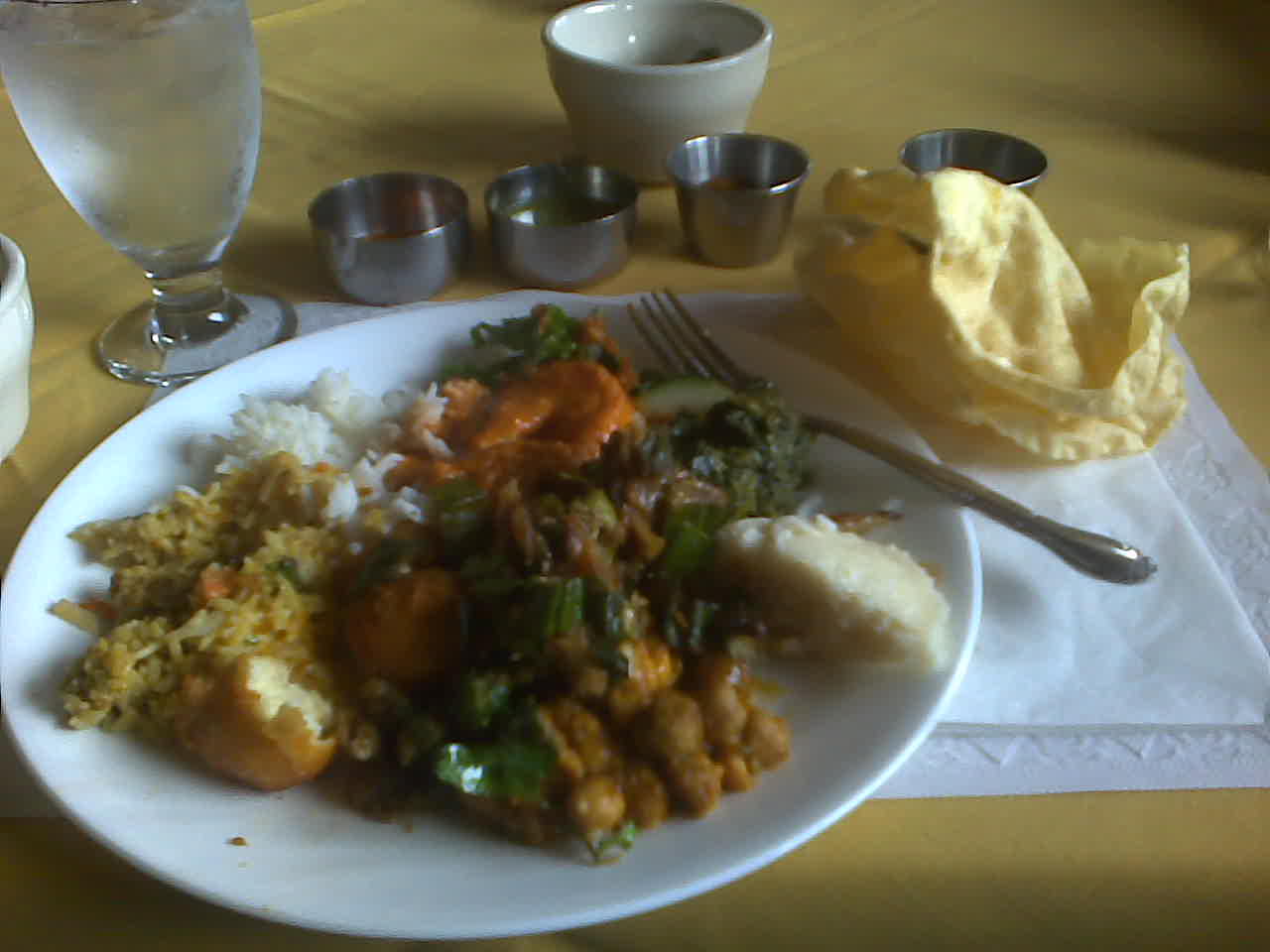
As I recently said, I am attempting to go meatless on Lenten Fridays, as per my cultural template and upbringing, just to see if I still have the fortitude to do so. Today was Lenten Friday #1, and I eschewed not only meat but fish (the go-to meat alternative for Catholics). My lunch choice was the always-tasty, always-filling, sometimes-a-little-slow Mango Grove for their always vegetarian lunch buffet. I had to hurry out since I was lunching between courses and had to get back to work. But it was quite a good choice. There was an okra dish that I had never seen or tasted before, and I failed to get the name of it, but it was quite a nice surprise. And their idli was soft and spongy. A good choice for anyone giving up meat for Lent. Even if only for 1/7 of the week.
Thursday, March 10, 2011
Soda Update #2 (and a Lenten Fast?)
I don't really do the "give up something for Lent" thing anymore, but I did consider giving up soda for Lent. Eventually I decided against it. I've been pretty good about not drinking too much soda. Though on average I'm still about 1 1/2 to 1 3/4 cans a day, I have gone up to about 2 cans on some days. Instead I've given up something far more (readily) dangerous to my teeth: chewing ice. I have that very bad habit and it would be nice to break myself of it. A Lenten fast should be something that betters you and gives you practice in temperance and self-control.
Along those lines, I have also decided to try, as much as possible, to go meatless on Lenten Fridays. Again, this is more an exercise in self-control. However, while there is nothing with eating meat (in my opinion), one does not need to eat it all the time. I may not succeed in this task, but I sure plan to try.
Tuesday, March 08, 2011
Because it's Fat Tuesday
It's Fat Tuesday, and many people are getting their Mardi Gras on. The last day to party before the Lenten fast begins, Catholic Christians - at least how I was taught growing up - traditionally fast from meat on Ash Wednesday and every Friday until Easter (I won't admit that I don't exactly do that anymore). But in Poland, apparently it's still much more fastidious: Catholics not only fast from meat but from grease, and do it all Lent long.
Channel 13's Ron Matz was at Polish Treasures in Upper Fells Point this morning finding out just how Polish Catholics indulge before Lent: with a pączki (pronounced like "POOCH-key - that's a short OO as in "look" not a long OO as in "food") - a Polish donut filled with all sorts of sweet things you want to use up before Lent. Though that video was not up when I wrote this (I'll try to post it if they do), I did find this informative video from About.com, starring chef John Mitzewich and in English no less, about how to make this Polish pastry:
Back to the Beltway is taking a break
I have not really gotten around to finishing the "Back to the Beltway" series. With the recent rise in gas prices, I have to cut back somewhere, and the mmoney I spend on gas and food for this series is the first sacrificial lamb. When gas prices start to go down again (er, if they do?), I'm heading back to the Beltway - next stops Hanover, Linthicum and Elkridge.
Sunday, March 06, 2011
Snacking State-by-State Mashup 2: Denver Omelette Roll and Delmarva Roll
Sushi takes a while to make, so I don't plan to make much of it in the near future. So to use up the rest of that sushi rice I decided to make a few more maki rolls - one of the many California recipes I tried out - out of some ingredients from my Colorado, Connecticut and Delaware posts.
Both rolls require making some sushi rice, the procedure for which you can find in my post for Southern California. I had enough sushi rice left for a little more than two rolls.
The mash-up recipes: Denver Omelette Roll and Delmarva / Clambake Nation Roll
Serves 1 or 2
Ingredients (state flag indicates State-by-State post where ingredient was featured. Ingredients with no flag were not specifically used for any one post): sushi ricesushi noririce wine vinegar (worked fine for me, though technically you should use rice vinegar instead)sesame seeds
 a few strips red bell pepper1 egg a few strips ham steak
 a few strips chicken breast3 oysters
 6 to 8 whole baby clamsa few slivers peacha few pieces avocado
wasabi mayonnaise
tempura batter:
1 cup flour
1 cup ice water
1 egg
After preparing the sushi rice, place it on a slice of nori on your bamboo sushi mat - this time I just put the bamboo mat in a gallon-size ziploc bag instead of saran wrap. Sprinkle with sesame seeds, and carefully flip over the nori so it is facing up and the sushi is facing down.
Maki Roll #1: Denver Omelette Roll
Next come the roll making itself. For the first roll, I wanted to revisit that first Denver omelette I made. In a way, I deconstructed it, got rid of the cheese, and put it in a roll.
Into this roll go the following: about half of a small one-egg omelette, a few strips of ham steak, and a few strips of red bell pepper. Green bell pepper is more authentic, but I don't enjoy eating it, so it's out. A little avocado on top (maybe I should have put it on after rolling it up instead of before), and then a little wasabi mayonnaise complete this roll.
 The Denver Omelette Roll
Maki Roll #2: Delmarva (or Clambake Nation) Roll
The second roll I made used ingredients from my Connecticut and Delaware posts - clams, oysters, chicken and peaches (all found in Delaware, and the clams and oysters also grow in Connecticut). Both states are in the RAFT Nations' "Clambake Nation", spanning coastal New England, New York City, New Jersey and much of the Delmarva Peninsula. A catchier name, however, may be the "Delmarva Roll", which is why I'm trending towards that one. Call it Fred for all I care though. The name's not that important.
For the Delmarva Roll, you'll need to make a tempura batter. This is fairly simple, so long as you use ice cold ice water. I just filled a bowl with water, stuck it in the freezer and occasionally broke the top if it froze over, until I needed it. Then mix it with a cup of flour and a beaten egg. Dip whatever you want to deep fry in the tempura batter. For example, for this roll I tempura-fried the clams and freshly shucked oysters. yes, the oysters met their end very quickly in the middle of fast-fried tempura batter. PETA will not like this recipe.
 Tempura clams, tempura oysters, and tempura crunchies, better than what you get at Long John Silver.
Into this roll go the following: the tempura clams (I did eat a few on the side - you'll use about 5 or 6), the tempura oysters (I used 2 and ate the third. I couldn't help it), small slices of peaches (about four) and a few slivers of cooked chicken breast. Again, roll it up, and top with a few more thin slices of peach.
 The Delmarva Roll, or Clambake Nation Roll


