
Showing posts with label Mid-Atlantic cuisine. Show all posts

Wednesday, October 17, 2012

Snacking State-by-State: Virginia I - "You got your Virginia ham in my biscuit!"

For just a few weeks, this State-by-State series comes back home.  Okay, almost back home - not in state but in regional terms.  Though Virginia is across the Potomac, our neighbors to the south share one very important thing with us here in Maryland: the big ol' Chesapeake Bay.  But a quick perusal of any cookbook or recipe collection claiming to be Chesapeake cuisine will show you that the foods we share are not just seafood.


Official Name: Commonwealth of Virginia
State Nickname: The Old Dominion State
Admission to the US: June 25, 1788 (#10)
Capital: Richmond (4th largest)
Other Important Cities: Virginia Beach (largest), Norfolk (2nd largest), Chesapeake (3rd largest); Newport News (5th largest), Hampton (6th largest), Alexandria (7th largest)
Region: South, Upper South, Mid-Atlantic, Chesapeake; South Atlantic (US Census)
RAFT Nations: Chestnut, Crab Cake
Bordered by: West Virginia (northwest), Maryland, District of Columbia and the Potomac River (northeast), Chesapeake Bay and Atlantic Ocean (east), North Carolina (south), Tennessee (southwest), Kentucky (west)
Official State Foods and Edible Things: brook trout (fresh water fish), milk (beverage), Eastern oyster (shell), striped bass (salt water fish)
Some Famous and Typical Foods: ham (especially Smithfield); peanuts; Chesapeake Bay cuisine to the north and east of the state, specifically crabs (fried, steamed, boiled, deviled, Norfolk and she-crab soup) and oysters; typical Southern foods to the south and west of the state (including ham biscuits, beaten biscuits, etc); diverse multicultural foods in Northern Virginia (notably South & Southeast Asian, West African, Ethiopian and Central American); Brunswick stew

What constitutes Virginia cuisine?  It depends on where in the Commonwealth you are (NB: Virginia is the last of the four "commonwealth states" we are hitting up, after Pennsylvania, Massachusetts and Kentucky.  Five if you count Puerto Rico, which isn't a state but is a commonwealth.  Ugh, my head hurts keeping track of all this).  The Virginia travel site (Virginia.org) with its well-known "Virginia is for lovers" tagline, boasts right at the top that "There's a lot more to Virginia Cuisine than Peanuts!" [Virginia Tourism Corporation 2012].  Well I knew that!  And they spell it out for us, region by region:

* Chesapeake oysters, beautiful blue crabs and - yes - flounder abound on Virginia's Eastern Shore, as Wachapreague (not far from Chincoteagoe) bills itself as the flounder capital of the world.  Getting Misty yet?
* South Central Virginia, best known for its Brunswick stew - something that the entire Upper South fights for credit over.  made with chicken or squirrel.  You will see this pop up in a few posts, though I'm not quite sure the recipe I used is the most authentic one.
* Appalachia is home to typical Appalachian foods - like the stack cakes and cornbreads we've seen in earlier posts.
* The Shenandoah Valley, which is apple country (that I just found out while researching this).
* Northern Virginia, like DC and the Maryland suburbs, draws in the cuisines of the world.  A simple glance at Tyler Cowen's Ethnic Dining Guide, based in NoVA, shows the true diversity of international eating around 495.  This is also wine country, by the way.
* And of course, the classically Southern fare of Richmond, Hampton Roads and the Tidewater, where ham, biscuits and peanuts abound. [Virginia Tourism Corporation 2012; Cowen 2012]

I really need to get to Virginia more often.  It is just next door after all, and I'm in DC a lot more often these days.

Among all the things I know Virginia for, it is crab.  And of course it would be: that's one of the big things Marylanders share with Virginians is the blue crab.  But most Americans probably identify Virginia more with ham.  Virginia is famous for its hams.  Again, you find these in neighboring states, too: Tennessee, Kentucky and even Southern Maryland all boast about their respective takes on ham.  But Virginia has cornered the national market (not to mention Food Network star Paula Deen in one nasty frozen ham assault a few years ago).  Most famous is Smithfield, though remember that many local farms smoke and sell their own hams to the public. Particularly important are their dry-cured hams, not the easiest thing to find in the mega-supermarkets - the Wegmanses and Harris Teeters in the area - but hard to miss in most Giants, where you literally stumble over the Virginia dry-cured hams (go fig).  As noted by Paul Graham, N.G. Marriott and R.F. Kelly for the Virginia Tech Cooperative Extension [Graham et al 2011], the process and trade in Virginia ham is an old and storied one in the Commonwealth
Virginia ham was one of the first agricultural products exported from North America. The Reverend Mr. Andrew Burnaby enthusiastically reported that Virginia pork was superior in flavor to any in the world (Burnaby 1775). Another early clergyman, the Reverend Mr. John Clayton, wrote the Royal Society in England that Virginia ham was as good as any in Westphalia (Force 1844). [Graham et al 2011; their sources included]
They further outline the process of dry-curing your own ham the Virginia way, from start to finish, even warning about the specific bugs that typically bother the ham during the curing process.

For this ham recipe, I would have liked to use dry cured ham.  But the stuff is pricey, and I just don't have the time to properly, or even half-assedly, prepare a dry cured ham for serving.  So instead I shot for the boneless smoked variety of party ham put out by, again, Smithfield.  To best utilize this, I turned to one of the most popular finger sandwiches in the South: the humble ham biscuit.  You can definitely make these with dry-cured ham, but it's just a lot cheaper, easier and less time-consuming with the pre-cooked, vacuum-packed-in-water stuff.

The ham biscuit is as popular with Southern hostesses, tailgaters and buffet-goers as that other Southern classic, pimento cheese.  So much so that the makers of Martha White flour [date unknown] have a few things to say about this cherished snack.
The origin of the yeast biscuit is unknown but seems to have surfaced in Southern cookbooks and in newspaper food sections during the 1950s. Alice Jarman, the founder of the Martha White Kitchen, developed a version for the company that was publicized across the South called "Riz" Biscuits. These biscuits became preferred carriers for country ham because of their light texture and good keeping qualities. [Martha White date unknown]
Martha White points out three variations, a thin, crisper biscuit, a softer, yeasty biscuit and a biscuit that has actual ham pieces in the dough.  The recipe below, which I got from Treva Chadwell whose recipe is posted at the Cooking Channel website, is a softer biscuit using no yeast at all - and swapping White Lily flour for Martha White (Chadwell doesn't specify any specific flour).  Hers also comes with a honey Dijon sauce and - gasp - chives!  What is a humble host like me to do with all this fabulousness!?!?

The Recipe: Virginia Ham Biscuits

For Chadwell's ham biscuit you will need the following:


First, you will need some biscuits.  You could cheat and buy some, but why not make them yourself?  Chadwell's chive biscuits call for:

* flour (had it on hand - White Lily in this case, though you could use Martha White as well.  Oh hell, any flour will do, but the softer the better)
* baking powder (had it)
* baking soda (same)
* salt (had this too)
* buttermilk (picked up a quart for about $1.50)
* lard (I should have gone to Giant and gotten actual lard, since they have it in their meat section.  Neither of the mega-huge supermarket chains that has come to our area - Wegman's and Harris Teeter - has lard.  The closest I found was Goya's lard, which upon reading the ingredients seems like some strange lard-Crisco hybrid at Harris Teeter.  It ran about $4.)
* chives (only $2 a bunch)

This recipe also calls for a honey mustard sauce.  For this you need:

* Dijon mustard (had it in the pantry)
* whole grain mustard (just $3.50 for a bottle)
* honey (had this on hand, too.  My sister brought some of this from Richmond Hill, outside of Savannah.  Best to keep this recipe as Southern as possible)

And finally, you will need:

* ham - otherwise, it wouldn't be a ham biscuit (I bought a vacuum-packed pre-cut boneless Smithfield ham at Harris Teeter for $4 per lb - about $9.50.  I will be eating this ham for a while)


First, whisk together the dry ingredients and the chives.


Next, cut in the lard.  It should be cold.


Whisk until it is of a crumbly but doughy consistency.


Flour the dough and roll it out to about a 1/2 inch consistency.


Punch it a few times...


...and cut it into rounds of about 2 1/2 inches.  I just used a drinking cup.


Bake it in a preheated 400°F oven for about 20 minutes.


While baking, mix the mustards and honey.


When your biscuits are cool enough to handle, make the ham biscuits.  Cut a biscuit in half.


Spread the honey-mustard sauce on at least one side.
\
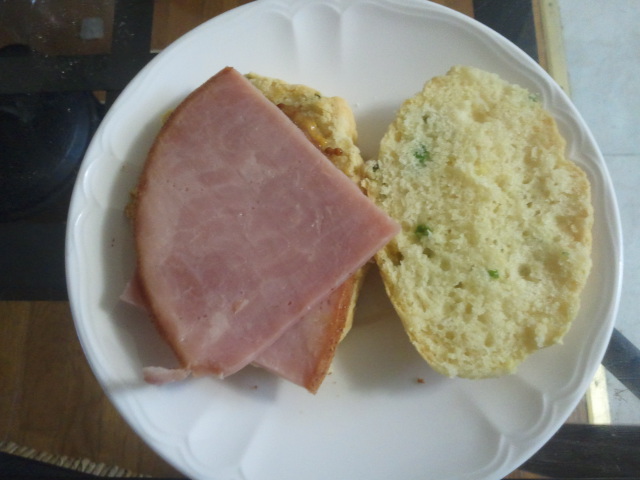
Place some of your ham on the biscuit.


I liked these biscuits, but for some reason mine always turn out flatter than most.  Still, this is a tasty sandwich.  Though I didn't cook the ham at all, I would warm it up a bit before I made this again.

Sources:

Anderson's Neck Oyster Company.  "History".  Copyright 2012, Anderson's Neck Oyster Company.  All rights reserved.

Brunswick Stewmaster's Association.  "Brunswick Stew History".  Copyright 2010, Brunswick Stewmaster's Association.  All rights reserved.

Carman, Tim.  "The Real Reason Why Squirrel Meat Isn’t Used in Brunswick Stew Anymore".  Young & Hungry column, Washington City Paper, posted May. 6, 2009.

Cowen, Tyler.  Tyler Cowen's Ethnic Dining Guide.  Copyright 2012, All rights reserved.

Chadwell, Treva.  "Virginia Ham Biscuits".  Provided for the Cooking Channel.  Copyright 2012, Cooking Channel LLC.  All rights reserved.

"Elmer Fudd" (user), "Elmer Fudd's Brunswick Stew".  Posted September 26, 2009.  Copyright 2009 Field & Stream.  All rights reserved.

Good Earth Peanut Company.  "All About Peanuts".  Date unknown.

Graham, Paul, N.G. Marriott and R.F. Kelly.  "Dry Curing Virginia-Style Ham".  Written for the Virginia Tech Cooperative Extension, 2011.

Peanut Shop of Williamsburg.  "Thai Cucumber Salad".  Copyright 2010, The Peanut Shop of Williamsburg.  All rights reserved.

Randolph, Mary.  The Virginia Housewife: Or Methodical Cook: A Facsimile of an Authentic Early American Cookbook.  1824.  Republication of the edition by E.H. Butler & Co., Philadelphia, 1860.  Introduction by Janice Bluestein Longone, Moneola, NY: Dover, 1993.


Shields, John. Chesapeake Bay Cooking. Broadway Books: New York, NY, 1998


Virginia Tourism Corporation. "Home page".  Copyright 2012, Virginia Tourism Corporation.  All rights reserved.

Some information also obtained from Wikipedia's "Virginia" page and other pages, and the Food Timeline State Foods link to "Virginia".

Sunday, February 26, 2012

Snacking State-by-State: New York I - That's a Fluffy Matzah Ball!

New York is among the most ethnically diverse of all states, and so much of that diversity rests in the southernmost tip of the state, in New York City.  Almost half of all Empire Staters live in one of the five boroughs of the Big Apple, and they represent people from every country in the world.

Official Name: State of New York
State Nicknames: The Empire State
Admission to the US: July 26, 1788 (#11)
Capital: Albany (6th largest)
Other Important Cities: New York City (largest in the state, largest in the nation!), Buffalo (2nd largest), Rochester (3rd largest), Syracuse (5th largest) 
Region:
 Northeast, Mid-Atlantic; Mid-Atlantic (US Census)
RAFT Nations: Maple Syrup; Wild Rice; Clambake
Bordered by: Québec (Canada) (north), Lake Ontario (northwest), Ontario (Canada) & Lake Erie (west), Pennsylvania (south and southwest), New Jersey (south), Connecticut & Long Island Sound (southeast), Massachusetts & Vermont (east)
Official State Foods and Edible Things: apple (fruit), milk (beverage), sugar maple (tree - for the maple syrup), rose (flower - they are edible, you know), trout (fish), apple muffin (muffin), bay scallop (shell), beaver (mammal, though outside of "Bizarre Foods" you won't see many people eating these)
Some Famous and Typical Foods: In New York City, anything and everything - it is one of the most multicultural and diverse cities in the United States, and is a culinary capital of the nation; typical NYC foods include: Waldorf salad, bagels & bialys, corned beef and pastrami, chocolate egg creams, hot dogs, New York pizza, General Tso's chicken, Baked Alaska (invented in New York City), and so on; New York cheesecake; "garbage plate" (Rochester only); Buffalo wings (Buffalo of course); apples and maple syrup, and of course, more apples


New York City is a center of many ethnic and cultural communities in the United States, its being one of the busiest ports on the East Coast and a center of immigration.  Over a third of all New Yorkers were born outside the United States, if Wikipedia is correct. I refuse to quote Wikipedia, but the New York Times has one awesome map of the modern ethnic makeup of NYC, including racial, national origin and cultural info on where ethnic groups are now moving.  Among the largest and most notable ethnicities and cultural groups in New York: Eastern European Jewish, Indian, Puerto Rican (note: I'll be focusing on Puerto Rico for a whole few weeks later on in this series), Mexican, Chinese, Haitian, Dominican, Filipino, Korean, African-American, Jamaican, Arab, and so on (and also one of the largest LGBT communities in the US, where the start of the modern gay rights movement started right at the Stonewall Inn).  Queens is especially representative of this diversity, with a bevy of ethnic groups all clustered together in one space (just get off at the 74th St/Broadway subway station and see for yourselves).

One of the many ethnic communities that is centered in New York City is America's Jewish community.  As the Jews in America website - amazing site, by the way - points out, the majority of European Jewish immigrants came during the great wave from the 1880's through the 1910's.  The New York State Archives' Jewish History page points out today that:
New York State is the location of both the oldest and largest Jewish community in North America. With nearly 2 million Jews, New York City alone accounts for over one-third of all Jews in the United States. At present, New York City remains the principal port of entry and site of settlement for new Jewish immigrants to the United States including Iranian, Israeli and Russian Jews. New York City is widely viewed as both the organizational and cultural "capital" of the American Jewish community with the majority of major American Jewish organizations maintaining their offices in Manhattan. Indeed, New York City has played such an outstanding role in American Jewish history that it is often difficult to separate local New York Jewish history from the larger national picture. [Sussman, date unknown]
From there rises the question, "What is Jewish food?"  Hey, I didn't ask it.  Mimi Sheraton poses that very question in the intro to the voluminous New York Times Jewish Cookbook [2003].  She answers the question thus:
I submit that Jewish food is the world's oldest fusion cuisine... [The] Jewish kitchen developed naturally over centuries, as home cooks migrated with their native dishes, fused them with strange local products and food customs and with recipes of their new Jewish neighbors from other countries.  Despite the constant change, one food ritual has remained the same: kosher laws - kashruth - are the kitchen commandments, the acknowledged modifiers of secular influences. [Sheraton 2003]
That description works for me!

Many of New York City's favorite foods were contributed by its varied Jewish community: bagels (a national staple), bialys (not so national), deli foods (the famed 2nd Ave Deli boasts one of the most famous pastrami sandwiches in the City), knishes, matzah brei (think an omelette with pieces of matzah cooked into it), and of course the legendary matzah ball soup.  There is many a recipe for this last dish, from the New York Times to Ina Garten to Joan Nathan to perhaps many a Jewish grandmother.  When Adam Roberts, the Amateur Gourmet, tackled the legendary matzah ball he relied on Joan Nathan's version, with a few minor adjustments: boiling them in the broth (an Ina Garten suggestion), adding dill, and here's a good idea on making your chicken broth extra-chicken-y that he got from an Epicurious chicken broth recipe: boiling the chicken in pre-made chicken broth.  Adam says what's in everybody's head:
WHAT!?!? [Roberts 2008]
Adam continues:
I know, I know: how is that making soup? Well listen. You boil chicken IN that chicken broth and thus the broth gets twice as chickeny. It’s the chickeniest chicken soup you will ever taste...[my note: refer to the first photo on the page for this recipe on his blog]. And it takes 20 minutes to cook the chicken—that’s far more appealing than the three hours it takes (and the money it costs) to make it all from scratch. [Roberts 2008]
I don't have the luxury of time either, Adam.  I'm doing the shortcut.  But why buy extra chicken (there will be enough of that with my next few posts, trust me) when I have duck parts in the freezer?  Yes, dear reader, I ended up making the duckiest chicken broth ever!  Hey, it's still kosher.

The Recipe: Matzah Ball Soup (in Duck-Chicken Broth)

I pretty much stuck to Adam's recipe (cutting it in half), following the Epicurious recipe (which I made a quarter of) for the first twenty minutes of boiling.  I then struck out and made his matzah balls, which are surprisingly easy to make.  For this recipe you will need:


* matzah (or matzoh, or matzo) meal (you need this, and I was surprised that the Bel Air Wegman's - on the way home from work - didn't have it.  Here's a tale of two kosher sections: the Hunt Valley Wegman's has an extensive international section.  Their kosher section is massive - if you can't get to a kosher market, it doesn't matter, because Hunt Valley has whatever you need.  The Bel Air Wegman's also has a massive international section.  Their kosher section is about as large as my closet.  I have an average size closet.  So no matzah meal there.  I would've gone to Wegman's in Hunt Valley, but I decided to take no chances, and forged over to the 7 Mile Market in Pikesville, the Mid-Atlantic's largest kosher supermarket.  They had several brands of matzah meal.  I picked up Streit's brand for about $3.00)
* egg (you need a couple of them)
* salt (had it)
* seltzer (Adam suggests using this instead of chicken broth.  Heck, I had some left over from the mojito I made for the one Nevada post and added that)
* oil (or schmaltz - while at the 7 Mile Market, I found some schmaltz - rendered poultry, in this case chicken, fat - in the refrigerated section and could not resist.  It was only $3.50)
* dill (this is Adam Roberts' addition.  Had it.)
* And you also need some water.

You will also need some soup, made from:
* chicken broth (most of them are kosher, but I went ahead and bought Manischewitz at the 7 Mile Market for about $2.50)
* chicken (or in this case, leftover duck neck from the freezer.  I made a duck for Christmas, and would have put the photos up but my computer died right around the time I was about to put the photos.  I never got around to it.  Note: follow Alton Brown's technique for butterflying and prepping - basically koshering - a duck.  Works beautifully.)
* various vegetables & herbs (I added celery and carrots, and fresh sage)


For the matzah balls, you will first crack a few eggs into a bowl and mix them.


Next add your oil or schmaltz.


Follow that with water...


...your matzah meal...


...salt and pepper...


...and the dill.


Mix it thoroughly with a fork or spoon until blended...


...and you will get this goopy mess.  No problem: it's supposed to be this way.  Adam didn't know this at first.  He added a little more at first, but after reading Ina Garten's recipe (which says DO NOT DO THIS), he stopped.

So, how do you make matzah balls out of this?  Simple...


...refrigerate it for a few hours.  We will return to this in a bit.  Anywho, time to make the soup.


Empty the chicken broth into a large pot.


Chop up any veggies you want to add...


...and add them, along with your meat (in this case duck neck).


Oh yeah, and any herbs you want in there.  Bring to a boil, cover and cook for twenty minutes (or you will wind up with not as much broth, like I did.  Oopsie.  Though I guess it was alright in the end - it was more intense flavor wise)


After a few hours, your matzah mixture will be easy to shape into balls (or other shapes, I guess).


I halved Adam's recipe, and got precisely nine matzah balls of about this size.


Add your matzah balls to the boiling soup (or water, but hey, you have the soup already so why not just put it in there?)


Cover and cook for half an hour.


And you wind up with matzah balls that are a bit bigger than the itty bitty balls you had earlier.


How ridiculously easy is this matzah ball recipe?  I had no idea it was; I figured it would be difficult.  And what's more, they are fluffy little things, a perfectly round kind of dumpling.  It doesn't really absorb much of the flavor of the soup, but it does complement it.  And Adam is right: this is a more intense broth than if you just boil chicken in water.  Yes I know that's cheating, but hey it works anyway!


Sources:


Anchor Bar.  "The Original Buffalo Wings Story".  Published 2008.  Copyright 2008 The Anchor Bar.  All rights reserved.


Beekman 1802 (Josh Kilmer-Purcell & Brent Ridge).  "December 12" (Maureen Lodes' Apple Cake).  Posted on the "Sharon Springs Heirloom Recipe Advent Calendar" page, Beekman 1802 website.  Copyright 2011, 2012 Beekman1802.com. All rights reserved.


Beekman 1802 (Josh Kilmer-Purcell & Brent Ridge).  "Sharon Springs Heirloom Recipe Advent Calendar" page, Beekman 1802 website.  Copyright 2011, 2012 Beekman1802.com. All rights reserved.


Bon Appétit.  "Old-Fashioned Chicken Noodle Soup".  Posted on the Epicurious website, December 1998.  Copyright 1998, 2012 Epicurious.  All rights reserved.  


Center for Jewish History.  "Jews In America: Our Story".  Copyright 2005 Center for Jewish History.  All rights reserved.


Mannur, Anita.  "Indian Food in the US: 1909-1921".  Published on the South Asian American Digital Archive website October 18, 2011.  Copyright 2008-2012, South Asian American Digital Archive.  All rights reserved.


Mitzewich, John.  "Authentic Anchor Bar Buffalo Chicken Wings".  Published on About.com, date unknown. Copyright 2012 About.com.  All rights reserved.

Roberts, Adam (Amateur Gourmet).  "Fall Out Of Fall With A Matzah Ball".  Posted November 21, 2006.  Copyright 2004-2012 Adam Roberts.  All rights reserved.


Sahni, Julie.  Classic Indian Cooking.  William Morrow & Company: New York, 1980.


Sheraton, Mimi.  "Introduction: A Table Before Me".  In The New York Times Jewish Cookbook, edited by Linda Amster.  St. Martin's Press: New York, 2003.


Stradley, Linda.  "New York Egg Cream - How To Make An Egg Cream".  Published on What's Cooking America (WhatsCookingAmerica.net) 2004.  Copyright 2004, 2012 What's Cooking America.  All rights reserved.


Suddath, Claire.  "A Brief History of Buffalo Wings".  Published on the Time Magazine website (Time.com), September 3, 2009.


Sussman, Lance J.  "Jewish History Resources: New York Jewish History".  Posted on the New York State Archives website, date unknown.  Copyright 2012 New York State Archives.  All rights reserved.

Stallworth, Lyn, and Rod Kennedy Jr. The Brooklyn Cookbook.  From the Knopf Cooks American series.  Alfred A. Knopf: New York, 1991. 


Some information also obtained from Wikipedia's "New York" and "Demographics of New York City" pages and other pages, and the Food Timeline State Foods link to "New York".

Wednesday, February 08, 2012

Snacking State-by-State: New Jersey IV - That Daffy Taffy

Throughout diners and along boardwalks and seashores in New Jersey, you will find more comfort food than the Jersey Devil can shake a stick at.  There is pizza.  There is the classic "ripper dog" - crunchy and split on the outside, soft on the inside.  And there is salt water taffy, commonly found down here when you go to Ocean City, MD, or Rehoboth Beach, DE.  Did you know that salt water taffy comes from Atlantic City?  You want to take a bet on that?


Official Name: State of New Jersey
State Nicknames: The Garden State
Admission to the US: December 18, 1787 (#3)
Capital: Trenton (10th largest)
Other Important Cities: Newark (largest), Jersey City (2nd largest), Paterson (3rd largest)
Region:
 Northeast, Mid-Atlantic; Middle Atlantic (US Census)
RAFT Nations: Clambake
Bordered by: Delaware and Delaware Bay (southwest); Pennsylvania (west); New York (north and northeast); Atlantic Ocean (east)
Official State Foods and Edible Things: honeybee (for the honey, not the bee); brook trout (fish); knobbed whelk (shell)
Some Famous and Typical Foods: Italian, Italian, and more Italian; diner foods; pork roll (aka Taylor ham); "ripper" dogs and various preparations thereof; very diverse cuisines (inckluding Italian, Indian, South American, etc) around Philadelphia (southwest) and New York City (northeast); Did I mention Italian?


The origin story of salt water taffy is one of those funny, quaint ones you might find on the side of, well, a box of salt water taffy or something.  As pointed out on the Virtual New Jersey Shore website, salt water taffy is not made with salt water - though you probably knew that already.  So what gives with the name?  VNJS says there were a few different stories about the origin - one says that confectioner David Bradley called his taffy "salt water taffy" after his shop (and his taffy) got soaked by ocean water [VirtualNewJerseyShore 1999].  Regardless, the person who popularized it was Joseph Fralinger.
One thing is certain though: It was Joseph Fralinger who popularized the salt water taffy and became Atlantic City's Saltwater Taffy King. Fralinger realized the potential of selling the candy to bathers and boardwalk visitors, and he saw there was a market for taking home the taffy as a souvenir. As an experiment, he boxed up the candy and he coudn't keep up with the demand. [Virtual New Jersey Shore 1999]
I've never made taffy before.  In fact, I've made very little candy at all before.  So in the name of science, here's what I can do now in case the Candy Kitchen is closed and I am in desperate need of salt water taffy.


The Recipe: Salt-Water Taffy


Out of all the recipes I found,the most straight-forward came from the Accidental Scientist website, which gives not only ingredients and tools but also explanations for why some of the ingredients need to be added.


* sugar (had it)
* corn starch (to make it smooth - had it)
* light corn syrup (to keep the taffy from crystallizing)
* butter (had it)
* water (also had it)
* salt (this too)
* glycerin (the food-grade, candy-making kind, not the topical kind.  This is to give the taffy a creamy texture.  it is, apparently, optional.  The only place I could find the edible kind of glycerin was in the candy & cake section of Michael's, made - what a surprise - by Wilton)
* food coloring and flavorings (while you don't have to have these, it'll taste better.  I used vanilla for some of the batch, and almond extract for the rest)
* In addition, you will need squares of parchment or wax paper to wrap the pieces of taffy in.


Put the sugar and cornstarch in your pot or saucepan, before you start heating it.


Next, add the corn syrup...


...the glycerin...


and the butter, water and salt.


Turn on medium heat and stir until it begins to boil.  It's best to use a wooden spoon for this.


Once it begins to boil, stop stirring and wait for it to get to somewhere between 270 and 290°F (soft crack stage - that is, if you take a bit of the sugar mixture and drop it into water, it'll disperse as threads.  When you pull it out, it will be slightly pliable before breaking).


Use a pastry brush - or in lieu of that, a wet piece of paper towel held by tongs - to wipe down the sides.  This keeps extra pieces of sugar from falling back in and recrystallizing.


When it reaches the soft-crack stage, take it off the heat and add whatever food coloring and flavoring you plan to add.


I wanted different kinds of taffy.  This batch was yellow and vanilla-flavored.


This batch was red and almond-flavored.


Pour the taffy onto a greased cookie sheet, or marble slab.  This latter thing wasn't an option, since I don't have a marble slab lying around anywhere.  It is thick enough that these two taffies won't mix with each other very much.


When cool enough to handle, oil or butter up those hands and get to pullin'.  You will need to pull over and over again for several minutes.  The recipe says ten.  I got good results with five, but should have gone longer to be honest.


Hey, you try pulling taffy with greasy hands while taking a photo of you in the process of doing this!


Roll or pull into a 1/2 inch rope.


Grease a knife or pair of kitchen shears and cut the taffy rope into one inch pieces.


As the taffy sits and hardens a little, cut up your parchment into squares.


With all the stirring, oiling, cutting and boiliing, this was the most tedious part.


This is my first taffy-making experience.  This taffy is more buttery and just as sweet as any I've bought before.  It's also a little tougher.  One thing I noticed: the pink taffy ended up being harder than the yellow.  I'm not exactly sure why.  Maybe I pulled the yellow taffy longer, or had more oil on my hands when I did it? Sadly, after a few hours the pink taffy was just so rock hard that, in the interest of not breaking my teeth, I had to throw it out.  The yellow taffy, however, stayed chewy, and again I am not sure why.  Anyway, they both taste lovely (when the pink taffy was edible, anyway), and now I don't have to spend $10 on a box the next time I head to Rehoboth!

- - - - -

It's time to leave the Jersey Shore (seriously, I hate that show).  Now we head from the Northeast to the Southwest, and see what the Land of Enchantment has to offer.  It's green chiles and frybread galore in New Mexico.

Sources:


Accidental Scientist (Exploratorium).  "Saltwater Taffy Recipe".  Date unknown.  © The Exploratorium, www.exploratorium.edu, 2011


Cristaldi, Justin R.  "Little Italy Across the Hudson".  PRIMO Magazine, September/October 2001.  Copyright Cristaldi Communications 1999-2001.


Giudice, Teresa, with Heather MacLean.  Skinny Italian: Eat It and Enjoy It - Live La Bella Vita and Look Great, Too!  Hyperion: New York, 2010


Jersey Pork Roll (JerseyPorkRoll.com).  "What is pork roll?"  Published 2005.  Copyright JerseyPorkRoll 2011.


Schwartz, Arthur.  Naples at Table: Cooking in Campania.  HarperCollins: New York, 1999.


Stern, Jane, and Michael Stern. 500 Things to Eat Before It's Too Late. Houghton Mifflin Harcourt: Boston, 2009.


Virtual New Jersey Shore (VirtualNJShore.com).  "Salt Water Taffy at the Jersey Shore". Published 1999.  Copyright New Jersey MetroNET, Inc., 1999.

Some information also obtained from Wikipedia's "New Jersey" page and other pages, and the Food Timeline State Foods link to "New Jersey".