Showing posts with label Virginia. Show all posts

Wednesday, October 24, 2012

Snacking State-by-State: Virginia IV - Stop being squirrelly! (No, seriously. Stop it.)


Ah, Brunswick stew.  So many states vie over it, each saying "We made it first!" We hear this from Tennessee, North Carolina and of course from Virginia (not so much Kentucky, though their burgoo is somewhat similar).  But what constitutes a Brunswick stew?  Some ingredients that you can easily find, though most of us don't know how to actually hunt them.


Official Name: Commonwealth of Virginia
State Nickname: The Old Dominion State
Admission to the US: June 25, 1788 (#10)
Capital: Richmond (4th largest)
Other Important Cities: Virginia Beach (largest), Norfolk (2nd largest), Chesapeake (3rd largest); Newport News (5th largest), Hampton (6th largest), Alexandria (7th largest)
Region: South, Upper South, Mid-Atlantic, Chesapeake; South Atlantic (US Census)
RAFT NationsChestnutCrab Cake
Bordered by: West Virginia (northwest), Maryland, District of Columbia and the Potomac River (northeast), Chesapeake Bay and Atlantic Ocean (east), North Carolina (south), Tennessee (southwest), Kentucky (west)
Official State Foods and Edible Things: brook trout (fresh water fish), milk (beverage), Eastern oyster (shell), striped bass (salt water fish)
Some Famous and Typical Foods: ham (especially Smithfield); peanuts; Chesapeake Bay cuisine to the north and east of the state, specifically crabs (fried, steamed, boiled, deviled, Norfolk and she-crab soup) and oysters; typical Southern foods to the south and west of the state (including ham biscuits, beaten biscuits, etc); diverse multicultural foods in Northern Virginia (notably South & Southeast Asian, West African, Ethiopian and Central American); Brunswick stew

Brunswick stew has a long history in the Upper South.  Of course, Brunswick County, Virginia, is one of the places that says they had it first.  I have no horse in this race, though Virginia is closer, so I guess they're as close to the home team as possible.  So the origins of Brunswick stew, in Brunswick County at least, dates back before the Civil War.

It all started back in 1828 on the banks of the Nottoway River during a hunting party. Dr. Creed Haskins, a member of the House of Delegates from 1839 through 1841, took a group of his friends on a hunting expedition. While they were on the hunt, camp cook Jimmy Matthews stirred together the first impromptu mixture that has become known as Brunswick Stew. The original thick soup was made from squirrels, onions, and stale bread. 
When the hunters returned, there was reluctance to try the new mixture. However, the reluctance turned to demands for second and third helpings of the warm, thick stew. [Brunswick Stewmaster's Association, date unknown]
When we think of Brunswick stew, we usually think of those squirrels. In fact, one message board commenter "Elmer Fudd" at the Field & Stream website, who offers his own recipe, swears that,
In my opinion an authentic Brunswick Stew must include three things: Squirrel, lima beans, and okra. Yet if you go online, you will find plenty of recipes that do not include *any* of these items. ["Elmer Fudd" 2009].
He suspects those recipes are from New York (As Elmer suggests, "This incredible development is what happens when we let Yankees dicker with things that should be left to Southerners").  And yet, while it is ridiculously easy to find the last two ingredients - there isn't exactly a shortage of lima beans or okra - finding squirrel isn't such an easy task, especially flying squirrels who are apparently the most authentic type of squirrel to use (this from Tim Carman [2009] at the Washington City Paper).  Yes, I am speaking as a non-hunter: I don't know how to hunt, I don't have the time to hunt, and all of my in-laws who do hunt have moved out of state.  This is also the reason why I haven't had venison in a few years.  So short of sneaking up on a few squirrels and bonking them on the head with a brick, I had to think of alternative meats out of necessity.   


The recipe I chose would almost make Elmer's blood curdle, I fear: no squirrel (sadly - you can't even find it on the internet for sale!), and no okra.  But at least it has lima beans in it.  And once more, I went back to John Shields' Chesapeake Bay Cooking for his expert advice.  Shields does urge the home cook to use squirrel instead of chicken, the go-to replacement these days.  Or you could get adventurous and use muskrat instead [Shields 1998].  But he does give you quantities for both squirrel and chicken, should you go the latter route.  His Brunswick stew, presumably from Virginia's Lower Eastern Shore, is on page 168 of Chesapeake Bay Cooking.  I halved this recipe.

The Recipe: Brunswick Stew

For this Brunswick stew assemble the following, if you can't find squirrel that is:


* chicken (in lieu of squirrel; I bought it at Wegman's for about $3 per lb)
* onion (did not cost a lot)
* potato (same)
* bacon grease (or in this case, chicken schmaltz, which I had in the fridge)
* butter (had it)
* flour (same)
* lima beans (a bag of dried lima beans for about $1.50)
* chicken broth (a quart for about $2.  I used the entire thing)
* thyme (had it)
* bay leaf (same)
* corn (a can for about 70¢ at Wegman's)
* salt and pepper (had these of course)
I forgot to add to the photo one more important ingredient: tomatoes, which is an important part of many Brunswick stew recipes.  I added two, chopped.


* First, dredge you chicken pieces, with the skin on.


Melt your butter and schmaltz in a cast iron skillet.  I used my 12" skillet.


Brown your chicken pieces in the fat...


...a few minutes on either side.


Add the chicken broth and simmer for several minutes...


...covered.


Next add your vegetables...


...your lima beans,


...your herbs...


...and your tomatoes.


Simmer for a total of an hour and a half, from start to finish.


While this does not look like many of the Brunswick stews that I have seen (most of those look more like the burgoo I made for Kentucky), this is still a hearty stew that will fill you up.  I didn't have okra or squirrel, true.  Yes, I would have liked to try it with some squirrel meat.  But I couldn't get my hands on any, alright?  Seriously, man!

- - - - -

From the home of George Washington to the state that bears his name, we head from the Southeast to the Northwest, trading blue crabs for Dungeness ones and apples for, er, apples.  It's time to see what the Evergreen State has to offer as we explore the foods of Washington.

- - - - -

Sources:

Anderson's Neck Oyster Company.  "History".  Copyright 2012, Anderson's Neck Oyster Company.  All rights reserved.

Brunswick Stewmaster's Association.  "Brunswick Stew History".  Copyright 2010, Brunswick Stewmaster's Association.  All rights reserved.

Carman, Tim.  "The Real Reason Why Squirrel Meat Isn’t Used in Brunswick Stew Anymore".  Young & Hungry column, Washington City Paper, posted May. 6, 2009.

Cowen, Tyler.  Tyler Cowen's Ethnic Dining Guide.  Copyright 2012, All rights reserved.

Chadwell, Treva.  "Virginia Ham Biscuits".  Provided for the Cooking Channel.  Copyright 2012, Cooking Channel LLC.  All rights reserved.

"Elmer Fudd" (user), "Elmer Fudd's Brunswick Stew".  Posted September 26, 2009.  Copyright 2009 Field & Stream.  All rights reserved.

Good Earth Peanut Company.  "All About Peanuts".  Date unknown.

Graham, Paul, N.G. Marriott and R.F. Kelly.  "Dry Curing Virginia-Style Ham".  Written for the Virginia Tech Cooperative Extension, 2011.

Peanut Shop of Williamsburg.  "Thai Cucumber Salad".  Copyright 2010, The Peanut Shop of Williamsburg.  All rights reserved.

Randolph, Mary.  The Virginia Housewife: Or Methodical Cook: A Facsimile of an Authentic Early American Cookbook.  1824.  Republication of the edition by E.H. Butler & Co., Philadelphia, 1860.  Introduction by Janice Bluestein Longone, Moneola, NY: Dover, 1993.


Shields, John. Chesapeake Bay CookingBroadway Books: New York, NY, 1998


Virginia Tourism Corporation. "Home page".  Copyright 2012, Virginia Tourism Corporation.  All rights reserved.

Some information also obtained from Wikipedia's "Virginia" page and other pages, and the Food Timeline State Foods link to "Virginia".

Snacking State-by-State: Virginia III - Now That's a Big Ol' Peanut

If Virginia isn't the land of ham, crabs or oysters, it is the land of peanuts.  I've had quite a few Virginia peanuts in my lifetime.  One favorite time was a stop at a little peanut store just above the North Carolina line - it may have been the Good Earth Peanut Company shop in Skippers, VA - to get some delicious candied peanuts.  I still need to drive down just to get some more.


Official Name: Commonwealth of Virginia
State Nickname: The Old Dominion State
Admission to the US: June 25, 1788 (#10)
Capital: Richmond (4th largest)
Other Important Cities: Virginia Beach (largest), Norfolk (2nd largest), Chesapeake (3rd largest); Newport News (5th largest), Hampton (6th largest), Alexandria (7th largest)
Region: South, Upper South, Mid-Atlantic, Chesapeake; South Atlantic (US Census)
RAFT NationsChestnutCrab Cake
Bordered by: West Virginia (northwest), Maryland, District of Columbia and the Potomac River (northeast), Chesapeake Bay and Atlantic Ocean (east), North Carolina (south), Tennessee (southwest), Kentucky (west)
Official State Foods and Edible Things: brook trout (fresh water fish), milk (beverage), Eastern oyster (shell), striped bass (salt water fish)
Some Famous and Typical Foods: ham (especially Smithfield); peanuts; Chesapeake Bay cuisine to the north and east of the state, specifically crabs (fried, steamed, boiled, deviled, Norfolk and she-crab soup) and oysters; typical Southern foods to the south and west of the state (including ham biscuits, beaten biscuits, etc); diverse multicultural foods in Northern Virginia (notably South & Southeast Asian, West African, Ethiopian and Central American); Brunswick stew

Here's something I didn't know: though Virginia peanuts are from Virginia, originally grown in Sussex County (first grown in the Andes, then brought to Africa and Europe, spreading out to Asia, and finally to North America), the "Virginia peanut" is just one of four major types or "groups" of peanuts produced in the United States.  Typically the largest type of peanut, it is popular for snacking, and is grown not just in Virginia and North Carolina but much of the coastal South and Southeast as well (Good Earth Peanut Company, date unknown).  This helps clear up one point of confusion for me: when shopping for Virginia peanuts for this recipe I was puzzled when I hit up Wegman's only to find a massive canister of "Virginia-style peanuts".  The most popular type of peanut in the United States, by the way, is the Runner, a high-yielding peanut that is smaller than the Virginia-style, grown mostly in the Deep South, Texas and Oklahoma (Good Earth Peanut Company, date unknown).

Well now I know what they mean by "Virginia-style".  They may not actually be from Virginia, but they are the type of peanut they grow in Virginia.

For this recipe, I did try to hunt down peanuts that were actually from Virginia.  In retrospect I'm not quite sure if I did succeed, but I did get a big canister of big roasted peanuts from Harris Teeter.  They are tasty.  Hopefully, in the spirit of the project, they actually came from Virginia.

There are many ways to prepare the incredible, edible peanut.  One popular way in the Deep South is to boil 'em.  But Virginia is not quite Deep South, and I've already done boiled peanuts for this series before.  Besides, there are many ways to prepare your peanuts.  Take Thai style, for example.  Northern Virginia, in particular, has a large Southeast Asian community, and one of the largest Thai-American communities in the nation.  Peanuts are an important part of Thai cuisine, as anyone who has eaten pad thai can attest.  I could have gone the pad thai route but felt like something a bit simpler.  So I was intrigued when I found this relatively easy Thai cucumber and peanut salad from the Peanut Shop of Williamsburg (2010).

The Recipe: Thai Peanut Cucumber Salad

For this Thai cuke salad you will need:


* cucumbers (they should be seedless, though I bought ones with seeds.  This was not really a problem)
* chile flakes (I ground up a few dried chiles)
* limes (you will need a few for the juice)
* cilantro (about $2 a bunch)
* basil (same)
* red onion (about 75 cents for this one)
* peanuts (as suggested above, I sought out Virginia peanuts - which I found at Harris Teeter for $9 a canister - instead of "Virginia-style" peanuts - the big kind that are called "Virginia" peanuts, which also cost $9 at Wegman's.  I'm still not 100% sure that the peanuts I did buy were actually grown in Virginia)
* salt and sugar (had them)
* soy sauce (this is not in the recipe, but I felt like adding it.  I used the Thai soy sauce I bought for my post on the Oregon food truck Thai soup)


Start by thinly slicing your cucumbers.


Chop up your basil and cilantro.


Juice your limes.  You should have the fresh stuff for this.


Slice the red onions while you're at it.


If you don't have chile pepper flakes, grind some dried chile peppers.


Now mix everything you've prepped so far all together, adding your lime juice.


Again, I decided to add some of that Thai soy sauce.


Now how about those peanuts?  You will need to crush them.  Put them in a ziploc bag...


...and smoosh them.  I used a small cast-iron skillet.


Put the cuke-onion mixture on a plate...


...and cover with the crushed Virginia peanuts.


While the prep is a little tedious, it still results in a relatively easy salad.  It's also a delicious, salty and crunchy salad.  Definitely I would make this again.

Sources:

Anderson's Neck Oyster Company.  "History".  Copyright 2012, Anderson's Neck Oyster Company.  All rights reserved.

Brunswick Stewmaster's Association.  "Brunswick Stew History".  Copyright 2010, Brunswick Stewmaster's Association.  All rights reserved.

Carman, Tim.  "The Real Reason Why Squirrel Meat Isn’t Used in Brunswick Stew Anymore".  Young & Hungry column, Washington City Paper, posted May. 6, 2009.

Cowen, Tyler.  Tyler Cowen's Ethnic Dining Guide.  Copyright 2012, All rights reserved.

Chadwell, Treva.  "Virginia Ham Biscuits".  Provided for the Cooking Channel.  Copyright 2012, Cooking Channel LLC.  All rights reserved.

"Elmer Fudd" (user), "Elmer Fudd's Brunswick Stew".  Posted September 26, 2009.  Copyright 2009 Field & Stream.  All rights reserved.

Good Earth Peanut Company.  "All About Peanuts".  Date unknown.

Graham, Paul, N.G. Marriott and R.F. Kelly.  "Dry Curing Virginia-Style Ham".  Written for the Virginia Tech Cooperative Extension, 2011.

Peanut Shop of Williamsburg.  "Thai Cucumber Salad".  Copyright 2010, The Peanut Shop of Williamsburg.  All rights reserved.

Randolph, Mary.  The Virginia Housewife: Or Methodical Cook: A Facsimile of an Authentic Early American Cookbook.  1824.  Republication of the edition by E.H. Butler & Co., Philadelphia, 1860.  Introduction by Janice Bluestein Longone, Moneola, NY: Dover, 1993.


Shields, John. Chesapeake Bay CookingBroadway Books: New York, NY, 1998


Virginia Tourism Corporation. "Home page".  Copyright 2012, Virginia Tourism Corporation.  All rights reserved.

Some information also obtained from Wikipedia's "Virginia" page and other pages, and the Food Timeline State Foods link to "Virginia".

Sunday, October 21, 2012

Snacking State-by-State: Virginia II - More of that Bounty of the Chesapeake


Having been born and raised near the Chesapeake Bay, I tend to think of our crabs, oysters and other local seafood as, well, the best.  Virginia shares that same distinction (and attitude towards its seafood) with Maryland - as I've always said, it's the same bay after all.  The same bay with the same delicious crabs and oysters, y'all.


Official Name: Commonwealth of Virginia
State Nickname: The Old Dominion State
Admission to the US: June 25, 1788 (#10)
Capital: Richmond (4th largest)
Other Important Cities: Virginia Beach (largest), Norfolk (2nd largest), Chesapeake (3rd largest); Newport News (5th largest), Hampton (6th largest), Alexandria (7th largest)
Region: South, Upper South, Mid-Atlantic, Chesapeake; South Atlantic (US Census)
RAFT NationsChestnutCrab Cake
Bordered by: West Virginia (northwest), Maryland, District of Columbia and the Potomac River (northeast), Chesapeake Bay and Atlantic Ocean (east), North Carolina (south), Tennessee (southwest), Kentucky (west)
Official State Foods and Edible Things: brook trout (fresh water fish), milk (beverage), Eastern oyster (shell), striped bass (salt water fish)
Some Famous and Typical Foods: ham (especially Smithfield); peanuts; Chesapeake Bay cuisine to the north and east of the state, specifically crabs (fried, steamed, boiled, deviled, Norfolk and she-crab soup) and oysters; typical Southern foods to the south and west of the state (including ham biscuits, beaten biscuits, etc); diverse multicultural foods in Northern Virginia (notably South & Southeast Asian, West African, Ethiopian and Central American); Brunswick stew

Virginia (and Maryland, for that matter) has its share of fairly complicated blue crab recipes.  My Great-Uncle Eddie, who died when I was four, had his recipe for crab imperial that is still part of the family recipe file.  And of course from Virginia we see those fairly rich she-crab soups, popular all along the Southern coast.  Somewhere in between are the Maryland crab cakes and heaping helpings of crab Norfolk - neither terribly complicated, but not as simple as they at first appear.  Some of my favorites, however, are the simplest to make: the steamed crabs and fried soft shells.  

I've been eating these things for years, of course.  One of my most memorable experiences came when I was just out of college, taking a soon-to-be-married friend from upstate New York into Old Town Alexandria with his fellow bachelor partiers, all also from upstate New York.  We went into a non-descript pub whose kitchen was just about to close.  I was hungry, and ordered the soft-shell crab sandwich.  My Northern friend was not interested, but his buddies really were the ones to react: when the plate came out with that big deep fried bug looking thing poking out from inside the bread and a few pieces of lettuce, one of them actually said, "Now I think that I'm going to throw up!"  More for me.

My mother's mother, born and raised in Baltimore, had perhaps the simplest and most delicious method for preparing a soft: just cut off the face, dredge it in flour, fry it up in butter a few minutes each side, and serve it up on white bread with some mayonnaise.  John Shields gathers quite a few soft shell crab recipes in his Chesapeake Bay Cooking, and flipping through my well-worn copy I found more than a few that sparked my interest.  But of course, there was a recipe from Tidewater Virginia that was more or less the same as my Grandmom's.

This was Alva Crockett's "No Bullhocky" Fried Soft-Shells.  Tangier Islander Alva Crockett, so says Shields,
is a down-to-earth guy who doesn't take kindly to fancy soft-shell preparations.  Just thinking about sautéed crabs with this and that on them sends his nerves all to hell...  He figures that if you fry them up like this, you'll never eat them any other way" [Shields 1998: 46]
My Grandmom died when I was four years old, so I don't know whether she would've hated a fancier interpretation of soft shells or been intrigued by them, kind of like my mother.  But Mom, like her mother before her and of course this feller Alva Crockett, are just three of the thousands upon thousands of people serving up soft shells this very way.

The recipe I use is indeed Alva's, page 46 of Shields' cookbook, though the recipe is essentially the same as my grandmother's.  And the same as so many other grandmothers, uncles, mothers and sons from Havre de Grace, Maryland, to Chesapeake, Virginia, and on either shore - like Tangier Island.

The Recipe: Fried Soft-Shell Crab Sandwich

To make this fried soft shell crab sandwich, assemble the following:


* soft shell blue crab (I picked one up, thawed, for $3.50)
* flour (just enough to dredge it)
* salt and pepper (had them)
* cayenne pepper (had it too)
* Old Bay (Alva's recipe doesn't have this, nor does my grandmother's.  I just felt like adding some)
* oil (peanut oil in this case)


Dredge the soft shell in the mixed dry ingredients.


Pour in enough oil to fry the crab, and place the crab in the oil.


Fry about two to three minutes on a side.


I have always eaten these on white bread with mayo, nothing else.


There are so few things as satisfying as this sandwich.  I just can't go into any more detail.. It's just delicious: crispy on the outside, soft inside, with that beautiful crab flavor exploding around your taste buds.

Of course, the Chesapeake is also known for its bounty of urshters.  And like the crabs, people have been eating them here for thousands of years.  Archaeologists have found many a shell midden in the Chesapeake dating not only to colonial times but earlier.  Anderson's Neck Oyster Company [2012] based on the York River have a whole page on the lengthy history of oyster farming and use dating not just to the 1500's but well before that.

So it is no surprise that oysters feature in one of the United States' first official cookbooks.  Mary Randolph wrote her book The Virginia Housewife Or, Methodical Cook [Randolph 1824; Bluestein Longone 1993] well before the Civil War, and features many a recipe that the modern cook can just interpret for his or her kitchen.  This "facsimile of an Authentic Early American Cookbook" (the subtitle of the 1993 reprint) is just the latest in myriad reprints, as Janice Bluestein Longone [1993] notes in the introduction to a much more recent edition:
It was an immediate success and went through at least nineteen editions before the outbreak of the Civil War.  In addition, copies appeared in the late nineteenth century and at least three modern reprints have been published, apart from the one in hand. [Bluestein Longone 1993]
And the editor notes the popular recipes and styles that might surprise modern cooks: everything from "Spanish dishes" {gaspacho and ropa veija) to salads and vegetable dishes, to even a few exotic things like "dough nuts" ("A Yankee Cake").

I was, actually, surprised at the dearth of crab recipes: I found none.  But Mrs. Randolph has more than a few things to do with oysters.  Her recipe for "Scolloped Oysters" was perhaps the easiest to do, once you shuck the oysters - and yes, you must use oysters in the shell, or else have spare shells to put them in.  I do not typically quote whole recipes at length, but with this almost 200 year old recipe I think I can make an exception.  This is on page 68 of the 1993 edition:
TO SCOLLOP OYSTERS.When the oysters are opened, put them in a bowl, and wash them out of their own liquor; put some in the scollop shells, strew over them a few bread crumbs, and lay a slice of butter on them, then more oysters, bread crumbs, and a slice of butter on the top; put them into a Dutch oven to brown, and serve them up in the shells. [Randolph 1824; Bluestein Longone 1993]
I swapped out the Dutch oven for my broiler (just because, alright?), but even without that, this is a ridiculously easy dish to interpret as is.

The Recipe: Scalloped Oysters

You don't need too much for Randolph's Virginia Housewife scalloped oysters.


* oysters (I got Chincoteague oysters, natch, for about $1 each)
* bread crumbs (I had these in the pantry)
* butter (had this too)


First, shuck the oysters.  Make sure they are free of any grit and shell bits.  You won't be saving the liquor in this case.


Make sure to save enough oyster shells to use for holding the oysters.


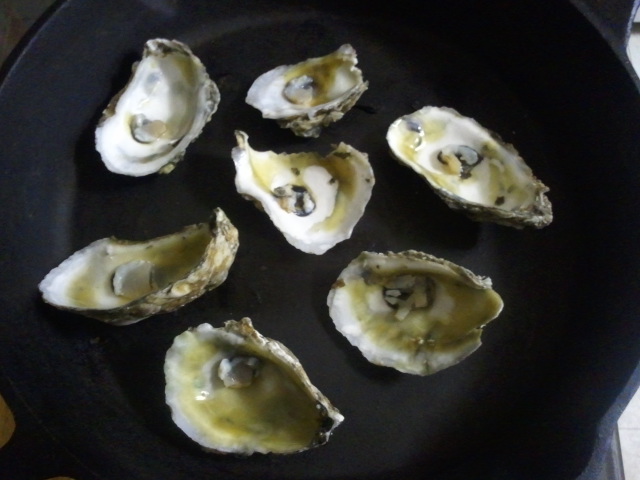
Place an oyster into each shell.


Top each oyster with bread crumbs.


And then top each with a pat of butter.


Do it again: some more bread crumbs, some more butter.


Place in a Dutch oven - or in this case, under the broiler - for a few minutes until browned.


Apart from the arduous process of oyster shucking, this is a ridiculously simple yet decadent appetizer.  Cook just long enough to get the oysters cooked through and soft.  The crunch of the buttery bread crumbs are a nice addition.  You will have to bite a little into the oyster, but make sure you drink down the butter so don't get it all over yourself.

Sources:

Anderson's Neck Oyster Company.  "History".  Copyright 2012, Anderson's Neck Oyster Company.  All rights reserved.

Brunswick Stewmaster's Association.  "Brunswick Stew History".  Copyright 2010, Brunswick Stewmaster's Association.  All rights reserved.

Carman, Tim.  "The Real Reason Why Squirrel Meat Isn’t Used in Brunswick Stew Anymore".  Young & Hungry column, Washington City Paper, posted May. 6, 2009.

Cowen, Tyler.  Tyler Cowen's Ethnic Dining Guide.  Copyright 2012, All rights reserved.

Chadwell, Treva.  "Virginia Ham Biscuits".  Provided for the Cooking Channel.  Copyright 2012, Cooking Channel LLC.  All rights reserved.

"Elmer Fudd" (user), "Elmer Fudd's Brunswick Stew".  Posted September 26, 2009.  Copyright 2009 Field & Stream.  All rights reserved.

Good Earth Peanut Company.  "All About Peanuts".  Date unknown.

Graham, Paul, N.G. Marriott and R.F. Kelly.  "Dry Curing Virginia-Style Ham".  Written for the Virginia Tech Cooperative Extension, 2011.

Peanut Shop of Williamsburg.  "Thai Cucumber Salad".  Copyright 2010, The Peanut Shop of Williamsburg.  All rights reserved.

Randolph, Mary.  The Virginia Housewife: Or Methodical Cook: A Facsimile of an Authentic Early American Cookbook.  1824.  Republication of the edition by E.H. Butler & Co., Philadelphia, 1860.  Introduction by Janice Bluestein Longone, Moneola, NY: Dover, 1993.


Shields, John. Chesapeake Bay CookingBroadway Books: New York, NY, 1998


Virginia Tourism Corporation. "Home page".  Copyright 2012, Virginia Tourism Corporation.  All rights reserved.

Some information also obtained from Wikipedia's "Virginia" page and other pages, and the Food Timeline State Foods link to "Virginia".

Wednesday, October 17, 2012

Snacking State-by-State: Virginia I - "You got your Virginia ham in my biscuit!"

For just a few weeks, this State-by-State series comes back home.  Okay, almost back home - not in state but in regional terms.  Though Virginia is across the Potomac, our neighbors to the south share one very important thing with us here in Maryland: the big ol' Chesapeake Bay.  But a quick perusal of any cookbook or recipe collection claiming to be Chesapeake cuisine will show you that the foods we share are not just seafood.


Official Name: Commonwealth of Virginia
State Nickname: The Old Dominion State
Admission to the US: June 25, 1788 (#10)
Capital: Richmond (4th largest)
Other Important Cities: Virginia Beach (largest), Norfolk (2nd largest), Chesapeake (3rd largest); Newport News (5th largest), Hampton (6th largest), Alexandria (7th largest)
Region: South, Upper South, Mid-Atlantic, Chesapeake; South Atlantic (US Census)
RAFT NationsChestnut, Crab Cake
Bordered by: West Virginia (northwest), Maryland, District of Columbia and the Potomac River (northeast), Chesapeake Bay and Atlantic Ocean (east), North Carolina (south), Tennessee (southwest), Kentucky (west)
Official State Foods and Edible Things: brook trout (fresh water fish), milk (beverage), Eastern oyster (shell), striped bass (salt water fish)
Some Famous and Typical Foods: ham (especially Smithfield); peanuts; Chesapeake Bay cuisine to the north and east of the state, specifically crabs (fried, steamed, boiled, deviled, Norfolk and she-crab soup) and oysters; typical Southern foods to the south and west of the state (including ham biscuits, beaten biscuits, etc); diverse multicultural foods in Northern Virginia (notably South & Southeast Asian, West African, Ethiopian and Central American); Brunswick stew

What constitutes Virginia cuisine?  It depends on where in the Commonwealth you are (NB: Virginia is the last of the four "commonwealth states" we are hitting up, after Pennsylvania, Massachusetts and Kentucky.  Five if you count Puerto Rico, which isn't a state but is a commonwealth.  Ugh, my head hurts keeping track of all this).  The Virginia travel site (Virginia.org) with its well-known "Virginia is for lovers" tagline, boasts right at the top that "There's a lot more to Virginia Cuisine than Peanuts!" [Virginia Tourism Corporation 2012].  Well I knew that!  And they spell it out for us, region by region:

* Chesapeake oysters, beautiful blue crabs and - yes - flounder abound on Virginia's Eastern Shore, as Wachapreague (not far from Chincoteagoe) bills itself as the flounder capital of the world.  Getting Misty yet?
* South Central Virginia, best known for its Brunswick stew - something that the entire Upper South fights for credit over.  made with chicken or squirrel.  You will see this pop up in a few posts, though I'm not quite sure the recipe I used is the most authentic one.
* Appalachia is home to typical Appalachian foods - like the stack cakes and cornbreads we've seen in earlier posts.
* The Shenandoah Valley, which is apple country (that I just found out while researching this).
* Northern Virginia, like DC and the Maryland suburbs, draws in the cuisines of the world.  A simple glance at Tyler Cowen's Ethnic Dining Guide, based in NoVA, shows the true diversity of international eating around 495.  This is also wine country, by the way.
* And of course, the classically Southern fare of Richmond, Hampton Roads and the Tidewater, where ham, biscuits and peanuts abound. [Virginia Tourism Corporation 2012; Cowen 2012]

I really need to get to Virginia more often.  It is just next door after all, and I'm in DC a lot more often these days.

Among all the things I know Virginia for, it is crab.  And of course it would be: that's one of the big things Marylanders share with Virginians is the blue crab.  But most Americans probably identify Virginia more with ham.  Virginia is famous for its hams.  Again, you find these in neighboring states, too: Tennessee, Kentucky and even Southern Maryland all boast about their respective takes on ham.  But Virginia has cornered the national market (not to mention Food Network star Paula Deen in one nasty frozen ham assault a few years ago).  Most famous is Smithfield, though remember that many local farms smoke and sell their own hams to the public. Particularly important are their dry-cured hams, not the easiest thing to find in the mega-supermarkets - the Wegmanses and Harris Teeters in the area - but hard to miss in most Giants, where you literally stumble over the Virginia dry-cured hams (go fig).  As noted by Paul Graham, N.G. Marriott and R.F. Kelly for the Virginia Tech Cooperative Extension [Graham et al 2011], the process and trade in Virginia ham is an old and storied one in the Commonwealth
Virginia ham was one of the first agricultural products exported from North America. The Reverend Mr. Andrew Burnaby enthusiastically reported that Virginia pork was superior in flavor to any in the world (Burnaby 1775). Another early clergyman, the Reverend Mr. John Clayton, wrote the Royal Society in England that Virginia ham was as good as any in Westphalia (Force 1844). [Graham et al 2011; their sources included]
They further outline the process of dry-curing your own ham the Virginia way, from start to finish, even warning about the specific bugs that typically bother the ham during the curing process.

For this ham recipe, I would have liked to use dry cured ham.  But the stuff is pricey, and I just don't have the time to properly, or even half-assedly, prepare a dry cured ham for serving.  So instead I shot for the boneless smoked variety of party ham put out by, again, Smithfield.  To best utilize this, I turned to one of the most popular finger sandwiches in the South: the humble ham biscuit.  You can definitely make these with dry-cured ham, but it's just a lot cheaper, easier and less time-consuming with the pre-cooked, vacuum-packed-in-water stuff.

The ham biscuit is as popular with Southern hostesses, tailgaters and buffet-goers as that other Southern classic, pimento cheese.  So much so that the makers of Martha White flour [date unknown] have a few things to say about this cherished snack.
The origin of the yeast biscuit is unknown but seems to have surfaced in Southern cookbooks and in newspaper food sections during the 1950s. Alice Jarman, the founder of the Martha White Kitchen, developed a version for the company that was publicized across the South called "Riz" Biscuits. These biscuits became preferred carriers for country ham because of their light texture and good keeping qualities. [Martha White date unknown]
Martha White points out three variations, a thin, crisper biscuit, a softer, yeasty biscuit and a biscuit that has actual ham pieces in the dough.  The recipe below, which I got from Treva Chadwell whose recipe is posted at the Cooking Channel website, is a softer biscuit using no yeast at all - and swapping White Lily flour for Martha White (Chadwell doesn't specify any specific flour).  Hers also comes with a honey Dijon sauce and - gasp - chives!  What is a humble host like me to do with all this fabulousness!?!?

The Recipe: Virginia Ham Biscuits

For Chadwell's ham biscuit you will need the following:


First, you will need some biscuits.  You could cheat and buy some, but why not make them yourself?  Chadwell's chive biscuits call for:

* flour (had it on hand - White Lily in this case, though you could use Martha White as well.  Oh hell, any flour will do, but the softer the better)
* baking powder (had it)
* baking soda (same)
* salt (had this too)
* buttermilk (picked up a quart for about $1.50)
* lard (I should have gone to Giant and gotten actual lard, since they have it in their meat section.  Neither of the mega-huge supermarket chains that has come to our area - Wegman's and Harris Teeter - has lard.  The closest I found was Goya's lard, which upon reading the ingredients seems like some strange lard-Crisco hybrid at Harris Teeter.  It ran about $4.)
* chives (only $2 a bunch)

This recipe also calls for a honey mustard sauce.  For this you need:

* Dijon mustard (had it in the pantry)
* whole grain mustard (just $3.50 for a bottle)
* honey (had this on hand, too.  My sister brought some of this from Richmond Hill, outside of Savannah.  Best to keep this recipe as Southern as possible)

And finally, you will need:

* ham - otherwise, it wouldn't be a ham biscuit (I bought a vacuum-packed pre-cut boneless Smithfield ham at Harris Teeter for $4 per lb - about $9.50.  I will be eating this ham for a while)


First, whisk together the dry ingredients and the chives.


Next, cut in the lard.  It should be cold.


Whisk until it is of a crumbly but doughy consistency.


Flour the dough and roll it out to about a 1/2 inch consistency.


Punch it a few times...


...and cut it into rounds of about 2 1/2 inches.  I just used a drinking cup.


Bake it in a preheated 400°F oven for about 20 minutes.


While baking, mix the mustards and honey.


When your biscuits are cool enough to handle, make the ham biscuits.  Cut a biscuit in half.


Spread the honey-mustard sauce on at least one side.
\

Place some of your ham on the biscuit.


I liked these biscuits, but for some reason mine always turn out flatter than most.  Still, this is a tasty sandwich.  Though I didn't cook the ham at all, I would warm it up a bit before I made this again.

Sources:

Anderson's Neck Oyster Company.  "History".  Copyright 2012, Anderson's Neck Oyster Company.  All rights reserved.

Brunswick Stewmaster's Association.  "Brunswick Stew History".  Copyright 2010, Brunswick Stewmaster's Association.  All rights reserved.

Carman, Tim.  "The Real Reason Why Squirrel Meat Isn’t Used in Brunswick Stew Anymore".  Young & Hungry column, Washington City Paper, posted May. 6, 2009.

Cowen, Tyler.  Tyler Cowen's Ethnic Dining Guide.  Copyright 2012, All rights reserved.

Chadwell, Treva.  "Virginia Ham Biscuits".  Provided for the Cooking Channel.  Copyright 2012, Cooking Channel LLC.  All rights reserved.

"Elmer Fudd" (user), "Elmer Fudd's Brunswick Stew".  Posted September 26, 2009.  Copyright 2009 Field & Stream.  All rights reserved.

Good Earth Peanut Company.  "All About Peanuts".  Date unknown.

Graham, Paul, N.G. Marriott and R.F. Kelly.  "Dry Curing Virginia-Style Ham".  Written for the Virginia Tech Cooperative Extension, 2011.

Peanut Shop of Williamsburg.  "Thai Cucumber Salad".  Copyright 2010, The Peanut Shop of Williamsburg.  All rights reserved.

Randolph, Mary.  The Virginia Housewife: Or Methodical Cook: A Facsimile of an Authentic Early American Cookbook.  1824.  Republication of the edition by E.H. Butler & Co., Philadelphia, 1860.  Introduction by Janice Bluestein Longone, Moneola, NY: Dover, 1993.


Shields, John. Chesapeake Bay CookingBroadway Books: New York, NY, 1998


Virginia Tourism Corporation. "Home page".  Copyright 2012, Virginia Tourism Corporation.  All rights reserved.

Some information also obtained from Wikipedia's "Virginia" page and other pages, and the Food Timeline State Foods link to "Virginia".