Showing posts with label Southern (Upper South). Show all posts

Wednesday, October 24, 2012

Snacking State-by-State: Virginia IV - Stop being squirrelly! (No, seriously. Stop it.)


Ah, Brunswick stew.  So many states vie over it, each saying "We made it first!" We hear this from Tennessee, North Carolina and of course from Virginia (not so much Kentucky, though their burgoo is somewhat similar).  But what constitutes a Brunswick stew?  Some ingredients that you can easily find, though most of us don't know how to actually hunt them.


Official Name: Commonwealth of Virginia
State Nickname: The Old Dominion State
Admission to the US: June 25, 1788 (#10)
Capital: Richmond (4th largest)
Other Important Cities: Virginia Beach (largest), Norfolk (2nd largest), Chesapeake (3rd largest); Newport News (5th largest), Hampton (6th largest), Alexandria (7th largest)
Region: South, Upper South, Mid-Atlantic, Chesapeake; South Atlantic (US Census)
RAFT Nations: Chestnut, Crab Cake
Bordered by: West Virginia (northwest), Maryland, District of Columbia and the Potomac River (northeast), Chesapeake Bay and Atlantic Ocean (east), North Carolina (south), Tennessee (southwest), Kentucky (west)
Official State Foods and Edible Things: brook trout (fresh water fish), milk (beverage), Eastern oyster (shell), striped bass (salt water fish)
Some Famous and Typical Foods: ham (especially Smithfield); peanuts; Chesapeake Bay cuisine to the north and east of the state, specifically crabs (fried, steamed, boiled, deviled, Norfolk and she-crab soup) and oysters; typical Southern foods to the south and west of the state (including ham biscuits, beaten biscuits, etc); diverse multicultural foods in Northern Virginia (notably South & Southeast Asian, West African, Ethiopian and Central American); Brunswick stew

Brunswick stew has a long history in the Upper South.  Of course, Brunswick County, Virginia, is one of the places that says they had it first.  I have no horse in this race, though Virginia is closer, so I guess they're as close to the home team as possible.  So the origins of Brunswick stew, in Brunswick County at least, dates back before the Civil War.

It all started back in 1828 on the banks of the Nottoway River during a hunting party. Dr. Creed Haskins, a member of the House of Delegates from 1839 through 1841, took a group of his friends on a hunting expedition. While they were on the hunt, camp cook Jimmy Matthews stirred together the first impromptu mixture that has become known as Brunswick Stew. The original thick soup was made from squirrels, onions, and stale bread. 
When the hunters returned, there was reluctance to try the new mixture. However, the reluctance turned to demands for second and third helpings of the warm, thick stew. [Brunswick Stewmaster's Association, date unknown]
When we think of Brunswick stew, we usually think of those squirrels. In fact, one message board commenter "Elmer Fudd" at the Field & Stream website, who offers his own recipe, swears that,
In my opinion an authentic Brunswick Stew must include three things: Squirrel, lima beans, and okra. Yet if you go online, you will find plenty of recipes that do not include *any* of these items. ["Elmer Fudd" 2009].
He suspects those recipes are from New York (As Elmer suggests, "This incredible development is what happens when we let Yankees dicker with things that should be left to Southerners").  And yet, while it is ridiculously easy to find the last two ingredients - there isn't exactly a shortage of lima beans or okra - finding squirrel isn't such an easy task, especially flying squirrels who are apparently the most authentic type of squirrel to use (this from Tim Carman [2009] at the Washington City Paper).  Yes, I am speaking as a non-hunter: I don't know how to hunt, I don't have the time to hunt, and all of my in-laws who do hunt have moved out of state.  This is also the reason why I haven't had venison in a few years.  So short of sneaking up on a few squirrels and bonking them on the head with a brick, I had to think of alternative meats out of necessity.   


The recipe I chose would almost make Elmer's blood curdle, I fear: no squirrel (sadly - you can't even find it on the internet for sale!), and no okra.  But at least it has lima beans in it.  And once more, I went back to John Shields' Chesapeake Bay Cooking for his expert advice.  Shields does urge the home cook to use squirrel instead of chicken, the go-to replacement these days.  Or you could get adventurous and use muskrat instead [Shields 1998].  But he does give you quantities for both squirrel and chicken, should you go the latter route.  His Brunswick stew, presumably from Virginia's Lower Eastern Shore, is on page 168 of Chesapeake Bay Cooking.  I halved this recipe.

The Recipe: Brunswick Stew

For this Brunswick stew assemble the following, if you can't find squirrel that is:


* chicken (in lieu of squirrel; I bought it at Wegman's for about $3 per lb)
* onion (did not cost a lot)
* potato (same)
* bacon grease (or in this case, chicken schmaltz, which I had in the fridge)
* butter (had it)
* flour (same)
* lima beans (a bag of dried lima beans for about $1.50)
* chicken broth (a quart for about $2.  I used the entire thing)
* thyme (had it)
* bay leaf (same)
* corn (a can for about 70¢ at Wegman's)
* salt and pepper (had these of course)
I forgot to add to the photo one more important ingredient: tomatoes, which is an important part of many Brunswick stew recipes.  I added two, chopped.


* First, dredge you chicken pieces, with the skin on.


Melt your butter and schmaltz in a cast iron skillet.  I used my 12" skillet.


Brown your chicken pieces in the fat...


...a few minutes on either side.


Add the chicken broth and simmer for several minutes...


...covered.


Next add your vegetables...


...your lima beans,


...your herbs...


...and your tomatoes.


Simmer for a total of an hour and a half, from start to finish.


While this does not look like many of the Brunswick stews that I have seen (most of those look more like the burgoo I made for Kentucky), this is still a hearty stew that will fill you up.  I didn't have okra or squirrel, true.  Yes, I would have liked to try it with some squirrel meat.  But I couldn't get my hands on any, alright?  Seriously, man!

- - - - -

From the home of George Washington to the state that bears his name, we head from the Southeast to the Northwest, trading blue crabs for Dungeness ones and apples for, er, apples.  It's time to see what the Evergreen State has to offer as we explore the foods of Washington.

- - - - -

Sources:

Anderson's Neck Oyster Company.  "History".  Copyright 2012, Anderson's Neck Oyster Company.  All rights reserved.

Brunswick Stewmaster's Association.  "Brunswick Stew History".  Copyright 2010, Brunswick Stewmaster's Association.  All rights reserved.

Carman, Tim.  "The Real Reason Why Squirrel Meat Isn’t Used in Brunswick Stew Anymore".  Young & Hungry column, Washington City Paper, posted May. 6, 2009.

Cowen, Tyler.  Tyler Cowen's Ethnic Dining Guide.  Copyright 2012, All rights reserved.

Chadwell, Treva.  "Virginia Ham Biscuits".  Provided for the Cooking Channel.  Copyright 2012, Cooking Channel LLC.  All rights reserved.

"Elmer Fudd" (user), "Elmer Fudd's Brunswick Stew".  Posted September 26, 2009.  Copyright 2009 Field & Stream.  All rights reserved.

Good Earth Peanut Company.  "All About Peanuts".  Date unknown.

Graham, Paul, N.G. Marriott and R.F. Kelly.  "Dry Curing Virginia-Style Ham".  Written for the Virginia Tech Cooperative Extension, 2011.

Peanut Shop of Williamsburg.  "Thai Cucumber Salad".  Copyright 2010, The Peanut Shop of Williamsburg.  All rights reserved.

Randolph, Mary.  The Virginia Housewife: Or Methodical Cook: A Facsimile of an Authentic Early American Cookbook.  1824.  Republication of the edition by E.H. Butler & Co., Philadelphia, 1860.  Introduction by Janice Bluestein Longone, Moneola, NY: Dover, 1993.


Shields, John. Chesapeake Bay Cooking. Broadway Books: New York, NY, 1998


Virginia Tourism Corporation. "Home page".  Copyright 2012, Virginia Tourism Corporation.  All rights reserved.

Some information also obtained from Wikipedia's "Virginia" page and other pages, and the Food Timeline State Foods link to "Virginia".

Wednesday, March 14, 2012

Snacking State-by-State: North Carolina II - It's All About the Lexingtons

As mentioned in the last post, North Carolinians get very defensive of their own barbecue varieties - against Yankees, against other Southerners, and especially against each other.  However, I have seen more than a fair amount of writeups where barbecue lovers have simply said "You know what?  It's all good!"  Even from North Carolinians: "I'm from North Carolina and even though I love my own regional variety and know it's the best, the other's not that bad."  And so, not being from the Tar Heel State myself, I have tried to familiarize myself with both styles.  The last State post was about the Eastern style.  This time it's the Western part of the state representin', Lexington-style.

Official Name: State of North Carolina
State Nicknames: The Tar Heel State, The Old North State
Admission to the US: November 21, 1789 (#12)
Capital: Raleigh (2nd largest)
Other Important Cities: Charlotte (largest), Greensboro (3rd largest), Winston-Salem (4th largest)
Region:
 South, Southeast, Upper South; South Atlantic (US Census)
RAFT Nations: Crabcake; Chestnut
Bordered by: Virginia (north); Tennessee (west); Georgia (southwest); South Carolina (south); Atlantic Ocean (east)
Official State Foods and Edible Things: blueberry & strawberry (berries), milk (beverage), channel bass (fish), Southern Appalachian brook trout (freshwater trout), Scuppernong grape (fruit), honey bee (insect - again, for the honey), gray squirrel (mammal), sweet potato (vegetable)
Some Famous and Typical Foods: two - count 'em: two famous styles of BBQ (Eastern and Western or "Lexington-style"); other standard Southern foods, including (typically eaten with said BBQ's) cole slaw, hush puppies, sweet tea; pimiento cheese (the nation's leading producer); also the birthplace of Pepsi-Cola


As noted last time, a few things separate east and west when it comes to North Carolina BBQ (east is listed first): vinegar-based vs ketchup-and-vinegar-based sauce, whole hog vs pork shoulder, and (as I have recently discovered through intense investigation) no rub at all vs some sort of minimal dry rub (sometimes none, other times just salt and pepper, once in a while something more elaborate that's both salty and sweet - but never anything as froufrou as fresh garlic).


If you remember the last post, cue fans, I have no smoker, but found a way to smoke my BBQ in the slow cooker (again, thanks to Stephanie O'Dea).  This time, I found an actual recipe at EasySouthernCooking.com for Lexington-style BBQ for the slow cooker!  I gathered up all the ingredients, even took my photos of the ingredients - this version had a particularly elaborate dry rub, though again no fresh garlic - and let it sit overnight in the fridge.

The next day I click on the link to continue the process, and come up with this:
Sorry 'www.easysoutherncooking.com meats lexington barbecue recipe slow cooker style ' does not exist or is not available. [my dumb luck, 2012]
Either I've gone insane or somebody at EasySouthernCooking.com doesn't have an active domain anymore.  Hmmm...

Perturbed, I looked around for similar recipes, and came up with very little.  I found a lot of great recipes for Lexington-style sauce/dip, and more than a few for Lexington-style BBQ featuring a rub of just salt and pepper, but only even similar to the elaborate brown sugar, paprika, salt and celery seed rub I found before, from Saveur.com.  So please bear with me, barbecue fans.  I've never actually had to change a recipe midstream.  You don't usually expect it to just vanish from the internet after all (and I guess there's something to be said for the printed word, huh?)

The Recipe: Western (Lexington-Style) North Carolina Style BBQ

Please note: as with the Eastern BBQ recipe from the last post, I did not need to bust out my bottle of liquid smoke.


For the barbecue itself you will need:

* pork shoulder (not whole hog, which wouldn't fit anyway - again, this is the other 4.5 lb half of the 9 lb bone-in shoulder that the nice woman at Wegman's sawed in half for me)
* hickory chips and parchment paper (yes, for our "slow cooker as smoker" method)
* apple juice (the original recipe suggested I pour this into the slow cooker halfway through the recipe.  I later found this was unnecessary)

As with the rub recipe, I lost the sauce recipe when the EasySouthernCooking website vanished.  No worries: do you realize just how many recipes there are out there for Lexington-style BBQ sauce.  No, not all are created equal, but I figured this one from the NC Barbecue Society was a safe bet for a good sauce.  This is the ingredient list for their Piedmont Lexington-Style Dip, and it was pretty much the same stuff with one or two things missing from the photo:

* vinegar (distilled white or apple cider; I used the latter)
* ketchup (again, the thing that separates Eastern and Western styles from each other.  This is probably not what you'll eat in Fayetteville or Durham)
* water (have it on hand)
* red pepper flakes (again, in this case I had to grind up a dried red chile pepper)
* cayenne (had it)
* sugar (brown or white; in this case I used white)
* salt (had it too)

For the rub, if anything, many recipes that I found just call for salt and maybe ground black pepper.  A few recipes have something more elaborate, like the now-gone recipe that I used.  The closest rub to this one that I could find is on Saveur.com's website, and the ingredient list is similar.  Next time though, I may just do a salt rub if anything.

* brown sugar (I used about a cup and a half; this recipe calls for a tablespoon)
* paprika (had it)
* salt and black pepper
* cayenne pepper
* garlic powder

The Saveur recipe also calls for dry mustard powder and white pepper, which I did not use.


If using a rub, depending on how complicated it is, mix it up in a bowl.


Next, pat it all over your pork shoulder.


All patted.  Let it sit overnight in the fridge, or for an hour on your counter.


When ready to smoke it in the slow cooker, again take wood chips that have soaked in water for at least half an hour, drain and wrap inside parchment paper, making a packet that will sit at the bottom of your slow cooker.


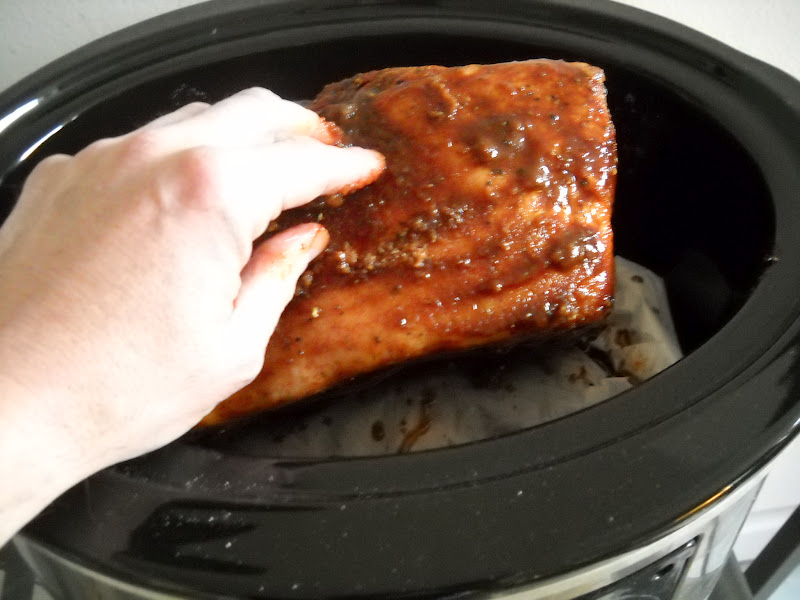
Set your pork shoulder on top of the wood chip packet, and set your slow cooker for 8 hours on LOW.


The original recipe that I was going to use suggested adding some apple juice and apple cider vinegar about halfway through.  I just added the apple juice.


Now for the barbecue sauce/dip: mix it all together in a saucepan, stir and simmer until the sugar is melted.  There, easy.


When the barbecue is done, chop it up.


Douse the meat with some of the barbecue sauce.


Typically, you will eat slaw with this version as well.  This slaw recipe is even easier, according to Saveur.com's website: just make some Lexington style dip and pour it over chopped up cabbage.  Again, easy.


What to make of this barbecue that I had to change recipes on midstream?  Well first the obvious: it's a mighty fine barbecue: I do like the tomato ketchup based vinegar sauce. In the end, this particular rub seemed not to add too much to this recipe, which is probably why so many recipes I've found for Western NC-style BBQ featured salt and not much else.  I don't think this recipe needs such an elaborate rub: the sauce and the wood chips are what add so much of the flavor to this barbecue.

Now for the $20,000 question: which do I prefer, Eastern or Western style?  I'm not saying; yes, I liked them both quite a lot.  If you didn't want to hear that, too bad!  I will say this, though: the sauces really made the difference.  Had I stuck with the $40 a Day sauce from the now defunct Barbecue Joint in the Research Triangle, I definitely would've given the Lexington-style BBQ the thumbs up over the Eastern style - no contest.  But after I whipped up a batch of the Meathead's Eastern style vinegar-only BBQ sauce, the two barbecues really are each quite good to me.  I can't choose.  I won't!  And y'all can't make me.


Sources:


Barbecue Joint.  "Eastern North Carolina Barbecue".  Featured on the episode "Durham, NC" of the show $40 a Day (Rachael Ray, host).  Food Network, 2005.

Bowen, Dana.  "East Vs. West: North Carolina Pulled Pork".  Saveur.com, Issue #139: BBQ Nation.  Published June 16, 2011.  Copyright 2011 Saveur.com.  All rights reserved.


Goldwyn, Craig "Meathead". "East Carolina Kiss & Vinegar Barbecue Sauce & Mop". Amazing Ribs website. Last revised September 12, 2011.  All

Graff, Michael, Wendy Perry, and Teresa Williford.  "The Pepsi ‘N’ Peanuts Cake".  Our State: Down Home in North Carolina. Posted February 2012.  Copyright 2012 Our State.  All rights reserved.

North Carolina BBQ Society.  "Eastern Style Slaw".  Copyright The North Carolina Barbecue Society, Inc. 2009.

North Carolina BBQ Society.  "Piedmont Lexington-Style Dip".  Copyright The North Carolina Barbecue Society, Inc. 2009.

North Carolina Travels (NorthCarolinaTravels.com).  "North Carolina Barbecue".  Date unknown.  Matt Barrett's Travel Guides: North Carolina.  All rights reserved.

O'Dea, Stephanie.  "You Can Use Your CrockPot as a Smoker".  A Year of Slow Cooking.  Posted August 7, 2008.

Pepsi Store (PepsiStore.com).  "History of the Birthplace".  Date unknown.  Copyright PepsiStore.com and Pepsi-Cola.  All rights reserved.

Saveur.com.  "Lexington Pulled Pork".  Saveur.com, Issue #139: BBQ Nation.  Published June/July 2011.  Copyright 2011 Saveur.com.  All rights reserved.

Saveur.com.  "Lexington-Style Red Slaw".  Saveur.com, Issue #139: BBQ Nation.  Published June/July 2011.  Copyright 2011 Saveur.com.  All rights reserved.

Southern Foodways Alliance (Sara Roahen and John T. Edge, editors).  The Southern Foodways Alliance Community Cookbook.  University of Georgia Press: Athens, GA, 2010.

Wallace, Emily.  "A brief history of pimento cheese".  Independent Weekly (IndyWeek.com).  Posted June 22, 2011.  Copyright 2012 Independent Weekly.  All rights reserved.

Some information also obtained from Wikipedia's "North Carolina" page and other pages, and the Food Timeline State Foods link to "North Carolina".

Sunday, March 11, 2012

Snacking State-by-State: North Carolina I - East Is East, West Is West, Never the Twain Shall Meet

Certain states have contributed very specific things to the American cultural landscape: of course, Maryland has its crabcakes, Massachusetts its own style of clam chowder, Texas its chili (and its barbecue but we won't get into that right now) and Illinois its deep dish pizza.  North Carolina is one of those states, and it contributes not one but two different styles of barbecue.  And I have the daunting task of trying to make them both in a short amount of time, with no access to a smoker.

Official Name: State of North Carolina
State Nicknames: The Tar Heel State, The Old North State
Admission to the US: November 21, 1789 (#12)
Capital: Raleigh (2nd largest)
Other Important Cities: Charlotte (largest), Greensboro (3rd largest), Winston-Salem (4th largest)
Region:
 South, Southeast, Upper South; South Atlantic (US Census)
RAFT Nations: Crabcake; Chestnut
Bordered by: Virginia (north); Tennessee (west); Georgia (southwest); South Carolina (south); Atlantic Ocean (east)
Official State Foods and Edible Things: blueberry & strawberry (berries), milk (beverage), channel bass (fish), Southern Appalachian brook trout (freshwater trout), Scuppernong grape (fruit), honey bee (insect - again, for the honey), gray squirrel (mammal), sweet potato (vegetable)
Some Famous and Typical Foods: two - count 'em: two famous styles of BBQ (Eastern and Western or "Lexington-style"); other standard Southern foods, including (typically eaten with said BBQ's) cole slaw, hush puppies, sweet tea; pimiento cheese (the nation's leading producer); also the birthplace of Pepsi-Cola


As noted way back when I looked at Missouri's KC-style BBQ ribs, barbecue is NOT the same thing as "a cookout".  Kansas City is but one stop on America's BBQ tour.  There are, of course, a few important sources for BBQ: Texas, Memphis, again Kansas City, to name some of the biggest.  (And yes, I would love to lump Baltimore pit beef in there, but technically it ain't BBQ, so I can't).

Of course, that's not to leave out North Carolina.  The whole state is home to not one but two of America's major styles of 'cue: Eastern and Western (or Lexington-style).  And Tar Heels are very defensive about their specific BBQ.  I don't know if wars have been started over which is better, but I'd rather not find out first hand.  Saveur contributor and self-professed Yankee transplant Dana Bowen spent years getting used to even one style, her husband's preferred Eastern style, which he grew up with.  She found out early on just how intense the BBQ rivalry can be:
Once I became a convert, I realized that it's not enough to simply love North Carolina barbecue...; you have to play favorites and defend yours at all costs. And these favorites will land you on one side or the other of a fierce and long-standing debate: Which is better, North Carolina's eastern- or western-style barbecue? To an outsider, this rivalry must seem silly: Both regions serve slow-smoked pork with tangy sauce and slaw. How different could they be? But to North Carolinians, the details represent something larger than barbecue itself: They're a matter of intense cultural pride. [Bowen 2011]
As Bowen soon points out  - hell, as any source points out - they're not the same.  The North Carolina Travels website has two very simple distinctions.  For one, the Eastern-style BBQ uses a vinegar-based sauce, while the Western-style (aka Lexington-style) is specifically ketchup-based.  That is the major difference, though there is one other important note:
The other difference is that in the east they use the whole hog, both white and dark meat, while in the west they cook only the pork shoulder, which is dark meat and thus more fatty, moister and richer. [NorthCarolinaTravels.com, date unknown]
I don't have the money to buy two different chunks of pork.  I cheated (I guess), and just used one 9 pound pork shoulder for both.  And oh yes, I made both, thanks to the nice lady at Wegman's who cut the pork shoulder in half for me, bone and all.  The Eastern recipe I used comes from Chapel Hill's now-closed The Barbecue Joint, showcased on Rachael Ray's $40 a Day a few years back.  It takes about 11 hours, and is done partly in the smoker and mostly in the oven.  In retrospect, I might have experimented with different vinegar sauces - many of the user reviews of the BBQ were not kind (and Rachael Ray was a fan, so there's that too).  "Great for Yankees who don't know BBQ" was one reviewer's headline (ouch).  So I'm willing to try a few vinegar based recipes in addition to this one.  There 's Michael Ruhlman's excellent one, which isn't really "traditional" (it uses fish sauce).  Though intrigued, I opted for something a bit closer to the norm, using one recipe recommended by Craig "Meathead" Goldwyn.  This was only after I used the one from the Barbecue Joint.  It can't hurt to have a few of these after all.

There was just one final problem: I don't have a smoker - or the time or patience to use the grill right now (even with the warmish weather we've been having lately) - so what do I do?  As with the KC ribs post, I tried to figure out how to smoke my BBQ indoors.  There are definitely ways to do it, though not necessarily authentic ones.  I could have done what I did for the KC pork ribs, using that oven-smoking method.  But I didn't want to leave the oven on for ten hours.  I just didn't.  So ever resourceful, I tried to find out if there was a way to turn my slow cooker into a smoker.

Yes, there is!  Thanks to Stephanie O'Dea, who got the idea from the now-defunct Crockpot Alchemist (and who was echoed by Jamie at Suddenly Stay@Home), I found out that one can indeed use a slow cooker as a makeshift smoker.  It's not the most authentic method, but it works for my very humble purposes.  Stephanie avoided liquid smoke by soaking wood chips, wrapping them in parchment, placing them at the bottom of her slow cooker, poking holes throughout it, and then slow cooking a dry rubbed brisket with the wood chips.  Since she did this with brisket, I figured why not try this with the pork shoulder?  And as with Stephanie's brisket, it did actually work.

The Recipe: Eastern North Carolina-Style BBQ (Smoked in the Slow Cooker)

For the recipe featured on $40 a Day you will need:


* pork shoulder (as stated above, I bought a 9 lb pork shoulder on sale at Wegman's for about $11.  One half is in the photo above.  The other half is in the next post)
* wood chips - soaked in water - and parchment paper (this is for my slow cooker smoker project.  I bought hickory chips at Home Depot for $3.50)

For the vinegar sauce, you will need:

* apple cider vinegar (the basis for your sauce - a bottle isn't that expensive, about $1 or $2)
* garlic (got it)
* black pepper and kosher salt (same)
* red pepper flakes (or since I didn't have any, a dry chile pepper ground up)

The ingredients are pretty much the same as those in the Goldwyn recipe, with the exception of sugar (any kind) and hot sauce, which the above recipe doesn't have.  I'll be trying his sauce later on in this post.


Before all else, prep your wood chips.  Soak them in water for at least half an hour.


The longer the better: these were soaking for about four or five hours.  No particular reason.  I just had to go out and do some things: some shopping, a soccer game, a long drive.  Before you know it several hours go by!


Drain the wood chips and place them in the middle of a large sheet of parchment paper.


Fold over the parchment paper to form a packet, like a very rough en papillote.


Like so.


Place the packet in the slow cooker and poke many holes in it to let the steam and flavor escape.


Next, place your pork shoulder on top of the packet.  Stephanie says to add liquid but this recipe does not require it at all.  Set your slow cooker for 10 hours - yes, 10 hours - on LOW.  That's how you do North Carolina BBQ: slowly.


While the pork is cooking, prep your vinegar sauce.  Combine all the rest of the ingredients minus the black pepper in a saucepan.


Bring to a boil, and simmer on medium-high heat for about 20 minutes.


Turn off, let cool, add ground pepper and stir.

There are specific sides that are typically served with Eastern NC BBQ: hush puppies, sweet tea and cole slaw.  Why not make some slaw while you're waiting?  This recipe comes from the North Carolina Barbecue Society [2009], whose Eastern North Carolina Style Cole Slaw makes it clear that even the slaw is different from east to west.  Their recipe serves 50.  I reduced it to 1/12 the size.


You'll need:

* cabbage (duh.  Cabbage is pricey outside of St. Patrick's Day - a 4 lb head for $4.80)
* sugar (had it)
* celery seed (same)
* green onion (the last onion I pulled out of my garden this winter)
* salt (got it)
* apple cider vinegar (hey, I have this lying around)
* mayo (many prefer Duke's from Richmond, a very Southern mayonnaise)


Shred your cabbage.


Mix everything else.


Pour the sauce over the shredded cabbage and mix it thoroughly. 


And there you go.  You will typically eat this on top of your BBQ in a bun.

And speaking of which, it's been about 10 hours.  Let's check in on that pork shoulder.


It's a gorgeous, wonderful smelling pork shoulder.  As Easterners like to point out, their pork must be high quality, since it isn't masked by all that thick ketchup-y sauce.  Best not to say that to a Westerner.


10 hours under a large pork shoulder and look at the hickory wood chip parchment: surrounded by a moat of pork fat.  Smells wonderful.  You can't reuse this packet, mind you.


Transfer the pork to a large platter or tray or something else on which you can pull it apart with your fork, knife or other utensil.


Pour the sauce over it and mix it in thoroughly.  I didn't have enough sauce to keep any on the side.


You won't typically eat the BBQ this way.  More likely, you will eat it like this:


I have to say, there wasn't a lot of sauce here, but what I tasted did have a nice tang.  But again, I read some not nice reviews of this sauce, so I tried out the Meathead's sauce to see if it would make a difference.  At least the brown sugar and hot sauce should make the flavor a bit different, right?

It was - oh boy, it was!  Meathead's recipe does not call for cooking - just mix it all together and let sit for 12 hours.  But I simmered it to a boil anyway and let it cool down.  It was still much better than the other vinegar sauce.  Which makes me wonder: had the Barbecue Joint used Meathead's recipe, would it still be open today?


Sources:


Barbecue Joint.  "Eastern North Carolina Barbecue".  Featured on the episode "Durham, NC" of the show $40 a Day (Rachael Ray, host).  Food Network, 2005.

Bowen, Dana.  "East Vs. West: North Carolina Pulled Pork".  Saveur.com, Issue #139: BBQ Nation.  Published June 16, 2011.  Copyright 2011 Saveur.com.  All rights reserved.


Goldwyn, Craig "Meathead". "East Carolina Kiss & Vinegar Barbecue Sauce & Mop". Amazing Ribs website. Last revised September 12, 2011.  All

Graff, Michael, Wendy Perry, and Teresa Williford.  "The Pepsi ‘N’ Peanuts Cake".  Our State: Down Home in North Carolina. Posted February 2012.  Copyright 2012 Our State.  All rights reserved.

North Carolina BBQ Society.  "Eastern Style Slaw".  Copyright The North Carolina Barbecue Society, Inc. 2009.

North Carolina BBQ Society.  "Piedmont Lexington-Style Dip".  Copyright The North Carolina Barbecue Society, Inc. 2009.

North Carolina Travels (NorthCarolinaTravels.com).  "North Carolina Barbecue".  Date unknown.  Matt Barrett's Travel Guides: North Carolina.  All rights reserved.

O'Dea, Stephanie.  "You Can Use Your CrockPot as a Smoker".  A Year of Slow Cooking.  Posted August 7, 2008.

Pepsi Store (PepsiStore.com).  "History of the Birthplace".  Date unknown.  Copyright PepsiStore.com and Pepsi-Cola.  All rights reserved.

Saveur.com.  "Lexington Pulled Pork".  Saveur.com, Issue #139: BBQ Nation.  Published June/July 2011.  Copyright 2011 Saveur.com.  All rights reserved.

Saveur.com.  "Lexington-Style Red Slaw".  Saveur.com, Issue #139: BBQ Nation.  Published June/July 2011.  Copyright 2011 Saveur.com.  All rights reserved.

Southern Foodways Alliance (Sara Roahen and John T. Edge, editors).  The Southern Foodways Alliance Community Cookbook.  University of Georgia Press: Athens, GA, 2010.

Wallace, Emily.  "A brief history of pimento cheese".  Independent Weekly (IndyWeek.com).  Posted June 22, 2011.  Copyright 2012 Independent Weekly.  All rights reserved.

Some information also obtained from Wikipedia's "North Carolina" page and other pages, and the Food Timeline State Foods link to "North Carolina".