Showing posts with label baked goods. Show all posts

Tuesday, January 22, 2013

Using Pi for Cake!

Those of you on the Facebook may have seen by now the below photo making the rounds from the page "I fucking love science" (seriously, that's the name of the page).  This is absolutely awesome.  Anybody care to try this?  This photo is completely theirs and not mine.  That and I think it's looking at me.


How to cut a cake into four equal pieces (with one smooth cut).  From the Facebook page "I fucking love science."

Wednesday, November 28, 2012

Snacking State-by-State: West Virginia II - I know, it's odd - pepperoni is a land meat. But there it is!

When researching recipes for this post, I really had no idea what West Virginians ate, or what was particularly popular to eat there.  Apparently there is a savory treat that I had never even imagined would exist, particularly in Appalachia: the humble, spicy pepperoni roll.


Official Name: State of West Virginia
State Nickname: The Mountain State
Admission to the US: June 20, 1863 (#35)
Capital: Charleston (largest)
Other Important Cities: Huntington (2nd largest), Parkersburg (3rd largest), Morgantown (4th largest), Wheeling (5th largest)
Region: Appalachia, South, Northeast, Midwest; South Atlantic (US Census)
RAFT NationsChestnutMaple Syrup
Bordered by: Pennsylvania (northeast), Maryland (east), Virginia (southeast), Kentucky (southwest), Ohio (northwest)
Official State Foods and Edible Things: black bear (animal, though these are generally no longer eaten); brook trout (fish), Golden Delicious apple (fruit), honeybee (insect, for the honey) sugar maple (tree, for the sap), timber rattlesnake (reptile, though again, not really eaten)
Some Famous and Typical Foods: typical foods of Appalachia; apple butter; pepperoni rolls; pickled ramps; spoon bread

According to Bob Heffner's Pepperoni Roll Page [2002; 2011] - yes, a page for everything and to everything a page - the pepperoni roll originated sometime between 1927 and the 1940's at the Country Club Bakery in Fairmont.  He sides with the latter date, though he does note guide book author Jeannie Mozier goes with the earlier one.  What nobody disputes is the location.  It likely was invented by Italian-American Giuseppe Argiro, who passed his recipe on to his son.  It was simply chunks of pepperoni baked into small loaves of bread, and was a handy lunch for the many miners in the area.

Heffner [2002; 2011] describes the pepperoni roll in much more luscious tones than have I:
A pepperoni roll is a few thin slices of pepperoni baked in a soft, golden oval of slightly sweet dough, smaller than a dinner roll. They aren't 'bready' and they aren't tough and hard like pizza crust. Pepperoni grease seeps out of the ends of the roll as it's baked, leaving an orangish-red soft spot at either end. [Heffner 2002; 2011]
He also has many recipes on his page.  The one I used is perhaps the easiest one: Fairmont resident JoAnn Corbin's pepperoni roll just uses a stick of pepperoni and thawed bread dough you buy in the freezer section of the supermarket [in Heffner 2002; 2011].  It was also the first one listed on the page.

The Recipe: Pepperoni Roll

For Corbin's pepperoni roll, you will just need two things:


* one stick of pepperoni (about $5 at Giant)
* one pound of pre-frozen, thawed bread dough (the package was about $4, also at Giant.  I only noticed after the fact that both the pepperoni and the bread dough were made by the folks at Chicago-based Bridgford. They also have their own, pre-made pepperoni roll, but I don't want to be that lazy)


Peel your stick of pepperoni.


Cut the pepperoni into chunks of about two to three inches.


Meanwhile, thaw your bread dough and let it rise for at least an hour (I left it in a recently warmed oven, which aided the rising process).  Punch it a few times, cut it into enough pieces that you have one for each chunk of pepperoni.


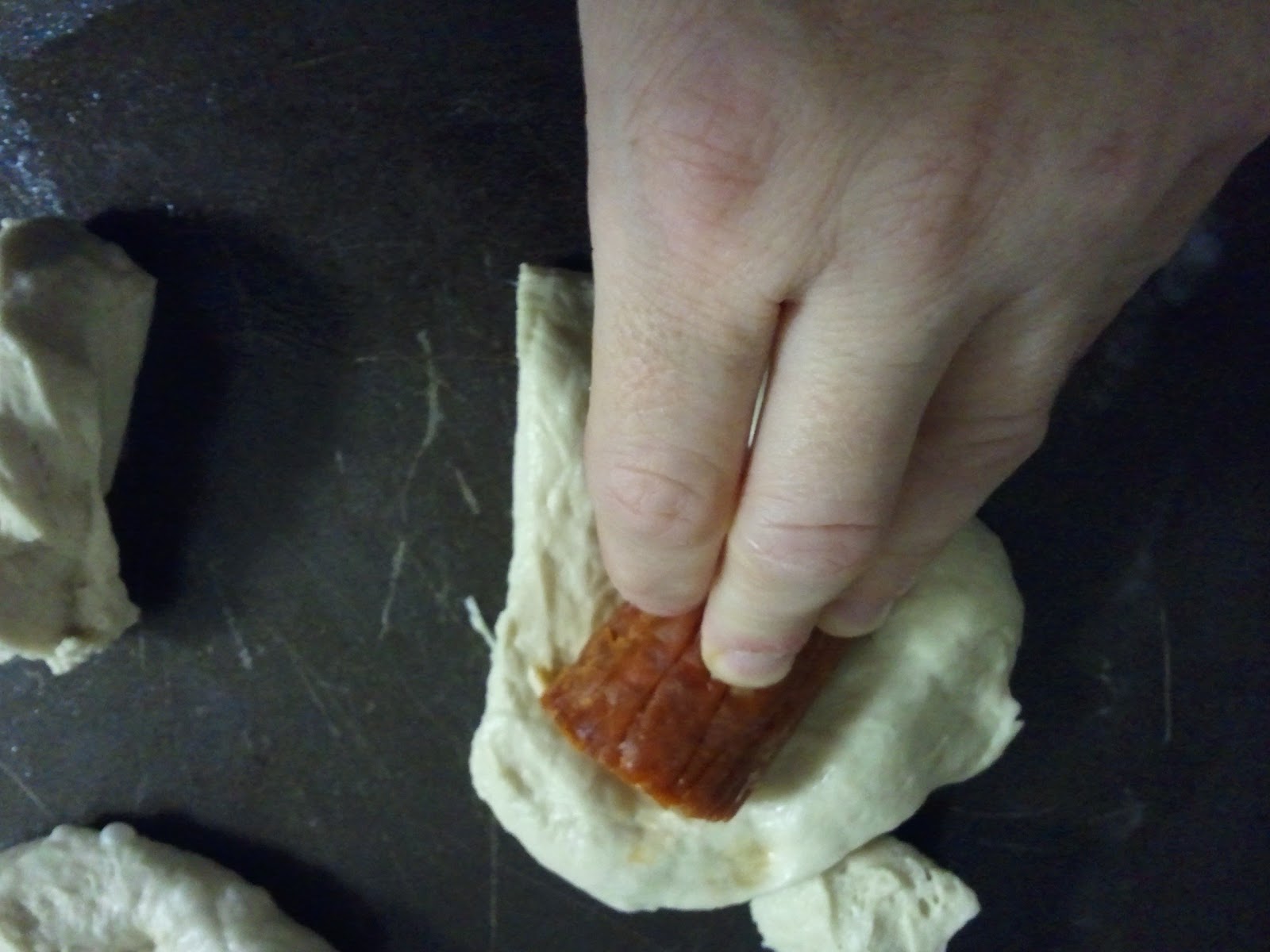
Wrap the dough around the pepperoni, pinch the ends and let the rolls rise again until about doubled in size.


Bake at 300° for half an hour.


Notice that the greases from the pepperoni seep into the bread dough while baking (for that matter, before baking, too)


This is a filling and convenient snack.  I noticed when I bit into it that the pepperoni easily came out, so perhaps I would cut the pepperoni into smaller chunks next time for easier biting.  Heffner says that some people love smothering these in tomato sauce and melted mozzarella cheese, but I find it good as is.

- - - - -

Onward from West Virginia to our final foray into the Midwest proper, where fried cheese curds and beer brats await.  We'll be kickin' it Wisco-style in our armchair visit to Wisconisn.

Sources:

Corbin, JoAnn. "Pepperoni Rolls".  Date unknown.  In Bob Heffner, "Pepperoni Roll and Pepperoni Bread Recipes".  The Pepperoni Roll Homepage, 2002, 2011.


Heffner, Bob.  "What is a Pepperoni Roll?".  The Pepperoni Roll Homepage, 2002, 2011.

Heffner, Bob.  "The History of the Pepperoni Roll".  The Pepperoni Roll Homepage, 2002, 2011.

López-Alt, J. Kenji.  "Pickled Ramps."  Serious Eats, 2011.

Some information also obtained from Wikipedia's "West Virginia" page and other pages, and the Food Timeline State Foods link to "West Virginia".

Wednesday, October 17, 2012

Snacking State-by-State: Virginia I - "You got your Virginia ham in my biscuit!"

For just a few weeks, this State-by-State series comes back home.  Okay, almost back home - not in state but in regional terms.  Though Virginia is across the Potomac, our neighbors to the south share one very important thing with us here in Maryland: the big ol' Chesapeake Bay.  But a quick perusal of any cookbook or recipe collection claiming to be Chesapeake cuisine will show you that the foods we share are not just seafood.


Official Name: Commonwealth of Virginia
State Nickname: The Old Dominion State
Admission to the US: June 25, 1788 (#10)
Capital: Richmond (4th largest)
Other Important Cities: Virginia Beach (largest), Norfolk (2nd largest), Chesapeake (3rd largest); Newport News (5th largest), Hampton (6th largest), Alexandria (7th largest)
Region: South, Upper South, Mid-Atlantic, Chesapeake; South Atlantic (US Census)
RAFT NationsChestnut, Crab Cake
Bordered by: West Virginia (northwest), Maryland, District of Columbia and the Potomac River (northeast), Chesapeake Bay and Atlantic Ocean (east), North Carolina (south), Tennessee (southwest), Kentucky (west)
Official State Foods and Edible Things: brook trout (fresh water fish), milk (beverage), Eastern oyster (shell), striped bass (salt water fish)
Some Famous and Typical Foods: ham (especially Smithfield); peanuts; Chesapeake Bay cuisine to the north and east of the state, specifically crabs (fried, steamed, boiled, deviled, Norfolk and she-crab soup) and oysters; typical Southern foods to the south and west of the state (including ham biscuits, beaten biscuits, etc); diverse multicultural foods in Northern Virginia (notably South & Southeast Asian, West African, Ethiopian and Central American); Brunswick stew

What constitutes Virginia cuisine?  It depends on where in the Commonwealth you are (NB: Virginia is the last of the four "commonwealth states" we are hitting up, after Pennsylvania, Massachusetts and Kentucky.  Five if you count Puerto Rico, which isn't a state but is a commonwealth.  Ugh, my head hurts keeping track of all this).  The Virginia travel site (Virginia.org) with its well-known "Virginia is for lovers" tagline, boasts right at the top that "There's a lot more to Virginia Cuisine than Peanuts!" [Virginia Tourism Corporation 2012].  Well I knew that!  And they spell it out for us, region by region:

* Chesapeake oysters, beautiful blue crabs and - yes - flounder abound on Virginia's Eastern Shore, as Wachapreague (not far from Chincoteagoe) bills itself as the flounder capital of the world.  Getting Misty yet?
* South Central Virginia, best known for its Brunswick stew - something that the entire Upper South fights for credit over.  made with chicken or squirrel.  You will see this pop up in a few posts, though I'm not quite sure the recipe I used is the most authentic one.
* Appalachia is home to typical Appalachian foods - like the stack cakes and cornbreads we've seen in earlier posts.
* The Shenandoah Valley, which is apple country (that I just found out while researching this).
* Northern Virginia, like DC and the Maryland suburbs, draws in the cuisines of the world.  A simple glance at Tyler Cowen's Ethnic Dining Guide, based in NoVA, shows the true diversity of international eating around 495.  This is also wine country, by the way.
* And of course, the classically Southern fare of Richmond, Hampton Roads and the Tidewater, where ham, biscuits and peanuts abound. [Virginia Tourism Corporation 2012; Cowen 2012]

I really need to get to Virginia more often.  It is just next door after all, and I'm in DC a lot more often these days.

Among all the things I know Virginia for, it is crab.  And of course it would be: that's one of the big things Marylanders share with Virginians is the blue crab.  But most Americans probably identify Virginia more with ham.  Virginia is famous for its hams.  Again, you find these in neighboring states, too: Tennessee, Kentucky and even Southern Maryland all boast about their respective takes on ham.  But Virginia has cornered the national market (not to mention Food Network star Paula Deen in one nasty frozen ham assault a few years ago).  Most famous is Smithfield, though remember that many local farms smoke and sell their own hams to the public. Particularly important are their dry-cured hams, not the easiest thing to find in the mega-supermarkets - the Wegmanses and Harris Teeters in the area - but hard to miss in most Giants, where you literally stumble over the Virginia dry-cured hams (go fig).  As noted by Paul Graham, N.G. Marriott and R.F. Kelly for the Virginia Tech Cooperative Extension [Graham et al 2011], the process and trade in Virginia ham is an old and storied one in the Commonwealth
Virginia ham was one of the first agricultural products exported from North America. The Reverend Mr. Andrew Burnaby enthusiastically reported that Virginia pork was superior in flavor to any in the world (Burnaby 1775). Another early clergyman, the Reverend Mr. John Clayton, wrote the Royal Society in England that Virginia ham was as good as any in Westphalia (Force 1844). [Graham et al 2011; their sources included]
They further outline the process of dry-curing your own ham the Virginia way, from start to finish, even warning about the specific bugs that typically bother the ham during the curing process.

For this ham recipe, I would have liked to use dry cured ham.  But the stuff is pricey, and I just don't have the time to properly, or even half-assedly, prepare a dry cured ham for serving.  So instead I shot for the boneless smoked variety of party ham put out by, again, Smithfield.  To best utilize this, I turned to one of the most popular finger sandwiches in the South: the humble ham biscuit.  You can definitely make these with dry-cured ham, but it's just a lot cheaper, easier and less time-consuming with the pre-cooked, vacuum-packed-in-water stuff.

The ham biscuit is as popular with Southern hostesses, tailgaters and buffet-goers as that other Southern classic, pimento cheese.  So much so that the makers of Martha White flour [date unknown] have a few things to say about this cherished snack.
The origin of the yeast biscuit is unknown but seems to have surfaced in Southern cookbooks and in newspaper food sections during the 1950s. Alice Jarman, the founder of the Martha White Kitchen, developed a version for the company that was publicized across the South called "Riz" Biscuits. These biscuits became preferred carriers for country ham because of their light texture and good keeping qualities. [Martha White date unknown]
Martha White points out three variations, a thin, crisper biscuit, a softer, yeasty biscuit and a biscuit that has actual ham pieces in the dough.  The recipe below, which I got from Treva Chadwell whose recipe is posted at the Cooking Channel website, is a softer biscuit using no yeast at all - and swapping White Lily flour for Martha White (Chadwell doesn't specify any specific flour).  Hers also comes with a honey Dijon sauce and - gasp - chives!  What is a humble host like me to do with all this fabulousness!?!?

The Recipe: Virginia Ham Biscuits

For Chadwell's ham biscuit you will need the following:


First, you will need some biscuits.  You could cheat and buy some, but why not make them yourself?  Chadwell's chive biscuits call for:

* flour (had it on hand - White Lily in this case, though you could use Martha White as well.  Oh hell, any flour will do, but the softer the better)
* baking powder (had it)
* baking soda (same)
* salt (had this too)
* buttermilk (picked up a quart for about $1.50)
* lard (I should have gone to Giant and gotten actual lard, since they have it in their meat section.  Neither of the mega-huge supermarket chains that has come to our area - Wegman's and Harris Teeter - has lard.  The closest I found was Goya's lard, which upon reading the ingredients seems like some strange lard-Crisco hybrid at Harris Teeter.  It ran about $4.)
* chives (only $2 a bunch)

This recipe also calls for a honey mustard sauce.  For this you need:

* Dijon mustard (had it in the pantry)
* whole grain mustard (just $3.50 for a bottle)
* honey (had this on hand, too.  My sister brought some of this from Richmond Hill, outside of Savannah.  Best to keep this recipe as Southern as possible)

And finally, you will need:

* ham - otherwise, it wouldn't be a ham biscuit (I bought a vacuum-packed pre-cut boneless Smithfield ham at Harris Teeter for $4 per lb - about $9.50.  I will be eating this ham for a while)


First, whisk together the dry ingredients and the chives.


Next, cut in the lard.  It should be cold.


Whisk until it is of a crumbly but doughy consistency.


Flour the dough and roll it out to about a 1/2 inch consistency.


Punch it a few times...


...and cut it into rounds of about 2 1/2 inches.  I just used a drinking cup.


Bake it in a preheated 400°F oven for about 20 minutes.


While baking, mix the mustards and honey.


When your biscuits are cool enough to handle, make the ham biscuits.  Cut a biscuit in half.


Spread the honey-mustard sauce on at least one side.
\

Place some of your ham on the biscuit.


I liked these biscuits, but for some reason mine always turn out flatter than most.  Still, this is a tasty sandwich.  Though I didn't cook the ham at all, I would warm it up a bit before I made this again.

Sources:

Anderson's Neck Oyster Company.  "History".  Copyright 2012, Anderson's Neck Oyster Company.  All rights reserved.

Brunswick Stewmaster's Association.  "Brunswick Stew History".  Copyright 2010, Brunswick Stewmaster's Association.  All rights reserved.

Carman, Tim.  "The Real Reason Why Squirrel Meat Isn’t Used in Brunswick Stew Anymore".  Young & Hungry column, Washington City Paper, posted May. 6, 2009.

Cowen, Tyler.  Tyler Cowen's Ethnic Dining Guide.  Copyright 2012, All rights reserved.

Chadwell, Treva.  "Virginia Ham Biscuits".  Provided for the Cooking Channel.  Copyright 2012, Cooking Channel LLC.  All rights reserved.

"Elmer Fudd" (user), "Elmer Fudd's Brunswick Stew".  Posted September 26, 2009.  Copyright 2009 Field & Stream.  All rights reserved.

Good Earth Peanut Company.  "All About Peanuts".  Date unknown.

Graham, Paul, N.G. Marriott and R.F. Kelly.  "Dry Curing Virginia-Style Ham".  Written for the Virginia Tech Cooperative Extension, 2011.

Peanut Shop of Williamsburg.  "Thai Cucumber Salad".  Copyright 2010, The Peanut Shop of Williamsburg.  All rights reserved.

Randolph, Mary.  The Virginia Housewife: Or Methodical Cook: A Facsimile of an Authentic Early American Cookbook.  1824.  Republication of the edition by E.H. Butler & Co., Philadelphia, 1860.  Introduction by Janice Bluestein Longone, Moneola, NY: Dover, 1993.


Shields, John. Chesapeake Bay CookingBroadway Books: New York, NY, 1998


Virginia Tourism Corporation. "Home page".  Copyright 2012, Virginia Tourism Corporation.  All rights reserved.

Some information also obtained from Wikipedia's "Virginia" page and other pages, and the Food Timeline State Foods link to "Virginia".

Sunday, October 14, 2012

Snacking State-by-State: Vermont II - My muffin top is all that, cheddar cheese and so fat...

When we think of Vermont and food in the rest of the country, we think of maple syrup (and of course there's the pie).  The next thing that pops up is Ben & Jerry's.  What comes next?  Probably Cabot Creamery, Vermont's most famous exporter of cheddar cheese to the nation.  It is, of course, not the only one - not by a long stretch.  But a cheese company so notable needs a place in this blog tour.

Official Name: State of Vermont
State Nickname: The Green Mountain State
Admission to the US: March 4, 1791 (#14 - the first one they added after the thirteen original colonies)
Capital: Montpelier (5th largest city, though several unincorporated towns are larger)
Other Important Cities: Burlington (largest), North Burlington (2nd largest), Essex (largest town - if it were a city it would be the 3rd largest in Vermont)
Region: New England, Northeast; New England (US Census)
RAFT NationsMaple Syrup
Bordered by: Québec (Canada) (north), New Hampshire (east), Massachusetts (south), New York (west), Lake Champlain (northwest)
Official State Foods and Edible Things: apple (fruit), apple pie (pie), brook trout (cold water fish), honeybee (insect - for the honey), maple (flavor), milk (beverage), sugar maple (tree - for the maple syrup), walleye pike (warm water fish) 
Some Famous and Typical Foods: pie, pie and more pie; maple syrup (there's a pie for that, by the way); cranberries, apples (in the official state pie); French Canadian foods (poutine, tourtière - again with the pie!?)

For all the information you will ever need on Vermont cheeses, look up the Vermont Cheese Council, which dedicates itself "to the production and advancement of Vermont cheese" [2012]. Of course.  In doing so they list so many of the Green Mountain State's cheese makers and the many varieties of cheese they put out.  Yes, among those is the Cabot Cheese Cooperative, which makes the hearty Vermont cheddars you find in the stores.  Started in 1919 by a group of Vermont farmers looking to use up excess milk, Cabot eventually evolved into a cooperative of 1,200 farms throughout New England and upstate New York, and today:
Our company blends state-of-the-art facilities and a savvy entrepreneurial spirit, with the timeless values a personal commitment to quality that comes from being 100% owned by our farm families. [Cabot Cheese Cooperative 2012]
Hence, the co-op.

Cabot, like the Vermont Cheese Council, has a Recipes section on its website (along with pairings, natch).  It is on Cabot's website that I found a tempting muffin recipe that utilizes not just one but three popular New England ingredients: Vermont cheddar, apples and cranberries.  Nope, no maple syrup this time.  This is the recipe I interpret below.

The Recipe: Apple Cranberry Cheddar Muffins

For Cabot Cheese Co-op's muffins you will need:


* flour (again, White Lily makes a lovely albeit less Yankeefied muffin.  Cabot suggests King Arthur brand flour, based, yes, in Vermont)
* sugar (had it)
* baking powder (same)
* egg (again, same)
* vegetable oil (had it)
* salt (hey, my pantry's better stocked than I thought!)
* cranberry juice (a bottle of the high fructose corn syrup-free variety cost about $3.50 at Harris Teeter)
* dried cranberries (again Ocean Spray brand, like the juice.  Fork out about $3 to $4)
* apples (two for about $1.50)
* Cheddar cheese (8 oz for about $4, and yes I opted for Cabot in sticking with the theme of this post and the source of the recipe.  Use a sharper variety)


First, save yourself some trouble in the cleanup department by shoving some muffin cups into your muffin tin.


Peel and core your apples.  You will need to chop them finely.  I got my auto-hand chopper out for this task.


Wishing I had a mini-food processor.


Set aside those apples and grate your cheese.  The "Surprisingly Sharp" variety of Cabot's gets particularly crumbly when you do this.


Whisk together your dry ingredients.


Next, add the cheese and set aside.


In a separate bowl, combine the egg and cranberry juice.


Stir the liquid into the dry + cheese bowl.


Next add your apples and cranberries.  I found that one apple would have been more than enough. The other apple is sitting in my freezer, finely chopped and frozen.


Stir until just blended but still lumpy.


Bake in a 400° oven for about 15 minutes.


I liked this muffin, a little dry but packed with sweet and tangy flavors I don't always imagine together.  A little butter and, dare I say it, maple syrup just sends this muffin over the top.  A muffin, top?  Yes, a muffin, top.

- - - - -

Now leaving New England for the last time on this State-by-State trip, we head back towards 95 and across the Mason-Dixon and the Potomac for one last foray into the South, the Mid-Atlantic and our glorious Chesapeake Bay.  It's finally time to showcase the seafood, pork and legume wonders of our immediate neighbor to the south, the Old Dominion State.  Now entering Virginia, only 25 minutes on the other side of I-495 (traffic permitting).

Sources:

Cabot Cheese Cooperative.  "Apple, Cranberry and Cheddar Muffins ".  Copyright 2012.

Cabot Cheese Cooperative.  "The History of the World's Best Cheddar".  Copyright 2012.

Nicole (blogger, Baking Bites). "Grade A Maple Syrup vs Grade B"  Posted February 13, 2009.  Copyright 2012 Baking Bites.  All rights reserved.

Stern, Jane & Michael.  500 Things to Eat Before It's Too Late.  Houghton Mifflin: New York, 2009.

Traditional.  "An Old Yankee Poem".  Date unknown.  Reprinted from The Heart of New England: Celebrating the unique character & culture of Maine, New Hampshire, Vermont website.  Date unknown.

Vermont Cheese Council.  "Home page".  Copyright 1996-2011 Vermont Cheese Council.  All rights reserved.

Vermont Sustainable Jobs Fund.  "Analysis of Vermont's Food System - 3.3 Food Production: Maple Syrup".  Prepared by Scott Sawyer, Ellen Kahler, and Kit Perkins.  Copyright 2012 Vermont Sustainable Jobs Fund.  All rights reserved.


Some information also obtained from Wikipedia's "Vermont" page and other pages, and the Food Timeline State Foods link to "Vermont".

Wednesday, October 10, 2012

Snacking State-by-State: Vermont I - You want some pie to go with that pie?

Our final stop in the Northeast is the only landlocked state in New England, a state known for its fierce progressive values, its cheeses, its Ben & Jerry's, its maple syrup and, of course, its pies.  So so soooooo many pies.

Official Name: State of Vermont
State Nickname: The Green Mountain State
Admission to the US: March 4, 1791 (#14 - the first one they added after the thirteen original colonies)
Capital: Montpelier (5th largest city, though several unincorporated towns are larger)
Other Important Cities: Burlington (largest), North Burlington (2nd largest), Essex (largest town - if it were a city it would be the 3rd largest in Vermont)
Region: New England, Northeast; New England (US Census)
RAFT NationsMaple Syrup
Bordered by: Québec (Canada) (north), New Hampshire (east), Massachusetts (south), New York (west), Lake Champlain (northwest)
Official State Foods and Edible Things: apple (fruit), apple pie (pie), brook trout (cold water fish), honeybee (insect - for the honey), maple (flavor), milk (beverage), sugar maple (tree - for the maple syrup), walleye pike (warm water fish) 
Some Famous and Typical Foods: pie, pie and more pie; maple syrup (there's a pie for that, by the way); cranberries, apples (in the official state pie); French Canadian foods (poutine, tourtière - again with the pie!?)

True, pie isn't the only foodie thing Vermont is known for: there is, again, its cheddar, its apples, its maple syrup and again that famous aforementioned ice cream.  But historically, from what this outsider has read, pie seems to be at the very heart of the Vermonter identity.  And it's what makes a Yankee a "Yankee".  True, to those of us below the Mason-Dixon Line and, especially, outside our borders the term isn't the nicest thing to call someone. But once you get to New England it all changes (why else name a whole magazine after this demonym?)  And yes, many New Englanders think of "Yankees" as those White Anglo-Saxon Protestants who have been there, eating pie, for generations, though a seemingly ancient New England poem gives us some humorous insight into just who exactly is a "Yankee":
To the European, a Yankee is an American.
To an American, a Yankee is a New Englander.
To a New Englander, a Yankee is a Vermonter..
To a Vermonter, a Yankee is someone who eats apple pie for breakfast.
And to a Vermonter who eats apple pie for breakfast, a Yankee is someone who eats it with a knife.
[Traditional "Old New England joke", date unknown, quoted from The Heart of New England, date unknown; note: this is not the famous E.B. White poem about Yankees, though it may be derived from it,]
It's a much more exclusive club than I ever realized.

For this penultimate New England post, I knew I had to tackle pies one final time.  I decided against apple pie, however, and went for one of Vermont's other favorite exports: maple syrup.  In my first ever trip to New England a few years ago, I stopped in Boston's fabled Faneuil Hall.  Wandering around the gift shop, of course I found little bottles of authentic New England maple syrup.  But notably, and to my surprise, it wasn't Massachusetts-made.  Instead, it proudly display the "Made in Vermont" label.  It's less surprising when you consider how important maple syrup is to the Vermont economy, producing almost half of the entire United States output of the stuff in 2010 [Vermont Sustainable Jobs Fund 2012]:
Throughout Vermont’s history, maple syrup has been an important staple, providing a natural sweetener as well as an additional source of income for many farms. First introduced to the earliest settlers from Native Americans, generations of Vermonters have passed down the art of sugar making. Each year, well before the first signs of spring, families with small sugar shacks and commercial-scale producers have tapped groves of maple trees (i.e., sugar bushes) in preparation for winter’s end. Warm days in Vermont mean muddy roads and sugar on snow – an annual culinary tradition of hot maple syrup and a bowl of snow, served with a pickle and cider donut. [Vermont Sustainable Jobs Fund 2012].
The hot maple syrup on snow thing sounds intriguing.  The pickle? I guess it's a New England thing.

In their 500 Things to Eat Before It's Too Late [2009], Roadfoodies Jane and Michael Stern highlight "maple desserts" as one of their favorite things to find in northern New England.  In first looking it up I thought it was actually a dish called "Maple Dessert".  No, just an overarching term for desserts made with maple syrup: cakes, cookies, and yes, pies.  They gush, as is their style, about a maple cream pie from a humble restaurant in Montpelier:
Maple cream pie at the Wayside Restaurant and Bakery near Montpelier, Vermont, is a Yankee powerhouse!  It isn't dramatic to see - just a modest wedge with an amber filling below a browned crust mottled with sweet cream.  The dairy infusion tempers the maple's punch; the flavor is intensely woodsy, pure country [Stern and Stern 2009: 43-44; link added by me].
They never say, but I assume the recipe they give on page 44 of their book is the Wayside's recipe.  I was surprised to find ground black pepper in it as well - just a little.  It also cuts the strength of the maple syrup just enough to make it surprisingly mellow.

The Recipe: Maple Cream Pie

For the 500 Things to Eat recipe for maple cream pie you will need the following:


* all-purpose flour (again, all I had on hand was a softer Southern flour, but note that actual Yankees will use something heartier than White Lily)
* maple syrup (well duh.  I had half a bottle on hand, so I knew that would not suffice for the amount I needed for this pie.  I bought a second bottle of Grade A Amber at Harris Teeter - no Grade B in sight, though this darker version is loved by many maple syrup connoisseurs; a description of the difference here at the Baking Bites blog from 2009 - for about $5.  It bears the "Made in New England" label, so there's at least a 50-50 shot that this is from Vermont.  The maple syrup I had on hand was Canadian.  Note: Though half of all US maple syrup is from Vermont, 80% of the world's maple syrup is from Canada, most of that from Québec [Vermont Sustainable Jobs Fund 2012])
* eggs (had on hand)
* black pepper (this was surprising.  I used a mortar and pestle so mine is not finely ground, and it shows in the finished product)
* heavy whipping cream (left over from that Famous Green Jell-O recipe from Utah)
* pie crust (I thawed some out that I had left over from Trader Joe's, but to make a long story short, the crust didn't do too well during pre-baking.  I had to buy another one in a jif from Giant for about $3.50)


Empty your eggs in a bowl.


Cream the eggs with the flour until blended.


While doing so, add your black pepper...


Your maple syrup...


And your heavy whipping cream.  Mix until blended.  I had a bit of trouble doing this since I was taking all these photos.


Pour into a semi-pre-baked and partially cooled pie shell, 10" pie plate preferably though all I had was 9 1/2", which you recently took out of that 350° oven that is still set to that temperature.


Bake at 350° for 40 minutes (with my narrower, deeper pie shell I had to leave it in for about another 15 to 20 minutes).


Let cool, and serve cold or at room temperature, preferably with some whipped cream on top.


Yep, that's a wicked fine pie, alright!  As noted above, the ultra sweetness of the maple syrup is tamed a good deal by the cream and to a lesser extent the black pepper.  This is a good use for all that leftover maple syrup you might have laying around.  I think I prefer it cold, but try it both ways for yourself and see which way you prefer it.

Sources:

Cabot Cheese Cooperative.  "Apple, Cranberry and Cheddar Muffins ".  Copyright 2012.

Cabot Cheese Cooperative.  "The History of the World's Best Cheddar".  Copyright 2012.

Nicole (blogger, Baking Bites). "Grade A Maple Syrup vs Grade B"  Posted February 13, 2009.  Copyright 2012 Baking Bites.  All rights reserved.

Stern, Jane & Michael.  500 Things to Eat Before It's Too Late.  Houghton Mifflin: New York, 2009.

Traditional.  "An Old Yankee Poem".  Date unknown.  Reprinted from The Heart of New England: Celebrating the unique character & culture of Maine, New Hampshire, Vermont website.  Date unknown.

Vermont Cheese Council.  "Home page".  Copyright 1996-2011 Vermont Cheese Council.  All rights reserved.


Vermont Sustainable Jobs Fund.  "Analysis of Vermont's Food System - 3.3 Food Production: Maple Syrup".  Prepared by Scott Sawyer, Ellen Kahler, and Kit Perkins.  Copyright 2012 Vermont Sustainable Jobs Fund.  All rights reserved.

Some information also obtained from Wikipedia's "Vermont" page and other pages, and the Food Timeline State Foods link to "Vermont".