
Showing posts with label Appalachian. Show all posts

Wednesday, November 28, 2012

Snacking State-by-State: West Virginia II - I know, it's odd - pepperoni is a land meat. But there it is!

When researching recipes for this post, I really had no idea what West Virginians ate, or what was particularly popular to eat there.  Apparently there is a savory treat that I had never even imagined would exist, particularly in Appalachia: the humble, spicy pepperoni roll.


Official Name: State of West Virginia
State Nickname: The Mountain State
Admission to the US: June 20, 1863 (#35)
Capital: Charleston (largest)
Other Important Cities: Huntington (2nd largest), Parkersburg (3rd largest), Morgantown (4th largest), Wheeling (5th largest)
Region: Appalachia, South, Northeast, Midwest; South Atlantic (US Census)
RAFT NationsChestnutMaple Syrup
Bordered by: Pennsylvania (northeast), Maryland (east), Virginia (southeast), Kentucky (southwest), Ohio (northwest)
Official State Foods and Edible Things: black bear (animal, though these are generally no longer eaten); brook trout (fish), Golden Delicious apple (fruit), honeybee (insect, for the honey) sugar maple (tree, for the sap), timber rattlesnake (reptile, though again, not really eaten)
Some Famous and Typical Foods: typical foods of Appalachia; apple butter; pepperoni rolls; pickled ramps; spoon bread

According to Bob Heffner's Pepperoni Roll Page [2002; 2011] - yes, a page for everything and to everything a page - the pepperoni roll originated sometime between 1927 and the 1940's at the Country Club Bakery in Fairmont.  He sides with the latter date, though he does note guide book author Jeannie Mozier goes with the earlier one.  What nobody disputes is the location.  It likely was invented by Italian-American Giuseppe Argiro, who passed his recipe on to his son.  It was simply chunks of pepperoni baked into small loaves of bread, and was a handy lunch for the many miners in the area.

Heffner [2002; 2011] describes the pepperoni roll in much more luscious tones than have I:
A pepperoni roll is a few thin slices of pepperoni baked in a soft, golden oval of slightly sweet dough, smaller than a dinner roll. They aren't 'bready' and they aren't tough and hard like pizza crust. Pepperoni grease seeps out of the ends of the roll as it's baked, leaving an orangish-red soft spot at either end. [Heffner 2002; 2011]
He also has many recipes on his page.  The one I used is perhaps the easiest one: Fairmont resident JoAnn Corbin's pepperoni roll just uses a stick of pepperoni and thawed bread dough you buy in the freezer section of the supermarket [in Heffner 2002; 2011].  It was also the first one listed on the page.

The Recipe: Pepperoni Roll

For Corbin's pepperoni roll, you will just need two things:


* one stick of pepperoni (about $5 at Giant)
* one pound of pre-frozen, thawed bread dough (the package was about $4, also at Giant.  I only noticed after the fact that both the pepperoni and the bread dough were made by the folks at Chicago-based Bridgford. They also have their own, pre-made pepperoni roll, but I don't want to be that lazy)


Peel your stick of pepperoni.


Cut the pepperoni into chunks of about two to three inches.
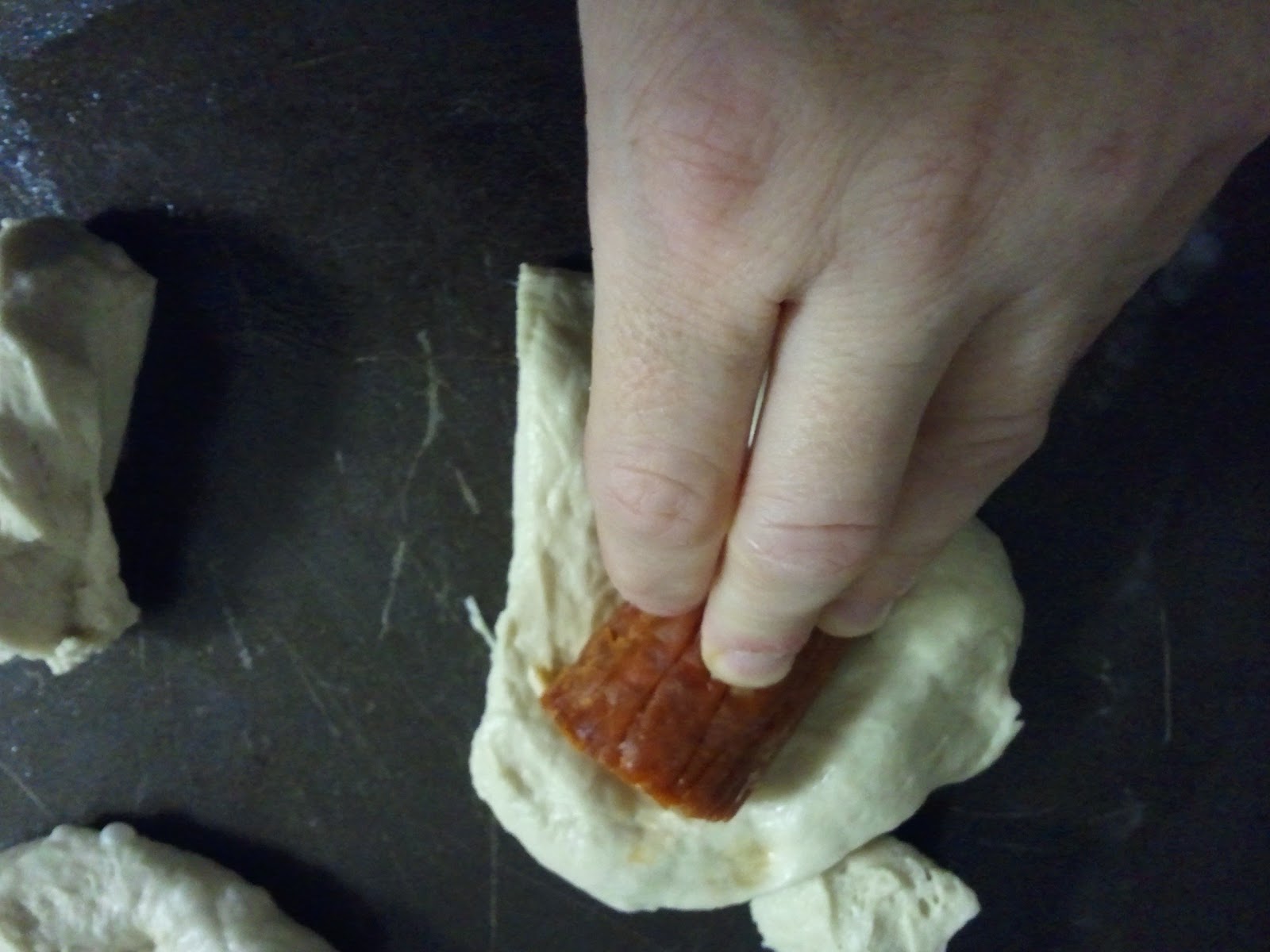

Meanwhile, thaw your bread dough and let it rise for at least an hour (I left it in a recently warmed oven, which aided the rising process).  Punch it a few times, cut it into enough pieces that you have one for each chunk of pepperoni.


Wrap the dough around the pepperoni, pinch the ends and let the rolls rise again until about doubled in size.


Bake at 300° for half an hour.


Notice that the greases from the pepperoni seep into the bread dough while baking (for that matter, before baking, too)


This is a filling and convenient snack.  I noticed when I bit into it that the pepperoni easily came out, so perhaps I would cut the pepperoni into smaller chunks next time for easier biting.  Heffner says that some people love smothering these in tomato sauce and melted mozzarella cheese, but I find it good as is.

- - - - -

Onward from West Virginia to our final foray into the Midwest proper, where fried cheese curds and beer brats await.  We'll be kickin' it Wisco-style in our armchair visit to Wisconisn.

Sources:

Corbin, JoAnn. "Pepperoni Rolls".  Date unknown.  In Bob Heffner, "Pepperoni Roll and Pepperoni Bread Recipes".  The Pepperoni Roll Homepage, 2002, 2011.


Heffner, Bob.  "What is a Pepperoni Roll?".  The Pepperoni Roll Homepage, 2002, 2011.

Heffner, Bob.  "The History of the Pepperoni Roll".  The Pepperoni Roll Homepage, 2002, 2011.

López-Alt, J. Kenji.  "Pickled Ramps."  Serious Eats, 2011.

Some information also obtained from Wikipedia's "West Virginia" page and other pages, and the Food Timeline State Foods link to "West Virginia".

Sunday, November 25, 2012

Snacking State-by-State: West Virginia I - How to pickle ramps when there are no ramps to pickle? (Or, "Pickled Garlic and Onions")

I'm the first to admit that I know blesséd little about the food of West Virginia.  This heartily Appalachian state does have some specific foods that you find all over Appalachia, and a few unique ones.  Some seem to fit both categories.  Take ramps, for example.  While you find them all over the eastern United States and Canada, West Virginia seems to have embraced them to the point that when you think of food in the Mountain State, you have to think of ramps.


Official Name: State of West Virginia
State Nickname: The Mountain State
Admission to the US: June 20, 1863 (#35)
Capital: Charleston (largest)
Other Important Cities: Huntington (2nd largest), Parkersburg (3rd largest), Morgantown (4th largest), Wheeling (5th largest)
Region: Appalachia, South, Northeast, Midwest; South Atlantic (US Census)
RAFT NationsChestnutMaple Syrup
Bordered by: Pennsylvania (northeast), Maryland (east), Virginia (southeast), Kentucky (southwest), Ohio (northwest)
Official State Foods and Edible Things: black bear (animal, though these are generally no longer eaten); brook trout (fish), Golden Delicious apple (fruit), honeybee (insect, for the honey) sugar maple (tree, for the sap), timber rattlesnake (reptile, though again, not really eaten)
Some Famous and Typical Foods: typical foods of Appalachia; apple butter; pepperoni rolls; pickled ramps; spoon bread


Ramps are in the onion family, a type of wild onion that grows in the spring.  Traditionally a part of spring recipes of the Upper South and of Québec, so Wikipedia notes, it is also known as wild leek or wild garlic.  Visually, I might describe it as the drag queen of wild onions: all green onion-like at the bottom with a dazzling green flare of garlicky leaves.  And West Virginia simply loves its ramps.  Sticking with the drag analogy for a bit, you find ramp festivals all over the state in the springtime, with ramp aficionados shantaying through a veritable party circuit of ramp kiki after ramp kiki. (Okay I promised myself I would never, ever use the word "kiki" in a sentence - pace, Scissor Sisters).

But as noted before, this wild onion, sadly, sashays away after spring.  Since I'm doing this post deep into the fall, obviously I'm not going to be finding any ramps for the next several months.

So this is a post about pickled onions and garlic instead.

Specifically, pickled onions I bought at the Waverly Farmers' Market, grown in the summer, picked in the fall and fresh waiting for me to immerse in a vinegar-sugar-salt solution.

There are lots of recipes for pickled ramps on the internet, for which I merely swapped out the long out-of-season ramps for the onions.  For good measure, I threw in some garlic, to help make the onions more garlicky, and to have some pickled garlic on hand to boot.  The recipe I used in the end: this recipe by J. Kenji López-Alt [2011] from the Serious Eats website.  I had to swap out red wine vinegar and white vinegar for the white wine vinegar, which I didn't bother to check that I had (I just assumed - remember what happens when you assume things).

The Recipe: Pickled Ramps, er, Onions and Garlic

For these pickled ramps-style pickled onions and garlic, gather the following:


* ramps - or since I didn't have access to ramps at this time of year, green onions (really any onion with small bulbs and green shoots still attached, but cleaned and trimmed; bought at the farmers' market for about $2.  I also added about four cloves of garlic, hopefully to make up for the lack of garlickiness from the lack of ramps)
* white wine vinegar (or since I did not have this, I combined white vinegar and red wine vinegar)
* sugar (had it)
* salt (I used pickling salt that I bought for those pickles from that Kansas post)
* red chile pepper flakes (from a dried chile I had)
* allspice berries (had this)
* bay leaves (had these too)
* whole mustard seeds (either yellow or black will do - had these too)

You should also have some clean jars to stuff them into.


First, clean and trim the onions.


Stuff the onions into your jars.


It doesn't have to be pretty.


Next, boil your vinegar...


...with your sugar, salt, chile flakes, allspice berries, mustard seeds and bay leaves.


Whisk and boil until the sugar and salt have dissolved into the vinegar.


Pour the solution into each jar, immersing the onions.  A canning funnel helps here.


Refrigerate for a few weeks.


These are nicely pungent onions that don't lose their crunch, and garlic that is still very sharp.  I'm already looking forward to spring, when I can get my hands on some actual ramps.  Now, sashay away.

Sources:

Corbin, JoAnn. "Pepperoni Rolls".  Date unknown.  In Bob Heffner, "Pepperoni Roll and Pepperoni Bread Recipes".  The Pepperoni Roll Homepage, 2002, 2011.


Heffner, Bob.  "What is a Pepperoni Roll?".  The Pepperoni Roll Homepage, 2002, 2011.

Heffner, Bob.  "The History of the Pepperoni Roll".  The Pepperoni Roll Homepage, 2002, 2011.

López-Alt, J. Kenji.  "Pickled Ramps."  Serious Eats, 2011.

Some information also obtained from Wikipedia's "West Virginia" page and other pages, and the Food Timeline State Foods link to "West Virginia".

Sunday, September 09, 2012

Snacking State-by-State: Tennessee III - This Cake Is STACKED!


The Appalachian Mountains extend from Newfoundland to Alabama, but the cultural region we think of as "Appalachia" (with a long or a short a) roughly stretches from Pennsylvania and West Virginia through to Alabama.  Tennessee runs smack dab in the middle of this, and you will find many Appalachian classics right in the Volunteer State.

Official Name: State of Tennessee
State Nickname: The Volunteer State
Admission to the US: June 1, 1796 (#16)
Capital: Nashville (2nd largest, but is the largest metropolitan area)
Other Important Cities: Memphis (largest), Knoxville (3rd largest), Chattanooga (4th largest)
Region: South, Middle South or Mid-South; East Central South (US Census)
RAFT NationsCornbread & BBQChestnut
Bordered by: North Carolina (east), Mississippi, Alabama & Georgia (south), Arkansas, Missouri & the Mississippi River (west), Kentucky (north), Virginia (northeast)
Official State Foods and Edible Things: bobwhite quail (game bird); channel catfish (commercial fish); Eastern box turtle (reptile); honeybee (agricultural insect, for the honey); raccoon (wild animal); smallmouth bass or bronzeback (sport fish); tomato (fruit - no, not vegetable)
Some Famous and Typical Foods: Southern foods, including fried chicken, cornbread and so on; Memphis style barbecue (both dry and wet); hot chicken (particular to Nashville); smoked hams; ham and red-eye gravy; Appalachian foods (Brunswick stew, stack cake, etc); anything eaten by Elvis (sure, not many Tennesseeans eat fried peanut butter and banana sandwiches, but "the King" would want me to mention it, no?)

The Smithsonian Center for Folklife and Heritage (2003) featured Appalachia as one of its featured cultures in its 2003 Folklife Festival.  The list of dishes from the region is lengthy, and some I didn't even realize were from Appalachia:
Stack cakes, shuck beans, chicken 'n' dumplings, soup beans, and fried apple pies-- important regional foods of Appalachia. Add biscuits and gravy, fried apples, chow chow, and gritted corn bread, and this food reveals roots in the cultures of Europe, Asia, [Native] America, and Africa...
...The Foxfire Book, published in 1972, was among the first to give wide national attention to Appalachian food including dried green beans or "leather britches," dried pumpkin, sauerkraut, pickled beets, souse or hog's head cheese, stew, watermelon pickles, and methods of preserving such as burying, bleaching, drying, distilling, and churning. In the mountains, communities began organizing street festivals to celebrate regional foods and established days or whole weeks to honor sorghum, apples, honey, ramps (a kind of wild garlic), maple syrup, dandelions, bean soup, fried chicken, bourbon, buckwheat, and even squirrels. [Smithsonian Center for Folklife and Heritage 2003]
Notice the very first thing they mention is "stack cake".  There are many recipes for this in Tennessee, Kentucky, West Virginia and so on. It typically features dried fruit or applesauce, and is almost as tedious to bake as Maryland's own Smith Island Cake.  What makes it "almost" as tedious is that you don't ice it; instead you only put rehydrated dried fruit in between the layers.

The version I made is a family recipe I found online from the Tennesse GenWeb (TNGenWeb.com) genealogy website, from its section titled "The Table of Our Ancestors, Old Time Southern Recipes".  The source for this Old Time Southern Recipe comes at the bottom:
Note: This is a very old recipe from the family of Hilda Marsh of Knoxville, Tennessee. Stack cakes were indigenous to the East Tennessee and Appalachian mountains. Apples were plentiful and, at least one [sic - at least one apple tree?], could be found on the farms and homesteads in the mountains. [TNGenWeb, date unknown]
I interpret this age old Marsh family recipe below for our final journey into Tennessee food.


The Recipe: Stack Cake


For this cake assemble the following:


 * flour (wow, I actually left out the flour from this photo. Duh.  You will need a lot of it - this recipe calls for six cups.  I used White Lily soft flour.
* shortening (here, Crisco.  I had this)
* dark brown sugar (I did not have this on hand; a box ran around $1.50)
* baking soda and baking powder (had both)
* molasses (had it but am now out; note to self: buy more molasses)
* egg (only one)
* buttermilk (about $2 for a pint from Harris Teeter)
* nutmeg and cinnamon (had both)
* vanilla (again, had to replenish it; bought a small bottle of the pure stuff.  Don't get the budget stuff that's watered down with corn syrup or water, and definitely avoid the "imitation" crap)
* salt (had it)
* dried apple slices (if you don't have this or it's too pricey - which it often is - many recipes suggest applesauce as an acceptable subsitute.  I bought about two 4.5 oz containers at Whole Foods, which surprisingly enough had them cheaper than anywhere else I could find them at $4 a container)


Before anything else, reconstitute the dried apples.  Water is good enough.  Soak for about an hour.


Cream the shortening and brown sugar together.  This killed the third-hand stand mixer I bought for $30.  I had to resort to my hand beater, which fared better.


Add your egg and vanilla and continue to beat.


Next add the molasses.


Here's where the ancient stand mixer started to go downhill: when I added the flour.  The recipe says to alternate between the remaining dry ingredients (flour, baking powder, baking soda, nutmeg - not the cinnamon, though honestly it won't hurt anything if you do add it - and salt) and the buttermilk.


Blend until thick.


Your dough will look something like this.  Divide it into six equal balls and roll each ball out onto a floured surface, thin enough to fit into an 8" cake pan.


Press each flattened ball into a cake pan.


Bake in a preheated 350°F oven for 15 minutes.


Turn out onto parchment paper if you have no other surface to lay them on, until you have baked all six of these.


Back to the apples.  Once soft enough, mix the apples with brown sugar and the cinnamon.


Now assemble the cake: put one layer on a plate, and spread a fifth of the apples on top.


Stack another layer on top of the apples and continue spreading apples and stacking layers until you use up all the apples.


Let the whole thing sit for a few hours or (better yet) overnight.
\

Cut and serve.


This cake falls apart easily if you aren't careful, but it is a filling and hearty, dark and rich, slightly dry cake.  This is a nice contrast with the moist apple mixture.  Eat a thin slice because it will fill you up fast.  It is delicious and worth the trouble you will go through to make it.  Not to mention the stand mixers that you go through.

- - - - -

We're heading west - southwest to be specific.  South by southwest to be pedantic.  Our next stop on this culinary tour is the biggest state in the South and the Southwest, a place known for big flavors and big steers.  A state that is pretty diverse in and of itself.  We're visiting the Lone Star State soon, with barbecue, chili, Tex-Mex and more.

Sources:


Bedell, Malcolm.  "Nashville Hot Chicken". Far Away: Cooking and Eating in Maine, posted April 3, 2012.  Copyright 2010-2012, FromAway.com  All rights reserved.

Jones, Justin.  Personal correspondence to Nashville Scene website.  Published in "Bites Exclusive: Winning Hot Chicken Recipe!" by Jim Ridley, Nashville Scene, posted July 31, 2008. Copyright 1995-2012, City Press LLC.  All rights reserved.

Neely, Gina, and Patrick Neely, with Paula Disbrowe.  Down Home with the Neelys: A Southern Family Cookbook.  Alfred A. Knopf: New York, NY, 2009.

Raichlen, Steve.  "Memphis Dry Rub Ribs".  Food & Wine Magazine website, 2012.  Copyright 1997 - 2012, American Express Publishing Corporation. All rights reserved.

Ridley, Jim.  "Bites Exclusive: Winning Hot Chicken Recipe!Nashville Scene, posted July 31, 2008. Copyright 1995-2012 City Press LLC.  All rights reserved.

Severson, Kim.  "Nashville’s Rising Stars: The Kitchen Is Their StudioNew York Times, published June 18, 2012.

Smithsonian Center for Folklife and Cultural Heritage.  "Appalachian Foods".  From "Appalachia: Heritage and Harmony" Resources Page for the 2003 Smithsonian Folklife Festival, 2003.  Copyright 2003 by the Smithsonian Instution.

Tennessee Gen Web (TNGenWeb.com). "Stack Cake".  From "The Table of Our Ancestors, Old Time Southern Recipes".  Family recipe from the family of Hilda Marsh, Knoxville, TN.  Date unknown.

Some information also obtained from Wikipedia's "Tennessee" page and other pages, and the Food Timeline State Foods link to "Tennessee".

Sunday, July 24, 2011

Snacking State-by-State: Kentucky II - Burgoo Me, Baby!

If the mint julep is the official drink of the Kentucky Derby, the official meal of Kentucky must be burgoo. People outside of Kentucky and the immediate area may not have any clue what this is, though there are variations by the same name in southern Indiana and Illinois. It is a close cousin to Brunswick stew, and is pretty darn hearty to say the least.

Official Name: Commonwealth of Kentucky
State Nickname: The Bluegrass State
Admission to the US: June 1, 1792 (#15)
Capital:
Frankfort (14th largest city)
Other Important Cities: Louisville (largest); Lexington (2nd); Bowling Green (3rd); Owensboro (4th)
Region:
Appalachia, South, Upper South; East South Central (US Census)
RAFT Nations: Cornbread & BBQ; Chestnut
Bordered by: Illinois, Indiana & Ohio (north); West Virginia (northeast); Virginia (east); Tennessee (south); Missouri & the Mississippi River (west)
Official State Foods and Edible Things: blackberry (fruit); gray squirrel (wild animal game species); Kentucky spotted bass (fish); milk (drink)
Some Famous & Typical Foods: common Southern foods; Kentucky-specific foods such as burgoo & Derby pie; fried chicken (though not "Kentucky Fried Chicken"); mint julep & Kentucky bourbon

Just like Indian pudding in New England, gumbo in the Gulf Coast and our own crab cake here in the Chesapeake, every family and community seems to have its own recipe for burgoo. To go back to Jean Anderson's book A Love Affair with Southern Cooking, while legends abound about the origin of burgoo - some say it came from as far away as Wales - many historians agree on the general facts:

[Most h]istorians... agree that burgoo was created during the Civil War by Gus Jaubert, a French chef serving Confederate general John Hunt Morgan. At war's end, Jaubert settled in Lexington, Kentucky, began making burgoo on a massive scale, and soon gained fame as "the burgoo king"... Jaubert's original recipe apparently contained blackbirds. Unable to say "blackbird stew" not only because French was his first language but also because he had a hairlip, Jaubert pronounced it "burgoo." Or so I [Jean Anderson] was told. Elsewhere I learned that those early burgoos contained mostly squirrels plus whatever vegetables came to hand. [Anderson 2007: 128]
Anderson goes on to note that she literally found hundreds of burgoo recipes. After my research, it seemed as if I had found about as many, with enough sheer variety that I just had no idea how to approach this project. Among the few common threads I found:

* Burgoo usually includes a few meats - this ain't vegan food here - and usually chicken is one of those meats. Mutton does not feature into all recipes, but many recipes specify mutton as one of those meats. Beef and/or pork also are common.
* Though no longer common, the early burgoos added all manner of game animals. Squirrel was, indeed, very popular, and you will still find it in a few modern recipes for it (No squirrel? Add chicken)
* Most recipes yield enough to feed a family reunion. Unless you want to cook for 20 people, you will need to pare down this recipe, which is what I did.
* This is not a quick thing to make. Food Network sent the ever-lovable Dave Lieberman down to Kentucky for his "In Search of Real Food" segment to see another massive burgoo-making operation in Owensboro for a Catholic Church function, and it wound up on YouTube:


After much hemming and hawing, I finally went with another Owensboro-based recipe for Kentucky burgoo - this from the Moonlite Inn in Owensboro. As they told NPR's "Hidden Kitchens" segment, it often featured chicken, mutton and various vegetables. I more or less followed Moonlite Inn's recipe, adding only beef and lima beans (which also pop up in many other recipes). And since I didn't have all day to make burgoo, and I didn't have a church full of people waiting for it, I went and cut the Moonlite Inn's recipe down to a quarter the size. The original makes about three gallons of the stuff.

The recipe: Kentucky Burgoo

To make the Moonlite Inn's Kentucky burgoo you will need more than a few ingredients:


* lamb meat (I bought about a pound for $6)
* chicken (I had this in the freezer - yes!)
* beef (not in the Moonlite Inn's recipe, but enough recipes have it that I wanted some in mine - about a half pound was $4, and I used half of that and froze the rest)
* cabbage and onion, ground up (I had the onion, and the half a head of cabbage, more than enough, was not much)
* a few potatoes, peeled (had those laying around)
* canned or fresh corn (not expensive)
* tomato ketchup, tomato purée, Worcestershire sauce and vinegar (had them)
* lemon juice (same)
* salt, pepper and cayenne (same)
* lima beans (half of an inexpensive one pound bag was good enough)
* water - lots of water

The one other modification I made to the Moonlite Inn recipe was to bust out the slow cooker for several of the steps. There are burgoo recipes for the slow cooker, but I didn't like the ones I saw.

Start with your mutton and beef. Moonlite says to cover them with water and cook for a few hours. This is one part that is well-suited to the slow cooker (I cooked them for 2 1/2 hours on low), where you can just leave the red meats to cook while you do other things.

When they are done cooking, take them out, cut away the meat from the bone and fat, and grind up the meat in your food processor.

While you are cooking the mutton, cook the chicken in a large pot on the stove, in lots of water, until tender.

When done, again remove bones and skin from the chicken, chop up the meat and set aside.

Grind up your onion and cabbage in the food processor...

...and add it to the chicken broth, along with the diced potatoes, the corn, ketchup and more water. Boil, and then add the meats and all other ingredients.

Here I transferred everything from the pot to the slow cooker, and set it too cook for another four hours, again on low.

I spread out the meats and felt for any missed gristle, most of which came from the lamb.

In go the contents from the stove.

Then the spices, Worcestershire and tomato paste

I added the lima beans unsoaked. Laugh, if you must, but after only four hours I kind of liked their unusually firm texture. Of course, you should soak them overnight, though for me it ruined nothing.

It needs to cook for a while so it can become thick. A burgoo is not a consommé after all. In fact, I was wondering as I made this why Chunky Soup hadn't commandeered a burgoo for one of its pready-made "soups that eat like a meal".

Serve with bread, biscuit, cracker or corn bread.


This is, indeed, quite the hearty stew. Everything blends nicely together - in fact, I would say the mutton, for my taste, blended a little too well with everything else since I couldn't find it too easily. It doesn't matter: as long a process as burgoo-making is, it is well worth the effort. Plus, with all the things you could add to it, I can see why each family seems to have its own recipe. Now when I eventually get to Brusnwick stew, I look forward to seeing just where the differences are. Bonus fact: on Kentucky Derby day, burgoo often follows that fabled mint julep as a first course, sometimes in the previous glass once it's empty.

From one end of the South to the other: the next state on my list is a state with one of the most famously unique and regional cuisines, unique not just in the US but within the South itself. Read on next week as I try my hand at Cajun food when I finally get to Louisiana.

Sources:

Anderson, Jean. A Love Affair with Southern Cooking: Recipes and Recollections. William Morrow: New York, 2007.

Beaumont Inn. "Recipe: How to Make the Perfect Mint Julep". Video "How to Make a Mint Julep" by Beaumont Inn, featuring Dixon Dedman. Video posted on YouTube by Beaumont Inn (user BeaumontInn) on May 24, 2010.

Hellmann's. "Owensboro Kentucky: Burgoo". From the In Search of Real Food YouTube Series with Dave Lieberman. Posted August 6, 2007.

National Public Radio. "Moonlite Burgoo and Mutton Dip". From the
"Hidden Kitchens" Series. Originally published November 5, 2004.

Lacabe, Marga. "Margarita's Appalachian Menu". Date unknown.

Maker's Mark. "Mint Julep Recipe". Reprinted on the Beaumont Inn website. Date unknown.

Moonlite Bar-B-Q Inn. "The Burgoo Soup Story / The Burgoo Recipe". Copyright 1996-2005 The Moonlite Bar-B-Q Inn, Inc.

Some information also obtained from Wikipedia's "Kentucky" page and other pages, and the Food Timeline State Foods link to "Kentucky".