Showing posts with label sausages. Show all posts

Wednesday, December 12, 2012

Snacking State-by-State: Wisconsin IV - There's a Brat in My Beer, and I'm Cryin' for You, Dear


My final Midwestern post takes us back to a food savored at millions of cookouts and tailgates all across America.  Mind you, Ohio fights for the glory, but Wisconsin insists on brushing them aside in the war of the bratwursts.  Perhaps but one can claim the mantle.


Official Name: State of Wisconsin
State Nickname: The Badger State
Admission to the US: May 29, 1848 (30th)
Capital: Madison (2nd largest)
Other Important Cities: Milwaukee (largest), Green Bay (3rd largest), Kenosha (4th largest), Racine (5th largest)
Region: Midwest, Upper Midwest, Great Lakes; East North Central (US Census)
RAFT NationsWild Rice
Bordered by: Minnesota (west); Lake Superior (northwest); Michigan (upper panhandle) (northeast); Lake Michigan (east); Illinois (south); Iowa (southwest)
Official State Foods and Edible Things: badger (animal, though these aren't typically eaten anymore); corn (grain); dairy cow (domesticated animal); honeybee (insect, for the honey); milk (beverage); muskellunge, or "muskie" (fish); sugar maple (tree, for the maple sap); white-tailed deer (wildlife animal)
Some Famous and Typical Foods: typical Midwestern cuisine; German, Central European and Scandinavian foods; dairy, especially cheese and fried cheese curds; Wisconsin-style fish boil (usually done on a massive scale for many people); beer brats (bratwurst cooked in beer and grilled, usually on a "Sheboygan roll", a typical bratwurst roll from the Midwest); beer, beer and more beer

For those of you who have been following this blog, or at least this series, I have already explored bratwurst.  Twice!  Both times were when I was exploring Ohio.  One was a simple pan-boiled brat, the other used bratwurst to make delicious fried balls of sauerkraut, Cleveland-style.  And yet, Sheboygan, Wisconsin, still claims to be the "Bratwurst Capital of the World".  I've already described bratwursts in the aforementioned posts, and that does include their tie to Wisconsin's identity.  They go together about as much as Wisconsin and cheese, or beer.  In fact, this Cheesehead trinity is so important that the very conservative Republican governor of Wisconsin Scott Walker invited angry Democrats to the Governor's Mansion after his recall attempt earlier this year and tried to smooth things over with beer, cheese and - of course - brats (Fulton 2012).  These people love their brats as much as some others in this country love their fish fries, clam bakes and steamed crab feasts.

Now while my friend Eric pointed out to me that people sometimes cook brats in a pan with water or beer, in the Upper Midwest they don't seem to prefer that method, if my research does not deceive me.  The folks at the Bratwurst Pages (2005), based in Wisconsin, have a whole collection of Bratwurst-related links, including the procedure for fixing brats the typical, correct way.  Of course, you need to grill it, and of course, I have no grill handy at the moment.  Fortunately Jonathan Croswell (2011) helps out on that score in his Livestrong.com article about how to cook brats in the oven when there is no grill available - long story short, broil 'em, setting them about five to seven inches away from the broiler.  I set mine as far away as I could.

The Bratwurst Pages people point out that a bratwurst is correctly eaten with various fixin's, from kraut to ketchup to mustard - but they are very specific to note that yellow mustard is an abomination.  Spicy brown mustard, however, works well.  Also note: you are not supposed to use hot dog rolls for these things.  They mention something called a "Sheboygan roll", a malty roll that is somewhat crisp on the outside and soft on the inside commonly found around the Bratwurst Capital of the World, but not at all found in my part of the country.  Trying to be un-abominable as possible, I eventually sought out non-baked club rolls from Harris Teeter, and baked them myself while the brats were cooking.  If you actually want to make some of these rolls, get thee to a homebrewing store (not like I hadn't gone recently) because you will need some malt extract.  I didn't feel like buying a whole container just for a roll I didn't have time to make anyway - malt extract ain't cheap - which led me to buy the club rolls.

The Recipe: Classic Wisconsin Beer Brats

To keep these as authentic as humanly possible, since we're not using the outdoor grill, assemble the following:


* bratwurst (Johnsonville, out of Sheboygan Falls, are a no-brainer for this Wisconsin-esque recipe.  Only $4 at Harris Teeter)
* onion (small to medium yellow one, had it)
* butter (had this too)
* beer (now I have tons of beer at home, but the beer I made in the last post was still in the fermenting process (as you can see in the picture above, the decanter is still sitting underneath my kitchen table), so instead I sought out a few bottles of Leinenkugel, based out of Chippewa Falls.  I still didn't have enough, so I used an extra bottle of Rolling Rock I had sitting in my pantry to top it off)
* club rolls (as noted above, do not use hot dog rolls.  Find Sheboygan rolls if you have them, but if you're outside of the Midwest you likely will not find them.  These unbaked club rolls cost about $3 at Harris Teeter)


Prepare your beer bath (ooooh, fun) by boiling together your beer and onions.  Some authentic recipes do not do this step, but others do and since I'm not grilling these outside I wanted to go this extra step.  I reserved half my beer and onion for this step, because the brats will sit in a beet-butter-onion bath after grilling as well.


If you go this route, boil your brats in the beer for about twenty minutes.  If you do not do this step, prepare the beer bath for the brats to sit in after grilling them.  You need to do that step regardless.


When they start looking like this (yes you should turn them), remove them and get ready to either grill them or...
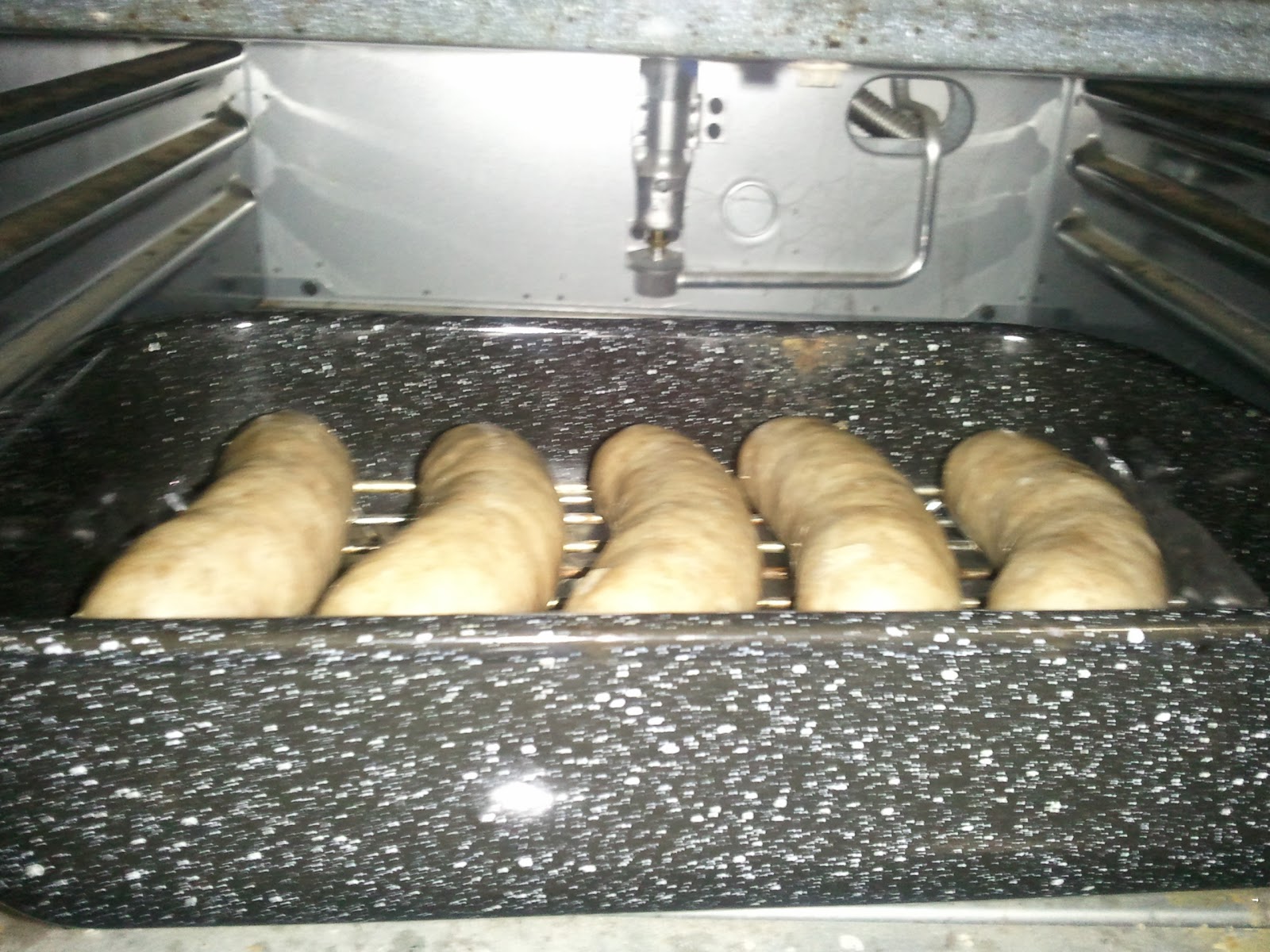

...place them under your preheated broiler.  If you can't grill for some reason you will want to set your broiler pan as far away from the flame as possible (five to seven inches is optimal).  Leave them there for about 10 minutes, with no pre-boiling, leave them there longer.  If grilling, leave them on for about 20 to 25.  You really have to guesstimate here.


While those brats are a-broilin', prep your second beer bath.


Add the rest of your chopped onion to the beer bath.


And then add your butter.


Melt everything together, and let your brats simmer in this liquid until ready to eat.  For this part, you really do leave them in there indefinitely, based on the recipe I saw.


Finally, bake your club rolls, or use pre-baked ones.  If you have bratwurst rolls, use those instead.


And now you're ready to build your bratwurst.


Typically, you put ketchup, sauerkraut, chopped onions and non-yellow mustard on your brat.


I used some of the chopped onions from the beer and butter bath, whole seed brown mustard and ketchup.


I can't say much about this.  It was a bratwurst.  It was juicy and delicious would have been a little messy were it not for the massive roll sopping up the juices and toppings.  I'm not used to bathing it in beer and butter of course, but I may use this method again when I do brats.

- - - - -

What a strange milestone: we are but one state away from the end of this long, loooooong series!  Or are we?  Once we're finished with Wyoming, our final destination, I will be making the rounds briefly just to re-explore the different regions of the country to see if I missed anything.  This I will be doing in ten - yes, ten - posts.  Then this State-by-State thing will truly be finished.  But I'm getting ahead of myself.  On to Big Sky Country!

Sources:

Beer Institute.  "State Per Capita Consumption 2003 to 2011" (PDF available).  Copyright 2012, All rights reserved.

Bostwick, William & Jessi Rymill.  Beer Craft: A Simple Guide to Making Great Beer.  Rodale: New York, 2011.

Bratwurst Pages.  "Classic Wisconsin Beer Brats".  Bratwurst Pages, 2003.  Copyright 2002, 2003 Bratwurst Pages, All rights reserved.

Croswell, Jonathan.  "How to Cook a Bratwurst in the Oven".  Livestrong, 2011.  Copyright 2011, 2012, All rights reserved.

Door County Today (YouTube channel: DoorCounty Today).  "History of the Door County Fish Boil".  Posted March 15, 2012.

Fisher, Joe and Dennis.  "Wild, Wild Rice!"  Brew Your Own, October 2000.

Fulton, April.  "Will Beer And Brats Break Through Wisconsin's Partisan Divide?"  The Salt: What's on Your Plate.  Posted June 12, 2012.  Copyright 2012 National Public Radio, All rights reserved.

Midwest Living.  "Wisconsin Fish Boil".  Midwest Living, 2012.  Copyright 2012 Meredith Corporation, All rights reserved.

Mr. Beer.  "Instructions, Premium/Deluxe Editions".  Copyright 2011 Catalina Products LLC, All rights reserved.

Spencer, James, and Steve Wilkes (YouTube channel: basicbrewing). "Basic Brewing Video - Doctoring Mr. Beer - January 7, 2012".  Posted January 7, 2012.

Splendid Table.  "Episode 487: The Japanese Grill", July 30, 2011, Segment 21:46 – 28:35 (William Bostwick talks home brewing).  Copyright 2011, 2012 American Public Media, All rights reserved.

Vics, Drew (YouTube channel: Cryptobrewology).  "Brewing Mr. Beer American Devil IPA".  Posted January 25, 2010.
Wisconsin Brewer's Guild.  "Wisconsin Brewer's Guild".  Copyright 2009-2012, All rights reserved.

Wisconsin Historical Society.  "Dictionary of Wisconsin History: Pabst Blue Ribbon beer advertisement, 1940 (WHi-56371)".  Copyright 1996-2012, All rights reserved.

Wisconsin Milk Marketing Board.  "Cookin' Up Wisconsin Curds".  Wisconsin Milk Marketing Board, 2012.  Copyright 2012, All rights reserved.


Wisconsin Milk Marketing Board.  "History of Wisconsin Cheese".  Wisconsin Milk Marketing Board, 2012.  Copyright 2012, All rights reserved.
Some information also obtained from Wikipedia's "Wisconsin" page and other pages, and the Food Timeline State Foods link to "Wisconsin".

Wednesday, November 28, 2012

Snacking State-by-State: West Virginia II - I know, it's odd - pepperoni is a land meat. But there it is!

When researching recipes for this post, I really had no idea what West Virginians ate, or what was particularly popular to eat there.  Apparently there is a savory treat that I had never even imagined would exist, particularly in Appalachia: the humble, spicy pepperoni roll.


Official Name: State of West Virginia
State Nickname: The Mountain State
Admission to the US: June 20, 1863 (#35)
Capital: Charleston (largest)
Other Important Cities: Huntington (2nd largest), Parkersburg (3rd largest), Morgantown (4th largest), Wheeling (5th largest)
Region: Appalachia, South, Northeast, Midwest; South Atlantic (US Census)
RAFT NationsChestnutMaple Syrup
Bordered by: Pennsylvania (northeast), Maryland (east), Virginia (southeast), Kentucky (southwest), Ohio (northwest)
Official State Foods and Edible Things: black bear (animal, though these are generally no longer eaten); brook trout (fish), Golden Delicious apple (fruit), honeybee (insect, for the honey) sugar maple (tree, for the sap), timber rattlesnake (reptile, though again, not really eaten)
Some Famous and Typical Foods: typical foods of Appalachia; apple butter; pepperoni rolls; pickled ramps; spoon bread

According to Bob Heffner's Pepperoni Roll Page [2002; 2011] - yes, a page for everything and to everything a page - the pepperoni roll originated sometime between 1927 and the 1940's at the Country Club Bakery in Fairmont.  He sides with the latter date, though he does note guide book author Jeannie Mozier goes with the earlier one.  What nobody disputes is the location.  It likely was invented by Italian-American Giuseppe Argiro, who passed his recipe on to his son.  It was simply chunks of pepperoni baked into small loaves of bread, and was a handy lunch for the many miners in the area.

Heffner [2002; 2011] describes the pepperoni roll in much more luscious tones than have I:
A pepperoni roll is a few thin slices of pepperoni baked in a soft, golden oval of slightly sweet dough, smaller than a dinner roll. They aren't 'bready' and they aren't tough and hard like pizza crust. Pepperoni grease seeps out of the ends of the roll as it's baked, leaving an orangish-red soft spot at either end. [Heffner 2002; 2011]
He also has many recipes on his page.  The one I used is perhaps the easiest one: Fairmont resident JoAnn Corbin's pepperoni roll just uses a stick of pepperoni and thawed bread dough you buy in the freezer section of the supermarket [in Heffner 2002; 2011].  It was also the first one listed on the page.

The Recipe: Pepperoni Roll

For Corbin's pepperoni roll, you will just need two things:


* one stick of pepperoni (about $5 at Giant)
* one pound of pre-frozen, thawed bread dough (the package was about $4, also at Giant.  I only noticed after the fact that both the pepperoni and the bread dough were made by the folks at Chicago-based Bridgford. They also have their own, pre-made pepperoni roll, but I don't want to be that lazy)


Peel your stick of pepperoni.


Cut the pepperoni into chunks of about two to three inches.


Meanwhile, thaw your bread dough and let it rise for at least an hour (I left it in a recently warmed oven, which aided the rising process).  Punch it a few times, cut it into enough pieces that you have one for each chunk of pepperoni.


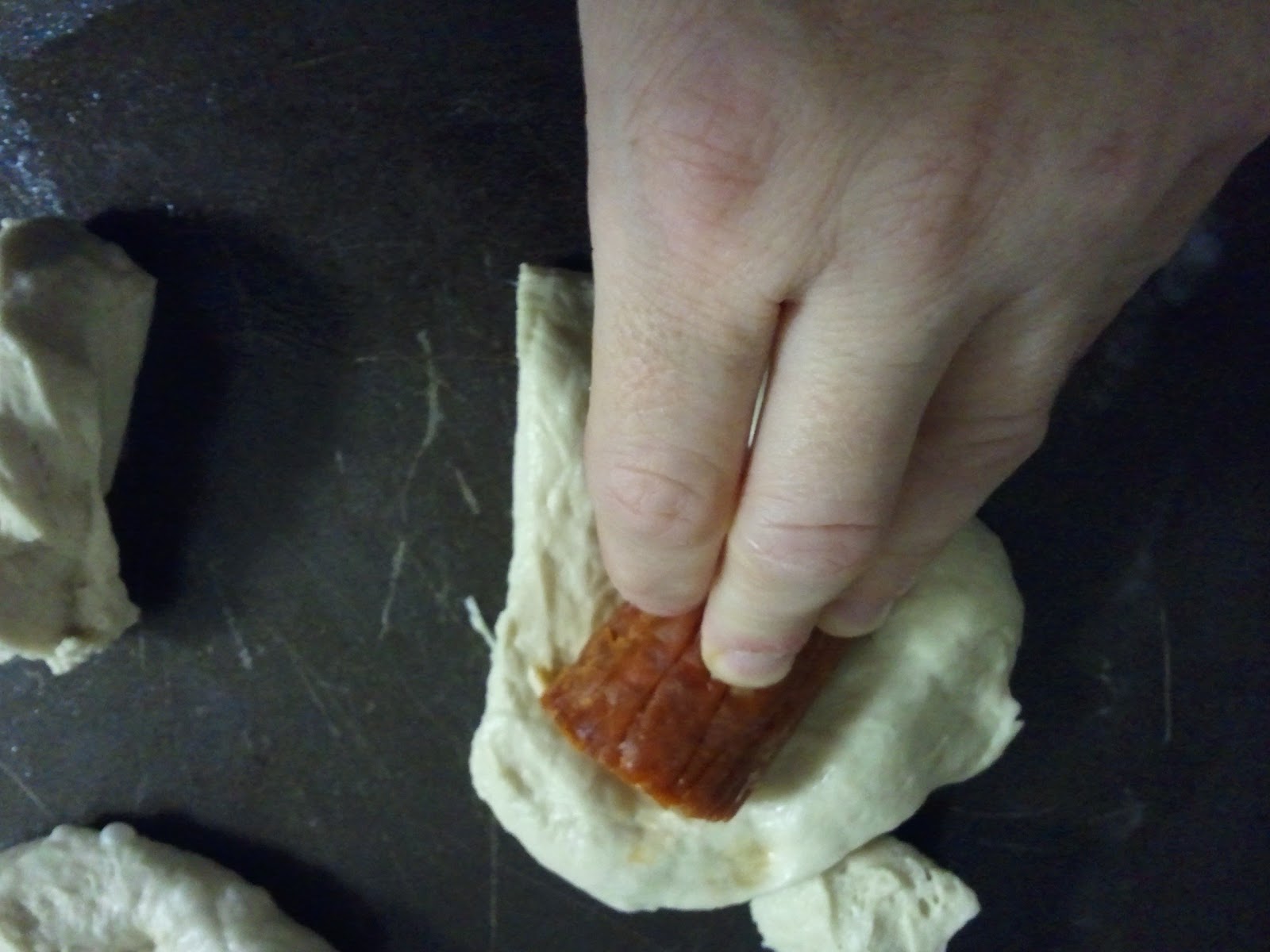
Wrap the dough around the pepperoni, pinch the ends and let the rolls rise again until about doubled in size.


Bake at 300° for half an hour.


Notice that the greases from the pepperoni seep into the bread dough while baking (for that matter, before baking, too)


This is a filling and convenient snack.  I noticed when I bit into it that the pepperoni easily came out, so perhaps I would cut the pepperoni into smaller chunks next time for easier biting.  Heffner says that some people love smothering these in tomato sauce and melted mozzarella cheese, but I find it good as is.

- - - - -

Onward from West Virginia to our final foray into the Midwest proper, where fried cheese curds and beer brats await.  We'll be kickin' it Wisco-style in our armchair visit to Wisconisn.

Sources:

Corbin, JoAnn. "Pepperoni Rolls".  Date unknown.  In Bob Heffner, "Pepperoni Roll and Pepperoni Bread Recipes".  The Pepperoni Roll Homepage, 2002, 2011.


Heffner, Bob.  "What is a Pepperoni Roll?".  The Pepperoni Roll Homepage, 2002, 2011.

Heffner, Bob.  "The History of the Pepperoni Roll".  The Pepperoni Roll Homepage, 2002, 2011.

López-Alt, J. Kenji.  "Pickled Ramps."  Serious Eats, 2011.

Some information also obtained from Wikipedia's "West Virginia" page and other pages, and the Food Timeline State Foods link to "West Virginia".

Sunday, April 15, 2012

Snacking State-by-State: Ohio III - The Sausage of Champions

Wisconsinites will proudly tout the bratwurst as their own - the well-known Johnsonville brats hail from Sheboygan, a city which proclaims itself to be the "Bratwurst Capital of the World".  But don't tell that to the residents of Bucyrus, Ohio, which touts itself as the "Bratwurst Capital of America".  Every August their Bratwurst Festival celebrates the Midwest's favorite German sausage, with arts, crafts, parades and (presumably) more than a few different preparations of bratwurst.

Official Name: State of Ohio
State Nicknames: The Buckeye State, The Mother of Presidents
Admission to the US: March 1, 1803 (#17)
Capital: Columbus (largest)
Other Important Cities: Cleveland (2nd largest), Cincinnati (3rd largest), Toledo (4th largest), Akron (5th largest)
Region: Midwest, Great Lakes; East North Central (US Census)
RAFT NationsMaple SyrupWild RiceChestnutCorn Bread & BBQ
Bordered by: Lake Erie (north); Michigan (northwest); Indiana (west); Ohio River (south); Kentucky (southwest); West Virginia (southeast); Pennsylvania (east)
Official State Foods and Edible Things: white-tailed deer (mammal), tomato (fruit), pawpaw (native fruit), tomato juice (beverage)
Some Famous and Typical Foods: typical Midwestern foods; city chicken (no longer common); ethnic European foods, particularly German (bratwurst, German potato salad, sauerkraut) & Amish foods, Polish, Italian and Irish; buckeye candies; Shaker lemon pie; Cincinnati chili, sauerkraut balls and (again) bratwurst

I have not eaten many brats in my life.  I admit that.  And yes, Midwesterners will gasp - gasp, I tells ya (sorry, y'all)!  I think my first one was in California, of all places, when a fellow grad student invited a bunch of us over to her house.  She was from Columbus originally, and was grilling up some brats outside in the warm Inland Empire air.  It was good, but I still hadn't gotten around to eating many more after this.

Fast forward to today, and I still haven't eaten many of these things.  It's something I will need to do more of, as I hadn't realized what I was missing.  But I wasn't sure exactly how to make these.  Again I turned to Eric, my Columbus born-and-raised ethnographic source on all things Ohioan.  He told me in preparation for this post that if you're not grilling them outside - which is what one typically does - you might cook them in a pan on the stove, usually in beer or water.  Sounds simple enough.  And it was one of those few times where it actually was as simple as it sounded.

The Recipe: Bratwurst

To prepare brats on the stove in this fashion, you will need:


* bratwurst (I got Johnsonville's Beer 'n Bratwurst version for about $5 at Harris Teeter)

I decided to be lazy, and instead of opening a bottle of beer I cooked these in water.  Next time I'll use beer.  Okay, honestly it wasn't really all laziness. I had to leave in an hour or two and I knew I would drink a good bit of that beer if I opened it.  So in the interest of safe driving, I held off on the beer.


Place the uncooked brats in water in a pan on the stove.  Fill the pan with enough water - or beer - to just barely cover the brats.  As you can see, there are already bits of things in the pan.  I cooked these brats while in the middle of another recipe (coming up next).  I figured it wouldn't hurt.

Here is the easy part: simmer, don't boil the brats until the water reduces down.  Once it does, they should be cooked through.


I was not quite sure how to eat them or with what.  I didn't ask Eric this.  But apparently people in Wisconsin get extremely particular about how to prepare and serve their brats.  I'm not quite sure if the same can be said for Ohio.  When I explore Wisconsin food (sometime around the end of the year) I will come back to bratwurst and see just how they do it up in the Badger State.  Apparently, at the very least, you eat them on bratwurst rolls with a non-yellow mustard (and not with ketchup either).  I ate them nekkid (the bratwursts were nekkid, I mean).

There are so many ways to prepare bratwurst.  Even though I realized they could be an ingredient in many recipes, it didn't dawn on me just how versatile the bratwurst actually is.  I explore what else to do with this delicious sausage in my next post.

Sources:

Adams, Marcia. Heartland: The Best of the Old and the New from Midwest Kitchens. Clarkson Potter: New York, 1991.

Christina (blog author).  "Sauerkraut Balls".  Sweet Pea's Kitchen, posted February 5, 2012.  Copyright 2010-2012 Sweet Pea's Kitchen, all rights reserved.

Lowe, Cliff.  "The Life and Times of Chili Cincinnati Chili - Part Two" [sic].  In Mama's Kitchen, date unknown.  Copyright 2012 In Mama's Kitchen, all rights reserved.

"Ohio's Favorite: Buckeye Candy Recipe".  Recipe postcard, date unknown.

University of Akron Press.  "Akronisms: Sauerkraut Balls".  An Akronism, posted June 9, 2010.  Copyright 2012 University of Akron Press, all rights reserved.

Some information also obtained from Wikipedia's "Ohio" page and other pages, and the Food Timeline State Foods link to "Ohio".

Special thanks to Eric Randolph for making the buckeyes with me, for offering the use of his kitchen, and for giving me his advice in making buckeye candy and in preparing bratwurst.

Saturday, September 13, 2008

Assault with a Deadly Pepperoni

This weirdness from the Fresno Bee in Fresno, California: a man broke into the house of two men, and attacked them - with food. Antonio Vásquez rubbed spices into one man's face, and smacked the other man with an 8 ft. sausage. Vásquez also apparently stole $900. Police found him in a field in just his underwear, but they only held him for a few days since they had no hard evidence to charge him with. Personally, I would think the spices on his fingers would be evidence enough!

On an unrelated note, I've met people who are into that sort of thing.