Showing posts with label German. Show all posts

Wednesday, December 12, 2012

Snacking State-by-State: Wisconsin IV - There's a Brat in My Beer, and I'm Cryin' for You, Dear


My final Midwestern post takes us back to a food savored at millions of cookouts and tailgates all across America.  Mind you, Ohio fights for the glory, but Wisconsin insists on brushing them aside in the war of the bratwursts.  Perhaps but one can claim the mantle.


Official Name: State of Wisconsin
State Nickname: The Badger State
Admission to the US: May 29, 1848 (30th)
Capital: Madison (2nd largest)
Other Important Cities: Milwaukee (largest), Green Bay (3rd largest), Kenosha (4th largest), Racine (5th largest)
Region: Midwest, Upper Midwest, Great Lakes; East North Central (US Census)
RAFT NationsWild Rice
Bordered by: Minnesota (west); Lake Superior (northwest); Michigan (upper panhandle) (northeast); Lake Michigan (east); Illinois (south); Iowa (southwest)
Official State Foods and Edible Things: badger (animal, though these aren't typically eaten anymore); corn (grain); dairy cow (domesticated animal); honeybee (insect, for the honey); milk (beverage); muskellunge, or "muskie" (fish); sugar maple (tree, for the maple sap); white-tailed deer (wildlife animal)
Some Famous and Typical Foods: typical Midwestern cuisine; German, Central European and Scandinavian foods; dairy, especially cheese and fried cheese curds; Wisconsin-style fish boil (usually done on a massive scale for many people); beer brats (bratwurst cooked in beer and grilled, usually on a "Sheboygan roll", a typical bratwurst roll from the Midwest); beer, beer and more beer

For those of you who have been following this blog, or at least this series, I have already explored bratwurst.  Twice!  Both times were when I was exploring Ohio.  One was a simple pan-boiled brat, the other used bratwurst to make delicious fried balls of sauerkraut, Cleveland-style.  And yet, Sheboygan, Wisconsin, still claims to be the "Bratwurst Capital of the World".  I've already described bratwursts in the aforementioned posts, and that does include their tie to Wisconsin's identity.  They go together about as much as Wisconsin and cheese, or beer.  In fact, this Cheesehead trinity is so important that the very conservative Republican governor of Wisconsin Scott Walker invited angry Democrats to the Governor's Mansion after his recall attempt earlier this year and tried to smooth things over with beer, cheese and - of course - brats (Fulton 2012).  These people love their brats as much as some others in this country love their fish fries, clam bakes and steamed crab feasts.

Now while my friend Eric pointed out to me that people sometimes cook brats in a pan with water or beer, in the Upper Midwest they don't seem to prefer that method, if my research does not deceive me.  The folks at the Bratwurst Pages (2005), based in Wisconsin, have a whole collection of Bratwurst-related links, including the procedure for fixing brats the typical, correct way.  Of course, you need to grill it, and of course, I have no grill handy at the moment.  Fortunately Jonathan Croswell (2011) helps out on that score in his Livestrong.com article about how to cook brats in the oven when there is no grill available - long story short, broil 'em, setting them about five to seven inches away from the broiler.  I set mine as far away as I could.

The Bratwurst Pages people point out that a bratwurst is correctly eaten with various fixin's, from kraut to ketchup to mustard - but they are very specific to note that yellow mustard is an abomination.  Spicy brown mustard, however, works well.  Also note: you are not supposed to use hot dog rolls for these things.  They mention something called a "Sheboygan roll", a malty roll that is somewhat crisp on the outside and soft on the inside commonly found around the Bratwurst Capital of the World, but not at all found in my part of the country.  Trying to be un-abominable as possible, I eventually sought out non-baked club rolls from Harris Teeter, and baked them myself while the brats were cooking.  If you actually want to make some of these rolls, get thee to a homebrewing store (not like I hadn't gone recently) because you will need some malt extract.  I didn't feel like buying a whole container just for a roll I didn't have time to make anyway - malt extract ain't cheap - which led me to buy the club rolls.

The Recipe: Classic Wisconsin Beer Brats

To keep these as authentic as humanly possible, since we're not using the outdoor grill, assemble the following:


* bratwurst (Johnsonville, out of Sheboygan Falls, are a no-brainer for this Wisconsin-esque recipe.  Only $4 at Harris Teeter)
* onion (small to medium yellow one, had it)
* butter (had this too)
* beer (now I have tons of beer at home, but the beer I made in the last post was still in the fermenting process (as you can see in the picture above, the decanter is still sitting underneath my kitchen table), so instead I sought out a few bottles of Leinenkugel, based out of Chippewa Falls.  I still didn't have enough, so I used an extra bottle of Rolling Rock I had sitting in my pantry to top it off)
* club rolls (as noted above, do not use hot dog rolls.  Find Sheboygan rolls if you have them, but if you're outside of the Midwest you likely will not find them.  These unbaked club rolls cost about $3 at Harris Teeter)


Prepare your beer bath (ooooh, fun) by boiling together your beer and onions.  Some authentic recipes do not do this step, but others do and since I'm not grilling these outside I wanted to go this extra step.  I reserved half my beer and onion for this step, because the brats will sit in a beet-butter-onion bath after grilling as well.


If you go this route, boil your brats in the beer for about twenty minutes.  If you do not do this step, prepare the beer bath for the brats to sit in after grilling them.  You need to do that step regardless.


When they start looking like this (yes you should turn them), remove them and get ready to either grill them or...
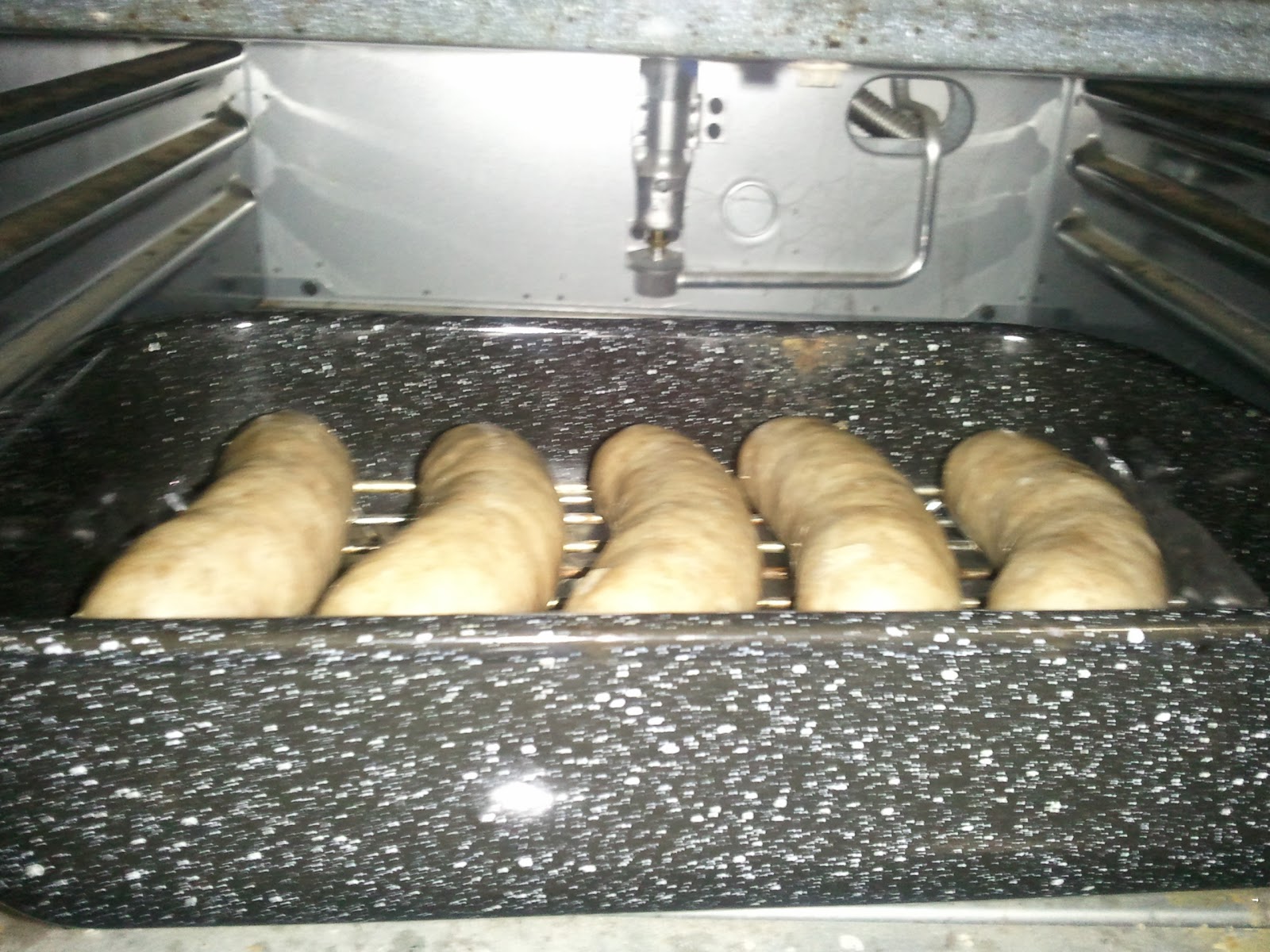

...place them under your preheated broiler.  If you can't grill for some reason you will want to set your broiler pan as far away from the flame as possible (five to seven inches is optimal).  Leave them there for about 10 minutes, with no pre-boiling, leave them there longer.  If grilling, leave them on for about 20 to 25.  You really have to guesstimate here.


While those brats are a-broilin', prep your second beer bath.


Add the rest of your chopped onion to the beer bath.


And then add your butter.


Melt everything together, and let your brats simmer in this liquid until ready to eat.  For this part, you really do leave them in there indefinitely, based on the recipe I saw.


Finally, bake your club rolls, or use pre-baked ones.  If you have bratwurst rolls, use those instead.


And now you're ready to build your bratwurst.


Typically, you put ketchup, sauerkraut, chopped onions and non-yellow mustard on your brat.


I used some of the chopped onions from the beer and butter bath, whole seed brown mustard and ketchup.


I can't say much about this.  It was a bratwurst.  It was juicy and delicious would have been a little messy were it not for the massive roll sopping up the juices and toppings.  I'm not used to bathing it in beer and butter of course, but I may use this method again when I do brats.

- - - - -

What a strange milestone: we are but one state away from the end of this long, loooooong series!  Or are we?  Once we're finished with Wyoming, our final destination, I will be making the rounds briefly just to re-explore the different regions of the country to see if I missed anything.  This I will be doing in ten - yes, ten - posts.  Then this State-by-State thing will truly be finished.  But I'm getting ahead of myself.  On to Big Sky Country!

Sources:

Beer Institute.  "State Per Capita Consumption 2003 to 2011" (PDF available).  Copyright 2012, All rights reserved.

Bostwick, William & Jessi Rymill.  Beer Craft: A Simple Guide to Making Great Beer.  Rodale: New York, 2011.

Bratwurst Pages.  "Classic Wisconsin Beer Brats".  Bratwurst Pages, 2003.  Copyright 2002, 2003 Bratwurst Pages, All rights reserved.

Croswell, Jonathan.  "How to Cook a Bratwurst in the Oven".  Livestrong, 2011.  Copyright 2011, 2012, All rights reserved.

Door County Today (YouTube channel: DoorCounty Today).  "History of the Door County Fish Boil".  Posted March 15, 2012.

Fisher, Joe and Dennis.  "Wild, Wild Rice!"  Brew Your Own, October 2000.

Fulton, April.  "Will Beer And Brats Break Through Wisconsin's Partisan Divide?"  The Salt: What's on Your Plate.  Posted June 12, 2012.  Copyright 2012 National Public Radio, All rights reserved.

Midwest Living.  "Wisconsin Fish Boil".  Midwest Living, 2012.  Copyright 2012 Meredith Corporation, All rights reserved.

Mr. Beer.  "Instructions, Premium/Deluxe Editions".  Copyright 2011 Catalina Products LLC, All rights reserved.

Spencer, James, and Steve Wilkes (YouTube channel: basicbrewing). "Basic Brewing Video - Doctoring Mr. Beer - January 7, 2012".  Posted January 7, 2012.

Splendid Table.  "Episode 487: The Japanese Grill", July 30, 2011, Segment 21:46 – 28:35 (William Bostwick talks home brewing).  Copyright 2011, 2012 American Public Media, All rights reserved.

Vics, Drew (YouTube channel: Cryptobrewology).  "Brewing Mr. Beer American Devil IPA".  Posted January 25, 2010.
Wisconsin Brewer's Guild.  "Wisconsin Brewer's Guild".  Copyright 2009-2012, All rights reserved.

Wisconsin Historical Society.  "Dictionary of Wisconsin History: Pabst Blue Ribbon beer advertisement, 1940 (WHi-56371)".  Copyright 1996-2012, All rights reserved.

Wisconsin Milk Marketing Board.  "Cookin' Up Wisconsin Curds".  Wisconsin Milk Marketing Board, 2012.  Copyright 2012, All rights reserved.


Wisconsin Milk Marketing Board.  "History of Wisconsin Cheese".  Wisconsin Milk Marketing Board, 2012.  Copyright 2012, All rights reserved.
Some information also obtained from Wikipedia's "Wisconsin" page and other pages, and the Food Timeline State Foods link to "Wisconsin".

Sunday, July 29, 2012

Snacking State-by-State: South Dakota II - If you can't stand the cake, get into the kuchen

South Dakota is one of the few states with its own official state dessert, cake.  Or should I say kuchen, which is German for "cake".  With its large German American population, South Dakota's specifically German cake should be of little surprise as an official dessert.

Official Name: State of South Dakota
State Nickname: The Mount Rushmore State
Admission to the US: November 2, 1889 (#40)
Capital: Pierre (8th largest)
Other Important Cities: Sioux Falls (largest), Rapid City (2nd largest), Aberdeen (3rd largest)
Region: Midwest, Great Plains; West North Central (US Census)
RAFT Nations: BisonPinyon Nut
Bordered by: North Dakota (north), Minnesota (east), Nebraska (south), Wyoming & Montana (west)
Official State Foods and Edible Things: fry bread (bread), honey bee (insect, for the honey), kuchen (dessert), milk (drink), ring-necked pheasant (bird), walleye (fish), Western wheat grass (grass, though I imagine few people drink the wheat grass concoctions popular with health nuts elsewhere in the country),
Some Famous and Typical Foods: Native American foods, especially those of the Great Plains (wojapi, fry bread, Bannock bread, and so on, as well as traditional foods such as pemmican and wahuwapa wasna); German and Eastern European foods, including kuchen & chislic 

South Dakota officially made kuchen the official state dessert in 2000, after a hard fought (okay, maybe not that hard, but quite delicious) struggle the previous legislative session.  In his article "Cookin' Kuchen", Trevor Guthmiller - as referenced by the North Dakota State University Library's "Germans from Russia Heritage Collection" - points out that kuchen was an important part of South Dakota culture long before that.

German immigrants brought kuchen to South Dakota in the 1880s. Homesteaders often brought very little with them besides their clothes, basic tools, self- sufficiency and a determination to face the challenges that a rough and unsettled South Dakota threw at them...Many came directly from Germany, others most recently from Russia. Their hard work and agricultural prowess turned McPherson County [where many settled] into one of the largest wheat- producing areas in the country... 
To understand why kuchen is such a staple in McPherson County, you must understand the heritage of the people who live there. In 1990, 2,758 residents [the single largest ethnic group in the county] listed their primary ancestry as German... Eureka holds a Schmeckfest every fall, and Leola celebrates Rhubarb Day every other July, and kuchen is prominently featured in those events. There aren’t many lutefisk feeds in this part of the state; it’s a kuchen- eatin’ crowd if there ever was one. [Guthmiller 2004]
There are many different varieties of kuchen: those based on fruits, on cottage cheese, on cream cheese, on a streussel-type filling, and so on.  So it must have been a difficult choice to pick one to be the state's official dessert.  The one that was put in place: the apple and cream cheese kuchen.  The South Dakota state government [South Dakota Secretary of State Office 2007: 14] even prints the complete "official state recipe" in a government publication.  Good luck getting them to do that in Annapolis for Smith Island cake.

The recipe I interpret below is the official kuchen recipe of the state of South Dakota, on page 14 of the 2007 South Dakota Legislative Manual.  Since this is a government publication, I could copy and quote the recipe word for word, but you can look it up yourself.

The Recipe: Kuchen


For the official South Dakota kuchen recipe assemble the following:

For the crust, you will need:

* regular flour (have it)
* sugar (same)
* salt (yup, have that, too)
* vanilla (got it)
* butter (this I would have had, were it not for that wretched derecho that knocked out power in my neighborhood - and many neighborhoods throughout the Mid-Atlantic - for at least five whole days.  Another $2 for some new butter.  This should be cold but it worked fine at room temperature for me),

For the cream cheese filling that goes on top of the crust, you will need:

* more vanilla and sugar
* cream cheese (a pound, or two blocks, each about $2 at Harris Teeter)
* an egg (at room temperature - this also had to be replaced thanks to that damn storm)


And for the apple topping, you will also need

* still more sugar
* cinnamon (had it)
* and, of course, apples (I got three Granny Smiths for about $2 total)


Mix together the dry ingredients for your crust.  Use a mixer or just a spoon.


Cut in the butter and add the vanilla.


And press the dough into a lightly greased 9" x 13" pan.  Put in a preheated 450°F oven for about 15 minutes.  When done, take out and cool it down, also reducing your oven to 400°F.


While the crust is baking, peel, core and thinly slice your apples and set aside.


Mix together your filling ingredients, apart from the egg, again with a mixer or a spoon.


Add the egg...


...and mix thoroughly.


Pour the filling over the baked crust and spread out evenly.


Next, mix together your sugar and cinnamon.


Arrange the apple slices over the filling as tightly as possible.  Although I cut up three apples, I could barely fit half of the slices on top.


 Cover with the cinnamon and sugar, and bake for 20 minutes.


With as many components as this recipe has, it is easier than it seems.  It's best served cold I find, and easier to cut for that matter.  The apples are still a little crunchy and the cream cheese is a nice, sweet complement to them.  Now just imagine all the other recipes for kuchen I could have done!

- - - - -

Now we're done with South Dakota, and it's time to head southward to the home of of bluegrass, Memphis BBQ and the one and only Miss Dolly Parton!  We are ringing the bell(e)s of Tennessee next week!

Sources:

Globetrotter (TastyKitchen.com user).  "Chislic (South Dakota Treat)".  Posted January 21, 2011.  © Copyright 2006-2012, The Pioneer Woman (Ree Drummond). All rights reserved.

Guthmiller, Trevor T. "Cookin’ Kuchen: Naming a German Pastry the State Dessert Adds Spice to Life in McPherson County".  South Dakota Magazine, February 2004, 58-61.  Posted on the "Germans from Russia Heritage Collection" website (North Dakota State University Library).

Johnson, Laura. "Viborg's Pancake Balls".  South Dakota Magazine.com.  Posted June 21, 2012.  Copyright 2012 South Dakota Magazine.  All rights reserved.

McSpaden, Cheri. "There’s not much to chislic".  The Holland (Michigan) Sentinel website (HollandSentinel.com). Posted December 1, 2008.  Copyright 2012 The Holland Sentinel.  All rights reserved.

Preheim, Rich.  "The Chislic Circle".  South Dakota Magazine.com.  Originally printed in the July/August 2005 issue of the print issue of the Magazine.  Copyright 2012 South Dakota Magazine.  All rights reserved.

South Dakota Magazine.  "What We Eat.  How We Eat.  Who We Are."  South Dakota Magazine.com (posted on the magazine's blog).  Posted August 26, 2010.  Copyright 2012 South Dakota Magazine.  All rights reserved.

State of South Dakota. "Chapter 1" of the 2007 South Dakota Legislative Manual.  Copyright 2007, State of South Dakota.

Some information also obtained from Wikipedia's "South Dakota" page and other pages, and the Food Timeline State Foods link to "South Dakota".

Tuesday, April 17, 2012

Snacking State-by-State: Ohio IV - I can't wait to get my mouth around those sauer-y balls.

In a part of the country that is so German in its heritage there's a lot of German food: German potato salad, German sausages, German sauerkraut, etcetera.  As noted in the previous post, the very German bratwurst is popular in Ohio as in Wisconsin.  It can be used as ingredients in a variety of dishes.  So can sauerkraut for that matter.  While I don't know if Ohioans eat sauerkraut at Thanksgiving as a side, as is fairly common in Baltimore, they certainly use it in a whole other variety of ways.  They put it in cakes.  They feature it in main dishes.  Hell, they even roll it into balls and fry it.  Because in America, you can fry anything, dammit!


Official Name: State of Ohio
State Nicknames: The Buckeye State, The Mother of Presidents
Admission to the US: March 1, 1803 (#17)
Capital: Columbus (largest)
Other Important Cities: Cleveland (2nd largest), Cincinnati (3rd largest), Toledo (4th largest), Akron (5th largest)
Region: Midwest, Great Lakes; East North Central (US Census)
RAFT NationsMaple SyrupWild RiceChestnutCorn Bread & BBQ
Bordered by: Lake Erie (north); Michigan (northwest); Indiana (west); Ohio River (south); Kentucky (southwest); West Virginia (southeast); Pennsylvania (east)
Official State Foods and Edible Things: white-tailed deer (mammal), tomato (fruit), pawpaw (native fruit), tomato juice (beverage)
Some Famous and Typical Foods: typical Midwestern foods; city chicken (no longer common); ethnic European foods, particularly German (bratwurst, German potato salad, sauerkraut) & Amish foods, Polish, Italian and Irish; buckeye candies; Shaker lemon pie; Cincinnati chili, sauerkraut balls and (again) bratwurst

Yes, in Ohio they fry balls of sauerkraut.  Not everywhere in the state: this is specifically a Cleveland and Akron thing.  This is probably why my friend Eric, a Columbus native, has never heard of them.  According to the University of Akron Press' An Akronism blog [2010], the sauerkraut ball originates in "the ethnic cuisine of Northeast Ohio" and includes various other goodies, like onion and some kind of meat - pork, beef, or just break up an uncooked bratwurst, since people in Ohio love them so much.

Hey, I have some extra brats.  Why not put them to good use?

The Recipe: Sauerkraut Balls

While the An Akronism blog has a recipe included in its sauerkraut balls post, the recipe I ended up using comes from Christina at the Sweet Pea's Kitchen blog [2012], whose recipe is a Columbus-based version of the recipe.  She tries to recreate those sauerkraut balls she remembers from Columbus' Schmidt's Sausage Haus.  I have no idea if this is similar to the sauerkraut balls they eat in the northeastern part of the state.

For these sauerkraut balls you will need:


* sauerkraut (I had some in the pantry, which saved me the extra expense of buying more.  Make sure you drain it completely and chop it finely)
* pork (in this case, I ripped open two bratwursts, which I bought for the previous post)
* sweet onion (about $1.50 per lb, or 75¢ for one)
* yellow mustard (had it)
* garlic salt (or in my case, garlic powder, which is what I had)
* black pepper (had it)
* parsley (had it dried)
* cream cheese (an 8 oz tub was about $2.50)
* flour (had it)
* egg (same)
* milk (same)
* bread crumbs (had more than a few in the freezer.  Also wound up using some Italian bread crumbs, and I have a good bit of matzah meal from that New York post on matzah ball soup)
* vegetable oil (for frying)


Chop your onion finely.  I found it easier to just grate some off.
\

Throw that into a pan with your crumbled up bratwurst (or other meat)


Meanwhile, squeeze the liquid out of that sauerkraut, lest you have soggy, schweddy balls.


Chop the drained sauerkraut finely and throw into a bowl...


...with your onion-meat mixture.


Mix together...


...and add the black pepper, garlic powder and mustard.


In a separate bowl mix the cream cheese and parsley.


Add to the rest of the mixture and mix well.


Put in the fridge for at least an hour to chill.  This will make it easier to form your balls.


When ready, heat the oil to deep frying temperature, and get your dipping station ready: in three bowls put your flour, your egg and milk, and your bread crumbs.


Oh yeah, for the sauerkraut mixture into balls.  You need something to dip, right?


First, dip each sauerkraut ball into the flour.


Next, dip into your egg and milk mixture.


Finally, roll it in the bread crumbs.


I ran out of the bread crumbs I had in the freezer, so I busted out some finer ones from the pantry.  These looked better, but I did like the bigger chunks of bread from the other kind.


Fry for about two to three minutes.


Drain on paper towels and serve hot, preferably with a spicy or whole-grain mustard.


These were addictive little things: the pungent sauerkraut and the hearty bratwurst mixed with all these different ingredients.  Even better, they taste good after you reheat them - not the same, but still good, which is unusual for most foods in the "fritter" category.  This is a good use for sauerkraut that I never thought of.  A good way to use up all that Thanksgiving sauerkraut we have around here every late November.

- - - - -

In a few days we'll see another mashup recipe, and then we leave the Midwest for the Southwest.  We're heading for that land where the wind goes sweepin' down the plain.  We'll be doing fine, eating what they eat in Oklahoma.  Okay?

Sources:

Adams, Marcia. Heartland: The Best of the Old and the New from Midwest Kitchens. Clarkson Potter: New York, 1991.

Christina (blog author).  "Sauerkraut Balls".  Sweet Pea's Kitchen, posted February 5, 2012.  Copyright 2010-2012 Sweet Pea's Kitchen, all rights reserved.

Lowe, Cliff.  "The Life and Times of Chili Cincinnati Chili - Part Two" [sic].  In Mama's Kitchen, date unknown.  Copyright 2012 In Mama's Kitchen, all rights reserved.

"Ohio's Favorite: Buckeye Candy Recipe".  Recipe postcard, date unknown.

University of Akron Press.  "Akronisms: Sauerkraut Balls".  An Akronism, posted June 9, 2010.  Copyright 2012 University of Akron Press, all rights reserved.

Some information also obtained from Wikipedia's "Ohio" page and other pages, and the Food Timeline State Foods link to "Ohio".

Special thanks to Eric Randolph for making the buckeyes with me, for offering the use of his kitchen, and for giving me his advice in making buckeye candy and in preparing bratwurst.