Showing posts with label Russian. Show all posts

Sunday, July 29, 2012

Snacking State-by-State: South Dakota II - If you can't stand the cake, get into the kuchen

South Dakota is one of the few states with its own official state dessert, cake.  Or should I say kuchen, which is German for "cake".  With its large German American population, South Dakota's specifically German cake should be of little surprise as an official dessert.

Official Name: State of South Dakota
State Nickname: The Mount Rushmore State
Admission to the US: November 2, 1889 (#40)
Capital: Pierre (8th largest)
Other Important Cities: Sioux Falls (largest), Rapid City (2nd largest), Aberdeen (3rd largest)
Region: Midwest, Great Plains; West North Central (US Census)
RAFT Nations: BisonPinyon Nut
Bordered by: North Dakota (north), Minnesota (east), Nebraska (south), Wyoming & Montana (west)
Official State Foods and Edible Things: fry bread (bread), honey bee (insect, for the honey), kuchen (dessert), milk (drink), ring-necked pheasant (bird), walleye (fish), Western wheat grass (grass, though I imagine few people drink the wheat grass concoctions popular with health nuts elsewhere in the country),
Some Famous and Typical Foods: Native American foods, especially those of the Great Plains (wojapi, fry bread, Bannock bread, and so on, as well as traditional foods such as pemmican and wahuwapa wasna); German and Eastern European foods, including kuchen & chislic 

South Dakota officially made kuchen the official state dessert in 2000, after a hard fought (okay, maybe not that hard, but quite delicious) struggle the previous legislative session.  In his article "Cookin' Kuchen", Trevor Guthmiller - as referenced by the North Dakota State University Library's "Germans from Russia Heritage Collection" - points out that kuchen was an important part of South Dakota culture long before that.

German immigrants brought kuchen to South Dakota in the 1880s. Homesteaders often brought very little with them besides their clothes, basic tools, self- sufficiency and a determination to face the challenges that a rough and unsettled South Dakota threw at them...Many came directly from Germany, others most recently from Russia. Their hard work and agricultural prowess turned McPherson County [where many settled] into one of the largest wheat- producing areas in the country... 
To understand why kuchen is such a staple in McPherson County, you must understand the heritage of the people who live there. In 1990, 2,758 residents [the single largest ethnic group in the county] listed their primary ancestry as German... Eureka holds a Schmeckfest every fall, and Leola celebrates Rhubarb Day every other July, and kuchen is prominently featured in those events. There aren’t many lutefisk feeds in this part of the state; it’s a kuchen- eatin’ crowd if there ever was one. [Guthmiller 2004]
There are many different varieties of kuchen: those based on fruits, on cottage cheese, on cream cheese, on a streussel-type filling, and so on.  So it must have been a difficult choice to pick one to be the state's official dessert.  The one that was put in place: the apple and cream cheese kuchen.  The South Dakota state government [South Dakota Secretary of State Office 2007: 14] even prints the complete "official state recipe" in a government publication.  Good luck getting them to do that in Annapolis for Smith Island cake.

The recipe I interpret below is the official kuchen recipe of the state of South Dakota, on page 14 of the 2007 South Dakota Legislative Manual.  Since this is a government publication, I could copy and quote the recipe word for word, but you can look it up yourself.

The Recipe: Kuchen


For the official South Dakota kuchen recipe assemble the following:

For the crust, you will need:

* regular flour (have it)
* sugar (same)
* salt (yup, have that, too)
* vanilla (got it)
* butter (this I would have had, were it not for that wretched derecho that knocked out power in my neighborhood - and many neighborhoods throughout the Mid-Atlantic - for at least five whole days.  Another $2 for some new butter.  This should be cold but it worked fine at room temperature for me),

For the cream cheese filling that goes on top of the crust, you will need:

* more vanilla and sugar
* cream cheese (a pound, or two blocks, each about $2 at Harris Teeter)
* an egg (at room temperature - this also had to be replaced thanks to that damn storm)


And for the apple topping, you will also need

* still more sugar
* cinnamon (had it)
* and, of course, apples (I got three Granny Smiths for about $2 total)


Mix together the dry ingredients for your crust.  Use a mixer or just a spoon.


Cut in the butter and add the vanilla.


And press the dough into a lightly greased 9" x 13" pan.  Put in a preheated 450°F oven for about 15 minutes.  When done, take out and cool it down, also reducing your oven to 400°F.


While the crust is baking, peel, core and thinly slice your apples and set aside.


Mix together your filling ingredients, apart from the egg, again with a mixer or a spoon.


Add the egg...


...and mix thoroughly.


Pour the filling over the baked crust and spread out evenly.


Next, mix together your sugar and cinnamon.


Arrange the apple slices over the filling as tightly as possible.  Although I cut up three apples, I could barely fit half of the slices on top.


 Cover with the cinnamon and sugar, and bake for 20 minutes.


With as many components as this recipe has, it is easier than it seems.  It's best served cold I find, and easier to cut for that matter.  The apples are still a little crunchy and the cream cheese is a nice, sweet complement to them.  Now just imagine all the other recipes for kuchen I could have done!

- - - - -

Now we're done with South Dakota, and it's time to head southward to the home of of bluegrass, Memphis BBQ and the one and only Miss Dolly Parton!  We are ringing the bell(e)s of Tennessee next week!

Sources:

Globetrotter (TastyKitchen.com user).  "Chislic (South Dakota Treat)".  Posted January 21, 2011.  © Copyright 2006-2012, The Pioneer Woman (Ree Drummond). All rights reserved.

Guthmiller, Trevor T. "Cookin’ Kuchen: Naming a German Pastry the State Dessert Adds Spice to Life in McPherson County".  South Dakota Magazine, February 2004, 58-61.  Posted on the "Germans from Russia Heritage Collection" website (North Dakota State University Library).

Johnson, Laura. "Viborg's Pancake Balls".  South Dakota Magazine.com.  Posted June 21, 2012.  Copyright 2012 South Dakota Magazine.  All rights reserved.

McSpaden, Cheri. "There’s not much to chislic".  The Holland (Michigan) Sentinel website (HollandSentinel.com). Posted December 1, 2008.  Copyright 2012 The Holland Sentinel.  All rights reserved.

Preheim, Rich.  "The Chislic Circle".  South Dakota Magazine.com.  Originally printed in the July/August 2005 issue of the print issue of the Magazine.  Copyright 2012 South Dakota Magazine.  All rights reserved.

South Dakota Magazine.  "What We Eat.  How We Eat.  Who We Are."  South Dakota Magazine.com (posted on the magazine's blog).  Posted August 26, 2010.  Copyright 2012 South Dakota Magazine.  All rights reserved.

State of South Dakota. "Chapter 1" of the 2007 South Dakota Legislative Manual.  Copyright 2007, State of South Dakota.

Some information also obtained from Wikipedia's "South Dakota" page and other pages, and the Food Timeline State Foods link to "South Dakota".

Sunday, July 22, 2012

Snacking State-by-State: South Dakota I - Chislic-in' Good!

Just as I saw with North Dakota a few months back, South Dakota is a state whose foods are based in Germany, Eastern Europe and the Sioux and other Upper Great Plains peoples.  The next few recipes will bear that out.  And in a nice contrast to South Carolina's very complex recipes for Lady Baltimore cake and shrimp and grits, one of the most popular state-specific foods of South Dakota is chunks of fried beef on toothpicks.

Wow, that's hard to make.

Official Name: State of South Dakota
State Nickname: The Mount Rushmore State
Admission to the US: November 2, 1889 (#40)
Capital: Pierre (8th largest)
Other Important Cities: Sioux Falls (largest), Rapid City (2nd largest), Aberdeen (3rd largest)
Region: Midwest, Great Plains; West North Central (US Census)
RAFT NationsBisonPinyon Nut
Bordered by: North Dakota (north), Minnesota (east), Nebraska (south), Wyoming & Montana (west)
Official State Foods and Edible Things: fry bread (bread), honey bee (insect, for the honey), kuchen (dessert), milk (drink), ring-necked pheasant (bird), walleye (fish), Western wheat grass (grass, though I imagine few people drink the wheat grass concoctions popular with health nuts elsewhere in the country),
Some Famous and Typical Foods: Native American foods, especially those of the Great Plains (wojapi, fry bread, Bannock bread, and so on, as well as traditional foods such as pemmican and wahuwapa wasna); German and Eastern European foods, including kuchen & chislic 

The cuisine of South Dakota - as opposed to its northern neighbor - is quite unknown to the rest of us.  It's even conspicuously absent from Roadfoodies Jane & Michael Stern's 500 Things to Eat Before It's Too Late, that otherwise comprehensive compendium of anything to eat in the lower 48.   Had they ventured anywhere in the state they might have found such delicacies as these (see South Dakota Magazine's blog post "What We Eat. How We Eat. Who We Are." for more):

* German, Danish and Eastern European foods, like Danish pancake balls known as æbleskiver (again: South Dakota Magazine has a feature on them - these intrigue me, but I would need to shell out the big euros for a special pan just to make them, so no æbleskiver).
* The most notable of the German dishes is the state dessert kuchen, that German cake recipe for which there are many variations: apple, peach, blackberry, cream cheese, custard and so forth.
* traditional and modern foods of the Lakota, Dakota and Nakota Sioux, and other Native American peoples of the state.  Note for example the delicious wojapi, that berry pudding that I tried to make back when I examined Nebraska, or bannock bread, basically an oven-baked (and therefore somewhat healthier) version of fry bread.
* walleye, the state fish
* milk - because South Dakota, like so many other states, wanted something exciting for its state beverage (to be fair, many states - including my own - don't even have a state beverage.  No, hons, it ain't Natty Boh.)
* steak, because South Dakota is a beef state.
* corn, because South Dakota is also a corn state
* chislic, because South Dakota is...er... Okay I'll bite, what the hell is that?

Simply put, chislic is cubed beef or mutton, sometimes breaded, sometimes seasoned, always fried and skishkebab'd or served on toothpicks.  It looks like a pretty simple dish to make.  According to Rich Preheim writing for - once more! - South Dakota Magazine, chislic was introduced by Russian immigrant John Hoellwarth.  A century later, it is an extremely popular and even important part of life in the southeastern corner of the state.

However it’s prepared, chislic sells. Papa’s Restaurant in Freeman serves up to 3,000 chislic sticks a week. Rachel Svartoein, whose grandfather sold chislic at a corner store south of Freeman for many years, provided 1,200 sticks for her high school graduation reception. At Marion’s 125th anniversary, the Jaycees sold 4,000 sticks on the first night. The chislic stand at the Turner County Fair in Parker sold 40,000 in 2004.
Chislic is simply an unquestioned thread in certain community fabrics; yet it remains a mystery meal, its origins unsure. Even theories and myths are difficult to find. “I know there are sheep in other places, so why chislic is popular here and not there, I don’t know,” said Papa’s co-owner Susan Letcher. [Preheim 2005]
That's right: chislic is almost as unheard of in the rest of South Dakota as it is in the rest of the country.  But it's a pretty simple dish to make, and shouldn't it be better known in the US?  I mean, what's more American than fried meat on a stick?

The Recipe: Chislic

Since it's such a simple dish to make, there is much room for variation.  Cheri McSpaden [2008] of the Holland Sentinel seeks out various chislic recipes that include anything from a garlic and soy sauce marinade to a Worcestershire sauce marinade, each of which sounds awesome.  But this even simpler recipe from Tasty Kitchen user "globetrotter" [2011] just fries up meat - "lamb, beef, venison, goose—any game meat, really" as he or she says - and sprinkles it with garlic salt or Lawry's seasoning.  I decided to mix and match these various ideas for the chislic recipe below.


* beef chunks (in this case, Angus top sirloin "fondue style" beef chunks, $8 per lb.  I got about 7/10 lb for around $5.60.  This is probably smaller than the meat chunks they would use for chislic in South Dakota, but hey it works for me)
* oil for frying (still getting lots of good use out of that big jug o' rice bran oil)
* garlic powder (since I have no garlic salt on hand; Lawry's is also used frequently)
* toothpicks (yes, my seemingly unending font of rainbow toothpicks that I stick into the little flags is coming in handy for actual eating - these will be your utensils).

I zhuzh'd it up, as I was inspired to do from the Holland Sentinel piece, with some soy and Worcestershire sauces for an impromptu marinade


If your beef is not already conveniently pre-chunked, go ahead and cut it into cubes now.  When ready, marinade it in the soy sauce and Worcestershire sauce, if you're inspired to do so (or for what I gather is the "authentic" way to do this, skip this part entirely).  Let it marinade for half an hour.


Heat your oil to deep frying temperature, and get ready to drop the beef chunks in (some preparations call for dredging the beef in flour but I figured short and simple would be nice for a change).


Fry those beef chunks up.  Bigger chunks will take about three minutes; these smaller, fondue-sized ones only took about one and a half.


Drain on a paper towel.


Sprinkle with garlic powder, garlic salt or Lawry's seasoning.


Or hell, any old thing.  That shaker of adobo seasoning is just itchin' to get used.  Maybe I should have tried it with Old Bay for that matter, which is probably unheard of in chislic country.


This is perhaps one of the easiest things I have made for this State by State project, apart from that sweet tea from one of my Florida posts.  So I am surprised that this isn't more common, since when you think about it this is - again - about as American a snack food as I can think of: chunks of meat, fried.  That's it.  And it is an addictive little snack food.  Even when just opening the fridge looking for something else I might snag one or two of these little things to eat.  Quick, fattening burst of energy.  And with all the different seasonings out there, you really can experiment with different flavors.

Sources:

Globetrotter (TastyKitchen.com user).  "Chislic (South Dakota Treat)".  Posted January 21, 2011.  © Copyright 2006-2012, The Pioneer Woman (Ree Drummond). All rights reserved.


Guthmiller, Trevor T. "Cookin’ Kuchen: Naming a German Pastry the State Dessert Adds Spice to Life in McPherson County".  South Dakota Magazine, February 2004, 58-61.  Posted on the "Germans from Russia Heritage Collection" website (North Dakota State University Library).

Johnson, Laura. "Viborg's Pancake Balls".  South Dakota Magazine.com.  Posted June 21, 2012.  Copyright 2012 South Dakota Magazine.  All rights reserved.

McSpaden, Cheri. "There’s not much to chislic".  The Holland (Michigan) Sentinel website (HollandSentinel.com). Posted December 1, 2008.  Copyright 2012 The Holland Sentinel.  All rights reserved.

Preheim, Rich.  "The Chislic Circle".  South Dakota Magazine.com.  Originally printed in the July/August 2005 issue of the print issue of the Magazine.  Copyright 2012 South Dakota Magazine.  All rights reserved.

South Dakota Magazine.  "What We Eat.  How We Eat.  Who We Are."  South Dakota Magazine.com (posted on the magazine's blog).  Posted August 26, 2010.  Copyright 2012 South Dakota Magazine.  All rights reserved.

State of South Dakota. "Chapter 1" of the 2007 South Dakota Legislative Manual.  Copyright 2007, State of South Dakota.

Some information also obtained from Wikipedia's "South Dakota" page and other pages, and the Food Timeline State Foods link to "South Dakota".

Sunday, April 01, 2012

Snacking State-by-State: North Dakota II - Knoepfla-licious (say THAT five times fast)

North Dakota's European-American population has contributed many Scandinavian, German and Russian recipes to the state's culinary background.  Take the Russo-German population: Germans from Russia and Ukraine who immigrated to the Great White North starting in the 1870's after Alexander III's "Russification" of ethnic German areas of the country [Germans from Russia Heritage Collection 2011] - see more at the North Dakota State University's section on Russo-German Heritage, noted above.  As North Dakota "Ambassador" Sandy McMurty points out, many of North Dakota's favorite foods come from this specifically Russo-German background: the custardy Kuchen cake, the fried Fleischküchle fruit pie, sausages, Spaetzle and of course favorite soups such as borscht and knoepfla.  This last one I haven't heard of, but apparently everyone in the Roughrider State has.

Official Name: State of North Dakota
State Nicknames: The Roughrider State, The Peace Garden State, the Flickertail State
Admission to the US: November 2, 1889 (#39)
Capital: Bismarck (2nd largest)
Other Important Cities: Fargo (largest), Grand Forks (3rd largest), Minot (4th largest)
Region:
 Midwest, Great Plains; West North Central (US Census)
RAFT NationsBisonWild Rice
Bordered by: Manitoba, Saskatchewan (Canada) (north); Montana (west); South Dakota (south); Minnesota (east)
Official State Foods and Edible Things: milk (beverage), northern pike (fish), chokecherry (fruit), Western wheatgrass (grass)
Some Famous and Typical Foods: wheat & milk (a leading producer of each), Native American (such as Lakota Sioux) foods (including fry bread, pemmican, foods using buffalo, etc.); buffalo, wild rice, chokecherries and other native foods; German, Scandinavian and Russo-German foods (including borscht and knoepfla soup, etc) [McMurty 2011].

Knoepfla (pronounced "NIF-la") soup - a creamy chicken soup with potatoes and homemade dumplings - is a common one in North Dakota: there seem to be quite a few recipes for the stuff.  The ones I found came in two varieties: those made from scratch, and those that used condensed cream of chicken soup as a shortcut.  Guess which one I went with?  Nope, I went with the shortcut.

There were a few family recipes I found online using cream of chicken soup as an ingredient, usually from some intrepid food blogger writing about the soup that his or her North Dakota-born grandfather or fiancé had remembered so fondly growing up.  Megan, author of the Diary of a Recipe Addict blog, is one such food blogger, discussing the knoepfla soup she grew up eating as a child:

I grew up eating this, often with premade "knoephla dumplings" that a local company called Baker Boy makes. We always made the recipe on the back of that package. Recently, I started wondering how hard it would really be to do it entirely from scratch. I came up with this recipe and I am really happy with it. I also like the fact that it contains much less than the entire stick of butter the Baker Boy recipe calls for. [Diary of a Recipe Addict 2011]
As much as I love butter, I couldn't bring myself to add any either.  And here in Maryland, we've never heard of Baker Boy (must be a Midwestern thing?), so I went with Megan's recipe.  Mind you, she's making the dumplings from scratch.  The soup part still has a can of cream of chicken soup.  I'm fine with that, just like Adam "Amateur Gourmet" Roberts and his chicken broth-infused matzah ball soup a few posts back.

The Recipe: Knoepfla Soup

The recipe I used is Megan's recipe [Diary of a Recipe Addict 2011], and I probably should have halved it.  It's a lot of soup.


For the soup part you will need:

*butter (okay there was some butter in the recipe, but only for frying up the next three ingredients)
* celery (a few stalks.  It's too bad one can't just buy "a few stalks" of celery because $3 for a whole head of celery that will just sit in my fridge mostly unused seems like a waste of about $2.47)
* carrots (these I will use - bought a small bunch for about $1.50 at Harris Teeter)
* onions (or in this case, a shallot for about 75¢ at Harris Teeter)
* bay leaves (had them)
* dill weed (optional - also had some)
* potatoes (had quite a few from the Waverly Farmer's Market - a pint of small ones for $3)
* chicken base (had none; I used some frozen duck broth left over from Christmas)
* cream of chicken soup concentrate (the whole can goes into one recipe)
* heavy whipping cream (about $2.50 for a pint; you will not need that much)
* and lots of water (had it on tap, natch)

And for the dumplings:

* milk
* eggs
* salt
* flour (yes I used White Lily - not exactly a Midwestern tradition but still.  Perhaps a harder flour would have been better for this recipe)


Melt a few tablespoons of butter in a large pot.


Add to this your celery, carrots and onions - all chopped.  Cook until the onion starts to become translucent.


Next add a few quarts of water (exact measurements in the original recipe linked above)...


...then add the bay leaves...


...the dill if you feel the need...


a few shakes of pepper (yes I forgot to include this in the photo above. It is very optional and I only added it at the last minute)...


...and of course, the potatoes and soup base / broth


While the soup is simmering, make the dumplings.  Mix all the dumpling ingredients together.


I tried to get some use out of this new - okay, old and used - stand mixer I bought a few weeks ago.  It doesn't have a kneading attachment, so I didn't find it terribly useful.

I eventually used a spoon, and then finally kneaded it in the bowl with my hands.


It never quite completely firmed up, so I had to add a good bit more flour (up to 1/3 of a cup, not all at once).


Once firmed up,  roll into a log about 1" in width, and cut more or less into 1" pieces with a pizza cutter.


Drop the dumplings into the soup and boil for several minutes.  This part reminded me of the matzah ball soup I mentioned earlier, except for the "not kosher because it mixes meat and dairy" part.


For the final touch, mix the cream of chicken concentrate with the cream.


Whisk together until blended.


And add to the rest of the soup.  Cook for just a few minutes and serve.


It is a lovely soup,  However, I might add a little more salt or - what!? - butter to it the next time I eat it.  My guess is that this is almost certainly not how people would eat it in North Dakota, but that's how I like it I suppose.  I wish I had not assumed I had chicken base or bouillon: the duck stock probably wasn't the same. And I don't know if my dumplings turned out the way they should have - I have no gauge for these things since I don't make too many of them.

- - - - -

We're not done with the Midwest yet.  On we go to the Buckeye State, where brats, buckeyes and big ol' plates of chili await: destination Ohio.

Sources:

Deer With Horns, Wendell and Nancy. "Buffalo Recipes".  Deer With Horns Web Site, date unknown.  Copyright 1998-2012 Deer With Horns Web Site.

Diary of a Recipe Addict (Megan, blogger).  "Knoephla Soup".  Posted March 10, 2011.  Copyright 2011-2012 Diary of a Recipe Addict.

Germans from Russia Heritage Collection.  "History and Culture".  Germans from Russia Heritage Collection, 2011.  Copyright 2012 North Dakota State University Libraries.

"HLakota51" (username). "Grandma Connie's Buffalo Feast". NativeTech.org: Indigenous Food and Traditional Recipes. Date posted unknown. Copyright 2012 NativeTech.

McMurty, Sandy.  "Foods of North Dakota".  Thoughts from a North Dakota Ambassador.  Posted March 3, 2011.

Some information also obtained from Wikipedia's "North Dakota" page and other pages, and the Food Timeline State Foods link to "North Dakota".

Monday, November 13, 2006

Russian Festival

I'm still a little astounded at the less-than-inspiring food at the Maryland Irish Festival this past weekend. It was MUCH bigger than the one in Canton a few months ago, but the food at that one was, actually, better. Involvement of local Baltimore pubs is probably what made the food so much better; this festival seemed like just one big corporate-sponsored washout with mediocre food. Not that this is a reflection on Timonium's An Poitín Stil - I ran out of money before I could try their grub.

So as I was loading the photos from my camera onto my computer, I found pics not just from this festival (and a wild Halloween party the other week) but from Baltimore's Russian Festival, held this past October 20-22 at the Holy Trinity Russian Orthodox Church, near Kennedy Krieger.

I am quite unfamiliar with Russian food, so this was an experience. It, too, was crowded, but not in an obnoxious way - Baltimore Irish Festival-size crowd, not Maryland Irish Festival-size. The performers played on a stage under a long, narrow tented area with lots of food sellers. One had beer, the rest had delicious food. I ordered a bowl of halushki (noodles and cabbage, which I had tried at the Polish Festival earlier in the ) for $2 and kept looking around. Despite my ignorance, I saw some familiar words - borscht for one - and some semi-familiar ones - blinchiki, which I reasoned was a type of blintz.

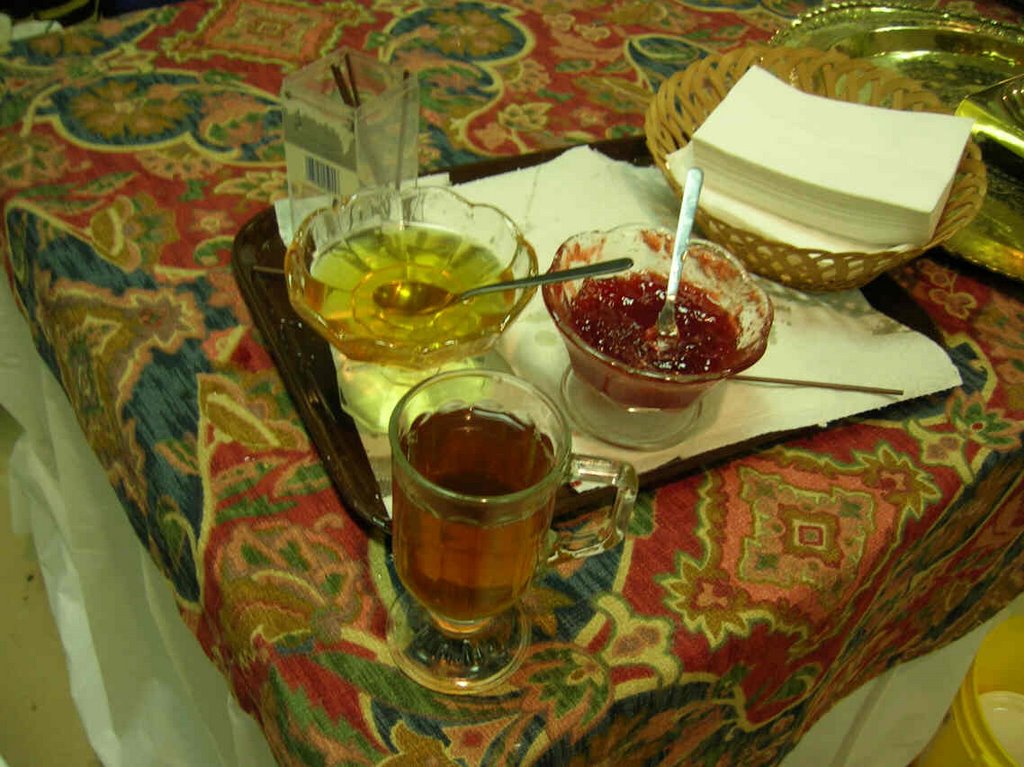
I put these in the back of my mind and headed into the church hall. Another massive spread, with lots of tables, foods and gifts waited there. I started with what I supposed was the ladies' auxiliary. They had some delicious powerded cookies, very similar to Mexican wedding cookies, but the Russian name escapes me (OW! Here I am smacking myself for not writing it down. Nooo, I could remember the name of a cookie...) The cookies were 3 for $1, and likely went to support the church. I washed down the cookies with some Russian tea, which came with complimentary honey and jelly. I couldn't get over the idea of jelly floating in my tea, but I did put a heavy dollop of honey into it.

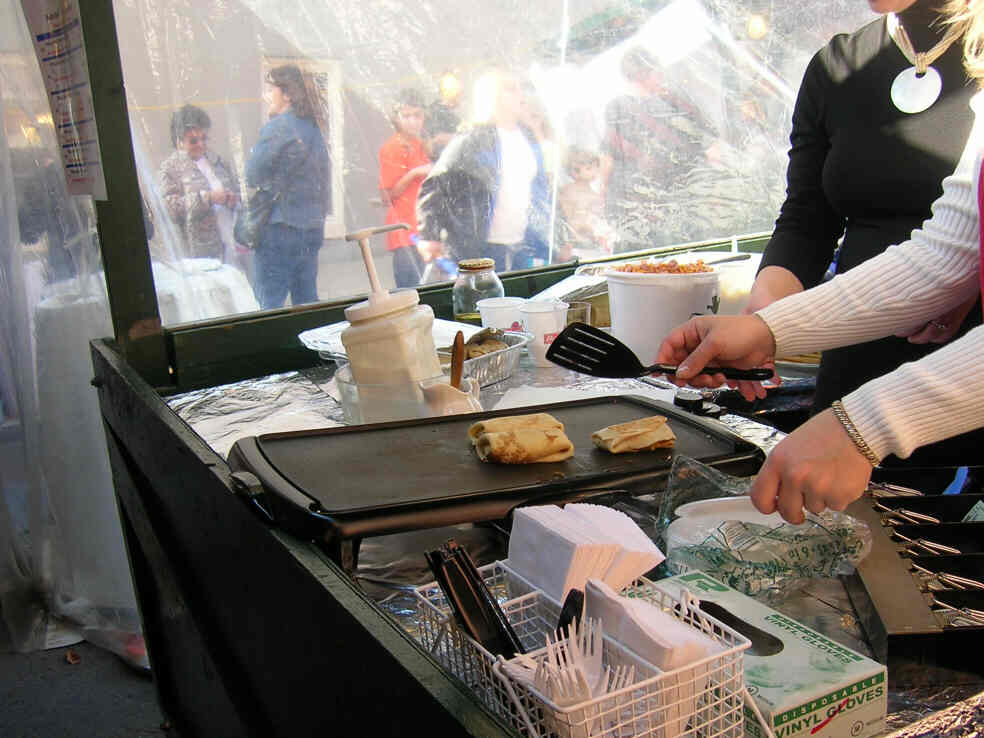
I enjoyed looking around the place, but was getting (yes) hungry again so I headed back outside for some blinchiki. These were indeed blintzes. I ordered two for $5 (one was $3) - one with little ham cubes and cheese, the other with sweet cheese, both wrapped in a tender crepe. These were good, with a little sour cream (urged onto me by the vendor). I left with these in tow, hoping that the massive Irish Festival in November would bring me more good eats.

Sigh.