South Carolina is the next stop on our culinary tour of the United States. This state is known for everything from mustard barbecue sauce (not all over the state, but it is unique to the Palmetto State) to boiled peanuts to its Lowcountry boils and other dishes. Many of those Lowcountry dishes come specifically from the Gullah people.
Official Name: State of South Carolina
State Nicknames: The Palmetto State
Admission to the US: May 23, 1788 (#8)
Capital: Columbia (largest)
Other Important Cities: Charleston (2nd largest), North Charleston (3rd largest), Greenville (6th largest)
Region: South, Southeast, Lowcountry; South Atlantic (US Census)
RAFT Nations: Chestnut;
Crabcake
Bordered by: North Carolina (north), Georgia (southwest), Atlantic Ocean (southeast)
Official State Foods and Edible Things: boiled peanuts (snack food), collard greens (vegetable), grits (food - okay, this is unofficial), milk (beverage), peach (fruit), rockfish / striped bass (fish), summer / wood duck (duck), white-tailed deer (animal), wild turkey (wild game bird)
Some Famous and Typical Foods: Southern foods, particularly Lowcountry foods in the southern / eastern half of the state (especially purloo, Gullah cuisine); seafood (shrimp, crabs, typically boiled or in soups); Lady Baltimore cake; different types of barbecue, including its unique mustard barbecue (between Columbia and Charleston)
South Carolina and coastal Georgia are Lowcountry. This cuisine, as Ramsey Prather at
Coastal Living Magazine (date unknown) points out, is heavy on rice, grits and seafood:
The Lowcountry teems with aquatic life, and for centuries local cooks have turned to the water for culinary inspiration. Crabs, shrimp, fish, and oysters form the basis of any traditional menu, and seafood dishes are offered at every meal. [Prather, date unknown]
Shrimp and grits, she-crab soup (not Virginia's variety from the Chesapeake Bay),
frogmore stew and so on are all typical dishes of the Lowcountry. Many of these dishes are important to the Gullah, that very localized Lowcountry African American culture that anthropologist Joseph Opala, an expert on Gullah culture, points out have
very strong ties to Sierra Leone (date unknown). In fact, the important tie between the Gullah and Sierra Leone is one specific food that is vital to Lowcountry cuisine: rice.
During the 1700s the American colonists in South Carolina and Georgia discovered that rice would grow well in the moist, semitropical country bordering their coastline. But the American colonists had no experience with the cultivation of rice, and they needed African slaves who knew how to plant, harvest, and process this difficult crop. The white plantation owners purchased slaves from various parts of Africa, but they greatly preferred slaves from what they called the "Rice Coast" or "Windward Coast"—the traditional rice-growing region of West Africa, stretching from Senegal down to Sierra Leone and Liberia. The plantation owners were willing to pay higher prices for slaves from this area, and Africans from the Rice Coast were almost certainly the largest group of slaves imported into South Carolina and Georgia during the 18th century. [Opala, 1986]
It is these enslaved West Africans that are the direct ancestors of the modern-day Gullah people, and the recipes I am interpreting for South Carolina are all familiar to them.
The first dish is indeed one of those rice dishes, one that exemplifies the importance of rice to the Lowcounrty. The ancestors of the Gullah brought their ideas about how to cook rice with them, and one of the most important ones was what modern cooks call
purloo. Apparently nobody agrees on exactly how to pronounce it, even in South Carolina - pur-LOWE, pur-LAO, PUR-lowe, pur-LEW? That's just a smattering of the many different ways to pronounce it: Joseph E. Dabney (2010:150) enumerates about sixteen that Lowcountry cooks have used in the past. From what Dabney notes in his cookbook
The Food, Folklore and Art of Lowcountry Cooking (2010), even though it came to America from West Africa,
purloo is not native to Africa:
...the word and the dish are said to have originated in ancient Persia (modern-day Iran). In subsequent centuries, the dish's popularity spread in all directions and accumulated many different name tags, such as pilaf in Turkey, pullao in India, and pelau in Provence, France [Dabney 2010:150]
That is, over time it worked its way from Persia through the Middle East into West Africa, and across the
Middle Passage into the Americas.
One common feature of
purloo, apart from the rice, is that it usually features meat or seafood as a main component of the dish. Chicken, shrimp, oyster, crab, ham and even duck and sausage
purloos abound in Lowcountry cookbooks. But you do often see vegetable ones too. The one I use below is from pages 156 and 157 of Dabney's book, which he adapts from Lillian Marshall's cookbook
Cooking Across the South, and features okra. Okay, okra and bacon. Even though he calls it "Savannah Okra Pilau" - as in Savannah, Georgia - this is for all intents and purposes a
purloo. And is it that difficult to believe that something they'd be making in Savannah wouldn't have crossed the river into Charleston? Seriously?
The Recipe: Savannah Okra Purloo (Pilau?)
To make this okra
purloo, on pages 156-157 of Dabney's book, you will need:
* rice (a smallish bag is all I needed - about a dollar at Wegman's)
* okra (a package of the fresh stuff ran about $2.75 at Wegman's. Typically I would've just bought frozen pre-sliced okra and saved myself the trouble, but the recipe calls for thinly sliced okra, and the frozen stuff is never thinly sliced)
* bacon (a few slices; the local variety set me back about $3.50 at Giant)
* onion (one is all you need - about 60¢)
* green bell pepper ($2 on sale, or about $1 for the one)
* chicken broth or bouillon (or this Better Than Bouillon stuff which seems to work)
* tomatoes (if not the goopy fresh kind you find in the supermarket, go with canned. A can cost no more than a dollar)
You will also need a dash of salt, which I forgot to put in the photo.
First you ought to defuzz the okra. Any of you who has dealt with fresh okra has learned this is not fun: the little hairs can sometimes bristle and stick in your skin and be a real pain. What some websites suggest is to wash the okra, and then take a nylon net or brush or even a paper towel and scrub the hairs off as best you can.
There really is no other way to photograph this, is there?
Next, slice your okra pods thinly.
Cube your bacon and add it to a heavy skillet or Dutch oven with your okra.
Add the other vegetables...
...and your tomatoes, chicken broth and (of course) your rice.
Cover and let cook without uncovering for 15 minutes.
STOP! Do NOT lift that lid! Since I have no lid for my cast-iron skillet, I used the lid for my crab pot like I did for the Maryland fried chicken recipe.
Uncover and fluff with a fork. I found that in my cast iron skillet nothing burned to the bottom of the pan, as it usually does in my large pot to which everything burns. That pot is now basically good only for boiling water and making soup. Oh well.
This is a relatively easy rice dish to make. The rice came out tender and the sliminess of the okra was hardly noticeable at all. Plus, the bacon and rendered bacon grease give a nice flavor. This was an all-around satisfying dish. I will make this again - but next time I';m just doing the pre-frozen okra.
Sources:
Food Network. "
True Grits". Episode of the show
Good Eats (Alton Brown, host). Food Network, 2004.
Dabney, Joseph.
The Food, Folklore, and Art of Lowcountry Cooking: A Celebration of the Foods, History, and Romance Handed Down from England, Africa, the Caribbean, France, Germany, and Scotland. Cumberland House: Naperville, Illinois, 2010.
DiRuscio, Mike. "
Transcription of Good Eats: True Grits".
Good Eats Fan Page (GoodEatsFanPage.com), 2004. Includes correspondence between DiRuscio and Alton Brown about the episode.
Lee, Matt, and Ted Lee.
The Lee Bros. Southern Cookbook: Stories and Recipes for Southerners and Would-be Southerners. W.W. Norton & Company: New York, 2006.
Opala, Joseph A. "
Introduction to The Gullah: Rice, Slavery, and the Sierra Leone-American Connection".
The Gullah: Rice, Slavery, and the Sierra Leone-American Connection, online version of the pamphlet, United States Information Service: Freetown, Sierra Leone, 1986. Online access available through the Gilder Lehrman Center, Yale University.
Prather, Ramsey. "
Lowcountry Cuisine: South Carolina's coast is home to one of the country's richest culinary traditions." Coastal Living Magazine.com (CoastalLiving.com). Date unknown. Copyright 2012 Time Inc. Lifestyle Group. All Rights Reserved.
Shields, John.
Chesapeake Bay Cooking. Broadway Books: New York, 1998.
Villas, James.
The Glory of Southern Cooking. John Wiley & Sons: Hoboken, NJ, 2007.
Some information also obtained from Wikipedia's "
South Carolina" page and other pages, and the
Food Timeline State Foods link to "
South Carolina.
Pimento cheese is one of those specifically Southern foods you see throughout the "proper South". While Maryland has its ties to Southern cuisine - in terms of seafood, fried chicken, hams, familiarity with Moon Pies as opposed to whoopies, which are only newly popular here, etc - we are clearly above the culinary Mason-Dixon Line in terms of pimento cheese. But like the sweet Yankee whoopie pie, the decidedly Southern pimento cheese has started to make itself very much known in Maryland and throughout the nation, busting waistlines all over.
Official Name: State of North Carolina
State Nicknames: The Tar Heel State, The Old North State
Admission to the US: November 21, 1789 (#12)
Capital: Raleigh
(2nd largest)
Other Important Cities: Charlotte (largest), Greensboro (3rd largest), Winston-Salem (4th largest)
Region: South, Southeast, Upper South; South Atlantic (US Census)
RAFT Nations: Crabcake;
Chestnut
Bordered by: Virginia (north); Tennessee (west); Georgia (southwest); South Carolina (south); Atlantic Ocean (east)
Official State Foods and Edible Things: blueberry & strawberry (berries), milk (beverage), channel bass (fish), Southern Appalachian brook trout (freshwater trout), Scuppernong grape (fruit), honey bee (insect - again, for the honey), gray squirrel (mammal), sweet potato (vegetable)
Some Famous and Typical Foods: two - count 'em: two famous styles of BBQ (Eastern and Western or "Lexington-style"); other standard Southern foods, including (typically eaten with said BBQ's) cole slaw, hush puppies, sweet tea; pimiento cheese (the nation's leading producer); also the birthplace of Pepsi-Cola
Emily Wallace, a native of the Piedmont North Carolina, writes for the Durham-based
Independent Weekly about the history of what I might easily assume is a food she enjoyed as a child. Pimento cheese, as she puts it, is "parading around as the nation's new It Girl" [Wallace 2011]. She points out that the hearty mix of cheddar cheese, pimentos and mayo (among other things) is a food that is both proletarian and bourgeois, appearing in lunch pails and tea rooms since the early 20th century:
Many people in the Piedmont, including my mother, briefly, worked in a textile mill. There, formalized meal breaks were largely disregarded by the 1920s, and workers were encouraged to eat on the job as they found time. To facilitate this process, sandwiches and crackers were sold at worker's stations by way of dope carts—wagons named for the caffeinated "dopes," or sodas they stocked. Of the sandwiches, which included other salad spreads like ham, chicken and egg, pimento cheese became the most iconic. Tasty, affordable and convenient, it nonetheless retained its status as a delicacy in certain circles. [Wallace 2011]
And wouldn't you know it, Charlotte, according to Wallace, is the nation's pimento cheese capital, and North Carolina the nation's leading producer of the stuff. Also the home of one of my favorite supermarket chains (yes, those words actually came out of my brain) Harris Teeter, you will find a good selection of pimento cheeses there - notably
Augusta's Creations, also out of Charlotte (they make regular and
jalapeño pimento cheeses).
Pimento cheese is one of those foods for which every family has its own recipe, like crab cakes or chili. The recipe I used - originally from Nan Davis - comes from the
Southern Foodways Alliance Community Cookbook, edited by Sara Roahen and John T. Edge. It speaks to the popularity of pimento cheese that the very first recipe in the collection is a pimento cheese recipe. Forgive me, Charlotte, but this recipe comes to us from Edge's home state of Mississippi - not exactly North Carolina, but a good recipe nonetheless.
The Recipe: Pimento Cheese
For Nan Davis' Blue Ribbon Pimento Cheese (recipe on page 5 of the
SFA Community Cookbook) you will need the following:
* cheddar cheese (different recipes I saw also added some Monterey Jack, but every recipe I saw had at the least cheddar cheese, as bright yellow as you can get. A 16 oz block set me back about $3 on sale at, yes, Harris Teeter)
* pimentos (you absolutely need these - a 4 oz jar is $3)
* mayonnaise (while the recipe calls for a homemade mayo, the recipe for which follows, I stuck with Richmond-based Duke's Mayonnaise)
* Worcestershire sauce (not every recipe will call for this, or any of the other ingredients that follow)
* sugar (just a tad)
* onion powder (I bought a small bottle for about $1.50)
* cayenne pepper (had it)
First, grate your cheddar cheese. You could also cheat and buy it pre-shredded. Maybe that would've saved me some time, but this recipe isn't a difficult one to begin with.
I thought about adding a little leftover
pecorino romano, though I only added a little.
Throw the shredded cheese in your food processor with all your other ingredients. I had to do this in two batches.
Pulse until it is like a rough paste. Add more mayonnaise if it's not soft enough.
This is a delicious, luscious and filling - very
damn filling - pimento cheese. I have enough to last me for a while, and that's after sharing half of it with friends. I just have to face facts: this is going to gain me a pound or two., Grilled pimento cheese sandwiches for the next few weeks anyone? Note though: I made this during Lent. A grilled pimento cheese sandwich would be the perfect meatless meal, although I would enjoy it too much.
Sources:
Barbecue Joint. "Eastern North Carolina Barbecue". Featured on the episode "Durham, NC" of the show
$40 a Day (Rachael Ray, host). Food Network, 2005.
Bowen, Dana. "
East Vs. West: North Carolina Pulled Pork".
Saveur.com, Issue #139: BBQ Nation. Published June 16, 2011. Copyright 2011
Saveur.com. All rights reserved.
Goldwyn, Craig "Meathead". "
East Carolina Kiss & Vinegar Barbecue Sauce & Mop".
Amazing Ribs website. Last revised September 12, 2011. All
Graff, Michael, Wendy Perry, and Teresa Williford. "
The Pepsi ‘N’ Peanuts Cake".
Our State: Down Home in North Carolina. Posted February 2012. Copyright 2012
Our State. All rights reserved.
North Carolina BBQ Society. "
Eastern Style Slaw". Copyright The North Carolina Barbecue Society, Inc. 2009.
North Carolina BBQ Society. "
Piedmont Lexington-Style Dip". Copyright The North Carolina Barbecue Society, Inc. 2009.
North Carolina Travels (NorthCarolinaTravels.com). "
North Carolina Barbecue". Date unknown.
Matt Barrett's Travel Guides: North Carolina. All rights reserved.
O'Dea, Stephanie. "
You Can Use Your CrockPot as a Smoker".
A Year of Slow Cooking. Posted August 7, 2008.
Pepsi Store (
PepsiStore.com). "
History of the Birthplace". Date unknown. Copyright PepsiStore.com and Pepsi-Cola. All rights reserved.
Saveur.com. "
Lexington Pulled Pork".
Saveur.com, Issue #139: BBQ Nation. Published June/July 2011. Copyright 2011
Saveur.com. All rights reserved.
Saveur.com. "
Lexington-Style Red Slaw".
Saveur.com, Issue #139: BBQ Nation. Published June/July 2011. Copyright 2011
Saveur.com. All rights reserved.
Southern Foodways Alliance (Sara Roahen and John T. Edge, editors).
The Southern Foodways Alliance Community Cookbook. University of Georgia Press: Athens, GA, 2010.
Wallace, Emily. "
A brief history of pimento cheese". Independent Weekly (
IndyWeek.com). Posted June 22, 2011. Copyright 2012 Independent Weekly. All rights reserved.
Some information also obtained from Wikipedia's "
North Carolina" page and other pages, and the
Food Timeline State Foods link to "
North Carolina".
Cole slaw: it's one of those unassuming yet still classic of American dishes. And it exists in many forms: creamy, vinegary, boiled or non-boiled dressings, with or without sugar, with big slivers or small bits of cabbage, with red or green or even Chinese cabbage, with a very few ingredients or with many, and even some varieties from outside our country (such as the simple curtido variety brought in by Salvadorans and easily found in any Central American community in the DC region). And anyone can tell you that cole slaw is the quintessential barbecue side dish.
 Official Name:
 State of Missouri
The Show-Me State
Admission to the US: August 10, 1821 (#24)
Capital: Jefferson City (15th largest)
Other Important Cities: Kansas City (largest), St. Louis (2nd largest), Springfield (3rd largest), Independence (4th largest)
Region: Midwest, South; Wet North Central (US Census)
RAFT Nations: Corn Bread & BBQ; Bison
Bordered by: Iowa (north); Illinois and the Mississippi River (east); Kentucky and Tennessee (southeast); Arkansas (south); Oklahoma (southwest); Kansas (west); Nebraska (northwest)
Official State Foods and Edible Things: Eastern black walnut (tree nut); channel catfish (fish); Norton/Cynthiana grape (grape); bobwhite quail (game bird); crayfish (invertebrate)
Some Famous and Typical Foods: Midwestern and German foods to the north, Southern and Ozark foods to the South and in the center of the state; Kansas City BBQ (sweet BBQ sauce, with dry rub before barbecuing), gooey butter cake
Marcia Adams notes in her
Heartland cookbook - the definitive Midwestern cookbook that I keep coming back to for this project - that Midwestern cole slaw dressing is typically sweet and creamy. This is how I like it, and this is the cole slaw I ended up making (I have a lot of left over mayonnaise I need to use up). But a small contingent in Missouri and other parts of the Midwest like the boiled variety, which is unfamiliar to me.
In Missouri, as it is nearly everywhere in the Midwest, cole slaw is mostly creamy style... but there is a school of slaw makers who still prepare a boiled dressiing: the early forerunners of commercial bottled salad dressings like Miracle Whip. It is a tradition worth reviving. Laced with dry mustard, boiled dressing is good on potato salad: thinned with additional cream, it can also be served with roast pork, ham or fish [Adams 1991: 166]
Her boiled dressing, and the adaptation I followed for the typical non-boiled creamy version, are on page 166 of her
Heartland cookbook. And yes, it is a lovely accompaniment to the Kansas City style spare ribs I made in the last post.
The recipe: Creamy Cole Slaw
To make this cole slaw
without the boiled dressing you will need to replace all the eggs and flour and mustard and olive oil and cream with three things: mayonnaise (I used Duke's, which I have a whole lot of right now), sugar and apple cider vinegar. You will add that to the following:
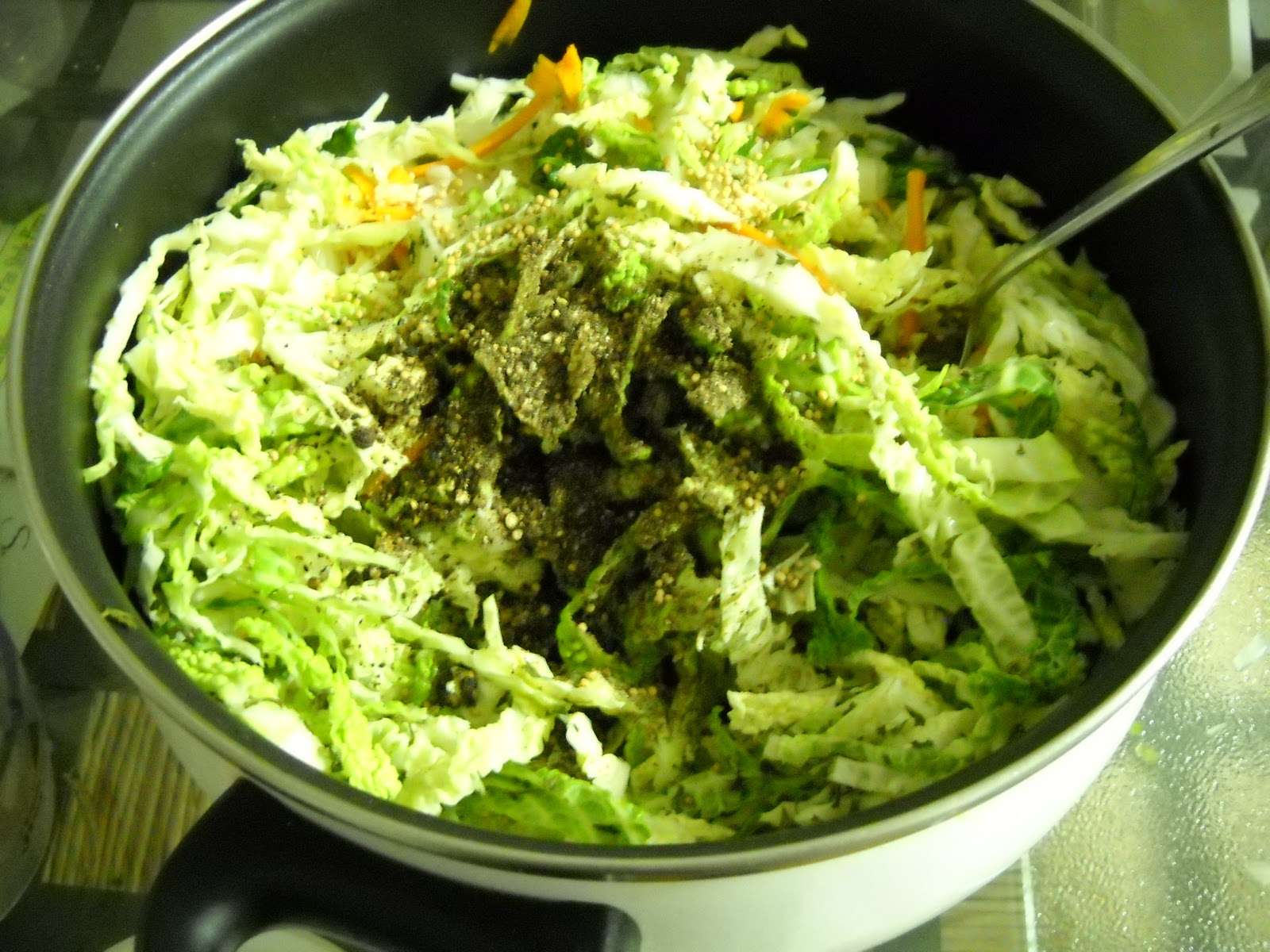
* cabbage (I used Savoy because it was a much smaller head - in retrospect I will just use plain green cabbage; Savoy makes a pretty cole slaw, though not a terribly crunchy one. Use it if you don't demand crunch in your cole slaw)
* parsley (no fresh on hand so I just used some of the dried - but do try to use fresh)
* carrot (shredded)
* celery (finely chopped)
* onion (also finely chopped)
* green bell pepper (yup - finely chopped)
* celery seed, mustard seed and ground black pepper (had all on hand)
Shred the cabbage as finely as you can (or as finely as your brain can stand), and finely chop or shred the other vegetables.
Mix together all the non-dressing ingredients, and then add the mayo, sugar and vinegar. Stir until well-blended. It's easier to mix the dressing first instead of adding the separate ingredients. (Note to self: read the whole recipe over again before adding your ingredients).
Though not as creamy or as sweet as my grandmother's cole slaw, this is still a pleasant slaw. I wish I had used the more standard green cabbage which Adams likely would have recommended as well. Adams notes that you can make this up to a day ahead. I have been eating this along with the ribs, and though it is a bit messy to hold the fork (as it always is - it
is barbecue after all), it still provides a nice crunch even with the Savoy cabbage.
Adams, Marcia.
Heartland: The Best of the Old and the New from Midwest Kitchens. Clarkson Potter: New York, 1991.
Bittman, Mark. "
For a Smoky Taste in Oven Ribs".
The New York Times website. Published: December 4, 2009.
Goldwyn, Craig "Meathead". "
A taxonomy of American barbecue sauces".
Amazing Ribs website. Last revised September 12, 2011.
Lee, Jennifer 8. "
St. Paul Sandwiches (in St. Louis), Made with Egg Foo Young Patties".
The Fortune Cookie Chronicles website. Published April 8, 2009.
"noahw" (
Instructables.com user). "
Oven Smoked Ribs".
Instructables.com website. Copyright 2011.
Oland, Sydney. "
Sunday Brunch: St. Louis Gooey Butter Cake".
Serious Eats website. Published May 28, 2011.
Raichlen, Steve.
How to Grill: The Complete Illustrated Book of Barbecue Techniques. Workman Publishing: New York, 2001.
STLToday. "
St. Paul Sandwich (Fortune Express)".
STLToday website. Published August 17, 2011.
Stradley, Linda. "
Gooey Butter Cake".
What's Cooking America website. Copyright 2004.
Some information also obtained from Wikipedia's "
Missouri" page and other pages, and the
Food Timeline State Foods link to "
Missouri".
Since Maine is a place where people have been eating seasonally long after it fell out of fashion, it stands to reason that the next dish I am preparing isn't typically made year round. But even fiddle head ferns, with the advent of flash freezing, should be easier to find year round. At least in those areas where people are familiar with them.
 Official Name: State of Maine
State Nicknames: The Pine Tree State
Admission to the US: March 15, 1820 (#23)
Capital: Augusta (9th largest city)
Other Important Cities: Portland (largest); Lewiston (2nd largest); Bangor (3rd largest)
Region: Northeast, New England; New England (US Census)
RAFT Nations: Maple Syrup; Clambake
Bordered by: New Hampshire (west); Québec (Canada) (northwest); New Brunswick (Canada) (north, northeast), Bay of Fundy (due east), Atlantic Ocean and the Gulf of Maine (southeast)
Official State Foods and Edible Things: wild blueberry (fruit); Maine wild blueberry pie (dessert); whoopie pie (treat); Moxie (soft drink); landlocked salmon (fish); moose (animal)
Some Famous & Typical Foods: New England foods; seafood, especially lobster, haddock, swordfish, salmon, clams; blueberries and apples; fiddle head ferns; whoopie pies; foods in common with southeastern Canada, including poutine
Being from Maryland, I have very little experience with fiddle head ferns. Family cookbooks in my part of the country do not feature fiddle heads because we just don't eat them here! The fiddle head is prepared like a leaf vegetable - though technically it isn't a vegetable but a fern. The fiddle head has historically been eaten in northern parts of France, Asia and North America. Today you can find fiddle heads eaten in Michigan's Upper Peninsula as well as in Québec, Nova Scotia and New Brunswick. Within the US, upper New England is where the fiddle head is perhaps the most popular. The tender scrolls, which taste a little like asparagus, are fresh only during a short part of the year, and are harvested close to the ground before they open to release their spores.
I have had one and only one experience with fiddle heads in my lifetime prior to this. A few years ago I wrote about these strange things that I picked up at Eddie's of Roland Park on Charles Street. I stir-fried them, not realizing that one has to cook and cook and cook them before eating. One does not eat raw fiddle heads, because (as I found at the time) they will make you sick.
By all accounts, fiddle heads should be prepared simply. I am not finding many complicated recipes for these things, so why bother trying? In fact, the most complicated recipe that I found for fiddle heads comes from the website for Yankee Magazine - the "New England Website" - and all of the complexity goes into the sauce that you whisk up while the fiddle heads are cooking simply and all by themselves.
Recipe: Dijon Fiddleheads
For this simple recipe, you will need the following:

* fiddle head ferns (well duh). I did not pick these up recently, but got a half a pound a few months ago at Graul's when they were fresh, for about $8 or $9 per pound, and froze them. The process for freezing is simple. I followed this procedure from the University of Maine:
To freeze fiddleheads, clean them as you would for the table. Blanch a small amount at a time for two minutes in 4 to 6 cups of water. Cool and drain in cold water or in an ice water bath (half water and half ice). Pack into moisture- and vapor-proof containers and freeze. Thaw and boil for 10 minutes before serving. [El-Begearmi et al 2010]
 The blanching of the fiddle heads
 And the drying of the fiddle heads before freezing
* Dijon mustard, mayonnaise and lemon juice (had them all)
* yogurt (picked up a tub of plain nonfat yogurt at Giant for $2)
* scallions (99 cents a bunch)
* salt and pepper

With that last experience with fiddle heads coming back to mind, I wanted to take no chances, so I steamed the fiddle heads in the pan with a little bit of olive oil for about 15 minutes.

Now for the difficult part:
 Wow, this is hard.
Whisk together the rest of the ingredients to make a sauce, and spoon it over the thoroughly cooked fiddle head ferns.

This time, the fiddle heads did not make me sick. That is because I cooked the
hell out of 'em! So this time I could actually enjoy them. They do taste a little like asparagus, which I do
not enjoy, but I liked these. The sauce is sharp and tangy, and goes very well with many vegetables. I recently ate this sauce over broccoli, and I can imagine it as a dressing for salad, though depending on the salad, you may have to thin it out a little bit: keep it thick for a potato salad, or thin it out for a garden salad.
Sources:Dojny, Brooke.
Dishing Up Maine: 165 Recipes That Capture Authentic Down East Flavors. Storey Publishing: North Adams, MA, 2008.
Dojny, Brooke.
The New England Clam Shack Cookbook. 2nd edition. Storey Publishing: North Adams, MA, 2008. Portions also available on
Google Books.
El-Begearmi, Mahmoud.
Facts on Fiddleheads (
Bulletin #4198, Facts on Fiddleheads). Updated by Alfred Bushway, Beth Calder and David Fuller. Cooperative Extension Publications (University of Maine): Orona, ME, 1995 & 2010.
Greenlaw, Linda, and Martha Greenlaw.
Recipes From a Very Small Island. Hyperion: New York, NY, 2005.
Yankee Magazine. "
Dijon Fiddleheads". From "Weekly Wisdom", May 2002. Copyright 2011
Yankee Magazine.
Some information also obtained from Wikipedia's "
Maine" page and other pages, and the
Food Timeline State Foods link to "
Maine".
If the previous post's horseshoe sandwich reflects Springfield, deep-dish pizza reflects Chicago and pierogi reflects Chicago's ethnic Polish community, what represents the entire state, if not the whole region? Corn, that's what.
 Official Name: State of Illinois
State Nicknames: The Prairie State; The Land of Lincoln
Admission to the US: December 3, 1818 (#21)
Capital: Springfield (6th largest city)
Other Important Cities: Chicago (largest in the state and the Midwest; 3rd largest in the US); Aurora (2nd largest); Rockford (3rd largest)
Region: Midwest, Great Lakes; East North Central (US Census)
RAFT Nations: Cornbread & BBQ, Wild Rice
Bordered by: Wisconsin (north); Lake Michigan (northeast); Indiana (east); Kentucky (southeast & south); Missouri (southwest); Iowa (northwest)
Official State Foods and Edible Things: popcorn (snack food); GoldRush apple (fruit); white-tailed deer (animal)
Some Famous & Typical Foods: typical Midwestern foods, especially corn; Native American and pioneer foods; state-specific foods (horseshoe sandwich, shrimp de Jonghe, Chicago dog, Italian beef); also note: deep-dish pizza and hot dogs were first made popular in Illinois
The Midwest is the hub of our nation's corn industry, and it's made a lot of people very wealthy. Corn goes into so many things that we never realized even had corn in them: everything from ethanol to batteries (!) to high fructose corn syrup (and don't believe the lies about HFCS being "just like sugar" Check out the Picky Eater Blog for a recent takedown of Big Corn's claims about how great HFCS really is). Yes, most of the corn we get in my area is local, but do not forget just how important corn is to the whole fabric of the Midwest.
For a truly simple and delicious corn dish, I thought about various recipes, from corn fritters - corn oysters, that is - to corn pudding to corn chowder to just plain old corn on the cob. The recipe I found on Pam's Midwest Kitchen Korner spoke to me in a different way, and I got inspired to make myself some creamed corn.
The recipe: Creamed Corn
Pam's recipe for creamed corn is simple, unless you (again) reinvent the wheel like I did, and cut the corn fresh off the cob (I'm a silly non-Midwesterner).
 Prepping the corn...
Pam used frozen corn, which you will probably do as well. The author's sister-in-law, who gave her this recipe, passed away not long before it was posted, and so she dedicates it to her.

The ingredients you will need include:
* corn (duh - I used six ears' worth, which after much research on the internet I reasoned equaled a one-pound bag's worth of frozen corn. This sort of thing shouldn't be so difficult to find.)
 About one 16-oz bag's worth of fresh corn
* both milk and whipping cream (had on hand)
* sugar, salt and cayenne pepper (again, had it)
* butter and flour (mmmm, butter)
Please check out her recipe for exact quantities. Pam also puts
Accent in her recipe. Accent (or "Ac'cent") is pure MSG, a no-no these days. I didn't have any and didn't buy any for this recipe. It worked just fine without it.
Again, I'm not going to post her recipe, but it is simple to sum up:

mix everything together but the butter and flour,

then add those toward the end to thicken.

This recipe was just about the loveliest corn recipe I have ever had. Far from the sloppy glop I'm used to seeing in restaurants, this was silky and sweet and just plain delicious. Pam and her sister-in-law had a good thing with this recipe, a simple and delicious way to prepare your corn.
Sources:Pam's Midwest Kitchen Korner (Pam). "
Creamed Corn".
Pam's Midwest Kitchen Corner, published November 12, 2009.
The Picky Eater: A Healthy Food Blog (Picky Eater). "
The Truth About High Fructose Corn Syrup".
The Picky Eater: A Healthy Food Blog, published April 19, 2011.
Some information also obtained from Wikipedia's "
Illinois" page and other pages, and the
Food Timeline State Foods link to "
Illinois".
Our only Polynesian state, Hawaii is part of what the Renewing America's Food Traditions (or RAFT) folks call the “taro nation”. Hawaii has one of the most unique cuisines the country, and it isn't just poi, pork and pineapples either. For this post, I aim to find out how to make food that reflects both Hawaii's history and multicultural identity. Let’s see where this goes.
 Official Name: State of Hawaii (Hawaiian: Mokuʻāina o Hawaiʻi - Hawaii has two official languages, English and Hawaiian)
State Nickname: The Aloha State
Admission to the US: August 21, 1959 (#50 - Ah, still has that new state smell)
Capital: Honolulu (largest city)
Other Important Cities: Hilo (2nd largest), Kailua (3rd), Kāne‘ohe (4th)
Region: West, Pacific; Pacific (US Census)
RAFT Nations: Taro
Bordered by: The Pacific Ocean (all sides)
Closest land mass: California, almost 2,500 miles away
Official State Foods and Edible Things: none
Some Famous & Typical Foods: poi & taro, pork, much local seafood (such as mahi mahi), macadamia nuts, tropical and "lu’au" foods (pineapple, coconut, etc), Asian and Native Hawaiian fusion cuisines, Spam and foods made from it (musubi, Spam stir fries, etc)
Hawaii is unique among its neighbors, in part because it really has no neighbors to begin with. One of the most isolated island chains in the world, humans did not reach it until about the 3rd century AD, bringing edible crops along with them, including sugarcane, breadfruit, sweet potatoes, yams and most importantly taro and pigs. Over a millennium later the ancestors of the modern Native Hawaiians reached the islands, likely from Tahiti, creating food traditions such as the lu’au feast, perhaps one of the more famous of Hawaii’s many exports to the mainland (NB: Dana Zia at the Go Lightly Gourmet blog has another very thorough description of both the cuisine of Hawaii and its history): Kauai Menu Magazine describes one lu’au thrown by King Kamehameha III, one of the largest ever thrown, in 1847. It included among other things, almost 300 pigs, thousands of taro plants, coconuts and salted fish and "482 large calabashes of poi" [Kauai Menu 2010]
Taro is among the most important foods in Hawaii, Polynesia and the Pacific Islands, and many of their food traditions center around that famous root crop that is as ubiquitous there as it is elusive here. Only in the last few years has taro even become readily available in Maryland, and even then you still have to know where to find it. I found mine at H Mart. It’s not the Hawaiian taro that most Hawaiians prefer, but the relatively available Asian taro that most Hawaiians do not. But unless I want to book those plane tickets to Honolulu right now, I’m going to just have to settle for the Asian variety. This is used to make many dishes (for example, this taro and crab dish from Papua New Guinea that I made last year). But the one most famous one to us haoles on the mainland is the ever-famous poi.
Yes, I’m going there.
The recipe: Poi
I have to admit: when I started this state-by-state series, one thing I was looking forward to was this recipe. The problem is that poi always seemed like a daunting challenge. The only videos or TV segments I had ever seen of poi making made it seem so exhausting, the constant pounding and working in of oil and sweat from the hands. I even considered ordering a container of powdered poi from Hawaii, but I wasn’t ready to confront how much that would cost (NB: there are lots of brands of poi that you can buy online if you want to go that route. The Islands Gift Shop is one of many that ships poi all over the country. As they point out, a 3 oz jar makes about 13 1/2 oz of poi.). And yet, as daunting as making poi from scratch seemed to me, most recipes I found online made the process much simpler.
Ingredient wise at least, all you need is:
 * whole taro corms (I got this at H Mart for about $2 or so per pound. Note: you can use other root crops to make poi, most notably sweet potato, but I wanted to go the taro route)
* water (for boiling and for making runnier two- and three-finger poi)
It is preferable that you prepare this in a calabash or gourd bowl. I don’t have one of these, and I’m not prepared to go to Michael’s to buy the ones they have for crafts that are sprayed with all manner of odd chemicals. Instead I bought a wooden bowl ($12 at Ikea) that worked nicely not just for this project but for many more I will do in the future. Come on, at that price I am sure as hell going to get as much use out of it as I can. But I digress.
I ended up using two different websites for my poi recipes. I imagine that this recipe from Food.com poster Mark O. is the more authentic one of the two I used. His recipe for poi maoli (or taro poi) uses the calabash bowl, the poi pounder, and so on. The other one, an eHow recipe whose author chose to remain anonymous, modernizes poi for the 21st century by recommending you throw the pieces in a food processor. I went ahead and tried both.
 First, peel the taro with a vegetable peeler. Yes, eHow Guy suggested scrubbing the hairy bristles off the corm, but that all came off with the peeler anyway.
 Cut up your taro into about 1 to 2 inch chunks and drop it into boiling water until you can pierce it like a soft potato. The difficulty with boiling taro is that you must boil it long enough to make it edible (raw taro is somewhat poisonous) but not so long that it becomes gooey and stringy (ick). So watch over it and once you can poke it with a fork and it feels like a boiled potato, it’s done.
Next you process the taro into poi.
 You can do it the modern way, and throw it in the food processor, or you can mash it in a bowl.
 My wooden bowl and potato masher stood in for the more traditional calabash bowl and poi pounder.
 I was satisfied with the result.
 You should add some water to your taro to get the consistency you want. This is where personal preference and taste come in. If you add just a little bit of water you will get a thicker poi.
 The Hawaiians call this “one finger poi” and it is apparently the preferable way to eat it. I certainly liked this kind better.
 Add more for a runnier “two finger poi” or even more for a goopier “three finger poi”. This one I was not a fan of.
 Hawaiians also prefer their poi slightly fermented. I did this too, both covering it with water and with a damp towel, and letting it sit for two to three days. Covering my poi with water turned my one finger poi into the distinctly three finger variety. However, covering it with a damp towel kept it nice and firm, though it did leave the poi on top a slightly sick-looking beige color. I’m not sure if you’re supposed to eat that part, but I scraped it off anyway. The poi underneath was still nicely sour.
 The finished poi, at long last.
So
poi doesn’t really have much of a flavor. No wonder Hawaiians prefer theirs to sit for a few days. It gives the
poi a bit of character. Honestly, I don’t know when I would need to make
poi again. Perhaps I might throw a
lu’au at some point to make it again. But for now, at least I have this experience under my belt.
Sources:Anonymous
eHow Food & Drink Editor. "
How to Make Poi".
eHow Food. Posted July 20, 2000.
Clark (
clarkonair). "How to Make
Lumpia". Posted on YouTube, December 27, 2007.
Kauai Menu. "
The History of Hawaiian Food".
Kauai Menu, author unknown. Copyright 2010
Kauai Menu.
Kondo Corum, Ann.
Hawai'i's Spam Cookbook. Bess Press: Honolulu, 1987.
Also available on Google Books.
Mark O. (
Food.com user). "
Poi Maoli (Taro Poi) Recipe".
Food.com. Posted February 4, 2002.
Zia, Dana (The Go Lightly Gourmet). "
History of Hawaii's Cuisine".
The Go Lightly Gourmet, posted March 8, 2011.
Some information also obtained from Wikipedia's "
Hawaii" page and other pages, and the
Food Timeline State Foods link to "
Hawaii".


+ingredients.jpg)
.jpg)
.jpg)
.jpg)
.jpg)


+ingredients.jpg)
.jpg)
.jpg)
.jpg)
.jpg)
.jpg)
.jpg)
.jpg)
.jpg)
.jpg)
+plated.jpg)

+ingredients.JPG)
.JPG)
.JPG)
.JPG)
.JPG)
+plated.JPG)