Showing posts with label fruit dishes. Show all posts

Wednesday, November 07, 2012

Snacking State-by-State: Washington III - So Much To Do With Apples...


The State of Washington is notable for having a massive apple industry.  In one year, Washington apple orchards produce over 10 to 12 million apples, each picked by hand.  That's 100 million boxes of apples, each weighing in at about 40 lbs [Washington Apple Commission 2010]. If Washington doesn't have the largest apple industry in the Pacific Northwest, it certainly is a leading contender.  And oh the things you can do with those apples.  You can even find them this far east, mixed in with all the apples from Pennsylvania and Virginia and those produced in our my home state.


Official Name: State of Washington
State Nickname: The Evergreen State
Admission to the US: November 11, 1889 (#42)
Capital: Olympia (21st largest)
Other Important Cities: Seattle (largest), Spokane (2nd largest), Tacoma (3rd largest) 
Region: Northwest, Pacific, Pacific Rim; Pacific (US Census)
RAFT Nations: Salmon
Bordered by: Pacific Ocean (west), Oregon (south), Idaho (east), British Columbia (Canada) (north)
Official State Foods and Edible Things: apple (fruit); bluebunch wheatgrass (grass); steelhead trout (fish); Walla Walla sweet onion (vegetable)
Some Famous and Typical Foods: Pacific coast seafood, including but not limited to: Dungeness crab, salmon, trout, scallops of many varieties, Geoduck clam, mussels, oysters, halibut, cod; blackberries, apples, huckleberries, cranberries, cherries; hazelnuts; coffee

The Washington Apple Commission website [2010] has a mind-boggling array of apple recipes.  It was pretty difficult to hone it down and find just one.  I explored chutneys, beverages, soups, stews, desserts, main dishes and so on.  I finally settled on a side dish that seems to promise a blend of Southern and Pacific Northwestern deliciousness..  Of course, in reading the article I had never even considered the idea of blending apples and yams, but in a way they certainly seem to go together.

The Recipe: Golden Apples and Yams

I halved the apple and yam recipe I got from the Washington Apple Commission's "Best Apples" website, and had to improvise just a bit, with pleasing results.


* Golden Delicious apple (not much at the farmer's market, though I forget the price per pound.  About $2.75 I think?)
* yam (bought at Wegman's for about 75 cents)
* packed brown sugar (the recipe does not specify dark or light.  I grabbed the dark)
* orange juice (Oops!  I thought I had this, but when I could not find it, I improvised with some lemon juice and a lime - not pictured - that I juiced on the spot)
* cloves (had them; you will need to grind them)
* cornstarch (had it)
* pecans (they don't cost that much if you buy a little bit of them in bulk at Wegman's - this way I only paid about 50 cents for them, if that; in the spirit of the Pacific Northwest I also added hazelnuts, again in bulk and again I didn't spend too much)


Either bake your yam in the oven at about 400° for 50 minutes or, if you have other things to do, poke it with a fork several times (I also scored it a few more times with a knife) and microwave it for about eight minutes.  Guess which one I did.


Peel and core your apple.  You are not making a pie here, so if you only have one of those coring-slash-wedging mechanisms you will have a little extra knife work to do.  You need apple rings here.


No, they're not perfect.


Likewise, when your yam is cool enough to handle, slice it as well.


Mix the brown sugar, cloves and cornstarch with your citrus juice over heat (it doesn't say low, medium or high heat.  Just guesstimating I went with low) until thickened.


Layer your apple and yam slices in an oven-safe dish, and pour the liquid over it.


Sprinkle chopped (or in this case, er, ground) nuts on top.  Bake in a 350° oven for about 20 minutes, or until the apples are tender.


This is a simple and delicious side dish, and marries together several ingredients I had never even thought to put together: apples and yams, plus pecans and hazelnuts.  Even though I did not have orange juice on hand, the citrus juices I did have worked beautifully, and next time I may just use those instead.

Sources:

Douglas, Tom.  Tom Douglas' Seattle Kitchen.  William Morrow: New York, 2001.

"kiwisoutback" (Squidoo.com user).  "How to Make a Starbucks Iced Latte."  In "Starbucks Coffee Drink Recipes", Copyright 2008, Squidoo.com.  All rights reserved.

Washington Apple Commission.  "Crop facts."  Copyright 2010 Washington Apple Commission.  All rights reserved. 


Washington Apple Commission.  "Golden Apples and Yams."  Copyright 2010 Washington Apple Commission.  All rights reserved.

Coffee.org.  "History of Starbucks."  Date unknown.

Some information also obtained from Wikipedia's "Washington" page and other pages, and the Food Timeline State Foods link to "Washington".

Wednesday, May 16, 2012

Snacking State-by-State: Oregon IV - No, this isn't a post about a dessert named after a former DC mayor

As noted before, James A Beard, one of the foremost food authorities in US history, was born in Portland.  He spent many a summer in the town of Gearhart where he became familiar with the local foods of Oregon and the Northwest: salmon, Dungeness crabs, hazelnuts, local fruits - and had it existed when he was younger, certainly the marionberry.  Marionberries, hmmm.

Official Name: State of Oregon
State Nicknames: The Beaver State
Admission to the US: February 14, 1859 (#33)
Capital: Salem (3rd largest)
Other Important Cities: Portland (largest), Eugene (2nd largest), Gresham (4th largest)
Region: Northwest, Pacific; Pacific (US Census)
RAFT Nations: Salmon, Pinyon Nut
Bordered by: Washington and the Columbia River (north), Idaho (east), the Snake River (northeast), California & Nevada (south), the Pacific Ocean (west)
Official State Foods and Edible Things: beaver (animal, though they are generally no longer eaten), milk (beverage), Dungeness crab (crustacean), Chinook salmon (fish), Oregon grape (flower, bearing an indigenous fruit that was once gathered and eaten), pear (fruit), Pacific golden chanterelle (mushroom), hazelnut / filbert (nut - they're the same thing)
Some Famous and Typical Foods: Northwestern and Pacific foods, including: Pacific seafood (salmon, Dungeness crab, etc), hazelnuts, pears, marionberries (first grown in Oregon), huckleberries, blueberries; Portland is an epicenter of the American food truck industry

I have never eaten marionberries - or Marion blackberries - before.  I've seen marionberry jam and preserves in the stores and marionberry syrup at Trader Joe's (or was it Whole Foods?) but never picked any up.  But the marionberry (no not the former Washington, DC, mayor and current city councilmember) is quintessentially Oregonian, not just Northwestern.  How so?  It was created in part by Oregon State University, as Monica Mersinger prosaically puts it for the Salem (Oregon) Public Library:
Summer's fresh flavor is locked in this hybrid blackberry developed by Oregon State University's Agricultural Research and Development Program in Corvallis, Oregon. It is a blackberry cross between two previous Oregon hybrids, the smaller, but tasty Chehalem and the larger, higher-producing Ollalie. George F. Waldo of the U.S. Department of Agriculture began its development in 1945, and it was tested at Willamette Valley farms. The new variety was released under its name of Marionberry in 1956. [Mersinger 2006]
Most of the few places that marionberries grow are in Oregon.  In fact, Mersinger says that about 90% of all marionberries are grown not just in Oregon, but specifically around the Salem area.

In honor of James A Beard and his love for Northwestern foods, Oregon Public Broadcasting produced an episode of its show The Oregon Experience about Beard.  The episode, "A Cuisine of Our Own", included recipes from the master himself.  It also includes a recipe Beard certainly would have enjoyed making and eating: a simple marionberry cobbler, courtesy of Nancy Lewis from her family farm, and featured in the book Eating It Up in Eden: the Oregon Century Farm & Ranch Cookbook by Richard Engeman [2009].

There is just one wee problem: I have looked all over the place and I simply cannot find marionberries anywhere.  I thought I had seen them frozen in a bag at Whole Foods, but I must have imagined this.  On the other hand, everyone has blackberries.  But I didn't want to make a simple blackberry cobbler, though that would have been a more than acceptable facsimile.  If I was stuck with blackberries for this Oregonian recipe, at least I was going to use ones from Oregon.

The Recipe: Marionberry, er, Blackberry Cobbler

For this easy cobbler you will need:


* blackberries (or marionberries if you can find them.  I used the Oregon Fruit brand, canned out of - yes - Salem. One can of blackberries equals roughly two cups.  I needed twice that amount, but didn't feel like shelling out another $4 for one can. So I reached into my freezer and pulled out...
* strawberries (I bought these and froze them last year from a farm in Harford County where they let me pick them myself.  Bonus: I had the foresight to freeze them in two cup increments)
* flour (had it)
* sugar (same, though I am now dangerously low)
* milk (had it)
* butter (yep, had it too)
* baking powder (same)


Drain the blackberries and dump them into a bowl (or if frozen, just dump them out of the bag).


Meanwhile, melt the butter.


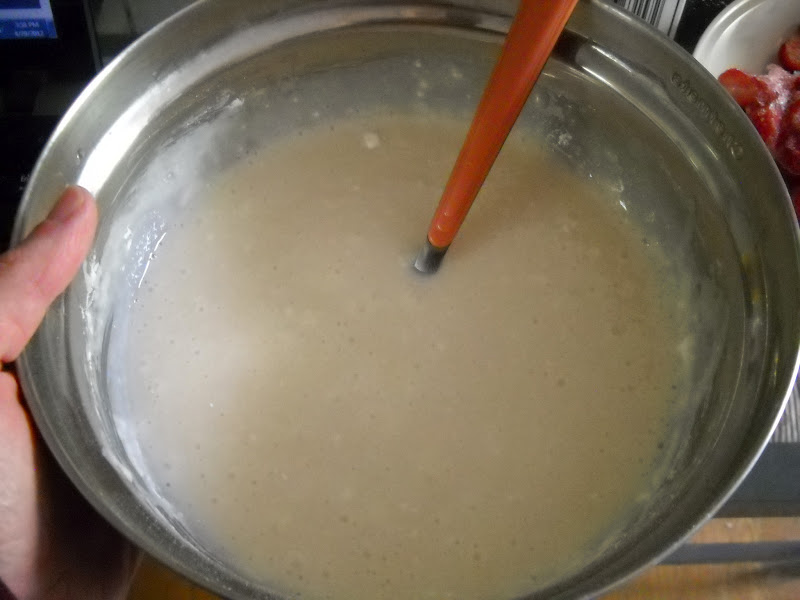
Mix together the milk and the dry ingredients in a bowl.


Yup, mixed.


Now to put it all together: pour the butter into a 9 x 13 inch pan.


Then pour in the batter.  Spread it but don't stir it.


And drop the blackberries on top.  I should have sprinkled them over top instead of lumping them into one place, because again, I couldn't stir it but how else was I supposed to distribute the fruit?  It also left me with some parts of the cobbler that were surprisingly fruit free.


I had to add those strawberries too.


Sprinkle sugar over it all.  The recipe recommends up to two additional cups (!) I know this ain't health food but still.  I eyeballed about a cup at the most.


Bake at 350°F for about an hour, or until it looks like this.


Cobblers are so damn easy to make, and so good afterwards to boot.  Again, it was a little light on the fruit around the edges, but that's really my fault more than anything.  Eat this hot and think about adding some ice cream.  I think I may have to get some today.

- - - - -

We are heading back to the East Coast now, to the Keystone State, part Northeast and part Midwest, a little bit Philly and a little bit Pitt, next we stop to see all that Pennsylvania has to offer.

Sources:

Brooks, Karen.  "Portland's top 10 food carts".  Posted October 8, 2009 (The Oregonian), reposted August 6, 2011 (OregonLive.com).

Cuisine Bonne Femme & Dieselboi (blog authors).  "About" (About Page for Food Carts Portland".  Copyright 2012 Food Carts Portland, all rights reserved.

Lewis, Nancy (recipe author).  "Marionberry Cobbler".  Information page for the episode "A Cuisine of Our Own" from the television program Oregon Experience, 2010.  Copyright Oregon Public Radio 2010-2012, all rights reserved.

Mersinger, Monica.  "Marionberries: A Delicious Part of Salem's Past".  Salem Online History, 2006.  Copyright Salem Public Library, 2005-2006, all rights reserved.

Oregon Public Radio. "A Cuisine of Our Own".  Information page for the episode "A Cuisine of Our Own" from the television program Oregon Experience, 2010.  Copyright Oregon Public Radio 2010-2012, all rights reserved.

Porges, Brad.  "Hazelnut Salmon with Apple and Pear Compote".  Posted on the Oregon Food website, date unknown. Copyright Travel Oregon 2009-2012, all rights reserved.

Shouse, Heather.  Food Trucks: Dispatches and Recipes from the Best Kitchens on Wheels.  Random House: New York, 2011.

World Culinary Institute. "James Beard".  World Culinary Institute, date unknown. Copyright World Culinary Institute, all rights reserved.

Some information also obtained from Wikipedia's "Oregon" page and other pages, and the Food Timeline State Foods link to "Oregon".

Tuesday, March 06, 2012

Snacking State-by-State: New York IV - An apple cake any llama with the drama would love

When journalist Josh Kilmer-Purcell and his partner Dr. Brent Ridge bought a farm in upstate New York, they came to understand the ins and outs of running a farm and selling its wares day to day.  Eventually this project led to The Fabulous Beekman Boys television show, based on the drama of running the Beekman 1802 Farm in Sharon Springs (this also led to Kilmer-Purcell's book The Bucolic Plague, available at bookstores and libraries near you).  Anyone who has seen their show knows that the townspeople often appear on the show.  Some of the residents of Sharon Springs even had their recipes  appear on the Beekman 1802 website during the holidays - a virtual Advent Calendar.

Official Name: State of New York
State Nicknames: The Empire State
Admission to the US: July 26, 1788 (#11)
Capital: Albany (6th largest)
Other Important Cities: New York City (largest in the state, largest in the nation!), Buffalo (2nd largest), Rochester (3rd largest), Syracuse (5th largest) 
Region:
 Northeast, Mid-Atlantic; Mid-Atlantic (US Census)
RAFT Nations: Maple Syrup; Wild Rice; Clambake
Bordered by: Québec (Canada) (north), Lake Ontario (northwest), Ontario (Canada) & Lake Erie (west), Pennsylvania (south and southwest), New Jersey (south), Connecticut & Long Island Sound (southeast), Massachusetts & Vermont (east)
Official State Foods and Edible Things: apple (fruit), milk (beverage), sugar maple (tree - for the maple syrup), rose (flower - they are edible, you know), trout (fish), apple muffin (muffin), bay scallop (shell), beaver (mammal, though outside of "Bizarre Foods" you won't see many people eating these)
Some Famous and Typical Foods: In New York City, anything and everything - it is one of the most multicultural and diverse cities in the United States, and is a culinary capital of the nation; typical NYC foods include: Waldorf salad, bagels & bialys, corned beef and pastrami, chocolate egg creams, hot dogs, New York pizza, General Tso's chicken, Baked Alaska (invented in New York City), and so on; New York cheesecake; "garbage plate" (Rochester only); Buffalo wings (Buffalo of course); apples and maple syrup, and of course, more apples


Josh & Brent have a lovely homage to the Beekman Farm's hometown, the Sharon Springs Heirloom Recipe Advent Calendar.  The residents of Sharon Springs, many of whose families have been in the town for generations, offer up family recipes and a slice of life in rural upstate New York that the rest of us don't think about when we're visiting New York City proper.  Inevitably, one of those recipes features the official state fruit, the apple.

While every recipe caught my attention, the one with apples posted under the December 12th entry filled my need for apples and cake at the same time.  Long time Sharon Springs shop owner Maureen Lodes, who owns and operates the Cobbler & Co. in town, shares with the Beekman Boys and with the world her family recipe for Apple Cake.  The video on the Beekman 1802 Advent Calendar website - yes, every contributor has her or his own video - follows:


A charming lady with her charming apple cake!  Prepare to be charmed.

The Recipe: Maureen Lodes' Apple Cake (care of Beekman 1802)

I tried to follow Lodes' recipe more or less the way she wrote it, though I had no 9 or 11 inch, or 9 by 11 inch.  The one in the video looked like a round dish anyway.  A 9" round dish is about 63 square inches.  My 8 x 8 inch cake dish is 64.  Close enough.

For her apple cake, you will need:


* apples (in an apple cake?  Yes - enough that when sliced they will cover the bottom of the dish in one layer.  I ended up needing about four)
* flour (had it)
* baking powder (had it too)
* sugar (same)
* salt (again, had it)
* milk (had it)
* butter (yup, got that too)
* eggs (got 'em)
* vanilla (hey, I have just enough!)
* You should also have on hand nutmeg and cinnamon to sprinkle on the raw apple slices.


Peel, core and slice your apples.


Enough to cover!  Perhaps they should be thinner, but this worked out fine in the end.


Oh yes, sprinkle liberally with nutmeg, and/or cinnamon, and/or more sugar, and butter bits as needed.


In another bowl, add your flour - unsifted, please.  This is so easy!  Just scoop and dump!


Then add bits of cold butter.


And next add your sugar mixture.


Mix everything together, with a spoon and not a beater or mixer.


Add the eggs and vanilla.


And again, mix until it is thoroughly blended - like so.  Lodes notes that the batter will be lumpy, due to the butter.  It won't be a problem.


Spoon on top of the apples and spread out to within an inch of (or as far as it can go towards) the sides.


Bake for an hour at 350°F.


As you can see, the topping spreads out while baking.


It does seep in between the apples, probably more so if the apples were sliced thinner.


And there you have it - a family apple cake recipe right from Sharon Springs, using the famous New York State apple.  It's a delicious cake, with a firm, buttery cake on top of soft, cinnamon-y apples.  It's pretty easy to make, so this is one I will have to come back to.


Sources:

Anchor Bar.  "The Original Buffalo Wings Story".  Published 2008.  Copyright 2008 The Anchor Bar.  All rights reserved.


Beekman 1802 (Josh Kilmer-Purcell & Brent Ridge).  "December 12" (Maureen Lodes' Apple Cake).  Posted on the "Sharon Springs Heirloom Recipe Advent Calendar" page, Beekman 1802 website.  Copyright 2011, 2012 Beekman1802.com. All rights reserved.


Beekman 1802 (Josh Kilmer-Purcell & Brent Ridge).  "Sharon Springs Heirloom Recipe Advent Calendar" page, Beekman 1802 website.  Copyright 2011, 2012 Beekman1802.com. All rights reserved.


Bon Appétit.  "Old-Fashioned Chicken Noodle Soup".  Posted on the Epicurious website, December 1998.  Copyright 1998, 2012 Epicurious.  All rights reserved.  


Center for Jewish History.  "Jews In America: Our Story".  Copyright 2005 Center for Jewish History.  All rights reserved.


Mannur, Anita.  "Indian Food in the US: 1909-1921".  Published on the South Asian American Digital Archive website October 18, 2011.  Copyright 2008-2012, South Asian American Digital Archive.  All rights reserved.


Mitzewich, John.  "Authentic Anchor Bar Buffalo Chicken Wings".  Published on About.com, date unknown. Copyright 2012 About.com.  All rights reserved.

Roberts, Adam (Amateur Gourmet).  "Fall Out Of Fall With A Matzah Ball".  Posted November 21, 2006.  Copyright 2004-2012 Adam Roberts.  All rights reserved.


Sahni, Julie.  Classic Indian Cooking.  William Morrow & Company: New York, 1980.


Sheraton, Mimi.  "Introduction: A Table Before Me".  In The New York Times Jewish Cookbook, edited by Linda Amster.  St. Martin's Press: New York, 2003.


Stradley, Linda.  "New York Egg Cream - How To Make An Egg Cream".  Published on What's Cooking America (WhatsCookingAmerica.net) 2004.  Copyright 2004, 2012 What's Cooking America.  All rights reserved.


Suddath, Claire.  "A Brief History of Buffalo Wings".  Published on the Time Magazine website (Time.com), September 3, 2009.


Sussman, Lance J.  "Jewish History Resources: New York Jewish History".  Posted on the New York State Archives website, date unknown.  Copyright 2012 New York State Archives.  All rights reserved.

Stallworth, Lyn, and Rod Kennedy Jr. The Brooklyn Cookbook.  From the Knopf Cooks American series.  Alfred A. Knopf: New York, 1991. 


Some information also obtained from Wikipedia's "New York" and "Demographics of New York City" pages and other pages, and the Food Timeline State Foods link to "New York".

Wednesday, December 28, 2011

Snacking State-by-State: Nebraska II - Wojapi makes me happi

Like the pemmican I made a while back, wojapi is a classic Great Plains dish.  Dale Carson, author of New Native American Cooking, makes hers from blackberries, but any berries (or even peaches if you've got 'em) will work with this dish.

Official Name: State of Nebraska
State Nicknames: The Cornhusker State
Admission to the US:  March 1, 1867 (#37)
Capital: Lincoln (2nd largest)
Other Important Cities: Omaha (largest), Bellevue (3rd largest), Grand Island (4th largest)
Region:
 Midwest, Great Plains; West North Central (US Census)
RAFT Nations: Bison; Pinyon Nut
Bordered by: South Dakota (north), Iowa, Missouri (east), the Missouri River (northeast and east), Oklahoma (south), Colorado (southwest), Wyoming (northwest)
Official State Foods and Edible Things: channel catfish (fish), honeybee (insect - of course, the honey is what people eat, not the bee), white-tailed deer (mammal)
Some Famous and Typical Foods: corn, wheat and honey; foods of the Great Plains, including Native American foods (pemmican, wojapi, etc); foods from German, Czech and Russian immigrants, and foods from Midwestern and Southern settlers; the Reuben and runza sandwiches; beef (Omaha steaks)


Wojapi is the Lakota Sioux (and most widely used) name for the fruit pudding found throughout the Great Plains.  An article from the Lincoln Journal Star earlier this year noted that the Ponca Tribe threw a party for the town of Milford, Nebraska, to thank the community that buried a member that died over a century ago on the forced Ponca Trail of Tears march from Nebraska to Oklahoma in the 1870's, to thank the community for "taking care of our ancestor for 134 years" noted Ponca Museum cultural director Gary Robinette [Abourezk 2011].  The feast, the article notes, included "a traditional meal of buffalo corn soup, frybread and wojapi (a kind of fruit pudding)" [Abourezk 2011].

There are various recipes out there for wojapi, but they are more or less the same: berries, water, cornstarch or flour, and sugar or honey.  Dale Carson's Lakota-style wojapi [1996: 157] has an almost 2 to 1 ratio of berries to sugar.  Hers also calls for minimal water, while a recipe on the NativeTech website for "blueberry wojapi" calls for twice as much water as sugar.  The same holds for a wojapi recipe posted on this multiethnic Nebraska for Life handout of recipes for many ethnic groups in Nebraska (indigenous and immigrant).

You don't necessarily have to add pure white sugar either.  A recipe on the Traditional Indigenous Recipes page of the American Indian Health and Diet Project aims to tackle the double tasks of fighting obesity and diabetes among Native Americans today, and making a more traditional version of the classic Great Plains fruit pudding.  This version, as the site notes,
...was not [traditionally] made with flour or sugar, but today it often is, rendering it only a marginally nutritious dish (even less so if the berries used are frozen “with sugar added”). If the berries you find are ripe and tasty, there is no need to add additional sweeteners. [American Indian Health and Diet Project, date unknown]
Instead of sugar, the recipe calls for honey to sweeten the wojapi, if you need anything at all.  It is this recipe that I decided to use.  Hell, I could use less sugar in my diet, too!

The Recipe: Wojapi (Plains Indian Fruit Pudding) - Sugar-Free Version


To make this version of wojapi you will need:


* fruit (in this case strawberries - I went to a farm not far from work a few months ago and picked these myself - a wide shallow cardboard box for $10 per pound - and I had these beauties waiting in the freezer since then.  This seems like a great use for them.  These two bags of frozen strawberries amounted to roughly 4 to 5 cups).
* water (this is one of the recipes calling for a smaller ratio of water - only a quarter cup)
* cornstarch (if you want to thicken it the faster way, which Mr. Impatient here would prefer)
* honey (to sweeten, literally as needed)


Take your strawberries (and thaw them if they're frozen), and mash them until pulpy.


You will then add the strawberries and water to a large pot, bring to a boil...


...and then simmer for an hour, stirring occasionally.


After half an hour it boiled down to this.


While you're simmering it, add some honey to taste.  I added about four spoonfuls, which sweetened it a little bit.


Stir in the honey, and add more to taste if you want.


If this isn't thick enough for you (or me), mix some cornstarch in a little bowl with some water.


Add the cornstarch water to the wojapi and stir it in.  I did this at the end, after I turned it off.


Stir in and serve up!


You could eat the wojapi straight up, or use it as a topping for many things.  Recipes I saw recommended it as a topping for frybread, ice cream or biscuits.  I tried it on freshly made paneer cheese.  This would also go great with Greek yogurt, or on that Czech Christmas bread I just made not long ago.  It is good stuff.  Find something to put it on and eat away.

Sources:

Abourezk, Kevin.  "Ponca Tribe to honor Milford for historical gesture".  Lincoln Journal Star.  Posted May 29, 2011.

American Indian Health and Diet Project.  "Traditional Indigenous Recipes: Wojapi".  American Indian Health and Diet Project, date unknown.  Copyright 2011, American Indian Health and Diet Project

Carson, Dale. New Native American Cooking.  Random House: New York, 1996.

CzechMate Diary (Tanja, blogger).  "Czech christmas magic: Vanocka / Kouzlo Vanoc: Vanocka".  CzechMate Diary.  Posted December 11, 2008.

Hill, Cheryl Joy.  "Blueberry Wojapi".  NativeTech.org: Indigenous Food and Traditional Recipes.  Date posted unknown.  Copyright 2011 NativeTech.

Nebraska Folklife Network.  "Recipes: Traditional Foods of Nebraska Ethnic Groups".  Date unknown.  Copyright 2011, Nebraska Folklife Network

Nebraska Guide (Nebraska-Guide.Info).  "As American as Apple Pie".  Date unknown.  Copyright 2004-2011, Interatctive Internet Websites, Inc.

NebraskaStudies.Org.  "The Immigrant Experience: The Czechs Move to Nebraska".  The Homestead Act: Who Were The Settlers? From Nebraska Studies.Org, date unknown.

Rader, Jim.  "Brief History of the Reuben Sandwich". The Reuben Realm, date unknown.

Red Star Yeast.  "Vanocka".  Red Star Yeast, date unknown.  Copyright 2011, Red Star Yeast.

Stern, Jane & Michael (Roadfood.com).  "Runza".  Roadfood.com, date unknown.  Copyright 2011, Roadfood.com.

Stradley, Linda.  "Reuben Sandwich - History of Reuben Sandwich".  What's Cooking America (WhatsCookingAmerica.net), 2004.

Weisman, Karen.  "Baking a Four-Strand Challah Bread Loaf".  eHow.com, date unknown.  Copyright 2011, eHow.com.

Some information also obtained from Wikipedia's "Nebraska" page and other pages, and the Food Timeline State Foods link to "Nebraska".