

Today I had better success eating meat-free. Lunch today was a sushi roll at Howard Community College. Do I remember the days when schools did not serve sushi. Those were less interesting food days.
Showing posts with label sushi. Show all posts
Showing posts with label sushi. Show all posts
Friday, March 18, 2011
Meatless Friday #2
Sunday, March 06, 2011
Snacking State-by-State Mashup 2: Denver Omelette Roll and Delmarva Roll
Sushi takes a while to make, so I don't plan to make much of it in the near future. So to use up the rest of that sushi rice I decided to make a few more maki rolls - one of the many California recipes I tried out - out of some ingredients from my Colorado, Connecticut and Delaware posts.
Both rolls require making some sushi rice, the procedure for which you can find in my post for Southern California. I had enough sushi rice left for a little more than two rolls.
The mash-up recipes: Denver Omelette Roll and Delmarva / Clambake Nation Roll
Serves 1 or 2
Ingredients (state flag indicates State-by-State post where ingredient was featured. Ingredients with no flag were not specifically used for any one post): sushi ricesushi noririce wine vinegar (worked fine for me, though technically you should use rice vinegar instead)sesame seeds
 a few strips red bell pepper1 egg a few strips ham steak
 a few strips chicken breast3 oysters
 6 to 8 whole baby clamsa few slivers peacha few pieces avocado
wasabi mayonnaise
tempura batter:
1 cup flour
1 cup ice water
1 egg
After preparing the sushi rice, place it on a slice of nori on your bamboo sushi mat - this time I just put the bamboo mat in a gallon-size ziploc bag instead of saran wrap. Sprinkle with sesame seeds, and carefully flip over the nori so it is facing up and the sushi is facing down.
Maki Roll #1: Denver Omelette Roll
Next come the roll making itself. For the first roll, I wanted to revisit that first Denver omelette I made. In a way, I deconstructed it, got rid of the cheese, and put it in a roll.
Into this roll go the following: about half of a small one-egg omelette, a few strips of ham steak, and a few strips of red bell pepper. Green bell pepper is more authentic, but I don't enjoy eating it, so it's out. A little avocado on top (maybe I should have put it on after rolling it up instead of before), and then a little wasabi mayonnaise complete this roll.
 The Denver Omelette Roll
Maki Roll #2: Delmarva (or Clambake Nation) Roll
The second roll I made used ingredients from my Connecticut and Delaware posts - clams, oysters, chicken and peaches (all found in Delaware, and the clams and oysters also grow in Connecticut). Both states are in the RAFT Nations' "Clambake Nation", spanning coastal New England, New York City, New Jersey and much of the Delmarva Peninsula. A catchier name, however, may be the "Delmarva Roll", which is why I'm trending towards that one. Call it Fred for all I care though. The name's not that important.
For the Delmarva Roll, you'll need to make a tempura batter. This is fairly simple, so long as you use ice cold ice water. I just filled a bowl with water, stuck it in the freezer and occasionally broke the top if it froze over, until I needed it. Then mix it with a cup of flour and a beaten egg. Dip whatever you want to deep fry in the tempura batter. For example, for this roll I tempura-fried the clams and freshly shucked oysters. yes, the oysters met their end very quickly in the middle of fast-fried tempura batter. PETA will not like this recipe.
 Tempura clams, tempura oysters, and tempura crunchies, better than what you get at Long John Silver.

Into this roll go the following: the tempura clams (I did eat a few on the side - you'll use about 5 or 6), the tempura oysters (I used 2 and ate the third. I couldn't help it), small slices of peaches (about four) and a few slivers of cooked chicken breast. Again, roll it up, and top with a few more thin slices of peach.
 The Delmarva Roll, or Clambake Nation Roll

As with the California roll I made a while back, these rolls were quite filling - so much so, in fact, that I felt the need to bite into some of the roll slices, resulting in the rolls falling apart. I think the Denver Omelette roll turned out the better of the two. It really was like eating a little Denver omelette inside a thick layer of rice and some wasabi mayonnaise. The Delmarva roll turned out less successfully in my view. Strange as it seemed to me, the chicken, oyster and clam competed for attention instead of complementing, which strangely led to one big mish-mash blur of blended flavors. Perhaps the crispy tempura coating masked the flavor of the shellfish? It was not a bad roll. I just wish the various meats had not competed with each other so much. This was perhaps a more successful attempt at maki rolls than the last time. But it is a tedious process, and I think I will leave the sushi making to the sushi chefs.
Sunday, January 16, 2011
Snacking State-by-State: California Part 1B (the Southern Half) - In Which I Try to Make Sushi
Southern (and, yes, Northern) California is also home to some of the best Vietnamese, Filipino, Indian and - yes - Thai foods. The last time I was in town I think I found more Thai restaurants than Mexican, Italian or Japanese. These are just some very large drops in the multicultural bucket that is Southern California. Take Japanese food, for example.
Snacking State-by-State: California
 Official Name: State of California
State Nickname: The Golden State
Admission to the US: September 9, 1850 (#31)
Capital: Sacramento (7th largest city)
Other Important Cities: Los Angeles (largest, & 2nd largest in the USA), San Diego (2nd largest), San Jose (3rd largest), San Francisco (4th largest)
Region: West, Pacific (small sections of the state can be considered Northwest or Southwest in terms of its food and culture); Pacific (US Census)
RAFT Nations: Acorn, Chile Pepper, Pinyon Nut, Salmon
Bordered by: Baja California, Mexico (south), Arizona & Nevada (east), Oregon (north), Pacific Ocean (west)
Official State Foods and Edible Things: golden trout (fish), California Valley quail (bird), grizzly bear (animal)
Some Famous & Typical Foods: Where to begin? "New California cuisine", diversity of ethnic cuisines, especially Asian, Latin American and Mediterranean (Mexican, Chinese, Japanese, Filipino, Thai, Salvadoran, Korean, Italian), citrus (especially in the south), wine (especially in the center and north), seafood, dates, and so much else
It was in Los Angeles that Japanese food, specifically sushi, spread to the rest of the country, all because of one special roll. The online Sushi Encyclopedia says more:
The California sushi roll, or simply California roll was invented in Los Angeles, California in the late 70's and is considered a big leap in sushi culture. It is also credited for spreading the popularity of sushi in the western world. Until the California roll was invented, most sushi rarely utilized ingredients that were foreign to Japanese cuisine. It was also out of the question to use imitation crab for a cuisine that concentrated on using the best seafood possible. [SushiEncyclopedia.com]California was the site of my first sushi experience. And though the California roll was not my first taste of sushi - at least I don't think it was - it was probably the first introduction to sushi for most Americans: that maki roll with cucumber, avocado and cooked crab and/or cooked shrimp and/or imitation crab in the middle. The California roll is unquestionably American, and it seemed like an appropriate place to get my feet wet in the world of making sushi.
The recipe: California Roll
The California roll was, perhaps, one of the most time-consuming recipes I have ever made. Mind you, this was the first time I had ever made sushi of any kind, so I was bound to go slowly. On top of that, I found myself constantly running out to buy this ingredient or that. It was not an efficient or money-saving experience for me. True, it will become easier, cheaper and faster as I make more. I sure hope so anyway.

The ingredients were many and varied:
 * Sushi rice (one box of 2 1/2 cups of dry rice was about $3, but there are cheaper ways to obtain it). To that you must add the following three items:
* Rice vinegar (Einstein bought mirin rice wine vinegar instead, for $3, but that turned out to work fine anyway. I originally thought I had this, but the Chinese rice vinegar I had was much darker and probably wouldn't have worked for this recipe)
* Sugar (that I have)
* Salt (again, yes. Have that)
In addition, you need the stuff that goes in the roll:
 * Cucumber ($1.49 per lb. I bought two but ended up needing one)
* Avocado ($1.50 for one)
* Crab (I bought about half a pound of Alaskan king crab legs for $12 per lb - that is, $6. I could've purchased imitation crab, but I was at Whole Foods, and for some strange reason theirs was actually more expensive than the real deal. Also because a Marylander such as myself just feels weird buying imitation crab, alright?)
* Nori (about $6)
* Sesame seeds (these I had)
And I needed a bamboo mat for rolling the California roll. I was surprised that this was only about $3.50, and even came with its own wooden paddle.
There are a few steps to making a California roll, and many books for the novice sushi chef. The one I ended up using was Sushi by Ryuichi Yoshii. Yoshii's book (one of many equally useful books he has authored on this subject) has many helpful photos, an illustrated glossary and lots of basic and more advanced, creative recipes. Yoshii's steps more or less parallel the following:
1. Make the sushi rice. First, wash it two or three times until the water is relatively clear.

Mine never got completely clear, and it is recommended that you not overrinse it. Let it drain for 30 minutes to an hour, and set it in the rice cooker.
 Find something else to do. I was skinning butternut squash. You'll find out why next week.
I used a rice cooker which seemed to have made for an especially sticky rice at first, but ended up being just fine.

No rice cooker? Watch John Mitzewich, whose video still helped me greatly in my first ever sushi rice making experience. About.com won't let me embed the video here. Just click on the man's name to watch how he does it.
I found this process to be the most difficult of the recipe: it seemed that both fanning the rice and drizzling the rice vinegar seasoning over it required the use of my right hand. Note: I am clearly not ambidextrous.

It will be ready for sushi-making when you can form it into a ball that stays together until you bite or dig into it.
 I'm not expecting any job offers from Minato, Chiyo or RA Sushi any time soon.
In retrospect, making sushi rice (redundant, actually, since "sushi" means "vinegared rice") was easier than I thought it would be. But it still wasn't easy.
2. Next, prepare the roll itself (again, online tutorials such as this one from About.com are very helpful): lay down the nori, then with wet fingers apply and smooth out sushi rice over most of the sheet.

Depending on whether you want an inside-out roll or not, flip over the rice-covered nori or not.
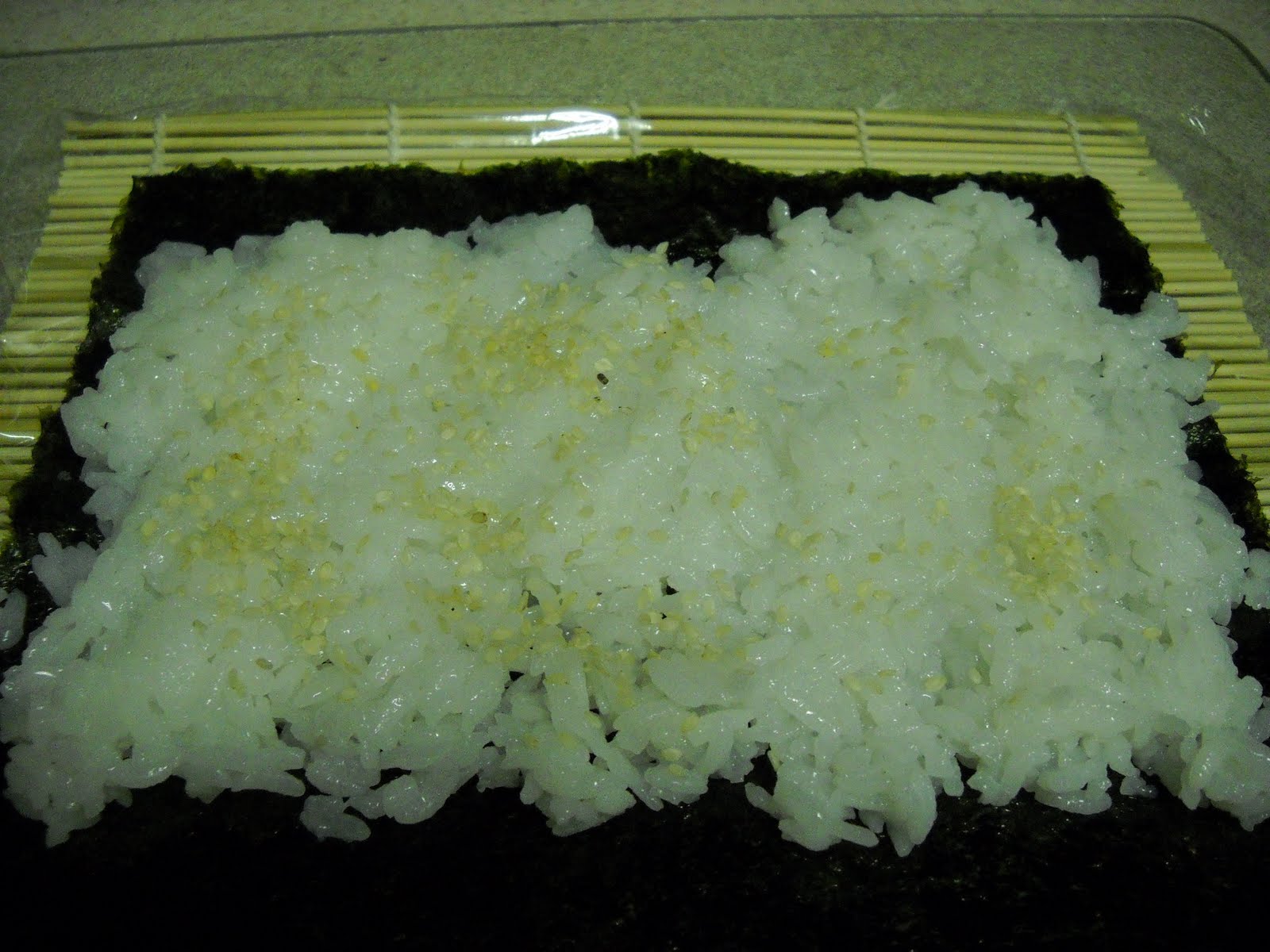 If you do want an inside-out California roll, sprinkle the rice with sesame seeds...
 ...and turn that puppy over.

Roll it up as tightly as you can. Here I failed, in retrospect. My roll could have been a bit tighter because some of the pieces were a little difficult to keep from falling apart, to wit:
 Yeah, make that tighter.
 Help! The avocado and crab are trying to escape!
As I made more, I did get better.
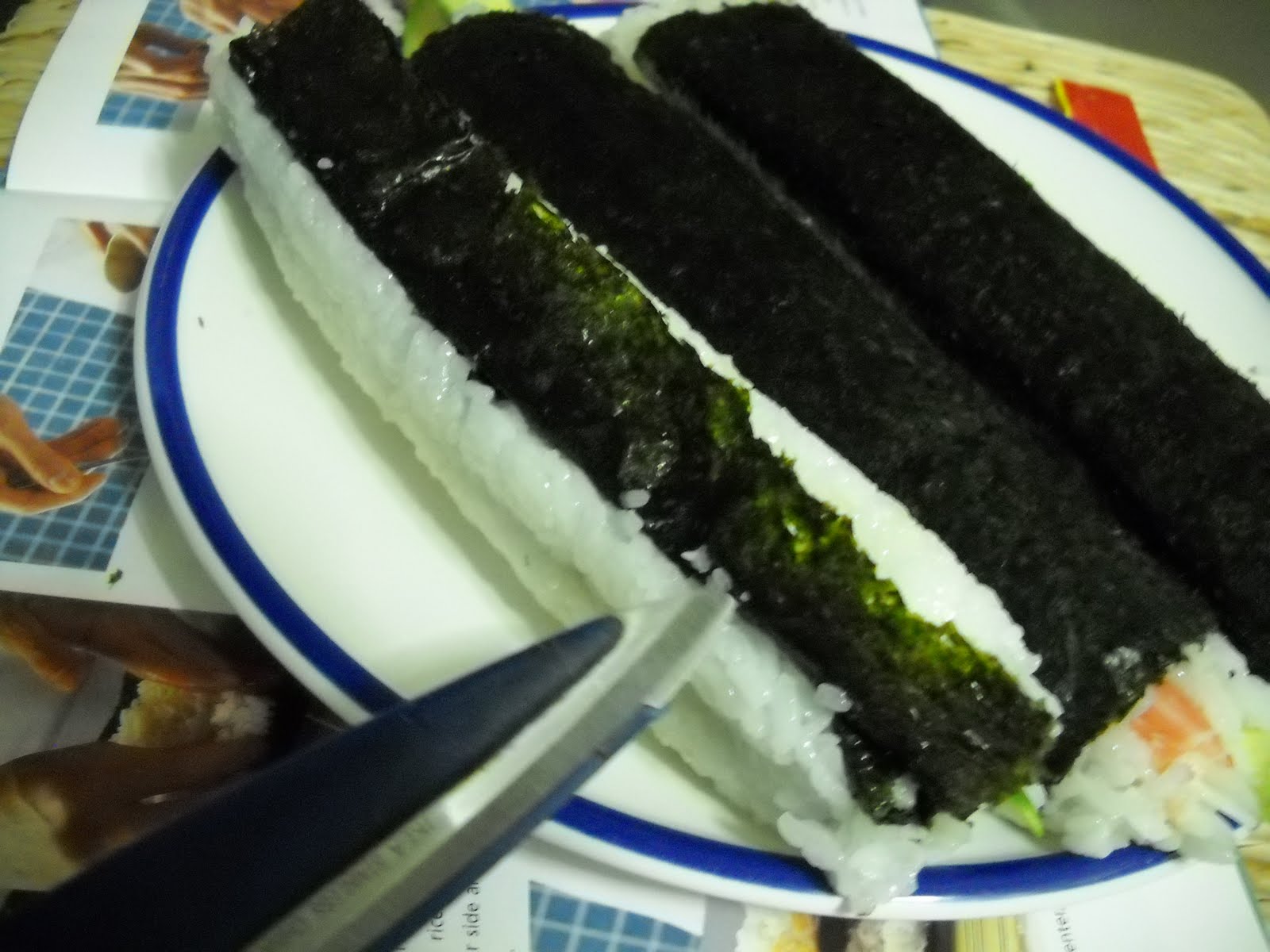 Oopsie! Some overhang. Better get those kitchen shears out.
Yes I know that's cheating. I don't care.

This California roll was especially filling, and why wouldn't it be? You need about a cup of sushi rice to make one roll that can be sliced into 8 to 12 pieces. On the other hand, I ended up using only half my avocado and cucumber. Lots of rice, not lots of vegetables. It was an educational experience, I must say, and it was satisfying to know that the freshly made sushi roll in front of me was made with my own hands. But with so much effort that had to be put forth, I may hold off on making another one at least until I'm done with this State by State thing.
Sources:
Mitzewich, John. How to Prepare Perfect Sushi Rice (video). About.com, date unknown.
Saveur. "Date Shake". Saveur.com (http://www.saveur.com). Originally printed in Saveur Issue #70, November 2003.
Yoshii, Ryuichi. Sushi. From the Essential Kitchen series. Periphus Editions (HK) Ltd., Boston, 1998.
Yoshizuka, Setsuko. "Making California Rolls". About.com, date unknown.
Some information also obtained from Wikipedia's "California" page and the Food Timeline State Foods webpage link to "California".
Subscribe to:
Posts (Atom)


