
Ah, summer. Filthy, shameful summer. Seriously though, whether you work in some sort of educational profession or not, you usually feel down about it coming to an end. And while this one was probably one of the hottest I can recall, fraught with more Grand Prix construction, it was not without its high points food wise.
Chiapparelli's, Little Italy, Baltimore
I headed here for Restaurant Week (yes, I really am taking that long to write this), and Chiapparelli's, a place my family had gone several times before, was one of the few places that did a prix fixe dinner for only $20 instead of $30. True, with beer, tax and tip (yes I drank beer with Italian food, okay? Sue me. And it wasn't even Peroni) it came closer to $35 but imagine what it would have been otherwise. I had a lovely salad and a minestrone soup that made me love minestrone again. I had grown tired of it, but Chiapparelli's was a nice change. The main course was the hearty, luscious shrimp nicola that I could just sit there and eat again and again if I had no bottom to my stomach. A cannolo for dessert topped off a fine, relatively iinexpensive (before drinks, tax and tip) gut-busting Italian meal.
Toss, North Baltimore
I went with friends Eric & Alan for pizza at Toss, a newly opened upscale BYOB pizza place on York Road. Long story short: cheap but good pizza and salad. Each of us spent about $10 - 15. The Greek salad is more than enough to fill you up before you get the pizza, which had a nice crispy crust underneath all that melted cheese. We got the Toss Special, covered in mozzarella, ham, Italian sausage, caramelized onions, roasted red peppers - hoo, Lawdy, is it hot in here?
Sláinte Pub, Fells Point, Baltimore
I've written about Sláinte a few times, and visited many, but I do have to give a shout out about the Irish bibimbap. You read that right. It's a Celtic take on the Korean classic, swapping out Korean style beef for Irish corned beef. Try it. It's good.
Aladdin Kabob, Mt. Vernon, Baltimore
This is one of those places you constantly pass by and never bother to go into because it's neatly tucked away where you cannot find it. Next to Mari Luna and across from the Meyerhoff, Aladdin Kabob (their sign is "Aladdin Kabob" but their website is spelled "Alladin Kabob", so please note) is a quite unassuming and, unfortunately, pretty sparsely populated Pakistani restaurant. At least it was when I went in on the Friday night of Artscape weekend. I didn't really see much of Artscape myself, but I did feel this place pulling men, and I left absolutely stuffed and with leftovers! Better yet, I was stuffed with food that was delicious: samosas, their wonderful chapli kabob for only $7, not to mention the free bread (the biggest naan I have ever seen) and a chickpea side dish. Your dollar will go a long way here.
Mission Inn, Riverside, CA
I didn't write anything about my recent trip to SoCal, but I have to note the beautiful, historic Mission Inn in Riverside. I note it for a few reasons: it is on the California Register of Historic Places, it's absolutely gorgeous both inside and out - done in an eye-popping Mission style (hence the name), and in all the years I've lived in and (since moving back home) re-visited the Inland Empire - 15 years I've known about this place - I've never been in. All that changed this month, as I decided to treat myself to a lunch that I knew was going to be a little pricier than I'm used to spending.
If you go to the Mission Inn to eat, note that there are several restaurants inside, including: Las Campanas (a Mexican restaurant), Bella Trattoria (an Italian restaurant), 54° at Duane's (a super upscale wine bar), the Presidential Lounge (ten US presidents have passed through the Mission Inn, including Ronald Reagan who honeymooned here with Nancy; this cocktail bar and lounge gives a nod to all of them), Duane's Prime Steaks & Seafood (steak, seafood, pricey), and Casey's Cupcakes, featured on that cupcake challenge TV show (Casey was a winner!)
I went for the Mission Inn Restaurant itself, and was pleasantly surprised when the waitress told me about their lunch buffet. Surprised not only that such a nice place would have a buffet in the first place, but that it was all of $18 (less than I would have otherwise spent), with a nice selection (quality wise, and to some extent quantity, too). When I was there, they served up (among other things) Korean short ribs, chicken, fish, and everything was delicious. Usually chicken and fish can and should be avoided with aplomb at these buffets, but the Mission Inn knows better than that. You get your money's worth. And please get some of the dessert as well. Their bread pudding is was the single best thing I ate the whole time I was out there.
Wednesday, August 29, 2012
Tidbits: Boys of Summer Edition
Sunday, January 23, 2011
Snacking State-by-State: California Part 2A - the Northern Half (California Fresh!)
Last week, I reveled in recipes from the Southern half of California, which I know quite well. This week, I try to understand the foods of the Northern half of the state, a place that is strange and unfamiliar to this Southern California boy. Okay, honorary Southern California boy by way of Baltimore, my hometown and current location.
Just to reiterate the background info:
Snacking State-by-State: California
 Official Name: State of California
State Nickname: The Golden State
Admission to the US: September 9, 1850 (#31)
Capital: Sacramento (7th largest city)
Other Important Cities: Los Angeles (largest, & 2nd largest in the USA), San Diego (2nd largest), San Jose (3rd largest), San Francisco (4th largest)
Region: West, Pacific (small sections of the state can be considered Northwest or Southwest in terms of its food and culture); Pacific (US Census)
RAFT Nations: Acorn, Chile Pepper, Pinyon Nut, Salmon
Bordered by: Baja California, Mexico (south), Arizona & Nevada (east), Oregon (north), Pacific Ocean (west)
Official State Foods and Edible Things: golden trout (fish), California Valley quail (bird), grizzly bear (animal)
Some Famous & Typical Foods: Where to begin? "New California cuisine", diversity of ethnic cuisines, especially Asian, Latin American and Mediterranean (Mexican, Chinese, Japanese, Filipino, Thai, Salvadoran, Korean, Italian), citrus (especially in the south), wine (especially in the center and north), seafood, dates, and so much else
Northern and Central California are perhaps most famous for their wine. As I pointed out last week, California wines have gotten good enough that they now rival wines from France in many competitions. Most famous among the California wines are those from Napa and Sonoma (though again, they aren't the only ones). I never got the chance to take a tour through wine country, though my friends Jim & Gil, also from SoCal, have talked about it. We will, someday. As Eric, one of my much more local friends, pointed out to me over a New Year's Eve dinner (thanks, guys), California grapes played a very important role in rescuing the French wine industry. In the 19th century, vineyards in both England and on the Continent were ravaged by the Phylloxera. Unable to stop their vineyards from dying, European vintners eventually grafted cuttings from North American vines that were more resistant than the completely non-resistant European varietals.
Of course, Northern (and Central) Cali is more than wine. It's also the home of Berkeley-based chef Alice Waters, the executive chef of Chez Panisse and the public face of "California cuisine". California cuisine is not the same thing as "California's cuisine". It's a whole way of looking at, procuring, preparing and eating food, period. It is the use of the freshest, most locally-grown and most in-season ingredients as you can find, and often prepared as simply as you can prepare them. As Waters writes in her book Chez Panisse Vegetables, we can all live "California cuisine" without even coming close to the Golden Coast:
If at all possible, plant a garden yourself, and above all, patronize farmer's markets. Get to know your purveyors and producers and give them feedback... Always explore your garden and go to the market before you decide what to cook. Decide on your menu based on what you find there. Buy products that are fresh, local, and organic. Select produce that looks freshly harvested and at its peak. Look for vegetables that look right back at you! [Waters, p. xix]In the spirit of Waters and California cuisine, I looked for something simple and in season to prepare. At first I thought a salad would be a great idea, but lettuce isn't exactly in season in Maryland right now. Winter squash is, and I ended up finding one from the farmers' market right on my counter.
The recipe: Oven-Roasted Squash with Garlic and Parsley

This recipe, from Waters' Chez Panisse Vegetables cookbook, is a simple and surprisingly sumptuous way to prepare pretty much any winter squash. I found it worked especially well with butternut. It was almost as easy as that date shake I wrote about last week:
* winter squash (mine was a butternut, about 1 lb, which I bought at the farmers' market for a buck)
* olive oil (had it)
* salt and pepper (had those, too)
* garlic (had a few cloves left)
* fresh parsley (had just enough in the fridge)

Peel and seed the squash and dice it into 1" pieces, then toss it with olive oil, salt and pepper. Waters' recipe didn't give exact amounts. I just added enough to my liking. Please, please don't go overboard with the salt and pepper.

Put the pieces on a baking sheet and bake for 375°F for 40 minutes, moving it around with a spatula once in a while to make sure it doesn't burn.

While baking the squash, finely chop a few cloves of garlic (I like garlic, so I chopped about 5 or 6 small cloves) and parsley (a small handful), and then toss with the squash just before serving. That's it.

It sometimes amazes me how such a simple recipe can be so tasty, but Waters' recipe was just that. The butternut just gets nice and sweet in the oven, and stands up so well against all the savory, salty ingredients thrown at it. Please do yourselves a favor and make this sometime. Eat it with a simple salad. Waters recommends a very simple dressing for many of her salads (look in the "lettuce" section of her Chez Panisse Vegetables), based on a finely chopped shallot that sits in wine vinegar and a little salt for about an hour, then mixed with some olive oil, pepper and other items of your choice. I poured a bit of this with chopped garlic over a salad of blood oranges and mixed greens.
Sources:
Lee, Jennifer 8. The Fortune Cookie Chronicles: Adventures in the World of Chinese Food. Twelve Books: New York, 2008.
Waters, Alice, and the Cooks of Chez Panisse. Chez Panisse Vegetables. HarperCollins Publishers: New York, 1996.
Yan, Martin. Martin Yan's Chinatown Cooking: The Companion Cookbook to the Public Television Series. William Morrow: New York, 1995.
Some information also obtained from Wikipedia's "California" page and the Food Timeline State Foods webpage link to "California".
Sunday, January 16, 2011
Snacking State-by-State: California Part 1C (the Southern Half) - Date Shake It Up, Baby
If that Southern California institution known as the California roll was especially complicated, this next one is very much the opposite.
Snacking State-by-State: California
Official Name: State of CaliforniaState Nickname: The Golden State
Admission to the US: September 9, 1850 (#31)
Capital: Sacramento (7th largest city)
Other Important Cities: Los Angeles (largest, & 2nd largest in the USA), San Diego (2nd largest), San Jose (3rd largest), San Francisco (4th largest)
Region: West, Pacific (small sections of the state can be considered Northwest or Southwest in terms of its food and culture); Pacific (US Census)
RAFT Nations: Acorn, Chile Pepper, Pinyon Nut, Salmon
Bordered by: Baja California, Mexico (south), Arizona & Nevada (east), Oregon (north), Pacific Ocean (west)
Official State Foods and Edible Things: golden trout (fish), California Valley quail (bird), grizzly bear (animal)
Some Famous & Typical Foods: Where to begin? "New California cuisine", diversity of ethnic cuisines, especially Asian, Latin American and Mediterranean (Mexican, Chinese, Japanese, Filipino, Thai, Salvadoran, Korean, Italian), citrus (especially in the south), wine (especially in the center and north), seafood, dates, and so much else
The ever-famous date shake is a desert invention, coming from the Coachella Valley and Inland Empire regions which I am more familiar with than any other part of California. I was quite familiar with the Cabazon-based Hadley Fruit Stand and its locally famous take on the shake. I was quite unfamiliar with the seeming rivalry between Hadley and Shields Date Gardens of Indio, who makes its own variety. I ended up using a third recipe, which Saveur.com attributes to Oasis Date Gardens in Thermal, CA.
The recipe: Date Shake

This one is ridiculously simple, almost as much as the quesadilla, and I actually had all the ingredients on hand:
* milk
* vanilla ice cream
* dates - preferably pitted ones

All you do is chop the dates - about 1/2 cup or 10 dates for a single serving of milkshake - and throw them in the blender with 1/2 cup of milk.

Blend and make sure the lid is on, because those date pieces will be flying all over the blender container. Then add a cup of ice cream, blend until drinkable, and you're done.

I've never cared for milkshakes that have things floating in them, but I admit this shake could grow on me if it weren't so rich. It is indeed a rich shake, with a honeyed taste (dates will do that). A single serving only yielded about 8 ounces, and I could barely finish that due to its richness. It is a shake that is meant to be drunk slowly and savored.
Stay tuned next week, when there will be no California rolls or date shakes. I'm hitting San Fran, Berkeley, Napa - it's all Northern California, dude, and it's hella awesome!
Sources:
Mitzewich, John. How to Prepare Perfect Sushi Rice (video). About.com, date unknown.
Saveur. "Date Shake". Saveur.com (http://www.saveur.com). Originally printed in Saveur Issue #70, November 2003.
Yoshii, Ryuichi. Sushi. From the Essential Kitchen series. Periphus Editions (HK) Ltd., Boston, 1998.
Yoshizuka, Setsuko. "Making California Rolls". About.com, date unknown.
Some information also obtained from Wikipedia's "California" page and the Food Timeline State Foods webpage link to "California".
Snacking State-by-State: California Part 1B (the Southern Half) - In Which I Try to Make Sushi
Southern (and, yes, Northern) California is also home to some of the best Vietnamese, Filipino, Indian and - yes - Thai foods. The last time I was in town I think I found more Thai restaurants than Mexican, Italian or Japanese. These are just some very large drops in the multicultural bucket that is Southern California. Take Japanese food, for example.
Snacking State-by-State: California
Official Name: State of CaliforniaState Nickname: The Golden State
Admission to the US: September 9, 1850 (#31)
Capital: Sacramento (7th largest city)
Other Important Cities: Los Angeles (largest, & 2nd largest in the USA), San Diego (2nd largest), San Jose (3rd largest), San Francisco (4th largest)
Region: West, Pacific (small sections of the state can be considered Northwest or Southwest in terms of its food and culture); Pacific (US Census)
RAFT Nations: Acorn, Chile Pepper, Pinyon Nut, Salmon
Bordered by: Baja California, Mexico (south), Arizona & Nevada (east), Oregon (north), Pacific Ocean (west)
Official State Foods and Edible Things: golden trout (fish), California Valley quail (bird), grizzly bear (animal)
Some Famous & Typical Foods: Where to begin? "New California cuisine", diversity of ethnic cuisines, especially Asian, Latin American and Mediterranean (Mexican, Chinese, Japanese, Filipino, Thai, Salvadoran, Korean, Italian), citrus (especially in the south), wine (especially in the center and north), seafood, dates, and so much else
It was in Los Angeles that Japanese food, specifically sushi, spread to the rest of the country, all because of one special roll. The online Sushi Encyclopedia says more:
The California sushi roll, or simply California roll was invented in Los Angeles, California in the late 70's and is considered a big leap in sushi culture. It is also credited for spreading the popularity of sushi in the western world. Until the California roll was invented, most sushi rarely utilized ingredients that were foreign to Japanese cuisine. It was also out of the question to use imitation crab for a cuisine that concentrated on using the best seafood possible. [SushiEncyclopedia.com]California was the site of my first sushi experience. And though the California roll was not my first taste of sushi - at least I don't think it was - it was probably the first introduction to sushi for most Americans: that maki roll with cucumber, avocado and cooked crab and/or cooked shrimp and/or imitation crab in the middle. The California roll is unquestionably American, and it seemed like an appropriate place to get my feet wet in the world of making sushi.
The recipe: California Roll
The California roll was, perhaps, one of the most time-consuming recipes I have ever made. Mind you, this was the first time I had ever made sushi of any kind, so I was bound to go slowly. On top of that, I found myself constantly running out to buy this ingredient or that. It was not an efficient or money-saving experience for me. True, it will become easier, cheaper and faster as I make more. I sure hope so anyway.

The ingredients were many and varied:
 * Sushi rice (one box of 2 1/2 cups of dry rice was about $3, but there are cheaper ways to obtain it). To that you must add the following three items:
* Rice vinegar (Einstein bought mirin rice wine vinegar instead, for $3, but that turned out to work fine anyway. I originally thought I had this, but the Chinese rice vinegar I had was much darker and probably wouldn't have worked for this recipe)
* Sugar (that I have)
* Salt (again, yes. Have that)
In addition, you need the stuff that goes in the roll:
 * Cucumber ($1.49 per lb. I bought two but ended up needing one)
* Avocado ($1.50 for one)
* Crab (I bought about half a pound of Alaskan king crab legs for $12 per lb - that is, $6. I could've purchased imitation crab, but I was at Whole Foods, and for some strange reason theirs was actually more expensive than the real deal. Also because a Marylander such as myself just feels weird buying imitation crab, alright?)
* Nori (about $6)
* Sesame seeds (these I had)
And I needed a bamboo mat for rolling the California roll. I was surprised that this was only about $3.50, and even came with its own wooden paddle.
There are a few steps to making a California roll, and many books for the novice sushi chef. The one I ended up using was Sushi by Ryuichi Yoshii. Yoshii's book (one of many equally useful books he has authored on this subject) has many helpful photos, an illustrated glossary and lots of basic and more advanced, creative recipes. Yoshii's steps more or less parallel the following:
1. Make the sushi rice. First, wash it two or three times until the water is relatively clear.

Mine never got completely clear, and it is recommended that you not overrinse it. Let it drain for 30 minutes to an hour, and set it in the rice cooker.
 Find something else to do. I was skinning butternut squash. You'll find out why next week.
I used a rice cooker which seemed to have made for an especially sticky rice at first, but ended up being just fine.

No rice cooker? Watch John Mitzewich, whose video still helped me greatly in my first ever sushi rice making experience. About.com won't let me embed the video here. Just click on the man's name to watch how he does it.
I found this process to be the most difficult of the recipe: it seemed that both fanning the rice and drizzling the rice vinegar seasoning over it required the use of my right hand. Note: I am clearly not ambidextrous.

It will be ready for sushi-making when you can form it into a ball that stays together until you bite or dig into it.
 I'm not expecting any job offers from Minato, Chiyo or RA Sushi any time soon.
In retrospect, making sushi rice (redundant, actually, since "sushi" means "vinegared rice") was easier than I thought it would be. But it still wasn't easy.
2. Next, prepare the roll itself (again, online tutorials such as this one from About.com are very helpful): lay down the nori, then with wet fingers apply and smooth out sushi rice over most of the sheet.

Depending on whether you want an inside-out roll or not, flip over the rice-covered nori or not.
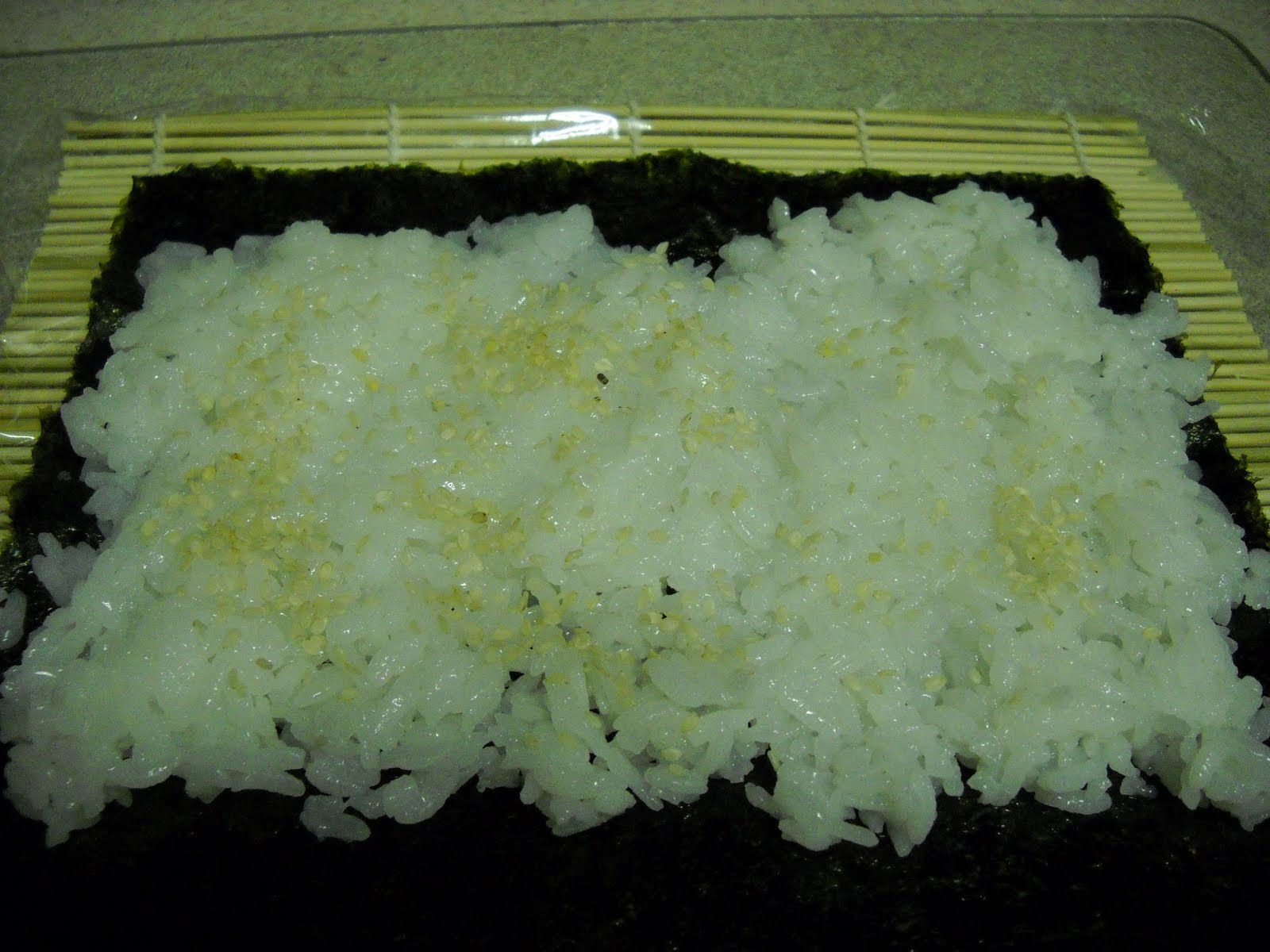 If you do want an inside-out California roll, sprinkle the rice with sesame seeds...
 ...and turn that puppy over.
Roll it up as tightly as you can. Here I failed, in retrospect. My roll could have been a bit tighter because some of the pieces were a little difficult to keep from falling apart, to wit:
 Yeah, make that tighter.
 Help! The avocado and crab are trying to escape!
As I made more, I did get better.
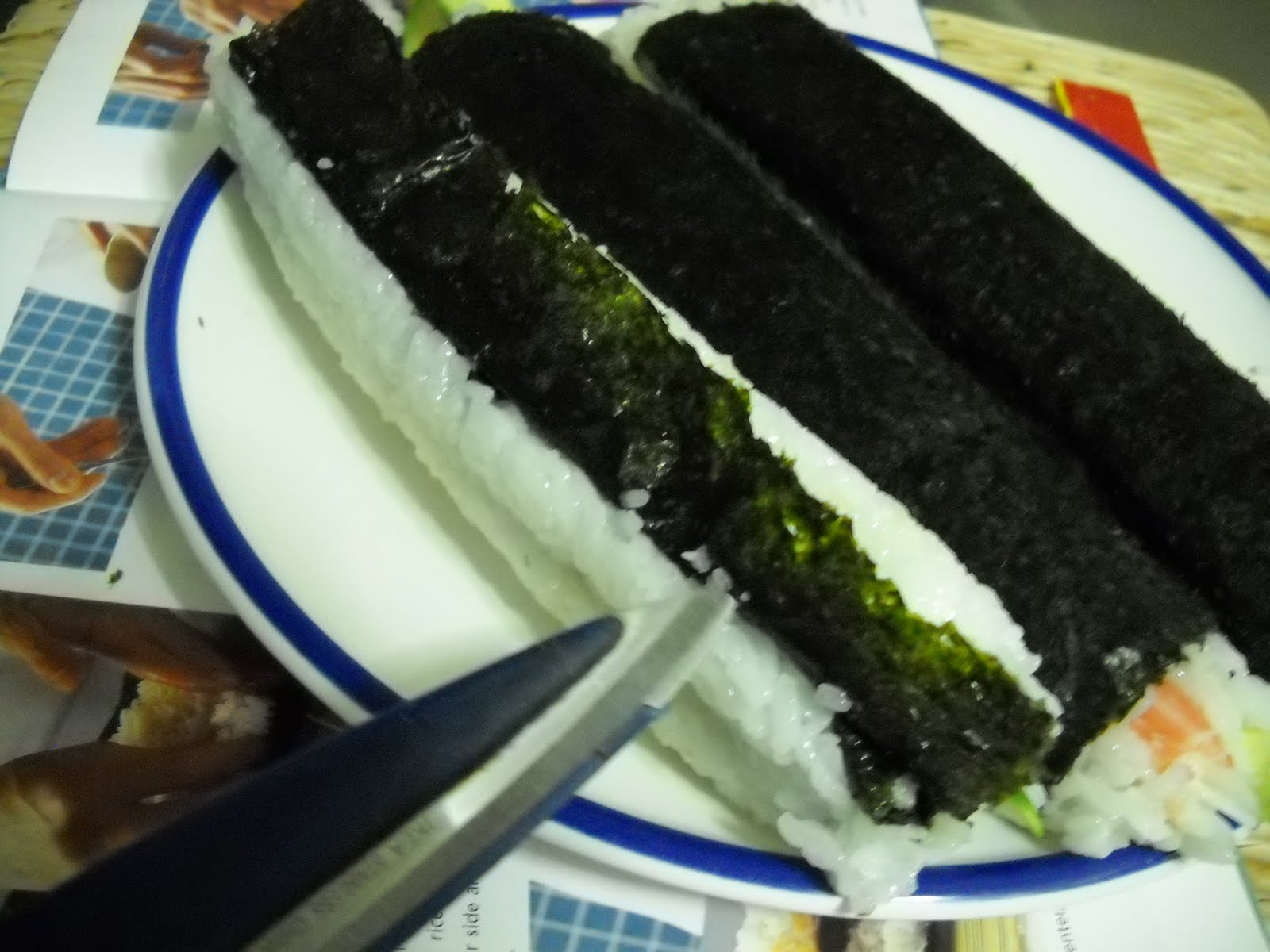 Oopsie! Some overhang. Better get those kitchen shears out.
Yes I know that's cheating. I don't care.

This California roll was especially filling, and why wouldn't it be? You need about a cup of sushi rice to make one roll that can be sliced into 8 to 12 pieces. On the other hand, I ended up using only half my avocado and cucumber. Lots of rice, not lots of vegetables. It was an educational experience, I must say, and it was satisfying to know that the freshly made sushi roll in front of me was made with my own hands. But with so much effort that had to be put forth, I may hold off on making another one at least until I'm done with this State by State thing.
Sources:
Mitzewich, John. How to Prepare Perfect Sushi Rice (video). About.com, date unknown.
Saveur. "Date Shake". Saveur.com (http://www.saveur.com). Originally printed in Saveur Issue #70, November 2003.
Yoshii, Ryuichi. Sushi. From the Essential Kitchen series. Periphus Editions (HK) Ltd., Boston, 1998.
Yoshizuka, Setsuko. "Making California Rolls". About.com, date unknown.
Some information also obtained from Wikipedia's "California" page and the Food Timeline State Foods webpage link to "California".
Snacking State-by-State: California Part 1A (the Southern Half) - The Quesadilla
Ah, California, the largest state in the Union - third largest in terms of land, and with some of the largest cities in North America, including the largest in the US after New York. California is special to me, because for 6 1/2 years it was home - Riverside, Redlands and San Bernardino in the Inland Empire. That first city (the 12th largest in the state) was central to the history of the California citrus industry, that last one (only the 18th largest) being the home of the original McDonald's right along Route 66, and that middle one? Well, they have a very nice farmers' market, okay? Plus it's the home of my very first ever Trader Joe's experience. I will always be a Marylander, but California is, like, a part of me.
Okay, sappy time over.
California is one big, diverse state. And it will be a difficult state to profile, but not for lack of food. Quite the opposite, actually: the sheer diversity of its foods makes this one an entire blog waiting to happen.
In fact, it is such a massive, diverse state that I just can't restrict it to one post. So I am breaking California up over two weeks, lest I have one massive book-like post (not that I haven't done that before). Next week I head up to Northern California. This week, we stick with the Southern half.
Snacking State-by-State: California
Official Name: State of CaliforniaState Nickname: The Golden State
Admission to the US: September 9, 1850 (#31)
Capital: Sacramento (7th largest city)
Other Important Cities: Los Angeles (largest, & 2nd largest in the USA), San Diego (2nd largest), San Jose (3rd largest), San Francisco (4th largest)
Region: West, Pacific (small sections of the state can be considered Northwest or Southwest in terms of its food and culture); Pacific (US Census)
RAFT Nations: Acorn, Chile Pepper, Pinyon Nut, Salmon
Bordered by: Baja California, Mexico (south), Arizona & Nevada (east), Oregon (north), Pacific Ocean (west)
Official State Foods and Edible Things: golden trout (fish), California Valley quail (bird), grizzly bear (animal)
Some Famous & Typical Foods: Where to begin? "New California cuisine", diversity of ethnic cuisines, especially Asian, Latin American and Mediterranean (Mexican, Chinese, Japanese, Filipino, Thai, Salvadoran, Korean, Italian), citrus (especially in the south), wine (especially in the center and north), seafood, dates, and so much else
Whole encyclopedias could be written about the foods of California, so pardon me for trying to sum it all up in a paragraph or two. A few thoughts come to mind. California cuisine is
- Native American, with sedentary hunter-gatherers living off of the rich resources to be found here and in Baja California. One of the most important traditional foods was the acorn, which has to be prepped a special way to keep one from becoming ill. It was often made into several kinds of mushes.
- Spanish and Mexican, with much of the same Southwestern influences that we see in Arizona & New Mexico, and much of the same foods spreading up from Baja.
- pioneer food, with many of those Midwestern and Southern food traditions carried in by 49ers, Mormons and other settlers into the area
- a plethora of immigrant cuisines - so many of the "ethnic" foods that we sometimes think of as American either flourished in California, or spread from Cali to the rest of the country: Vietnamese phở, Filipino longannisa, Thai pad thai, Japanese sushi and Chinese dim sum just to name a few.
- Wine Country. They even made a movie about it, remember? Seriously, California's many wine producing valleys produce some of the best wine in the world, at some competitions rivaling even those from France. Napa and Sonoma are the most famous, though living for so long in the Southland, I've become more familiar with Temecula's much less well known wines.
- "California cuisine" - exemplified by the freshest ingredients prepared in season. That comes with a de-emphasis on the Frankenstrawberries and Killer Tomatoes that are grown all over Cali and shipped to all points of the country, humongous and plump and lacking any discernible flavor (related note: California was also the home of Chicano activist César Chávez, who worked to organize migrant agribusiness farm workers so they could have at least a somewhat decent standard of living).
Southern California and Mexico - specifically Baja California - have a very special relationship, and some of the best Mexican food in our own country is right in SoCal - both the traditional and "taco shop" varieties. In fact, taco shops are as prevalent in the Southland as crab houses are here in the Chesapeake. It is real local food, and you will be hard-pressed not to find some corner that doesn't have takeout with tacos, tamales, burritos, enchiladas, quesadillas and so on, often with a hearty helping of beans and rice, pickled vegetables and your choice of salsas frescas, verdes and rojas. There were just too many to define any one favorite of mine. I would normally order an enchilada, though for a quick meal, a quesadilla is always a safe bet.
The recipe: Cheese Quesadilla

This is incredibly easy, and if you have all the ingredients (as I did), fast:
* tortillas (I prefer corn but I had flour)
* your choice of cheese (I had two on hand: Wisconsin cheddar and Honduran queso fresco)
I don't need to cite any specific recipe for this one, as I have made it before. Simply assemble the following:

tortilla, topped with cheese, topped with tortilla. Chicken is also a popular filling, though I prefer the simple one myself, filled with gooey cheese and nothing more.

Heat in a skillet until the tortillas are browned and the cheese is melted (also flip the quesadilla over to make sure it browns on both sides). Top it with your choice of salsa.
 Or just leave it plain like I did
Sources:
Mitzewich, John. How to Prepare Perfect Sushi Rice (video). About.com, date unknown.
Saveur. "Date Shake". Saveur.com (http://www.saveur.com). Originally printed in Saveur Issue #70, November 2003.
Yoshii, Ryuichi. Sushi. From the Essential Kitchen series. Periphus Editions (HK) Ltd., Boston, 1998.
Yoshizuka, Setsuko. "Making California Rolls". About.com, date unknown.
Some information also obtained from Wikipedia's "California" page and the Food Timeline State Foods webpage link to "California".


