
Wednesday, August 24, 2011

Snacking State-by-State Mashup 5: Haddock Étouffée in Bourbon, Yogurt and Ground Sunflower Seeds

How to wed together the disparate ingredients and cooking techniques of Cajun Country, Down East, Appalachia and the Great Plains? Make an étouffée, of course. You can throw many things in there, and it's all smothered in butter (yup - ran out of crawfish fat).

The mashup recipe:
Haddock Étouffée in Bourbon, Yogurt and Ground Sunflower Seeds
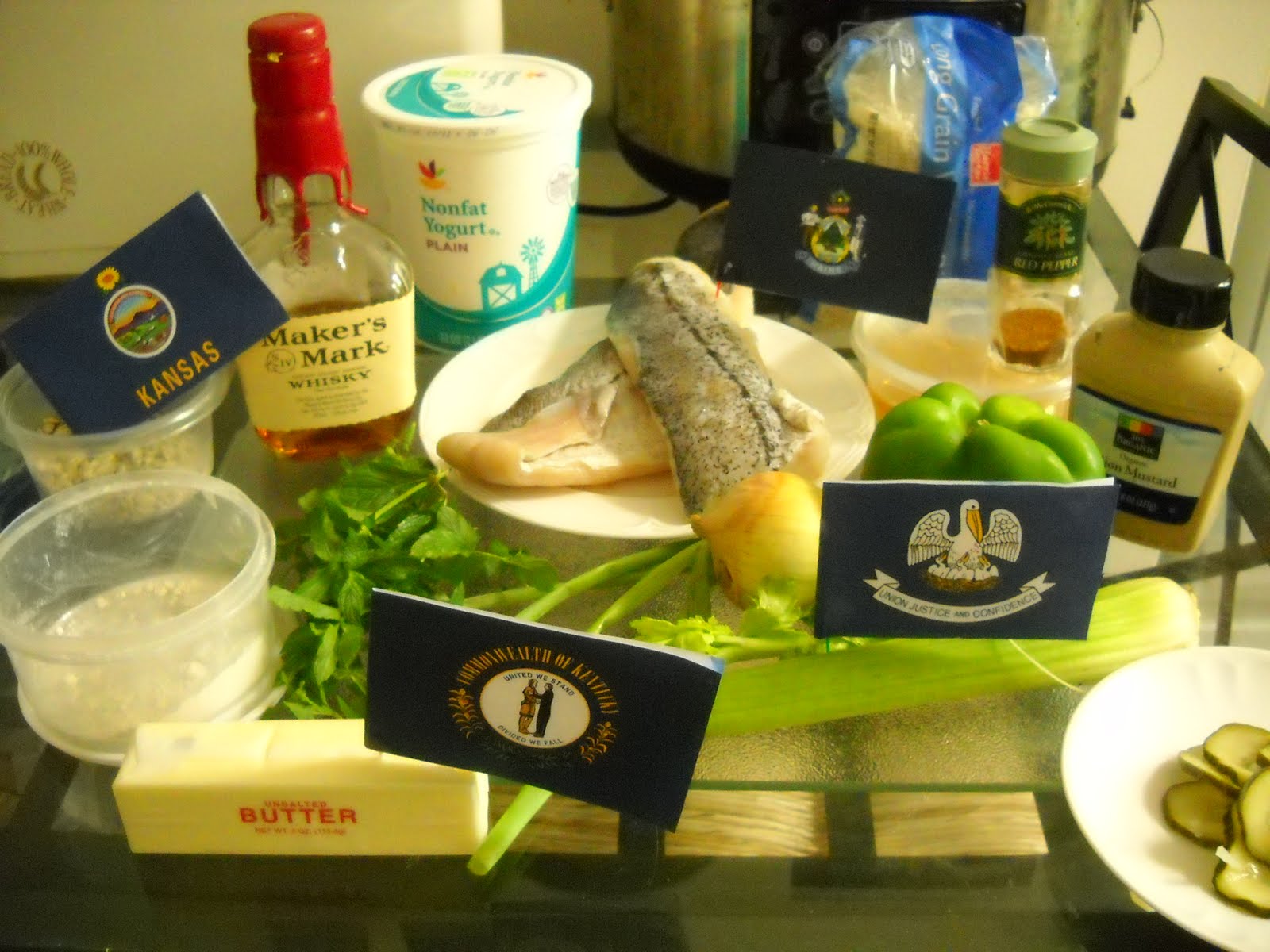

I used the basic outline of the étouffée recipe from Terri Pischoff Wuerthner's In a Cajun Kitchen, using one of the main ingredients - haddock - from Linda and Martha Greenlaw's haddock & lobster casserole from their Recipes from a Very Small Island cookbook. Added to this: mint julep ingredients, the Cajun Holy Trinity, and some of Kansas' official foods. I even got some additional use out of those Icicle Pickles from Judith M. Fertig's Prairie Home Cooking.

Makes 6 to 8 servings

Ingredients (state flag indicates State-by-State post where ingredient was featured. Ingredients with no flag were not specifically used for any one post. Since the flags of Kansas, Kentucky, Louisiana and Maine look so much alike from a distance, the state abbreviation will be included):

(Maine) 1 lb haddock

(Louisiana) 1 small yellow onion, 1 whole stalk celery & 1 green bell pepper, all chopped

(Kentucky) 1 bunch fresh mint, stripped from stems

(Louisiana & Maine) 1/4 cup flour & 1/3 stick butter (for roux)

(Kansas) 1/4 cup raw sunflower seeds

(Louisiana) 1 teaspoon cayenne pepper

(Kentucky & Louisiana) 1/4 cup Maker's Mark or other Kentucky bourbon

(Louisiana) 1/2 cup unsalted butter

(Maine) 1/2 cup plain nonfat yogurt (plain)

(Maine) 1/4 cup Dijon mustard

(Kansas) 1/4 cup honey

(Louisiana) 1 cup long grain white rice

(Kansas) 1/4 cup pickle chips, chopped (optional)

1 scallion, chopped (optional)

1 tablespoon olive oil (to stir-fry the chopped pickle chips and chopped scallion, if you do add these to the dish)

kosher salt to taste


First, poach the haddock until no longer translucent. Do not overcook, and remove from heat when done. You will need to cut the haddock into pieces before adding it to the other ingredients.


While poaching the haddock, make a roux from the flour - likely ground from good old Kansas wheat - and the smaller amount of butter. Stir constantly until dark. Don't burn it.


You should have just enough time between stirs of your roux to put your sunflower seeds, cayenne pepper and salt in a spice or coffee grinder, and ground until fine.

Wait - you can do that to sunflower seeds?

Set aside the sunflower seed mixture.


When the roux is a dark golden brown, start adding your ingredients. First add your onion, celery and green bell pepper. Stir over medium heat for five minutes.


Next, add the yogurt and larger amount of butter...


...the sunflower seed mixture...


...the Kentucky bourbon...


...the mint, honey and Dijon mustard...


...and finally, the haddock. Cover and cook for 15 to 20 minutes over low-medium heat, stirring occasionally. Start your rice about now - I put mine in my rice cooker, which took about 25 minutes.


While the étouffée cooks, take your chopped up scallions and/or pickles and quickly stir-fry in a little olive oil until the onions are slightly browned to your liking.


When the étouffée is done, feel free to add a little more of the honey, the bourbon and the Dijon as desired. Serve over white rice, top with stir-fried scallions and pickles and garnish with more fresh mint.


I dare say this has been both my most successful and my biggest failure of a mashup of them all. That depends on when you eat it: it was quite good when I first made it, but as it aged (over a period of just a few days), it just got less and less appetizing. This is mostly in its texture and appearance than its flavor.

I have made a few of these so far that did not look quite appetizing while cooking, but tasted and even looked impressive at the end. This is one of those recipes. While a bit scary in the pot, it turned out beautifully fresh on the plate. An étouffée does not have to have lots of complicated ingredients - the best ones often don't. However, I liked the different flavors of this dish coming together. Out of the pot, the étouffée smells faintly but distinctly of bourbon, and the flavors of the bourbon, the honey, the Dijon, the butter and (if you are looking for it) the sunflower seeds all jump out at you, but you do have to add them to your liking so feel free to put a little in here or there at the end. The ground sunflower seeds also serve a dual purpose with the roux of thickening the étouffée.

And yet, as I used it as leftovers, and the tastes blended together, the look and texture became less and less appetizing: it went from firm and buttery to grainy and thick, while the étouffée turned into one large beige-ish blob in my Corningware vessel. Haddock in this form seems to break down into a mush-like consistency that I just couldn't finish. At first, I was not sure how haddock would work in an étouffée. So in the end, would I recommend that you made this haddock étouffée? Yes, but only if you plan to eat or serve the whole thing in one sitting. As leftovers, they seem slightly more pleasant than an MRE.

I will say this, though: I now know that raw sunflower seeds, when ground to a powder, can be a useful thickening agent.

Tuesday, August 23, 2011

And Now, A Very Special Semi-Homemade

I have been known to bash Aunt Sandy and post some of her more excruciating stuff on this blog - like shooting fish in a Cocktail-Tini-filled barrel.  And I know I just recently got my Aunt Sandy "not-love" on recently, I even admit: at times I feel bad for doing so.  But the Foodista blog posted something you all have just got to see to believe.  Video posted by YouTube user VideoDisorder.


Somehow seeing this makes her seem less irritating. Maybe she released this on purpose.

Monday, August 22, 2011

Trippel and Mighty Arrow (New Belgium)


Continuing through the bottles of New Belgium that I brought back from Cali this summer - which I don't have to do anymore as of this week - are two brews I haven't tried before.  As an intro to these beers for those of us in the Mid-Atlantic, here's what I thought of a few more ales.


Trippel - As New Belgium describes it, this Belgian-style ale starts with a "bold blast of hops" and a hint of coriander.  I taste the coriander, which is not something I expect in a beer (but I was looking for it since, well, it said on the bottle that it had coriander in it).  It's a complex and different beer that I will look for when I go beer shopping.

Mighty Arrow - This winter seasonal pale ale is a good beer.  It tastes like many of the craft beers that I have had.  It's a good, bitter hoppy beer and I would order it if available.  Mind you, it isn't anything I would go out of the way for. But I would order it if it was there.

Any more beers?  I will have to wait until the full line of New Belgium rolls out here.

Sunday, August 21, 2011

Snacking State-by-State: Maine III - That's what you get folks for makin' whoopie

The last stop on my tour of the Down East takes me back to a topic I have visited once or twice over the last few years: the whoopie pie. Now found in various forms throughout the country, from the Mid-Atlantic to the West Coast to even the South (so long as you have a Starbucks nearby selling adorable little mini-whoopie pies for $1.50 a pop), it is still classic Yankee food.

Official Name: State of Maine
State Nicknames: The Pine Tree State
Admission to the US: March 15, 1820 (#23)
Capital:
Augusta (9th largest city)
Other Important Cities: Portland (largest); Lewiston (2nd largest); Bangor (3rd largest)
Region:
Northeast, New England; New England (US Census)
RAFT Nations: Maple Syrup; Clambake
Bordered by: New Hampshire (west); Québec (Canada) (northwest); New Brunswick (Canada) (north, northeast), Bay of Fundy (due east), Atlantic Ocean and the Gulf of Maine (southeast)
Official State Foods and Edible Things: wild blueberry (fruit); Maine wild blueberry pie (dessert); whoopie pie (treat); Moxie (soft drink); landlocked salmon (fish); moose (animal)
Some Famous & Typical Foods: New England foods; seafood, especially lobster, haddock, swordfish, salmon, clams; blueberries and apples; fiddle head ferns; whoopie pies; foods in common with southeastern Canada, including poutine

As I wrote a few years ago, the whoopie pie is relatively new to this side of the Mason-Dixon Line. Up until 2009, I thought it was just some type of Moon Pie, which it's not. It has its origins, it seems, in two cultures: upper New England (read: Maine) and the Amish. Legend has it that whenever New England children knew what their mothers had just made for them - or when an Amish farmer opened his lunch pail to see what his wife had put into it - a cry of "Whoopie!" would ring out, hence the name. I can't determine where it came from first, but Mainers love it so much that they made it their official state "treat" (since wild blueberry pie is already the official state dessert).

There are many variations on the whoopie pie, but most of them are still found in the Northeast: maple, vanilla, red velvet, peanut butter, and so on. Here in the Mid-Atlantic it's mostly just the traditional whoopie pie that you can find, and it's still not that common here (yet). I decided to do the standard whoopie pie and see how that turned out. For this, I went back to Brooke Dojny, who gives a seemingly pretty standard recipe in her cookbook The New England Clam Shack Cookbook, which I also used for my first New England recipe for this series, the semi-clear, very un-creamy clam chowder that you find along the coast of Connecticut.

Dojny gets this whoopie pie recipe, on pages 218-219 of her cookbook, from the Harraseeket Lunch and Lobster Company in South Freeport, Maine.

Recipe: Whoopie Pie

Whereas the previous recipe for fiddle head ferns was very simple, this is very not - there are a lot of steps, so block out a few hours in your schedule to make these things.


The ingredients and procedures are listed in two separate sections - first the cakes, then the filling. However, several of these ingredients overlap, so note that when you are shopping or searching for them.

For the cakes you will need the following (I ended up having most of this on hand):

* granulated sugar (mostly have it, and picked up a little extra just to be on the safe side)
* unsweetened cocoa powder
* eggs
* vanilla and salt
* vegetable shortening (just enough in the pantry - I ended up using Crisco)
* white vinegar
* whole milk
* baking soda

In addition, you should have at least one cookie sheet and parchment paper, and at least one wire cookie rack.

For the filling you will need:

* confectioners sugar (picked up an extra one pound box - you will use the whole box)
* vanilla
* butter (one stick will do)
* vegetable shortening (again, Crisco)
* marshmallow creme (by most accounts, New Englanders use Marshmallow Fluff from Lynn, Massachusetts, which has several recipes for whoopie pies on its website)


Before all else, you will need to cover the cookie sheet or sheets with parchment paper.

First, the procedure for the cakes:


The first thing you need to do is combine whole milk and white vinegar.


After about 10 minutes, the milk-vinegar mixture should become slightly thickened and foamy (mine did not). You will then add baking soda to this mixture.

Meanwhile, cream together the sugar, cocoa and shortening.

Now creamed

Add eggs and beat until smooth.

Beaten!


Next, sift the flour and salt together, and add it alternately with the milk-vinegar mixture.

What I did was to add the dry, then the wet, then dry, wet and dry.

Blend vanilla into the batter.

When you spoon the batter onto your baking sheet, Dojny recommends using a 2 ounce ice cream scoop or a 1/4 cup measure, and keep the blobs of batter two inches apart from each other. I found the ice cream scoop to work better, as it yielded a smaller whoopie cake. (Did I just type that?)

Uhhhh....

Bake in a 350°F oven for 12 to 15 minutes, and transfer to wire cooling racks. Because my milk-vinegar mixture never foamed up, my whoopie cakes wound up being, well, flatter than I had expected. They still worked out fine, but they didn't get the visual puff-up that I was anticipating.

The filling was frighteningly sweet and fatty, and I could taste this even while I was mixing the ingredients.


First, mix together the softened butter and the Crisco.


You will next add the marshmallow creme. An easy way to measure this out, as Dojny notes, is to grease the inside of the measuring cup (the residual Crisco in the cup is really all you need). You will add this, along with the powdered sugar and vanilla.

This is not health food.

Now you are ready to assemble the whoopie pies.


Take a spatula and spread a more or less generous amount, to your liking.

When I got to my final whoopie pie, I decided to test out a different flavor, and added just enough maple syrup to get a maple flavor (to New Englandize the recipe even more).


What to say about this incredibly sweet dessert? When I made my first one, I ate it immediately. I gotta tell you: it made my teeth hurt. This is sugary and sweet, and tasty and delicious and evil all at once. This is a dessert that I have to eat in pieces - I have not been able to eat any of these whoopie pies whole, instead needing to eat a half a pie here, a bite there. But even as flat as mine turned out to be, these were still worth the effort. Will I do this again? Well, it IS a lot of work, and whoopie pies are becoming more common down here. Perhaps again, later on down the road. The end result is very tasty.

We have gotten to the point on this state-by-state journey where I am ready to explore the state whose food is by far the most familiar to me, not to mention many of my readers. In crossing back below the Mason-Dixon Line, how do I address the unique cuisine of my own home state? This is the issue I will tackle over the next few weeks, as I head back home, to the Chesapeake - to Maryland, hon.

Sources:

Dojny, Brooke. Dishing Up Maine: 165 Recipes That Capture Authentic Down East Flavors. Storey Publishing: North Adams, MA, 2008.

Dojny, Brooke. The New England Clam Shack Cookbook. 2nd edition. Storey Publishing: North Adams, MA, 2008. Portions also available on Google Books.

El-Begearmi, Mahmoud. Facts on Fiddleheads (Bulletin #4198, Facts on Fiddleheads). Updated by Alfred Bushway, Beth Calder and David Fuller. Cooperative Extension Publications (University of Maine): Orona, ME, 1995 & 2010.

Greenlaw, Linda, and Martha Greenlaw. Recipes From a Very Small Island. Hyperion: New York, NY, 2005.

Yankee Magazine. "Dijon Fiddleheads". From "Weekly Wisdom", May 2002. Copyright 2011 Yankee Magazine.

Some information also obtained from Wikipedia's "Maine" page and other pages, and the Food Timeline State Foods link to "Maine".

Saturday, August 20, 2011

Cooking for Engineers

Have you checked this website out?  I was searching the internet for clam chowder recipes for an upcoming post about Massachusetts, and found the most geektastic food website ever.  Cooking for Engineers was started seven years ago (yes I am quite late to this bandwagon) by Michael Chu of the Silicon Valley.  He originally wanted a place to backup his recipes, and a server problem wiped out most of them.  Then he discovered Blogger and a whole new avenue opened up for him.

He outlines his recipes in a way similar to how I outline mine in my State-by-State and Food Ethnography posts, only much sleeker and more streamlined than mine.  Then he streamlines the recipe even more by putting it in a nice neat little box (for example, his recipe for lemon bars).  I guess it takes an engineer! I wish more recipes were diagrammed out like these.

Friday, August 19, 2011

Remind me why this fool has her own damn show again. Go on.

Just searching for funny Sandra Lee stuff on the YouTubes and lo, Aunt Sandy reminds us that the two most important ingredients in every "cake covered with cookies" recipe... are cake and cookies.


If a 12 year old did this, I would have to say, "Aww, that's so creative! Good for you!" If a person with her own damn TV show - no, two damn TV shows - on a food channel did this, I would have to shake my head in shame, and wonder why they let her get away with this stuff.

Did one of these people actually just utter the phrase "Sweet baby!" early in the video?

Thursday, August 18, 2011

Gino's is back

Brand new news about an age-old area food institution!  Gino's is back, and open in Towson.  In this day and age of the higher quality small chain burger (the Shake Shacks of the Northeast, the In N Outs of the West Coast), the time seems perfect for a Gino's resurrection.  ABC 2 News reports.


I remember Gino's from when I was a young child.  There was one open off Patapsco Avenue - and there was a Roy Rogers, too, I think.  Eh, Lansdowne and Baltimore Highlands were very large places for a 5 year old.  Anyway, Mom & Dad often took us there.  Then one day they stopped.  I didn't realize at the time that they had closed down.  You know the inevitable trip is coming sometime soon.  You just know it.  And you will read about it here.

Wednesday, August 17, 2011

Snacking State-by-State: Maine II - Fiddle Me This, Fiddle Me That

Since Maine is a place where people have been eating seasonally long after it fell out of fashion, it stands to reason that the next dish I am preparing isn't typically made year round. But even fiddle head ferns, with the advent of flash freezing, should be easier to find year round. At least in those areas where people are familiar with them.

Official Name: State of Maine
State Nicknames: The Pine Tree State
Admission to the US: March 15, 1820 (#23)
Capital:
Augusta (9th largest city)
Other Important Cities: Portland (largest); Lewiston (2nd largest); Bangor (3rd largest)
Region:
Northeast, New England; New England (US Census)
RAFT Nations: Maple Syrup; Clambake
Bordered by: New Hampshire (west); Québec (Canada) (northwest); New Brunswick (Canada) (north, northeast), Bay of Fundy (due east), Atlantic Ocean and the Gulf of Maine (southeast)
Official State Foods and Edible Things: wild blueberry (fruit); Maine wild blueberry pie (dessert); whoopie pie (treat); Moxie (soft drink); landlocked salmon (fish); moose (animal)
Some Famous & Typical Foods: New England foods; seafood, especially lobster, haddock, swordfish, salmon, clams; blueberries and apples; fiddle head ferns; whoopie pies; foods in common with southeastern Canada, including poutine

Being from Maryland, I have very little experience with fiddle head ferns. Family cookbooks in my part of the country do not feature fiddle heads because we just don't eat them here! The fiddle head is prepared like a leaf vegetable - though technically it isn't a vegetable but a fern. The fiddle head has historically been eaten in northern parts of France, Asia and North America. Today you can find fiddle heads eaten in Michigan's Upper Peninsula as well as in Québec, Nova Scotia and New Brunswick. Within the US, upper New England is where the fiddle head is perhaps the most popular. The tender scrolls, which taste a little like asparagus, are fresh only during a short part of the year, and are harvested close to the ground before they open to release their spores.

I have had one and only one experience with fiddle heads in my lifetime prior to this. A few years ago I wrote about these strange things that I picked up at Eddie's of Roland Park on Charles Street. I stir-fried them, not realizing that one has to cook and cook and cook them before eating. One does not eat raw fiddle heads, because (as I found at the time) they will make you sick.

By all accounts, fiddle heads should be prepared simply. I am not finding many complicated recipes for these things, so why bother trying? In fact, the most complicated recipe that I found for fiddle heads comes from the website for Yankee Magazine - the "New England Website" - and all of the complexity goes into the sauce that you whisk up while the fiddle heads are cooking simply and all by themselves.

Recipe: Dijon Fiddleheads

For this simple recipe, you will need the following:


* fiddle head ferns (well duh). I did not pick these up recently, but got a half a pound a few months ago at Graul's when they were fresh, for about $8 or $9 per pound, and froze them. The process for freezing is simple. I followed this procedure from the University of Maine:

To freeze fiddleheads, clean them as you would for the table. Blanch a small amount at a time for two minutes in 4 to 6 cups of water. Cool and drain in cold water or in an ice water bath (half water and half ice). Pack into moisture- and vapor-proof containers and freeze. Thaw and boil for 10 minutes before serving. [El-Begearmi et al 2010]

The blanching of the fiddle heads

And the drying of the fiddle heads before freezing

* Dijon mustard, mayonnaise and lemon juice (had them all)
* yogurt (picked up a tub of plain nonfat yogurt at Giant for $2)
* scallions (99 cents a bunch)
* salt and pepper


With that last experience with fiddle heads coming back to mind, I wanted to take no chances, so I steamed the fiddle heads in the pan with a little bit of olive oil for about 15 minutes.


Now for the difficult part:

Wow, this is hard.

Whisk together the rest of the ingredients to make a sauce, and spoon it over the thoroughly cooked fiddle head ferns.


This time, the fiddle heads did not make me sick. That is because I cooked the hell out of 'em! So this time I could actually enjoy them. They do taste a little like asparagus, which I do not enjoy, but I liked these. The sauce is sharp and tangy, and goes very well with many vegetables. I recently ate this sauce over broccoli, and I can imagine it as a dressing for salad, though depending on the salad, you may have to thin it out a little bit: keep it thick for a potato salad, or thin it out for a garden salad.

Sources:

Dojny, Brooke. Dishing Up Maine: 165 Recipes That Capture Authentic Down East Flavors. Storey Publishing: North Adams, MA, 2008.

Dojny, Brooke. The New England Clam Shack Cookbook. 2nd edition. Storey Publishing: North Adams, MA, 2008. Portions also available on Google Books.

El-Begearmi, Mahmoud. Facts on Fiddleheads (Bulletin #4198, Facts on Fiddleheads). Updated by Alfred Bushway, Beth Calder and David Fuller. Cooperative Extension Publications (University of Maine): Orona, ME, 1995 & 2010.

Greenlaw, Linda, and Martha Greenlaw. Recipes From a Very Small Island. Hyperion: New York, NY, 2005.

Yankee Magazine. "Dijon Fiddleheads". From "Weekly Wisdom", May 2002. Copyright 2011 Yankee Magazine.

Some information also obtained from Wikipedia's "Maine" page and other pages, and the Food Timeline State Foods link to "Maine".

Monday, August 15, 2011

New Belgium hits the Mid-Atlantic


Yes, microbrew lovers: we are just one short week away from New Belgium Beer finally hitting the Chesapeake region.  August 22nd is the day that Fat Tire and its associated beers finally come to Maryland, Virginia and the District.  I smuggled the above-pictured bottles in my checked luggage the last few times I visited California.  No need to do that anymore, or for that matter drive all the way to North Carolina.  Over the next week I will be drinking some of these beers, to give a taste of what we can expect. 

Already I can tell you about Fat Tire: this ale actually tastes fattening.  The first time I had one, in the company of my old grad school adviser and his wife (ah, social scientists like to drink, especially the anthropologists), I ended up drinking another.  Thus began a very long-distance love affair that led me to smuggle most of a twelve pack back in my checked luggage, and to get excited when I found it on tap at Flex, a Raleigh-area gay bar (er, "club" as they call them there).  Now all I have to do is head to the Wine Source.  Oh, that's right: I have to find out if they'll have it and when...