
Sunday, May 15, 2011

Snacking State-by-State: Idaho Part II - Huckleberry? Fine!

If the potato is Idaho's most famous export, the huckleberry is its most precious. Huckleberries abound in the Northwest - from Washington to Montana, with Idaho sandwiched right in between. They don't abound anywhere else.

Official Name: State of Idaho
State Nicknames:
The Gem State
Admission to the US: July 3, 1890 (#43)
Capital: Boise (largest city)
Other Important Cities: Nampa (2nd largest), Pocatello (3rd largest), Coeur D'Alene (6th largest)
Region: West, Northwest; Mountain (US Census)
RAFT Nations: Salmon, Pinyon Nut
Bordered by:
Washington & Oregon (west), British Columbia (Canada) (north), Montana & Wyoming (east), Utah & Nevada (south)
Official State Foods and Edible Things: huckleberry (fruit), potato (vegetable), cutthroat trout (fish)
Some Famous & Typical Foods: potatoes, potatoes and more potatoes; also huckleberries, chokecherries and blueberries, moose, salmon & trout; pioneer foods, Basque chorizo

I asked Rachel over at Coconut & Lime if she knew of any local source for huckleberry products - berries, jams, jellies, anything. She let me know that Atwater's in Belvedere Square occasionally sells it, but when I looked they didn't have any - as she said, occasionally. So I had to go the mail order route.


After much hemming, hawing and searching locally to make absolutely sure I could not find it at all around town, I finally settled on the Tastes of Idaho website, where I ordered two huckleberry products. One was a small - 4 oz - packet of dried huckleberries sweetened with sugar from Gold Mountain out of Orofino, Idaho. The other was an 8 oz jar of huckleberry jam, (relatively) much easier to find. The brand I ordered was from Wild Mountain Berries in Riggins, Idaho. I had never had dried nor jammed huckleberries before, and the taste is a bit analogous to blueberries. Since what I ordered came pre-sweetened, I will have to take their word for it, but huckleberries tend to be a little more tart and a little bit smaller (that I can see) than the closely-related blueberry.

Huckleberries are so difficult to find anywhere east of the Continental Divide, and can get very pricey - the dried ones were $7 and the jam was $8, plus another $13 shipping and handling made this project even pricier than those shrimp I bought a few weeks ago. Unless I up n' move to Boise or get them on the black market, I probably will have to use blueberries the next time I do the following recipe.

The recipe: Huckleberry Muffins, Two Ways

This recipe comes from humorist Patrick F. McManus. In his Whatchagot Stew: A Memoir of an Idaho Childhood, with Recipes and Commentaries, he and co-author/sister Patricia McManus Gass related stories of a childhood in the northern Idaho town of Sandpoint. Like the following huckleberry muffin recipe, most of the recipes in McManus' memoir are not his own:

Many of the recipes belonged to my grandmother, a cook much sought after in the logging camps of northern Idaho, where the loggers were more concerned with the quality of the food in the camp than the quantity of dollars in their pay envelopes. Gram was a superb cook. The aroma of her baking alone could activate one's salivary glands at six hundred yards. When the wind was right, she could empty all the hoboes from a freight train and bring them streaming to our house for a handout. [McManus et al 1989: xvi]
Because I had neither fresh nor frozen huckleberries, I had to make do with the pricey gourmet huckleberries shipped to me via the USPS. So instead of twelve huckleberry muffins, I made six with dried huckleberries and six with dollops of huckleberry jam in the middle.


For this recipe I used:

* Huckleberries (natch - I used about half of the 4 oz pack of dried huckleberries for six muffins, and about half of the 8 oz jar of jam for the other six. Again, those of us "Back East" will have to settle with blueberries, which are much easier and much cheaper to find. Huckleberries, if you must order them online, run about $40 to $50 for 3 lbs fresh. I am not about to spend that much on any one ingredient, especially before shipping and handling, unless I can steam it in Old Bay and beer and pick it with about 7 or 8 of my friends)
* 2 sticks butter, one to go in the muffins and the other for the sugar topping
* sugar, one to go in the muffins and the other 3/4 for the sugar topping
* 2 eggs
* sifted flour (a little under 2 cups - got it)
* baking powder, baking soda, salt, nutmeg and ground cloves (got 'em all)
* buttermilk (I actually had some in the fridge)
* orange rind (for the sugar topping)


First, cream the eggs, butter and sugar together. Cream them well. This is important, because it will give you fluffy and luscious muffins.


Once done, mix the dry ingredients and the buttermilk into the creamed butter, alternating (I did dry - buttermilk - dry - buttermilk - dry).


Here's where I deviated from McManus & his Gram. I divided the batter into two.


Into one half, I poured my dried huckleberries.
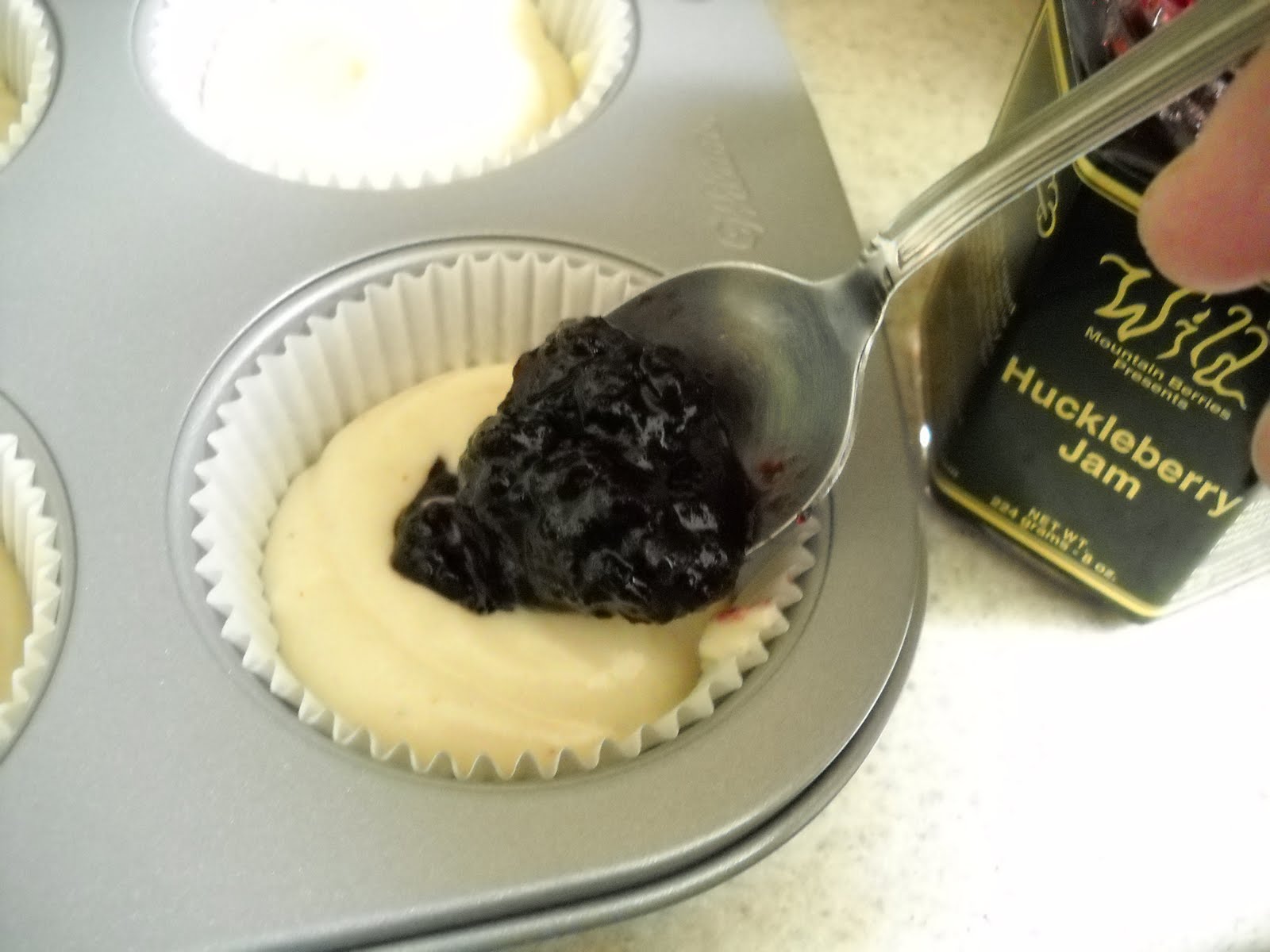


The other I spooned into muffin cups, filling about halfway, and then spooning a healthy teaspoon of huckleberry jam into each one.


I then finished by filling each with more batter.


The muffins were done 20 minutes and 375°F later, but McManus suggests a special sugary topping for the muffins. Mix orange rind, sugar and hot melted butter together until blended, and then dip each warm muffin into the mixture.


What you have is a luscious muffin topped with a super sweet and buttery sugar mixture. The muffins were delicious, though I was less than successful at baking six muffins each with a nice dollop of jam in the middle. Instead, I got six muffins each with a nice dollop of jam at the bottom. So the jam muffins did not turn out like I had hoped, though it was not a wash: I simply took the jam at the bottom of the muffin cup and spread it back on the muffin. The dried huckleberry muffins turned out more like I had envisioned them, and even though the berries did, again, migrate towards the bottom, at least it looked like a berry muffin.


In the future, apart from the whole blueberry vs huckleberry thing, I am leaving out the sugar topping. The reason is simple: as delicious as it is, I am left walking around for the next hour in a sugar coma. And I really don't want diabetes. But it's a lovely muffin.

We are done with Idaho, and next we head to the last region of that country that I haven't really gotten to yet in this State-by-State series: the Midwest. That's just how it worked out alphabetically. And I'm sticking around there for a while (again, alphabetically). The first stop is Illinois, the largest Midwestern state, and it has a whole lot of food to write about.

Sources:

McManus, Patrick F., and Patricia "The Troll" McManus Gass. Whatchagot Stew: A Memoir of an Idaho Childhood, With Recipes and Commentaries. Henry Holt & Company, New York, 1989.

Some information also obtained from Wikipedia's "Idaho" page and other pages, and the Food Timeline State Foods link to "Idaho".

Friday, May 13, 2011

Blogger Down

Please be patient with this and all other Blogger blogs right now. As many of you know Blogger was down for a good chunk of time over the last few days. I've been spending today fixing up the mess leftover from that escapade, recreating a blog post or two (rrrrrrrrrrrr), even contemplating a move to WordPress (I didn't like how it reformatted every single left or right justified photo). But things should be more or less back to where they're supposed to be. Until the next crash. Rrrrrrrrrrrr.

Thursday, May 12, 2011

Tenderloin that falls apart!

I made a pork tenderloin in the slow cooker yesterday. I had not made one before so I scoured the internet for an interesting recipe. I went with one of those "generic recipes" on one of those "generic recipe sites" like AllRecipes.com. The one I went with, called "Amazing Pork Tenderloin in the Slow Cooker", uses garlic, soy sauce, red wine, water and a packaged onion soup mix. Sounds salty? It's not as salty as it seems. Commenters suggested tinkering with the cook time, which I tried at first - instead of four hours on LOW, I was set to do it on HIGH. Half an hour into it, I reset it and did the final 3 1/2 hours on LOW.

The pork tenderloin was tender. I would not call it "fork split" tender, which it wasn't unless you really push down hard on that fork. One thing that aggravated me, however, purely affected the aesthetics of the dish: when I took it out, the entire tenderloin split in half lengthwise. This in itself isn't such a problem, except that I was hoping to cut it into rounds and use them in a future recipe that I needed tenderloin rounds for. Ah well. At least it tastes good and isn't dry (it's definitely not dry), and was on sale.

Tuesday, May 10, 2011

The peas are shootin' up!

A gardening update: my garden is starting to take real shape. A few things I noticed while I was working in my plot today, some more surprising than others:

  • I have a renegade lettuce problem. Oh sure, the romaine I have in the ground is doing nicely, but I have a whole lot of lettuce sprouting up all over my plot. This happened after my lettuce plants bolted last year. At least I liked the lettuce. Now I'll not have to buy lettuce at all this summer.
  • My sweet peas and snow peas are coming in even more nicely. I have never grown peas so I was surprised to see how fast they shot up after just a few weeks. I also have some big ass onions and some carrots, cabbages and potatoes shooting up.
  • Is my corn supposed to be growing already?
  • As I've said before, I had no idea that mint and oregano would grow so wildly. I'll be constantly pruning this stuff back all year. I hope it doesn't strangle out the parsley I just planted.
  • I finally put those peanuts in the ground. These may not sprout for a good while. I'll keep you all posted.

Sunday, May 08, 2011

Snacking State-by-State: Idaho Part I - The Idaho Potato

We head back to Big Sky Country to explore the state best known for the potato - and oh is it ever known for that! But as has been with case with all the other states and DC, I learned there was more to food in Idaho than I realized.

Official Name: State of Idaho
State Nicknames:
The Gem State
Admission to the US: July 3, 1890 (#43)
Capital: Boise (largest city)
Other Important Cities: Nampa (2nd largest), Pocatello (3rd largest), Coeur D'Alene (6th largest)
Region: West, Northwest; Mountain (US Census)
RAFT Nations: Salmon, Pinyon Nut
Bordered by:
Washington & Oregon (west), British Columbia (Canada) (north), Montana & Wyoming (east), Utah & Nevada (south)
Official State Foods and Edible Things: huckleberry (fruit), potato (vegetable), cutthroat trout (fish)
Some Famous & Typical Foods: potatoes, potatoes and more potatoes; also huckleberries, chokecherries and blueberries, moose, salmon & trout; pioneer foods, Basque chorizo

Idaho cuisine is frontier cuisine - pioneer cuisine - and much of what is characteristically Idahoan is hunted, gathered and grown, and many of those foods are found throughout the Northwest. Idaho is a heavily agricultural state, and the Idaho State Department of Agriculture breaks down how much it produces of its most famous foodstuffs. I love this kind of stuff:

If Idahoans had to consume all products produced within the state in 2009, every resident [all 1,545,801 of them according to the US Census Bureau] would need to eat or drink EVERY DAY
  • 219 slices of bread
  • 44 potatoes
  • 2 lbs of cheese or 40 glasses of milk
  • 1 8 oz. steak or 2 quarter-pound burgers
  • 2 onions
  • 2 cups of beans
[Idaho State Department of Agriculture 2010]
That's a lot of potatoes. And yes, Idaho has a great variety of agricultural output - as Idaho chefs very eagerly point out. Taite Pearson of Sego Restaurant in Ketchum, Idaho, tells Jennifer Hernandez for the Boise Weekly how he defines Idaho cuisine: "Simple, rustic cuisine"
"The food is connected to the land," he says. "It's made from things near here and is truly food of the land." The Ketchum chef believes Idaho cuisine is driven by what is available seasonally. "I'm trying to invent what Idaho food could be," he says. "I'm hoping to help create Idaho cuisine." [Hernandez 2010]
That said, there's no denying that the potato is by far Idaho's most famous export. And the Idaho Potato Commission is fiercely protective of that "Idaho potato" label. You can't call just any old russet potato (the most famous variety in the US) an "Idaho" potato (They've gone to court over this. For real). And it isn't just Russets either:
While the russet is the most well-known potato grown in Idaho, more than 25 other potato varieties are grown in Idaho including: Yukon Golds, Reds and Fingerlings. [Idaho Potato Commission 2011]
The same Idaho Potato website has a veritable bounty of recipes for Idaho potatoes, so this next recipe was much more difficult in the planning than I at first thought it would be. What to make? I finally settled on my most favorite potato dish of all, the might mashed potato, but found a fascinating take on it that I had to try out.

The recipe: Ricotta Garlic Mashed Potatoes


For mashed potatoes, one normally should mash and not whip them, with a combination of any of the following: milk, butter or cream. Some recipes suggest cheese as well. I had never considered ricotta in mashed potatoes before, but I had some lying around, and a few recipes that I found made it sound particularly intriguing. The following recipe is a mish-mash of two I found online, one Ricotta Mashed Potato recipe from the Country Living website, the other for Ricotta Garlic Mashed Potatoes from the Meatloaf for Moose blog. To my knowledge, neither recipe was written in Idaho.

Here's what you will need:

* 3 lbs potatoes (I used a variety of potatoes - russet, Yukon gold and red. If anyone from Idaho is reading this please don't be upset, because I was a bit frustrated in my search for Idaho potatoes. I could not find any. As great as the local food movement is, one peculiar downside to it is that when you actually need and want to find produce that was specifically grown in another state, you can't find it so easily. Pretty much all of the local potatoes in the supermarkets in my neck of the woods these days is from Maryland, North Carolina and Texas - but, alas, not Idaho. So I had to make do.
* 1 cup ricotta (left over from the previous mashup recipe for dessert lumpia - I had paid about $4 for it at the time)
* 1 head garlic, roasted (75¢ at the local farmers' market)
* salt and pepper (got it)
* 1 - 2 tablespoons heavy cream (about $1.75 for a half-pint)
* 4 tablespoons butter (got it)


Before you start prepping the potatoes, prepare a head of garlic for roasting, by cutting off the top and putting the rest of the head upside-down in a small dish of oil. Cover up with aluminum foil (Who needs one of those fancy $20 "garlic roasters" from Bed Bath and Beyond anyway?). Roast about half an hour at 350°F. When done, don't turn off the oven but instead turn it up to the broiler setting.


First, cube into about 1" cubes (but don't peel) 3 pounds of whatever potatoes you have, cutting off any eyes that have sprouted.


Boil about 20 minutes, drain and quickly rinse under cold water.


Next, add everything else - the ricotta, roasted garlic (squeeze out while holding it in something insulated - I had to use my kitchen towel), salt, pepper, butter and cream. I just eyeballed the cream.


Mash with a potato masher and place in a large Corningware (or other broiler-proof) dish, and then transfer the dish to your broiler for five to ten minutes.


This recipe turned out to be one of the more decadent things I have produced in my kitchen. These potatoes were rich and creamy but not gloppy like so many forgettably dull (or unforgettably bad) mashed potatoes I have had in the past. The consistency was part creamy /and part chunky, which is how I like my mashed potatoes, and they had a beautiful, slightly browned top thanks to their trip under the broiler. Whenever I have some extra ricotta left over, this will be a recipe I make again.

The second and final recipe I investigate from the Gem State uses an ingredient that is as impossible to find in Maryland as the potato is easy to find: I go in search of the ever-elusive huckleberry.

Sources:

Country Living Magazine. "Ricotta Mashed Potatoes". Author unknown. Copyright 2011 Hearst Communications, Inc. All Rights Reserved.

Hernandez, Jennifer. "Beyond The Potato: Idaho chefs define Idaho cuisine". Boise Weekly, published March 23, 2010.

Idaho Potato Commission. Frequently Asked Questions. Copyright 2011 Idaho Potato Commission.

Idaho State Department of Agriculture. Idaho Agriculture Facts. Copyright 2011 Idaho State Department of Agriculture.

Meatloaf for Moose. "Garlic Ricotta Mashed Potatoes". Meatloaf for Moose. Posted Thursday, April 5, 2007.

Some information also obtained from Wikipedia's "Idaho" page and other pages, and the Food Timeline State Foods link to "Idaho".

Friday, May 06, 2011

Shake Shack comes to the District

Shake Shack, that most In N Out-ish of New York City-based fast food chains, is coming to the District of Columbia soon, according to the Washington City Paper. There will be two locations - Dupont Circle and Nationals Park, that last one convenient for any DC-bound Mets fans. It has very high-quality meat, which it grinds itself! As often as I get to DC these days, this is just another reason to go. Now let's work on getting a Wagamama out to these parts.

Thursday, May 05, 2011

Por que es el cinco de mayo: Guacamole...

For cinco de mayo, a re-post of my favorite guacamole recipe, from last year:


2 avocados
1 Roma tomato - not those big-ass, flavorless beefsteaks - seeds removed, diced
1 small onion or 1 - 2 green onions, chopped
1 jalapeño, chopped, with or without seeds and vein (I prefer to keep all that in)
1 clove garlic, chopped
1/4 to 1/2 cup fresh cilantro, chopped (for me, the more the better)
juice of 1 lime
a little salt to taste

Mix it up, go to town. Repeat as necessary.

And if you want a good salsa to go with that, try this salsa del norte recipe from The Border Cookbook by Cheryl Alters Jamison and Bill Jamison that I made for my Arizona post from December 2010.

Tuesday, May 03, 2011

The Great Food Truck Thing

In case you missed it, Dan Rodricks had a whole episode last week on his Midday Show on WYPR on the whole food truck phenomenon. Among others, he talked to Heather Shouse, author of Food Trucks: Dispatches and Recipes from the Best Kitchens on Wheels. Shouse goes all over the country to examine local food trucks and the local adaptations to them. For example, Portland, Oregon, has a whole section of town devoted just to food trucks! Rodricks also interviewed several local food truck entrepreneurs, including the good people who bring us the food trucks from Gypsy Queen Café, Iced Gems Baking, Creperie Breizh, and Kooper's Chowhound, as well as the former owner of Juana Burrito who now runs the food truck consulting business Mobile Food Products. The food truck trend is starting to really rocket here, as it has in DC too - surprisingly since DC has such arcane laws that regulate food trucks in such a way that they may not park unless they have a queue of people waiting for them (I found this out a few weeks ago on the Kojo Nnamdi Show on WAMU). It's a trend I hope we see continue to flourish in Baltimore in the future.

Monday, May 02, 2011

On hoarding stuff at the supermarket

My God, someone went around to both the area Trader Joe's and bought up all the plain pizza dough (just 99 cents per pound). I'm not kidding - ALL of it. I stopped at the one in Pikesville, and the nice guy (kind of cute, too) told me this. He was so nice as to go into the back to check if there were any more. No more. So I bought some of the whole wheat pizza dough, and then drove to the Towson location on a hunch. Same - only whole wheat and garlic & herb, and lots of each, but no plain.

So to the person who went to both Trader Joe's in the Baltimore area and bought up all the plain pizza dough (again, just 99 cents a bag), a haiku:

What do you need with
Fifty bags of pizza dough?
World's largest calzone?

Dude, nobody needs
THAT much dough for pizza. Please:
Don't hog all of it :|

Sunday, May 01, 2011

Snacking State-by-State Mashup 3: Berbere Ricotta Dessert Lumpia with Key Lime-Poi Sauce

For my third mashup post, I had to find a way to combine leftover ingredients and dishes from Hawaii, Georgia, Florida (north and south) and the District into one unified recipe. The resulting recipe seemed all throughout as if it was going to bomb big time, but in the end it turned out to be pretty interesting, in a good way.

The mash-up recipe: Berbere Ricotta Dessert Lumpia with Key Lime-Poi Sauce


Serves 4

Ingredients (state flag indicates State-by-State post where ingredient was featured. Ingredients with no flag were not specifically used for any one post):

15 - 20 boiled peanuts (ground)

180 mL (1/2 glass bottle) pure sugar ("Mexican") Coca-Cola

1/2 teaspoon Ethiopian berbere spice

1 package lumpia wrappers

Sugar to taste

1 cup ricotta cheese

1/4 cup grits (prepared)

1/2 snack box (about 1 tablespoon) raisins

Dipping Sauce:

1/3 poi

Key lime juice to taste

1 - 3 tablespoons Kewpie mayonnaise (DC)

Sugar to taste

You also see cocoa powder in the ingredients photo. Along the way I decided not to use it, for reasons that will become clear.


Reduce half a bottle of Mexican Coca-Cola in a pan until you have s thin syrup. Though you may also want to add sugar to taste, the boiled-down Coke will serve as the main source of sweetness for the lumpia mixture.


Coke Minus?

While boiling down the Coke, mix the
ricotta, grits, raisins, ground down boiled peanuts (make sure you wash off the peanuts before you crush them) and berbere spice mix. Please make sure you don't use too much berbere because it will overpower your ricotta-grits mixture. I found that 1 teaspoon was more than enough to leave a strong berbere flavor, and a little kick, but to the point that I couldn't taste the Coke. Half the berbere will still give the flavor and some of the kick without overpowering everything else.


Here I added the Coca-Cola before everything else. Really, it doesn't matter exactly what order you add the Coke to the other ingredients.

One-finger ricotta-grits-Coke lumpia mixture!

Put your ricotta-grits mixture in the freezer for about 15 to 30 minutes to firm up if it is too loose, and in the meanwhile make your dipping sauce. Put the poi in the blender and slowly add your Key lime juice and Kewpie mayonnaise. You will want to add sugar to taste. Trust me on this. Please.


When ready to make your lumpia, put a hefty spoonful on a lumpia wrapper and fold as you would any other lumpia. Fry until golden brown in 350°F vegetable, peanut or canola oil. Serve with dipping sauce.


All the while I was making this recipe, it had the makings of "I know this is not going to work. I know that this is simply not going to work." But of the three mashup recipes I've done, this one by far turned out the best. The filling was not overpowering and was sweet, spicy and tangy all at once. The dipping sauce gave a very nice sweet and sour contrast all its own. If I had to do it over again, I would probably skip the grits, double the amount of reduced-down Coke and halve the amount of berbere I put in the recipe. A little powdered sugar on the lumpia wouldn't hurt either.