I've started splitting up the original MAMMOTH posts into individual posts for easy reference. To make things easier, I have given the new posts the original publish date. The first one to get split up is my original Alabama post, now into two bite-size chunks about fried fruit pies and fried catfish. Because everything tastes better when it's fried.
Tuesday, May 31, 2011
Goldilocks - it's not just a fairy tale character anymore
A few of the things I smuggled in my suitcase from California the other day were goodies from the brand-spanking new and glistening 99 Ranch in Rancho Cucamonga. 99 Ranch is the Chinese-American West Coast equivalent to our Korean-American H Mart here on the East Coast. One item that I bought that stood above the rest was a delicious, soft and sweet-but-not-too-sweet bread made my the baked goods and Filipino cuisine company Goldilocks. Goldilocks, my friend Gil tells me, is massively popular with Southern California's Filipino community. It offers baked goods of all varieties, specifically but not exclusively Filipino baked goods. Originally opened in 1966 in Makati, Philippines, it has now spread throughout much of the western US and Canada as well.
 Ahem, the bread... A little smooshed after 7 hours and one transfer in my luggage but just as edible, flanked by a package of their little hopia bean (yellow bean) buns
Back to the bread: this soft and delicious sweet bread is Goldilocks' ube loaf bread (about $4.50 at 99 Ranch). The ube loaf is a soft purple yam bread that you pull apart into individual pieces. Hopefully, you can make it last, which is not likely. I've been eating mine with Irish butter. If only they had this stuff on the East Coast I would probably buy this a lot more often.
Monday, May 30, 2011
Snacking State-by-State: Illinois IV - For Corn's Sake
If the previous post's horseshoe sandwich reflects Springfield, deep-dish pizza reflects Chicago and pierogi reflects Chicago's ethnic Polish community, what represents the entire state, if not the whole region? Corn, that's what. Official Name: State of Illinois
State Nicknames: The Prairie State; The Land of Lincoln
Admission to the US: December 3, 1818 (#21)
Capital: Springfield (6th largest city)
Other Important Cities: Chicago (largest in the state and the Midwest; 3rd largest in the US); Aurora (2nd largest); Rockford (3rd largest)
Region: Midwest, Great Lakes; East North Central (US Census)
RAFT Nations: Cornbread & BBQ, Wild Rice
Bordered by: Wisconsin (north); Lake Michigan (northeast); Indiana (east); Kentucky (southeast & south); Missouri (southwest); Iowa (northwest)
Official State Foods and Edible Things: popcorn (snack food); GoldRush apple (fruit); white-tailed deer (animal)
Some Famous & Typical Foods: typical Midwestern foods, especially corn; Native American and pioneer foods; state-specific foods (horseshoe sandwich, shrimp de Jonghe, Chicago dog, Italian beef); also note: deep-dish pizza and hot dogs were first made popular in Illinois
The Midwest is the hub of our nation's corn industry, and it's made a lot of people very wealthy. Corn goes into so many things that we never realized even had corn in them: everything from ethanol to batteries (!) to high fructose corn syrup (and don't believe the lies about HFCS being "just like sugar" Check out the Picky Eater Blog for a recent takedown of Big Corn's claims about how great HFCS really is). Yes, most of the corn we get in my area is local, but do not forget just how important corn is to the whole fabric of the Midwest.
For a truly simple and delicious corn dish, I thought about various recipes, from corn fritters - corn oysters, that is - to corn pudding to corn chowder to just plain old corn on the cob. The recipe I found on Pam's Midwest Kitchen Korner spoke to me in a different way, and I got inspired to make myself some creamed corn.
The recipe: Creamed Corn
Pam's recipe for creamed corn is simple, unless you (again) reinvent the wheel like I did, and cut the corn fresh off the cob (I'm a silly non-Midwesterner).
 Prepping the corn...
Pam used frozen corn, which you will probably do as well. The author's sister-in-law, who gave her this recipe, passed away not long before it was posted, and so she dedicates it to her.

The ingredients you will need include:
* corn (duh - I used six ears' worth, which after much research on the internet I reasoned equaled a one-pound bag's worth of frozen corn. This sort of thing shouldn't be so difficult to find.)
 About one 16-oz bag's worth of fresh corn
* both milk and whipping cream (had on hand)
* sugar, salt and cayenne pepper (again, had it)
* butter and flour (mmmm, butter)
Please check out her recipe for exact quantities. Pam also puts Accent in her recipe. Accent (or "Ac'cent") is pure MSG, a no-no these days. I didn't have any and didn't buy any for this recipe. It worked just fine without it.
Again, I'm not going to post her recipe, but it is simple to sum up:

mix everything together but the butter and flour,

then add those toward the end to thicken.

This recipe was just about the loveliest corn recipe I have ever had. Far from the sloppy glop I'm used to seeing in restaurants, this was silky and sweet and just plain delicious. Pam and her sister-in-law had a good thing with this recipe, a simple and delicious way to prepare your corn.
Sources:
Pam's Midwest Kitchen Korner (Pam). "Creamed Corn". Pam's Midwest Kitchen Corner, published November 12, 2009.
The Picky Eater: A Healthy Food Blog (Picky Eater). "The Truth About High Fructose Corn Syrup". The Picky Eater: A Healthy Food Blog, published April 19, 2011.
Some information also obtained from Wikipedia's "Illinois" page and other pages, and the Food Timeline State Foods link to "Illinois".
Because it's Memorial Day
Steven Raichlen shows us how to make the perfect all-American hamburger. I would gladly pay him Tuesday for this hamburger today.
* I admit that I've always had trouble pronouncing his name. But as he says, it's RIKE-lynn
Saturday, May 28, 2011
It's almost one month away!
It's coming! namely, the end to Maryland's stupid law that forbids a person from direct-shipping wine from a winery to his or her home. Starting July 1, as everyone else now knows, Marylanders may begin direct-ordering wine from out-of-state wineries. I still cannot benefit from that law during this current trip to Cali, since the law goes into effect a month after I return to Maryland. But at least I can order things from favorite wineries in Rancho Cucamonga or Temecula. That is a start.
Friday, May 27, 2011
Snacking State-by-State: Illinois III - So hungry I could eat a Horseshoe
Chicago may be the food center of the Midwest, but it is by no means the only city to feature its own favorite dishes. Just a few hundred miles south of the Windy City lies the capital, Springfield, and the local specialty: a shoe named after equine footwear.Official Name: State of Illinois
State Nicknames: The Prairie State; The Land of Lincoln
Admission to the US: December 3, 1818 (#21)
Capital: Springfield (6th largest city)
Other Important Cities: Chicago (largest in the state and the Midwest; 3rd largest in the US); Aurora (2nd largest); Rockford (3rd largest)
Region: Midwest, Great Lakes; East North Central (US Census)
RAFT Nations: Cornbread & BBQ, Wild Rice
Bordered by: Wisconsin (north); Lake Michigan (northeast); Indiana (east); Kentucky (southeast & south); Missouri (southwest); Iowa (northwest)
Official State Foods and Edible Things: popcorn (snack food); GoldRush apple (fruit); white-tailed deer (animal)
Some Famous & Typical Foods: typical Midwestern foods, especially corn; Native American and pioneer foods; state-specific foods (horseshoe sandwich, shrimp de Jonghe, Chicago dog, Italian beef); also note: deep-dish pizza and hot dogs were first made popular in Illinois
Springfield has its own signature dish, called the "horseshoe sandwich", an open-faced sandwich consisting of thick bread topped (in order) with some kind of meat, then French fries and finally a cheese and beer sauce. The horseshoe sandwich is found in many restaurants in the area - so note Jane & Michael Stern of the previously mentioned Roadfood.com. The Sterns' book Roadfood Sandwiches gives the skinny - er, the lowdown (there ain't nothin' skinny about this sandwich) on this fabled sandwich that is not found anywhere else in the Midwest, much less the country:The original, as invented in 1928 at the Leland Hotel [in Springfield], was built around a slab of ham. Since then, hamburgers have become even more popular as the meat of choice. Other local options include corned beef, walleye, grilled vegetables, turkey, chicken, tomato, and loosemeats [blogger's note: loosemeats will be addressed in a few weeks when we get to Iowa] [Stern & Stern 2007:115]
The Sterns' reprint their recipe from the Springfield Irish pub D'Arcy's Pint, and it is this recipe that I tried out here. Contra their suggestion, I did try it with a hamburger first, but ended up liking it better when I just took their advice and used a few big slices o' ham.
The recipe: Horseshoe Sandwich
I won't reproduce the recipe here (again, copyright), but I can tell you what goes in it:
* a few slices of bread (the thicker the better - the Sterns recommend using Texas toast, but all I had on hand was Wonder Bread. That's Midwestern enough, isn't it?)
* French fries (I got a small from the local Boardwalk Fries & Burgers while visiting the folks in Lansdowne. NB: Watch out for a Back to the Beltway post about Lansdowne & Arbutus when gas prices go back down)
* some kind of meat (I have two beautiful burgers pictured here, but eventually liked the version with meat better)
* The rest of the ingredients go into the legendary cheese sauce that covers the whole thing: cheddar cheese (I used the whole block), two egg yolks, Worcestershire sauce, dry mustard, and lager beer, in this case Victory. If you aren't close enough to a heart attack, you should also add butter. Yes, you will melt the cheese in the butter.
The most tedious part of the recipe is the making of the cheese sauce, and it isn't that tedious unless you are too impatient to wait for cheese to melt.
First, melt the cheese and the butter together (told you). In a separate dish, combine everything else, mix well, and add it to the fully melted cheese.
Once melted until smooth, or as smooth as you can get it, you will assemble the sandwich:
First the bread,
Next the meat (here, a hamburger patty cut lengthwise just because I can't bring myself to eat two hamburgers at once)
Then the French fries
And finally the cheese sauce.
And there you have it. As I said before, I also did this with ham, which I liked better.
I don't think I could eat this again. It is too much food and fat for me. Oh sure, it's decadent in its own, extreme eating sort of way, but even with ham instead of hamburger (and this was much more manageable mind you) it's just so much food for me! Maybe it's just a Springfield, Illinois, thing, I dunno.
Sources:
Stern, Jane, and Michael Stern. Roadfood Sandwiches. Houghton Mifflin: New York, 2007.
Some information also obtained from Wikipedia's "Illinois" page and other pages, and the Food Timeline State Foods link to "Illinois".
Tidbits from the West Coast
Just a few quick notes on things I've been eating out here lately:
* Yesterday my friends Jim & Gil and I all went to Wabi Sabi of Rancho Cucamonga. They were stunned to know that this place, which has been around for years, is completely new to me. As usual, we over-ordered. A few of things we got: an average but do-able spicy tuna roll, a lovely and hearty spate of veggie and seafood tempura, and - specifically for me - a combo plate of teriyaki salmon (not at all dry like so many I have had) and more veggie and shrimp tempura. The tempura soft shell crabs were also a nice reminder of home, crunchy and tender all at the same time.
* From there we ventured over to Palm Springs. It didn't hit us at the time, but Thursday nights are Village Fest nights in Palm Springs. Many blocks are closed to parking and traffic for a variety of kiosks: from various street performers (most good, though the guy tritely playing "Imagine" on the panpipes made me want to jab my ears with ice picks) to handbags and clothes to the "Ask a Rabbi" booth (I'm not making that up) to lots and lots of food. There was local produce, specifically dates and oranges (this is date and orange country after all), many fruits and vegetables. There were many booths of baked goods, including one where Jim bought a hearty "Crimson" bread filled with cranberries and currants. There was a lot of pre-prepared food, too: gyros and tacos, Mexican and Guatemalan, hot dogs and BBQ. If you ever find yourself in Palm Springs on a Thursday night, you will need to see this.
This topped off a visit to the Palm Springs Art Museum, which is free every Thursday night from 4 to 8, again to coincide with the Village Fest.
* Jim, by the way, has only once been to a Whole Foods, way back in 2002. There are none in the Inland Empire (note to Whole Foods: open a branch in Riverside or Ontario or something. Soon). Gil has just moved to Pasadena, which has two. We won't get to Gil's new pad while I am in town, but Gil promises to drag Jim's ass to Whole Foods in the near future.
Wednesday, May 25, 2011
Snacking State-by-State: Illinois II - Swiety Jacek z pierogami!***
My previous Illinois post examined the legendary Chicago deep-dish pizza. Of course, Italians are not the only Chicagoans who have altered the Midwestern foodie landscape. Greeks, Cubans, South Asians, Jews, Russians, Irish, African-Americans, Chinese, and so on - I could list ethnicities for the rest of this post. They have all contributed to Chicago's cuisine. The first (and so far only) time I visited Chicago, way back around 2000, I had Japanese, Armenian and Thai food in just a few days. Among those many ethnicities who have defined Chicago's cuisine are the Polish, who have had an important impact in the Windy City, boasting the largest Polish-American community in the country.Official Name: State of Illinois
State Nicknames: The Prairie State; The Land of Lincoln
Admission to the US: December 3, 1818 (#21)
Capital: Springfield (6th largest city)
Other Important Cities: Chicago (largest in the state and the Midwest; 3rd largest in the US); Aurora (2nd largest); Rockford (3rd largest)
Region: Midwest, Great Lakes; East North Central (US Census)
RAFT Nations: Cornbread & BBQ, Wild Rice
Bordered by: Wisconsin (north); Lake Michigan (northeast); Indiana (east); Kentucky (southeast & south); Missouri (southwest); Iowa (northwest)
Official State Foods and Edible Things: popcorn (snack food); GoldRush apple (fruit); white-tailed deer (animal)
Some Famous & Typical Foods: typical Midwestern foods, especially corn; Native American and pioneer foods; state-specific foods (horseshoe sandwich, shrimp de Jonghe, Chicago dog, Italian beef); also note: deep-dish pizza and hot dogs were first made popular in Illinois
Lamenting our own canceled Polish Festival in Baltimore, I felt extra-inspired to delve into that most beloved of Polish dumplings, the pierogi. The Polish American Journal has a whole webpage just on Polish and Polish American foods. There is so much I did not know about Polish food, but I do now know just how important the pierogi is. Apparently it even has its own patron saint - St. Hyacinth. May he grant this Irish-Italian guy luck in his first attempt at making that most Polish of dumplings.
The recipe: Pierogi (with Potato and Sauerkraut Fillings)
Though there are variations of pierogi all over Eastern Europe (Going through withdrawal over the Polish one? Wait for the Ukrainian Festival. They will have them), we know them best as Polish food, and far be it from me to say which culture's is best. Chef Robert Strybel of the same Polish American Journal mentions that they are such an important part of everyday life in Poland, as he says, it even led to a common expression.
"Swiety Jacek z pierogami!", (St. Hyacinth and his pierogi!) is an old expression of surprise, roughly equivalent to the American "good grief!" or "holy smokes!" Nobody seems to know what the connection between these dumplings and the saintly 13th century monk was all about. [Strybel 2011]With all the pierogi recipes online, I went with Strybel's, done less in recipe format and more in a narrative. It was a little more difficult to follow this way, but it worked. I more or less followed his recipe as he wrote it, with changes noted below.
I made two types of pierogi (singular and plural), potato and sauerkraut-mushroom. I made half of one and half of the other. Here's what I needed:

* For the dough I just needed all purpose flour, an egg, sa00lt and sour cream. I had all these around the kitchen.
* I had all the ingredients for the fillings as well: an onion, a few russet potatoes, another egg, butter, sauerkraut, mushrooms (dried), bread crumbs (optional) and chives.
I ended up making all the pierogi in batches: first the dough, then the fillings on another day, and then assembling and cooking them all later on. It was not so much difficult as it was tedious. There are a lot of steps to making these things.

The dough was easy to make in the food processor: just throw the ingredients together and when they are blended take it out and flatten it.
 What's Polish for "stress relief"?
The one change I made: most recipes call for adding a little sour cream to the pierogi dough, but Strybel's does not. I went ahead and added about two tablespoons.

Mix in the sour cream (this is where I deviate from the recipe) until well blended, and refrigerate.

For the potato filling, simply boil the potatoes, and fry up the onion in butter. Mash the potatoes and mix with the onion, egg and chives.

The sauerkraut filling starts by soaking the dried mushrooms in enough water to barely cover them. You will then let them soak for a few hours at least (I just left mine in the fridge for a few days and came back to them when I was ready). Chop or cut up the mushrooms and boil them in the water until reduced.

Meanwhile, drain the sauerkraut well and scald it in boiling water for 20 minutes, then add the mushrooms and some more sautéed onions, and cook for 30 minutes more. Let cool.

The assembly is the tedious part. You will roll out your pierogi dough and cut it out with a cookie cutter or something else round.

Then take a little bit of filling, put in the middle (or moreover, near it)...

...fold it over and crimp the sides with a fork.

Boil the pierogi in water and set aside. From here you can eat them or freeze them.

Or you could make them a little more palatable by frying them in butter.

I had a good bit of trouble making these pierogi. I started with enough dough for 30. About six or seven burst open before I even dropped them in the water, and another two or three burst open in the water. Eventually I had about 2/3 or what I started with. What I had left went well with sour cream and leftover sauerkraut filling, to which I added some salt (the scalding really takes the zing out of the sauerkraut). These were hearty pierogi, which I would always recommend you fry before eating. Not only does the butter add something to them, but they just become more palatable this way.
*** Saint Hyacinth and his pierogi! - A Polish expression equivalent to "Good grief!" according to Robert Strybel
Sources
Strybel, Robert. "Recipes". The Polish-American Journal, publish date unknown. © 2011 The Polish American Journal, All Rights Reserved.
Some information also obtained from Wikipedia's "Illinois" page and other pages, and the Food Timeline State Foods link to "Illinois".
Food Truck Crawl on the Miracle Mile in LA!
 En route to an hour of eating. I'm following that guy. Okay, I'm going the same direction as that guy, not really following him so to speak.
But I started my day in LA by seeking out food trucks. It all started out the night before when I read on my new phone about the Dim Sum Truck (Twitter: @dimsumtruck - NB: since so many of these food trucks get their word out through Twitter, I will post links to their Twitter feeds. This will be helpful if you visit LA, or if you actually are visiting my Bawlmer-based blog from the City of Angels). It's one of those Android phones (Hey, these things really are useful!!!) and I downloaded one of those free "apps" to tell me where food trucks are. The Dim Sum Truck was at the Miracle Mile yesterday, right across from the LA County Museum of Art (or LACMA). I had even set my GPS to its location (5850 Wilshire Blvd, LA, CA) to just go right there. What I found, however, was more than just the Dim Sum Truck. Oh yes, much, much more.
 If you see this across the street, you are in the right place.
* The Wien (Twitter: @thewientruck), one of two wiener trucks there, with regular, all beef, Polish, spicy Polish and (if I remember correctly) veggie dogs all priced around $5, before toppings and stuff. A dog is still going to run you not much more than $6 or $7 if you get a few toppings. And yes there is a bacon dog.
* Bool BBQ (Twitter: @BoolBBQ), which I ate from last year, with its revolutionary Korean BBQ tacos
* La Rue de Paris (Twitter: @laruedeparis), which sells pastries and especially crepes from between $4 and $8.
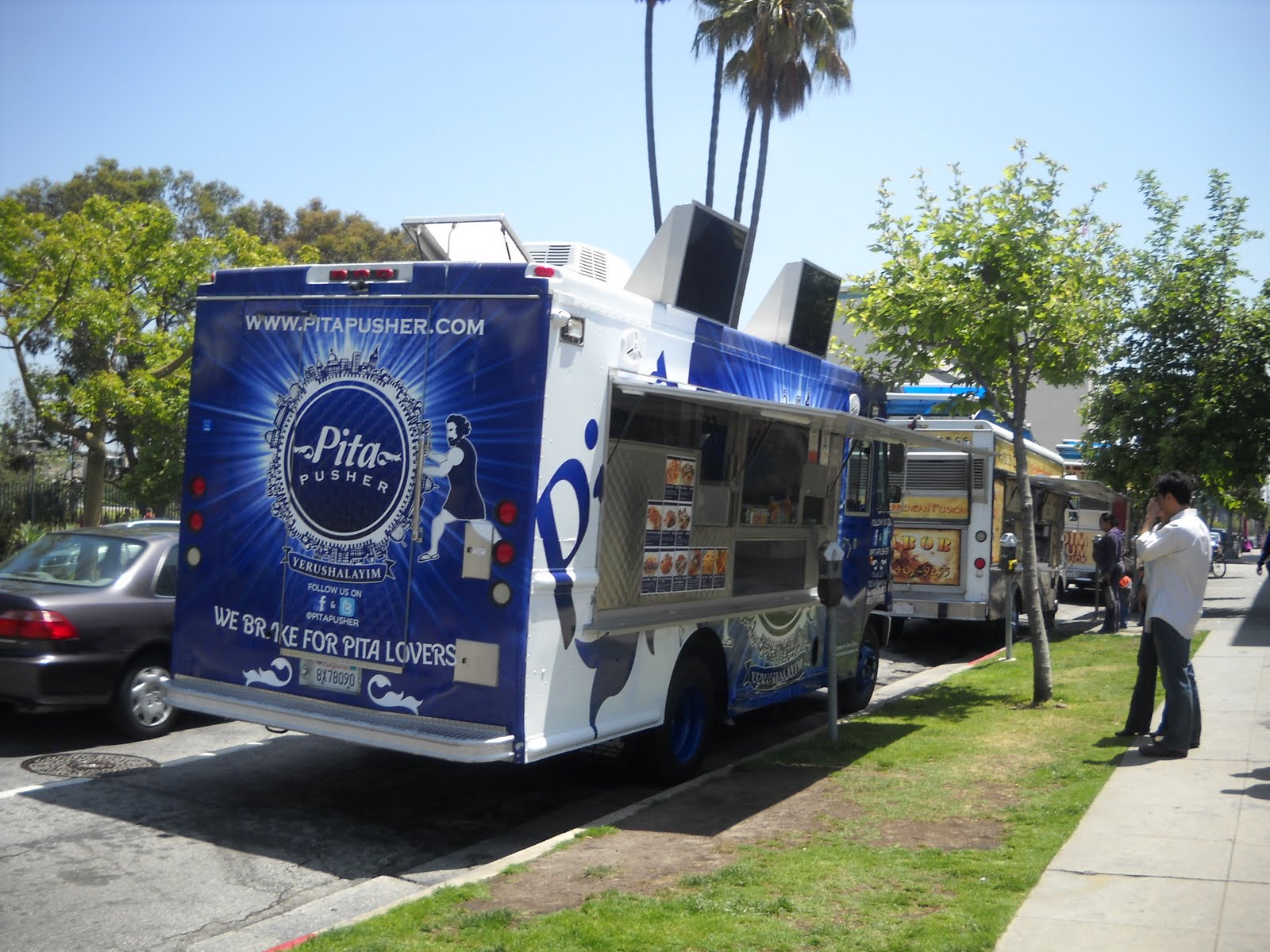
* No less than two Indian and two Mediterranean trucks, selling everything from tikka masala (New Delhi Express, Twitter: @newdelhiexpress) to pitas (Pita Pusher, Twitter: @pitapusher) to Mediterranean-Mexican fusion (Kabob Express, Twitter: @mykabobexpress).
* And of course, several taco trucks, including one of at least three Korean food trucks (the aforementioned Bool BBQ).
 The Dim Sum Truck
 dim sum and samosas
 The Bollywood Bites food truck
 There it is, hons.
Yes, I am a sucker for a Bawlmer ex-pat. I bought one of the Java tacos - Indonesian spices with pork, scallion and cucumber for $3.

While not nearly as spicy as they advertised (it didn't make my mouth hurt anyway), it was still a juicy, slightly sweet and savory, and tasty soft taco. I had some flashbacks to a cochinita pibil that I had made a while back, not so much for the flavor as for the look. Ooooh, I wonder if anyone is planning a Yucatecan food truck? (Note: some of the trucks take Visa or Mastercard. Komodo does, but you must spend at least $10. They make this easy for you, since they offer whole meals that cost $10).
I drove away from the Miracle Mile thinking that this was, by far, the best $15 I had ever spent on lunch in Los Angeles, and I have had more than a few of those over the last several years.
Finally, a helpful list of food trucks that showed up at the Miracle Mile on Tuesday. I have posted Twitter links wherever I could.
All-American Gourmet Grill (American food - Twitter: @AllAmericanGG)
Bollywood Bites (Indian - Twitter: @BOLLYWOOD_BITES)
Bool BBQ (Korean fusion, including their legendary Korean BBQ tacos - Twitter: @BoolBBQ)
Chili Dancer (pan-international dishes, focusing specifically on Thai and Southeast Asian food, that showcase chilis - Facebook: The Chili Dancer, though nothing is posted; Twitter account has been so inactive that I'm not sure it's even theirs)
Cool Haus (gourmet ice cream sandwiches - Twitter: @COOLHAUS)
The Greasy Wiener (hot dogs, including New Jersey-style "rippers" - Twitter: @TheGreasyWiener)
Happy Cup Ramen Truck (ramen noodles, duh - Twitter: @HappyCupRamen)
Kabob Express (Mediterranean-Latino fusion - Twitter: @mykabobexpress)
KoManna (Korean - Twitter: @KoManna)
Komodo Food Truck (pan-Asian and pan-international tacos - Twitter: @komodofood)
La Rue de Paris (pastries and crepes - Twitter: @laruedeparis)
New Delhi Express (Indian - Twitter: @newdelhiexpress)
New York Galbi (Korean - Phone: (213) 985-8219 - I cannot find a Twitter or Facebook account for them)
Pita Pusher (Mediterranean - Twitter: @pitapusher
Vchos (pupusas and "Central American-inspred tapas" - Twitter: @vchostruck)
The Wien (hot dogs - Twitter: @thewientruck)
Other photos:


Monday, May 23, 2011
Come fly with me, come fly come fly away...
I am back in California for the week, visiting friends from various facets of my 6 1/2 years in the Golden State. The plane ride was not terribly appetizing: just a breakfast burrito at California Kitchen (at BWI, no less), a Nathan's hot dog at Phoenix Sky Harbor between connections, and two soft tacos from Del Taco en route to my friends' house. Okay, those weren't horrible things to eat at all. I could have imagined worse (like those vanilla Oreos I got on the Southwest flight to Phoenix).
A few more food-related things to do whilst I am in the Southland:
* Tomorrow I hit LA (another taping of G4TV's Web Soup with the awesomely funny Nerdian-American comic Chris Hardwick). While here I want to try to make as much of my meals out of food truck eating as I can (I recently did this in DC. I will write about that when I get home). If not, well LA is definitely a food city.
* Vietnamese, Thai and Mexican abound in the Inland Empire. Imma eat it all.
* Not sure what to indulge in, food wise, in Palm Springs yet. We shall see.
* Some of my closest friends are doing an all-Southern meal for me (living with his wife and daughter in Redlands now, my buddy Kurt is originally from the other end of the Chesapeake Bay - Richmond - so we both have a crab-related culinary reference point)
* Two friends of mine, Gil and Jim, have fallen in love with this new sushi place. They will take me there or I will hurt them.
* And more shopping at Fresh and Easy, Tesco's US-tailored supermarket chain.
Ah, California here I've come!
NOTE: The state-spotlight posts about Illinois will still be going up this week. I actually wrote those a few weeks ago in anticipation of the trip. Pre-scheduled auto-publishing is a beautiful thing.
Sunday, May 22, 2011
Snacking State-by-State: Illinois I - How Deep Is Your Pizza?
This is a new day in my State-by-State project: my first foray into the Midwest. It's not that I've been neglecting this region. It's just that, alphabetically, no Midwestern state has come up yet (you've noticed maybe that I am going in alphabetical order). And we'll be in the Midwest for a while with this series, starting with the largest Midwestern state of them all.Official Name: State of Illinois
State Nicknames: The Prairie State; The Land of Lincoln
Admission to the US: December 3, 1818 (#21)
Capital: Springfield (6th largest city)
Other Important Cities: Chicago (largest in the state and the Midwest; 3rd largest in the US); Aurora (2nd largest); Rockford (3rd largest)
Region: Midwest, Great Lakes; East North Central (US Census)
RAFT Nations: Cornbread & BBQ, Wild Rice
Bordered by: Wisconsin (north); Lake Michigan (northeast); Indiana (east); Kentucky (southeast & south); Missouri (southwest); Iowa (northwest)
Official State Foods and Edible Things: popcorn (snack food); GoldRush apple (fruit); white-tailed deer (animal)
Some Famous & Typical Foods: typical Midwestern foods, especially corn; Native American and pioneer foods; state-specific foods (horseshoe sandwich, shrimp de Jonghe, Chicago dog, Italian beef); also note: deep-dish pizza and hot dogs were first made popular in Illinois
Many of us have a notion of what "Midwestern cuisine" is - that it's bland, that's it's vague, that it isn't even a cuisine really. It's certainly not as easy to pin down as "Southwestern" or "Southern" or "New England" cuisine. Indiana native Marcia Adams, author of Heartland: The Best of the Old and the New from Midwest Kitchens, does her best to sum up "Midwestern cuisine" for people like me who aren't from this most hearty part of the country.
...[T]he backbone [of Midwestern cuisine] is the wondrous bounty of the land. We have an embarrassment of riches at our doorsteps: grains, vegetables, tree fruits, game, fish, and range-fed cattle. it is in understanding how the divergent groups in this vast region have integrated indigenous foods while retaining and nurturing their individual ethnic heritages that the true essence of Heartland cooking can be found. [Adams 1991: xi]Adams points out that Midwestern ("Heartland") food is a combination of farm and frontier, WASP and immigrant and Native American, simple and haute cuisine (remember, Grant Achatz of Chicago's Alinea is at the forefront of molecular gastronomy, as I will explore sometime during this series). Perhaps the Midwest gets a bad rap for being bland and tasteless. But I am finding out that is not. Or at least not nearly as much as I had thought.
In fact, many of the nation's favorite dishes originated not just in Illinois, but right in Chicago, the third largest city in the nation:
- the Chicago style dog, easy to find at most hot dog shops in and around the country (in Baltimore? Try Zack's). What is it? The folks at Hot Dog Chicago Style, Wisconsin-based aficionados of the legendary dog, put it out there: on your steamed frankfurter put yellow mustard, green relish, chopped onions, tomato wedges (two, please), a pickle spear, sport peppers and celery salt on a sesame seed bun.
- the Italian beef, more famous in the Midwest than around the country, is thinly-sliced beef with Italian seasonings, on a roll (likely Italian roll). The meat juices often soak into the bread.
- Even less popular outside of Chicago, but very big in the city itself, is shrimp de Jonghe (sounds more or less like "shrimp de Young"). The Roadfood.com website of Jane & Michael Stern gives a classic version of the recipe: shrimp baked with lots of butter, bread crumbs and garlic, with sherry and cayenne pepper. I did not make this for this State-by-State series, but I must make this at some point in the not too distant future.
- The most famous of all Chicago recipes, even more so than the dog, is the Chicago-style deep dish pizza. Made famous by Pizzeria Uno, it is found all over the country. And if you know how to make it, it's easy. If you don't, well then...
As with any pizza, you can put whatever toppings you want in a deep-dish one. And since it's a "deep dish" pizza you can put even more of them on, er, in the pizza. Still, I have to reinvent the wheel, so I searched everywhere for recipes. I went with a combination of two. For the ingredients, I used Deven K. Mercer's "Chicago-Style Deep Dish Pizza" DKM (as I think he prefers on his website) measures out his ingredients exactly, for the dough and the pizza toppings. I ended up cheating and bought pre-made dough from Trader Joe's, which I know is not authentic, but for my first attempt I tried to make it easy on myself. For the equipment, I used Jeff's Recipes' website for deep dish in a cast iron skillet. The reason: I couldn't find a deep dish pizza pan anywhere (this is Maryland after all), and it was faster to just use a large cast iron skillet. He suggests a 12" skillet. This worked well for me.

So for my ingredients, I used:
* pizza dough - if you use pre-made, buy two 1-lb bags of dough (99¢ per bag), any kind but I preferred the plain variety
* olive oil (for the pan, to keep the pizza crust from sticking)
* one 28-oz can of crushed tomatoes (I used local fave Sun of Italy for about $3.50 and it was so worth it)
* several garlic cloves, a sliced shallot and a few anchovy fillets (had all on hand) - I sautéed them together in olive oil.
* 3 lbs (1 1/2 bags) of Italian cheese, mine being a mozzarella / provolone blend ($2.50 per bag, on sale)
* parmesan cheese (yes I used the granulated stuff)
* Italian mild sausage (DKM says that Italian sweet sausage is a Chicago fave but I could not find this. I got one fresh for about $1.50)
* pepperoni (one package of Ciao brand for about $3)
Before assembling anything, turn your stove up to 500° and just let it warm up. You need your oven to be hot. You will turn it down once you put the pizza in the oven.
The first part is to let the pizza dough come to room temperature before putting in the skillet.

Douse the skillet with oil and get ready to press the dough into the skillet.

You may find, as did I, that the dough does not want to stay in place. If that happens, rolling it out may be your best bet, unless you know how to toss it in the air. I don't.

Press the dough into the skillet, making sure to prick the bottom and circumference with a fork.

When in place, the rest should be easy. Add your crushed tomatoes first.

Next lay most of your cheese on top.

I then added other ingredients as desired: the Italian sausage, crumbled and sautéed; the pepperoni; the shallot/garlic/anchovy mixture (my sister did not appreciate the anchovy), and the parmesan. Add anything else as you desire.
Next, place the cast iron skillet in the oven and turn the temperature down immediately to 475°.
Bake in the oven for about 25 minutes, until the cheese is browned.

Jeff of Jeff's Recipes says that the pizza should slide right out after cooling for about 10 minutes. After about 20 I still couldn't pick up the skillet, so I put a large plate over the top, turned it over, and then did it again with another pan that I used to store it.

I might have just cut it in the pan, but I really didn't want the pizza toppings leaking all over the cast iron.

My first attempt at deep dish pizza was sort of messy. I don't know how solid the insides are supposed to be, but cutting it made it ooze all over. The pizza, while delicious, tasted better to me the next day. It was just a beautiful tasting pizza, that's for sure. Part of that may be the deep dish - it holds so much stuff.
Sources:
Adams, Marcia. Heartland: The Best of the Old and the New from Midwest Kitchens. Clarkson Potter: New York, 1991.
Hot Dog Chicago Style. "So What Exactly Is a Chicago Style Hot Dog?" Hot Dog Chicago Style,
copyright 2011, All Rights Reserved.
Mercer, Deven K (DKM). "Chicago-Style Deep Dish Pizza". PizzaMaking.com, copyright 2005, All Rights Reserved.
Jeff's Recipes (Jeff). "Deep Dish Pizza – Cast Iron Style". Published May 8th, 2007. Jeff's Recipes, copyright 2006 - 2009, All Rights Reserved.
Stern, Jane, and Michael Stern. "Shrimp de Jonghe". Roadfood.com, copyright 2011, All Rights Reserved.
Some information also obtained from Wikipedia's "Illinois" page and other pages, and the Food Timeline State Foods link to "Illinois".
Subscribe to:
Posts (Atom)


