Here's hoping that the new year is going to be better than this one, because it's been pretty dismal for me and mine. So Happy New Year and Happy New Decade. Please drive carefully and soberly tonight.
And don't y'all tell me "Oh the decade ends in 2010." I never hear people describe 1980 as "the seventies" or 2000 as "the nineties" - so "the aughties" end tonight. There, settled. Happy New Decade :)
Thursday, December 31, 2009
Best Wishes for the New Year and New Decade
Food Ethnography on a Budget: Romania III: Mămăligă
To finish out my brief flirtation with Romanian cuisine, I had to make a helping of what most cookbooks and websites I checked have cited as a favorite dish in and around Romania: mămăligă. Mămăligă was probably introduced from Italy, as a lot of influence has gone from Italy to Romania since Roman times (Romania literally means "New Rome" - roma nea - in Latin).
This dish is in the same family with polenta and grits, only with the fat factor kicked up a notch. Ever eaten cheese grits? I have. Ever eaten cheese grits drowning in sour cream and butter? I have not. I'm guessing you haven't either, no matter which side of the Mason-Dixon line you grew up on. But this is a good description of mămăligă - like polenta or grits, but baked and/or topped with sour cream. Mind you, it doesn't have to be sour cream - this Transylvanian version posted on The Austerity Kitchen blog doesn't even mention it, but it does include feta cheese - which is optional. It does seem, however, that Romanians love that sour taste so much, it seems par for the course that mămăligă probably should incorporate some sort of sourness.
I went back to Anisoara Stan's Romanian Cook Book and she had a few different recipes for mămăligă - a traditional version, a modern version, and so on. Doamnă Stan's more narrative recipes don't work too well for an ADD-addled brain such as mine, and in terms of ease in following, her recipe for mămăligă just wasn't working for me. So I turned elsewhere. I first turned to a beautiful new book of Eastern and Central European cooking (this is a mouthful, y'all), The Illustrated Food and Cooking of Poland, Russia and Eastern Europe, edited by Lesley Chamberlain. And that's without the subtitle, which lists cuisines ranging from Ukranian and Hungarian to German and Austrian. And yes, Romanian is also in there. This book has  helpful descriptions of each European region's style of cuisine, and every recipe comes with at least a finished photo and an accompanying how-to photo - sometimes several. The Chamberlain book's mămăligă recipe is different from all the others I read about, because it is in bread form. I didn't get the impression that mămăligă was a bread, and wanted something more authentic. I found it in my copy of Jeff Smith's Frugal Gourmet on Our Immigrant Ancestors. Smith just gets giddy over, well, every recipe he writes about in this book, a broader crash course in foods of different parts of the world (his is the semester version, mine is the self-taught over the course of a week version).
Smith tells us quite bluntly that we will all definitely like mămăligă. Well with all that butter and cheese and sour cream I can see why. I just don't know how I will keep from gaining five pounds from eating this stuff.
The meal: Mămăligă
The Frugal Gourmet's incorporates the following ingredients, almost all of which I had laying around. Seriously, this cost me about $2 extra, and all I had to do was head to Whole Foods to buy some of their extra cheese pieces they have in their salad bar section. Use any combo of sharper and less sharp cheeses you have lying around, and if you have feta but no sour cream, all the better for you.
- water (hmmm, I wonder where you're gonna find that? You need 1 1/2 quarts of it)
- yellow cornmeal, the finer the better (had a whole bag of this - you'll only need 1 1/2 cups. It has to be yellow - mămăligă isn't made from white corn meal)
- 1 cup sour cream (left over from the ciorbă)
- 1/2 stick of butter (got it)
- cheese - lots and lots of cheese (for this I had about 0.15 lb of Havarti laying around. I then went out and spent two more dollars on some small pieces of Irish Dubliner and Ohio's own Guggisberg Swiss. I had planned to add some Parmesan, but ended up not needing it.
 Mmmm. Cornmeal mush.
 The process is simple: boil the water, take it off the heat, slowly stir in the cornmeal and put the pot back on the heat, stirring frequently for 20 minutes until the cornmeal mush is the consistency of "thick cake batter" (Smith's words, not mine). While doing that, melt the butter in an 8" square pan in a 350°F oven. Pour half the mămăligă "batter" into the pan, then spread half the sour cream on top and sprinkle half the cheese on top of that. Repeat with the other half of the ingredients, and bake until the cheese is browned on top. I chose to put it under the broiler for a few minutes afterwards.
 The best way to describe mămăligă is rich. All of that cornmeal layered with cheeses and sour cream and butter, and I could not eat very much in one sitting (also some advice: if you're just recovering from a Crohn's or colitis flare up, you might want to hold off on the mămăligă, or else just eat a wee bit). It's a good if heavy accompaniment to ghiveci, and a nice complement to your meatball ciorbă.
On to a new year and a new culture in my quest to better know cuisines I know little about. Since it is cold and snowy here, more so than I ever remember in December, I'm really jonesin' for warmth. So my next stop is taking me to the tropics. Just where I'm not telling yet.
Sources of recipes:
Romanian Cook Book, by Anisoara Stan (1951: Castle, Secaucus, NJ); republished 1969, 1983 - ciorbă de perisoare cu carne, vegetable ghiveci
The Illustrated Food and Cooking of Poland, Russia and Eastern Europe: Discover the Cuisines of Russia, Poland, the Ukraine, Germany, Austria, Hungary, the Czech Republic, Romania, Bulgaria and the Balkans, edited by Lesley Chamberlain (2009: Lorenz Books, London, England, UK) - general background on Romanian cuisine
The Frugal Gourmet on Our Immigrant Ancestors, by Jeff Smith (1990: William Morrow & Company, New York, NY) - mămăligă
Wednesday, December 30, 2009
Because it's Kwanzaa (Day Five)
Habari gani? Well, the news is that there is a surprising dearth of food-related Kwanzaa videos on YouTube. This one from Chow.com's page has Grandma Martha and her grandson sharing her delicious candied sweet potatoes with us, and invites all of us to the celebration.
Tuesday, December 29, 2009
Food Ethnography on a Budget: Romania II: Vegetable Ghiveci
My next foray into Romanian cuisine turned out to be a dish that you might find in many different parts of the world. There didn't seem to be anything particularly Eastern European about roasted vegetables with olive oil, sautéed onions, and soup stock. But as many writers have said about Romania, they love their fresh vegetables.
One of the most common vegetable dishes not just in Romania but in much of Southeastern Europe is ghiveci (/gee-VECH/). Ghiveci can be embellished with meats, fish, etcetera, but it doesn't have to be. In fact, the recipe I used struck me as quite vegan., especially for the 1950's. And you aren't limited in the variety of vegetables or even fruits you add to this dish. Anisoara Stan in her Romanian Cook Book notes that this dish is made in winter or summer out of "all the vegetables you can put your hands on" (p. 33). While she gives a set list of vegetables to use in her ghiveci, one can feel free to vary them here and there.
What all the ghiveci dishes share in common is the dish in which they are roasted. The recipe itself is named not for the ingredients but for the dish in which they are cooked: a ghiveci is a very large, usually ceramic cooking vessel. I don't have one of these, so I went with the next best thing: my slow cooker, which had the added benefit of my being able to just leave it cooking while I was out. I'm sorry, but the idea of leaving my oven on while I'm out running errands doesn't sit quite well with me.
The meal: Vegetable Ghiveci
 I only used about 2/3 of these ingredients - they wouldn't all fit in the slow cooker
Stan has a set list of ingredients, as I have said before. I improvised on some of them not only because I didn't have the freshest ones available that Doamnă Stan recommended, but also because I couldn't fit them all in my slow cooker. I will say that I bought some vegetables specifically for this project, and others to use in a few recipes.
The ones she recommends, and my substitutions:
- 1 bunch carrots (I had two mammoth ones left over from the ciorbă)
- 4 large potatoes (I had lots of potatoes - a box at the I-83 Farmers' Market for only $2)
- 1 turnip (had two for $1)
- 1 eggplant (didn't buy one - not in season)
- 1 cup green peas (bought a can at Wegman's for 70¢, used half of it)
- 1 green pepper (didn't use one, but I did throw in a Thai chili I had lying around)
- 2 celery roots (my friend Jim recently got rapturous over the phone about his first experience with celery root. I'll use it next time; I just used leftover celery)
- 1 squash (acorn squash, one for 50¢)
- a bunch of leeks (replacement? 1 bunch of green onions)
- 2 bunch mixed herbs (I threw in some parsley)
- 1 bunch of grapes (had some green grapes in the fridge)
- 1 cup lima beans (I didn't use any, though it was due more to space than to lack of desire)
- other veggies left out: 3 parsley roots, 1 cup green beans, 1 small cabbage, 1 small cauliflower, a handful or two of okra, and about 10 tomatoes. In their place, I used a bunch of kohlrabi ($2) and a sweet potato and white mushrooms I had laying around.
- 4 heads of garlic (I just used 1 1/2 heads, a rare thing for me since I usually go overboard with the garlic)
- 4 or 5 onions (a large box of onions for $2 at the farmers' market)
- 1/2 cup olive oil, plus an extra cup (had it)
- 2 cups soup stock (instead I used white wine)
- salt and pepper
 The recipe is simple to adapt to the slow cooker: just keep on cutting, prepping and chopping whatever vegetables and fruits you have until you just about fill your slow cooker. This includes the green onions and whole garlic cloves. They all get thrown in. You should have at least a few of the vegetables that Stan lays out in her recipe, but the one you absolutely must have is the onion (you should have the leeks/green onions and the garlic, but you must have the onion). You don't just throw these in with everything else; instead, you need to prep these in a specific way. Instead of throwing the onions in with everything else, you fry these up in 1/2 c of olive oil until browned (mine isn't completely vegetarian - I added a smidge of butter). then you add 2 cups of stock, or white wine in my case (I had it laying around). Let it boil while you heat up that last cup of olive oil by itself until it is boiling. Dump the boiling oil on the screaming vegetables (MU-hahahahaha!) and then follow it up with the onions.
Next, Stan gets a little vague on her cooking instructions. Here is what she tells you to do next:
Cover and bake in a moderate oven, until the juice has been absorbed. Serve hot or cold. (p. 35)
 Yes, that's all it says. I need a wee bit more guidance than this - like what temperature I roast it at, or for how long I leave it in the oven. This is why I chose to use the slow cooker: I just set it on LOW for 5 hours. Perfect.
Of course, there is just one problem: how am I going to eat all this? Even after giving some to family or friends, I'll have a lot for one single man to eat. I could try to freeze some of it, but honestly I think it will become mushy. But this problem is mitigated by the ghiveci's versatility. It can be your entrée, or a nice side to turkey and stuffing, or ham, or chicken - just about anything. You can eat it in a large tortilla, or with another type of flat bread. Or you can eat it over cornmeal mush such as mămăligă (see below). I had it with some wild rice and a glass of that Hungarian wine Egri Bikavér (Bull's Blood).
 It would look prettier if I wasn't just using my camera phone.
I'm starting to feel like a Romanian housewife now! And to really get into that vibe I have to tackle one of the most common dishes in all of Romania: that first cousin of polenta and grits and second cousin to cornbread - mămăligă.
Monday, December 28, 2009
Baltimore Magazine's Best Restaurant of 2010 Poll
Baltimore Magazine has its poll up for the Best Restaurants for 2010. I'm voting now but y'all have until 11:59PM on January 15 to vote. So vote!
And stay tuned for my annual wrap-up of the year in food and restaurants, from my little neck of the woods.
Saturday, December 26, 2009
Because it's Boxing Day
No, we don't celebrate Boxing Day in the US. In fact, many of us would be hard-pressed to even define it. This day after Christmas is celebrated in many other parts of the English-speaking world, including Canada, the UK, etc. and so on, as a public holiday. It started out as a day to give to those less fortunate than (and/or subordinate to) you - because the poor would traditionally go from door to door with empty boxes for people to fill with goodies. Today it's basically a day to indulge in post-Christmas Day sales, watch sports, discuss last night's Doctor Who (airing tonight on BBC America, by the way - the first time an episode has ever aired so soon after it did in the UK) and have people over for buffets. This video from the UK's Tesco grocery chain makes an oven-baked salmon look fairly easy, especially on a cucumber-watercress salad.
Just remember: when he says 200 degrees, he's talking in Celsius. We would do 400 degrees Fahrenheit.
Friday, December 25, 2009
Because it's Christmas (Day 1)
Having once lived for several years in SoCal, I am quite familiar with the Southwestern, Mexican and generally Mesoamerican tradition of making tamales for Christmas (that is, I know of it, although I myself have never had the good fortune to partake in the tradition). Even though this is not a tradition my ancestors took part in, or even really knew about, I have wanted to do this for some time. For various reasons, this was just not going to be the year.
But leave it to the folks at the Food Network and their online-only show The Power of Food - the same guys who brought us a Hanukkah brisket from Bawlmer earlier this month - to head to the Southwest and set up shop in a cheery abuela's kitchen on Christmas Eve. This woman, along with two or three generations after her, do it all from scratch - from the roasting of the chiles to the soaking, nixtamalizing and grinding down of the corn to make the masa. God, I could use some tamales right now. ¡Feliz Navidad, y qué comas muchos tamales en el año nuevo!*
*Happy Christmas, and may you eat many tamales in the new year!
Monday, December 21, 2009
A Blue Christmas Message
The blog is going dark for a few days. My sister's dog has passed after 12 1/2 years of eating, running, playing in the snow and smelling the cat's behind. Rudy was my sister's dog, but the whole family loved him. I'll miss giving him the occasional piece of bacon whenever I was visiting in the morning, and I will miss shooing him away from the cat when he was feeling a little too friendly. He lived a very long life for a dog, and was surrounded by loving faces when he went. It's comforting to think that he's not gone - he's just everywhere. Rest in peace, big dog.
Sunday, December 20, 2009
Food Ethnography on a Budget: Romania I: Ciorbă de Perisoare cu Carne
A few years ago, I picked up a few inexpensive cookbooks at the legendary Baltimore Book Festival. One of these was a yellowed book from the early 50's of Romanian cooking. I was intrigued, because I knew nothing of Romanian cooking, and the book only cost me three bucks. Fast forward to 2009, and it is the next brick in the wall of my Food Ethnography project.
Food Ethnography: Romania Located in: Southeastern Europe
Some common ingredients: no blood - sorry, Dracula fans; meat, meat and more meat; also cabbage, cornmeal, eggplants, anything sour, peppers, more sour stuff; beans, tarragon, thyme, basil, parsley; did I mention anything sour?
Number of Romanian restaurants in the Baltimore area: 0
Number of Romanian restaurants in the DC area: 0, unless you're lucky enough to run across the Romanian Orthodox Church in Falls Church when they're serving Romanian food. The closest you're going to get is Café Sofia, which serves Bulgarian food, which is close.
Kind of like: When Hungary met the Mediterranean
M y whole-hog introduction to Romanian cuisine begins with Romanian-American chef and cookbook author Anisoara Stan. Stan is perhaps responsible for introducing Romanian food to an American audience. That audience, circa 1951, was at the time mostly American housewives with an interest in "exotic" food. Stan's Romanian Cook Book has quantities but reads more like a narrative than a step-by-step recipe. It was disconcerting enough to have to map out any recipes like I never have before.
Romanian cuisine, like much of Southeastern European cuisine, is highlighted by chili peppers (or "sharp peppers" as Stan calls them), sour soups (ciorbă), vegetable dishes (such as ghiveci) with or without a lot of meat, and the quintessentially Romanian dish mămăligă, which is in the polenta and grits family. Over the next week or so - hopefully by the end of the year - I will be attacking the three Romanian dishes of mămăligă, ghiveci and my first Romanian recipe, ciorbă de perisoare cu carne - or ciorbă with meatballs.
The meal: Ciorbă de Perisoare cu Carne (Sour Soup with Meatballs)
The last time I made a massive meatball soup was a few years ago for an Italian dinner. The soup du jour was Italian wedding soup. This ciorba isn't terribly similar, but the meatballs did ring a bell. Specifically, the reminded me just how tedious it was to make lots of little meatballs for a soup. But I'm getting ahead of myself here.
The reasons why this soup, like many of Doamnă (Mrs.) Stan's recipes, seems so daunting are, again, the narrative style of the recipe, and the sheer quantity of ingredients. I should've taken a cue from the introduction to her vegetable section, which urges you to use "all the vegetables you can put your hands on." But I was running low on vegetables, so I needed to buy some anyway. I took myself to the I-83 market (now the last one I will get to this season, since I had a tough time getting around after the blizzard of '09 this weekend), and stocked up on some veggies for this recipe.
 Everything one would need for a meatball ciorbă, minus a quart of water
For this recipe, I needed the following, some of which I bought at the farmers' market, some of which I had lying around, and some of which I had to improvise. There were three components to the soup: the stock, the meatballs, and the "etcetera" that goes into the ciorbă.
For the broth, add to 3 quarts of water:
- veal shank bone & fresh pork bones (I cheated, and used 2 quarts of chicken stock and a quart of water. I had one quart already, but if you buy the two, it'll be about $3.50 to $4)
- 2 large carrots (I bought some massive ones at the farmers' market, a big box for $2, but I will be using these for a while. One super big carrot was about 40¢)
- 2 parsley roots (I have no idea where to find these. The closest replacement: 2 parsnips, which I could only find at Wegman's for about $2 per lb. Two are about a half pound)
- 1 celery knob or 1 stalk celery (I had this lying around)
- 1 tomato (I only had a green one, so in it went)
- 1 quart of sauerkraut juice (It's not easy to find sauerkraut juice without the sauerkraut still in it. I got about a quart of kraut juice from 2 quarts of sauerkraut, which freezes well for up to a year. Each can was about $1.50).
- 1/2 lb chopped veal + 1/2 lb chopped pork (since veal is so expensive, I just sprang for a pound of ground pork, at $4 per lb)
- 1 egg (had it)
- 2 tablespoons of uncooked rice (again, on hand)
- 1 onion (another box for $2 - one onion was about 25¢)
- more celery (again, had it)
- leek (I bought a small bunch of green onions instead; I used half of a 99¢ bunch)
- fennel (ran out, so in a pinch I used some ground anise seed)
- thyme, tarragon and dill (used dried)
- parsley (I sprang for fresh this time, $1.29)
- lovage (not an easy herb to find, but celery leaves are so similar in taste, texture and look that I just used some of those)
- hot pepper seeds
- 2 egg yolks, 2 tablespoons of uncooked rice (both on hand), 1 cup sour cream (1 pint was $1.50), 1 tablespoon flour and salt and pepper (all on hand)
 I know it is less special to dump 2 quarts of chicken broth into a soup pot than it is to make your own broth, but again, I felt like cheating - so sue me. And to be honest, this cookbook comes from an era before "boxed organic chicken broth from Trader Joe's/Whole Foods." In fact, one of the fun things about Stan's book is how she marvels over these new-fangled modern conveniences such as the ready availability in the US of formerly exotic herbs and spices like garlic and tarragon (it was the 50's, after all). But back to the broth. To flavor it, I did add the recommended vegetables: celery, parsnip, carrot and tomato, brought all that to a boil, and then replace the veggies with the quart of kraut juice. The kraut juice is absolutely critical. Stan briefly laments that Romanians in her time no longer take the time to process sour wheat bran - the traditional souring agent for ciorbă. Instead, she suggests things like kraut juice and lemons, the latter of which were just becoming easier to find in Romania in the 50's.
 Evil Dead III: Army of Meatballs
The meatballs were, again, tedious but easy enough to make: just mix the ingredients (also with some parsley and thyme). Make as many walnut-sized meatballs as you can. In retrospect, I forgot to roll each in flour, which was Stan's recommendation. Re-boil the broth, add 2 T of uncooked rice, and drop in those meatballs along with celery, leek (green onion), fennel (anise) and your various herbs.
The soup is still not sour enough, so you have to add a thin sour cream paste to the boiling liquid. Mix the sour cream, egg yolks and flour together and water it down into a thin paste, and scoop it into the soup. Stir and boil for 20 minutes, and serve with parsley and a dollop of sour cream.
What can I say? The soup was sour. Not as sour as I first thought it would be, but sour nonetheless. The tang of the ciorbă made a nice contrast with the juicy pork meatballs. I tried to be conservative with the meatballs, and got about four in my bowl, but I had to go back for seconds. As stated before, this ciorbă is nothing like Italian wedding soup except for the fact that it has meatballs. Plus, the best part of this soup is that there is so much of it that it will last me a while, and I can share it.
 My first ciorbă
 Wine is a big part of many a Romanian meal. It's too bad that Romanian wine is not exactly easy to find in Baltimore. Fortunately the nice folks at the Wine Source pointed me towards a less refined, rustic red from nearby Hungary. The Egri Bikavér (Bull's Blood) 2005 has a lot going for it. My favorite thing about it is that I find it pleasantly drinkable. I often find red wines more difficult to tolerate than, say, whites. I found Bull's Blood to be a little easier on my palate, so I wasn't overpowered by it (ironic considering the name, "Bull's Blood"). Also great about it is the price: at about $8 or $9 if I remember correctly, it was quite reasonably priced, and I would buy it again to drink with chicken or vegetables - or, again, ciorbe.
Thursday, December 17, 2009
No one can resist my Schweddy balls.
And no one ever will.
Shannon. Gasteyer. Baldwin. Classic SNL back when it started being funny again.
Tuesday, December 15, 2009
Comments are now pop-ups!
So if anybody has any technical difficulties leaving comments because they're not in pop-up box format, let me know. I can change it back. I'm easy like that.
PS - I just realized: you can't let me know by comment, now can you? If it doesn't work, then let me know by email, which is linked to in the "About Me" section, posted on the right hand side of the page near the bottom.
Monday, December 14, 2009
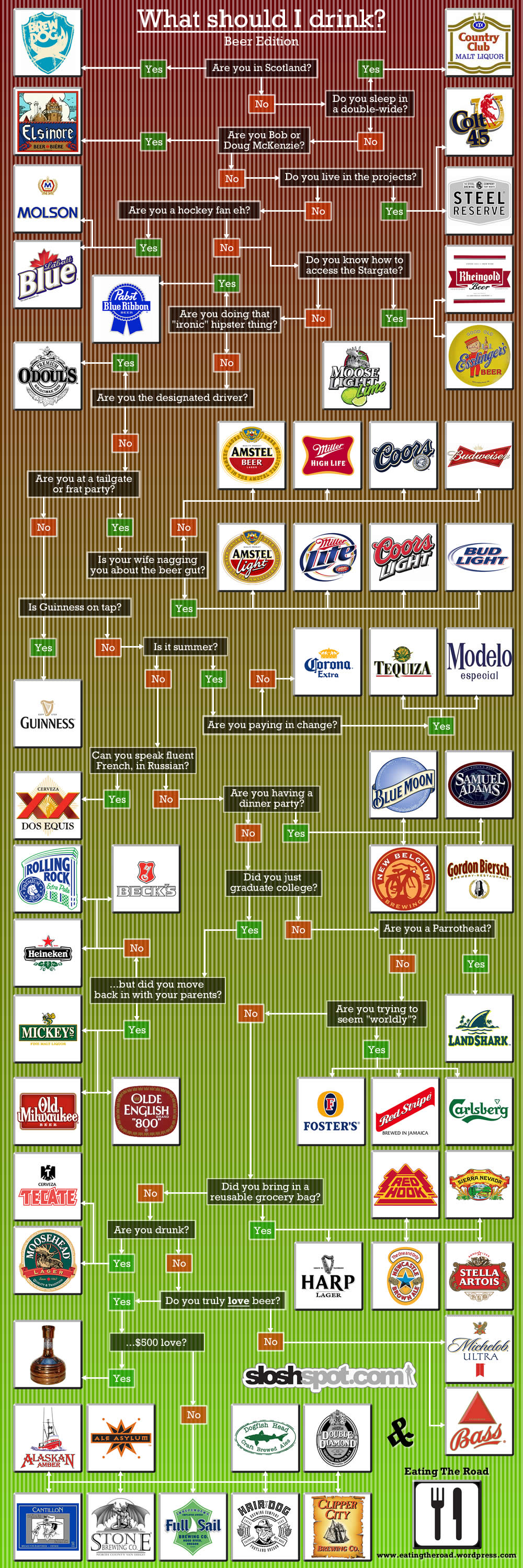
What Should I Drink - the Beer Edition
Wonder what kind of beer you should drink, but need a handy flowchart to tell you? Look no more! I would re-post it here, but I'll just let you surf over to Eating the Road, who put their heads together with Sloshfood.com to come up with this fabulousness. Local brew companies Clipper City and (not as local) Dogfish Head are on the map! Alas, Natty Boh isn't. When you see Pabst, just think Natty Boh.
Pickled Grapes
I was listening to Lynn Rosetto-Kasper of Splendid Table gushing over Matt & Tedd, the Lee Brothers, and their new cookbook Simple Fresh Southern. I was nodding at many of the Southern style party recipes they discussed with Rosetto-Kasper. One caught me totally off-guard: pickled grapes.
Again, stop wretching.
Yes, pickled grapes. The Lees said these Thompson seedless green grapes take on an almost olive-like quality. And all you need is equal parts water and vinegar, plus some chili pepper, rosemary and garlic. The sour grape takes on a pleasantly pickled flavor.
Of course I had to try this, but without their cookbook in front of me I had to improvise instead (of course, dumbass didn't bother to actually check the Splendid Table website, where the recipe is clearly posted). So I put about a cup of seedless green grapes in a container, added one cup each water and vinegar, plus three chopped cloves of garlic, a few sprigs of rosemary and a few generous pinches of roasted red pepper flakes. After marinating it all in the fridge overnight, I was pleasantly surprised.
However, I cannot say this was sour at all (maybe I didn't buy Thompson seedless). Instead, the grapes tasted a little sweet. This sweetness was actually magnified by the vinegar and garlic. So it wasn't the same thing that the Lees were promising, but it was good anyway. In fact, it instantly reminded me of the Cambodian style pickles where you just throw some fresh veggies into a water-vinegar-fish sauce-garlic solution and let it quickly marinate. So I wonder how these pickled grapes would taste with a little bit of fish sauce thrown into the pickling brine. I shall have to try this later on.
Since I didn't add the salt that the Lee Brothers so clearly put in their recipe, it's no wonder they come out sweet. I still like the flavor, but some salt or fish sauce still needs to go in. In retrospect, I did things very differently than they did. So next time, I will follow the actual recipe, to see how the Lee Brothers pickle their grapes.
Friday, December 11, 2009
Food Ethnography on a Budget: Eastern Woodlands IV: Frybread
I've been very busy this week, so I have not had much time to write much of anything on here. But the last recipe in my foray into Eastern Woodland Native American food doesn't take much time to make anyway, so it shouldn't take much time to write about either. This recipe is frybread. Unlike the other things I made, frybread is not in any way native to the Eastern Woodlands. It is, in fact, from the Great Plains. However, the popularity of frybread spread throughout the United States and Canada, perhaps by way of the powwow circuit. It's very much a part of the powwow, and that includes the powwows you find in Maryland, including the big one held every year at
 Patterson Park the Maryland State Fairgrounds.
There are many recipes for frybread. Many of them give you a fried dough that, when finished, looks very much like an elephant ear. You can leaven it with either yeast or baking powder, either pan fry it or deep fry it, and make it either sweet (with honey, maple syrup and sugar) or savory (with salsas, cheese and ground beef, to make the famous Navajo taco). I stuck with Dale Carson's recipe, also in her New Native American Cooking book.
The recipe was a simple standard one. Carson's version is pan-fried, but you can easily do this in the deep fryer instead. You probably have all the ingredients laying around - flour, salt, sugar, baking powder, vegetable oil and warm milk. You also need an extra bit of oil for the pan.
 They look like pancakes, but they're not.
Mix everything together and form the dough into small disks, about 5" (in retrospect, I think mine were a little small). Fry them until golden brown on each, and watch them so you don't burn them. Oops.
I admit that I expected my frybread to look like the fried dough I'd gotten at the State Fair or the Baltimore Powwow. Instead, they looked and felt like dense little hoecakes, but made out of wheat flour instead of cornmeal. They're still good, but next time I want to find a recipe that'll give me something fluffier instead.

I decided to do one savory and one sweet. I doused the sweet frybread with a bit of maple syrup (again, trying to get as much use out of it as possible). The savory one at first just got covered in butter, but then the Chesapeake started screaming to me, and I found my hand being drawn uncontrollably to the Old Bay. If anyone eats any kind of savory fried dough, you really should put some Old Bay on it sometime. Again, just about everything goes well with Old Bay.
That's it for my trip into the indigenous foods and traditions of the Eastern Woodlands, for now. If nothing else, I have learned that:
- cranberries are quite versatile
- it is pretty easy to make a nice, hearty deer stew with indigenous foods. Just don't leave it in the fridge over a week (yuck)
- wild rice is not rice as we know it, and it doesn't burn as easily as jasmine rice
- smothering cold wild rice with maple syrup is not as nasty as it sounds
- I like fluffy frybread better than the denser kind.
Sources of recipes:
HuntingSociety.org, "Basic Venison Stew," and NativeTech.org, "Cooking our foods we gather" - inspirations for venison stew
New Native American Cooking, by Dale Carson (1996: Random House, New York) - wild rice and maple syrup, sassamanesh relish, fry bread
Because it's Hanukkah
This shows just how little I have been paying attention these days, while my own life has been falling apart. I had no idea that the Food Network not only recently put out an instructional video (filmed nine years ago) on how to make a brisket, but that they came to Bawlmer to do so. Put that in your brisket, New York City and South Florida! Awww yeah, Baltimore's representin' in the brisket hooooouse...
Ketchup? Is that normal? I shouldn't be so surprised to see ketchup, I guess. Or should I? Italian-Irish Catholic boy here has no Hanukkah food background, so I'm honestly asking: is Heinz a normal part of the home cook's brisket recipe? Stories anyone?
Tuesday, December 08, 2009
Mo's Bacon Bar: Milk vs Dark
 One of the happiest days in my culinary life was the day I first realized that bacon could be used in a dessert context. This was when I walked out of Ma Petite Shoe with the legendary Mo's Bacon Bar from Vosges Chocolate. The smooth chocolatiness surrounding sweet and salty bits of crunchy applewood bacon were more than enough to send me over the edge. Wow.
Recently I found out that Vosges has started putting out a dark chocolate version of their famous Mo's Bacon Bar. I was ecstatic, because I much prefer the slightly bitter, more intense chocolate flavor of dark chocolate to the smooth yet slightly tamed down flavor of milk chocolate. The bar is lovely, but here's thing: although I prefer dark to milk, I prefer the milk chocolate bacon bar to the dark chocolate one.
I had to think about why this is the case.
It eventually dawned on me that the things that make me like dark chocolate don't work when you throw the sweet and salty intensity of bacon into the mix. In this case, the dark chocolate and bacon are fighting for your attention. In contrast, the milk chocolate bacon bar really lets the bacon shine. The milk chocolate isn't so much in the back seat as it is in the passenger seat - but the bacon is clearly the one driving. With the dark chocolate bacon bar, the dark chocolate is constantly fighting with the bacon to control the wheel. It works, but not as well as when there's just one driver.
So do try Mo's Dark Bacon Bar from Vosges, but I'm still sticking with the milk chocolate original.
Thursday, December 03, 2009
I cook... and then I chill. Awww yeeeah...
I love The State. I love puddin'. Awww, yeeeah...
$240 Worth of Pudding - watch more funny videos
Wednesday, December 02, 2009
Food Ethnography on a Budget: Eastern Woodlands III: Sassamanesh Relish
 I have done little cooking since Thanksgiving (and since my car's engine, as I have just found out, is officially "shot"). But back in my kitchen I decided to throw together a quick and tangy cranberry relish that caught my eye in Dale Carson's New Native American Cooking. The cranberry is native to New England, so it is certainly fair game for this project. Carson calls it by the Abenaki term sassamanesh. So I am making Carson's very own Sassamanesh Relish.
For this relish as for many of her recipes, Carson opens up the recipe to a mixture of indigenous and non-indigenous ingredients. Added into the indigenous North American foods in this recipe - cranberries, pecans, honey (which is indigenous to both sides of the Atlantic) - are oranges and apples, two fruits that are native to Asia. The recipe highlights how Native Americans, just like all other Americans, have united native and nonnative foods together.
 Sassamanesh Relish: the ingredients, and then some
The recipe is very simple: just take an apple (cored, unpeeled, cut up), an orange (divested of seeds, also unpeeled, and also cut up) and two cups of fresh cranberries (rinsed), and throw them in a food processer. Process the whole thing and then add 1/2 cup of chopped pecans and 1/2 cup of honey (I didn't have enough honey so I used half honey and half maple syrup). Mix it all up. That's it. It'll last up to two weeks in the refrigerator.
I took a quick bite and it's equal parts sweet and sour. As it sits, the flavors should mingle. It'll be a nice change from the dressing and sweet potatoes I'm eating with my leftover Thanksgiving turkey.
 About to relish the finished relish
Coming up: one last foray into the foods of the Eastern Woodlands, this time looking at one of the most popular foods on the powwow circuit not just here but all over the United States: frybread.
Tuesday, December 01, 2009
The Benefits of Virtual... FARMING!?
I frustrate my sister and our mutual friends by my stubborn refusal to join Facebook - though I hear they have a separate section where you can create non-personal Facebook pages for blogs.
I'm still not joining "the Facebook," but I admit that I'm missing out on the latest farming craze. Virtual farming.
Huh?!?!?
Atlantic food writer Dave Thier blogs about Farmville, the most popular game on Facebook and the engine through which Facebookers test the waters (er, mulch?) of the strange new trend of virtual farming. He also discusses how different Facebookers express themselves through both the designs and contents of their gardens - that is, how their gardens are arranged and what they plant in them. Thier, unlike myself, is a steadfast New England Yankee farmer, having been a part of the Yale Sustainable Food Project, so he knows a few things about farming. So he must have a pretty unique insight into virtual farming trends, and how closely it parallels real farming. For one, you have to pay real - or virtual - money if you want to go far with it. Sounds a wee bit like SecondLife. From the article:
When you log into the game, Farmville shows you a random picture of one idyllic farm or another--a bountiful field of pineapples, flowers, and wheat next to a little cottage, maybe, or perhaps an autumn scene of maple syrup and bright red trees. The reality, however, is that in order to afford such decorations you must either pay US dollars or plant endless fields of cash crops. Maybe I'm thinking about this too much, but for a simplistic videogame, Farmville offers a curious model for juxtaposing pastoral fantasy with the industrial realities of modern farming.A fun game, created by the people who brought us The Sims 1, 2 and 3, but with a price? At least it teaches a little about the ins and outs of farming, including cash cropping.
Blogging will be back up soon...
If you've been paying attention to the Twitter feed in the sidebar, y'all know I've been having a very rough weekend. A grand on a new catalytic converter, followed by a major engine malfunction (why does it pour when it rains?) that will cost more money than I have. But I will be posting again soon. Thanks, Cathy, for helping me out. I will be careful, I promise.
Subscribe to:
Posts (Atom)