
It comes full circle: the Stations of the Cross, Peeps-Style. I love how they do up Station VI,
Veronica Wipes the Face of Jesus". Trust me, you'll love it too.
Sunday, April 24, 2011
Because it's Easter Sunday
Snacking State-by-State: Hawaii II - Oh the things one can do with Spam
Mind you, Hawaiian cuisine is not just poi and sweet potatoes, pineapples and seafood. Hawaiian cuisine today is very much a fusion cuisine, specifically in terms of its Asian-American population (Asian-Americans are the largest demographic group in Hawaii). Japanese, Chinese, Filipino, Korean and other influences are strong throughout the Hawaiian islands, and it has led to both delicious Pan-Asian foods but also to fusion foods, such as the uniquely Hawaiian Spam musubi, a type of maki roll with Spam in the middle. Official Name: State of Hawaii (Hawaiian: Mokuʻāina o Hawaiʻi - Hawaii has two official languages, English and Hawaiian)
State Nickname: The Aloha State
Admission to the US: August 21, 1959 (#50 - Ah, still has that new state smell)
Capital: Honolulu (largest city)
Other Important Cities: Hilo (2nd largest), Kailua (3rd), Kāne‘ohe (4th)
Region: West, Pacific; Pacific (US Census)
RAFT Nations: Taro
Bordered by: The Pacific Ocean (all sides)
Closest land mass: California, almost 2,500 miles away
Official State Foods and Edible Things: none
Some Famous & Typical Foods: poi & taro, pork, much local seafood (such as mahi mahi), macadamia nuts, tropical and "lu’au" foods (pineapple, coconut, etc), Asian and Native Hawaiian fusion cuisines, Spam and foods made from it (musubi, Spam stir fries, etc)
Did I forget to mention, by the way, that Spam is one of the most favorite foods of Hawaii? You can even find it in the form of Spam burgers at McDonald’s. For my next recipe, I wanted something a bit more original than a Spam burger, to reflect Hawaii’s strong Asian-American identity. The Hawai'i's Spam Cookbook by Ann Kondo Corum has many recipes to encourage me. The one that caught my eye was one for deep fried Spam lumpia.
The recipe: Spam Lumpia
The Spam lumpia recipe originally comes from Vicki Perry’s “prize winning recipe”, as the authors of Hawaii’s Spam Cookbook mention. This very Hawaiian twist on the pork-filled Filipino fried favorite calls for:
* Spam (I have not bought this stuff in ages, so I didn’t realize one can would set me back about $3.50)
* kamaboko (basically, a type of Alaskan pollock fish cake from Japan. I had less trouble finding  exactly what I needed than I thought I would, since I found this in the “frozen fish cake” section of the H Mart for $4)
* chopped green onion (cheap at the farmers’ market)
* garlic salt (used garlic powder instead)
* 2 eggs, beaten (had them)
* chop suey mix, parboiled (this was what gave me the most trouble. At first I looked in every non-Asian supermarket thinking this would be some Americanized Chun King horror mix. Instead, I had my best luck in the Filipino section of the H Mart. Mama Sita is a particularly popular brand of chop suey/pancit seasoning mix for about $1.50)
* lumpia wrappers (much easier to find - about $3)
* frying oil (had that)
In addition, you will need a dipping sauce, which consists of catsup, vinegar, sugar, water and cornstarch.
To make the lumpia, grate the Spam and kamaboko.
 Grating the kamaboko
This in itself is pretty unusual, but you need to do this to get a proper lumpia filling.
 Ain't it purty?
Merely chopping it up with a knife isn’t going to cut it.
 This became a tad bit grating
 Pancit gravy?
Perhaps the recipe’s author meant something different than a powdered chop suey mix.
 Now added to the Spam mixture
Next, prepare the lumpia. I have never made one before so it took a little practice. This video by YouTuber clarkonair shows how to make lumpia, including how to most effectively wrap it so that it doesn’t come apart in your deep frying oil or on your plate (this is about 2:30 into the video).
If the video doesn't work, here's a walkthrough.
 Put about 1 to 2 tablespoons of Spam mixture above one corner of the wrapper, then fold up the corner to cover it.
 Like so
 And so
wet the final exposed corner and then roll up the rest of the lumpia towards that wet corner.
 What's Tagalog for "Voilà"?
You may need to wet it a bit more after you fold it up.

Finally, you need to fry the lumpia in oil until golden brown. Make sure the oil is around 350°F, and keep it there. The lumpia should get golden brown after about 3 to 5 minutes. Drain on paper towels, and dip in your dipping sauce.
 Making the dipping sauce. Never got thick.
Mine never got thick at all, even though I added about two to three times the amount of cornstarch the recipe calls for.

This was not one of my favorite recipes. It’s not that I did it wrong (unless the chop suey mix really wasn’t meant to be just a powdered mix). I think it is because of all that Spam. It’s been so long since I had ever eaten it that it overwhelmed me. It even exacerbated the Crohn’s a little bit. Perhaps I might need to build up a better tolerance for Spam than I have now? Until then, my next lumpia will be the more traditional one with pork instead of Spam and kamaboko. I will say this: however this Spam lumpia agreed or disagreed with me, it did go well with the very simple Spam-pineapple fried rice I made to go along with it. It's just 1/2 a block of Spam, cut into strips, fried with pineapple chunks, green onions, an egg and about 2 cups of rice.

We’re done in the Aloha State. Next we head up to the Northwest and the country’s largest exporter of potatoes. A hui hou kakou*, and Westward Idaho! (collective groans from the readership...)
* Until we meet again, according to this website of Hawaiian phrases.
ADDENDUM: A month after posting this, I told my friend Gil in Fontana, California, about my Spam lumpia experiment. Gil, who is Filipino-American, developed a sudden and palpable look on his face that I can only describe as 50% disgust and 50% horror. Honestly, I cannot say I didn't feel the same when I ate this, though it was funny to see at the time. Next time, I am making actual, honest-to-God lumpia, punyeta!
Sources:
Anonymous eHow Food & Drink Editor. "How to Make Poi". eHow Food. Posted July 20, 2000.
Clark (clarkonair). "How to Make Lumpia". Posted on YouTube, December 27, 2007.
Kauai Menu. "The History of Hawaiian Food". Kauai Menu, author unknown. Copyright 2010 Kauai Menu.
Kondo Corum, Ann. Hawai'i's Spam Cookbook. Bess Press: Honolulu, 1987. Also available on Google Books.
Mark O. (Food.com user). "Poi Maoli (Taro Poi) Recipe". Food.com. Posted February 4, 2002.
Zia, Dana (The Go Lightly Gourmet). "History of Hawaii's Cuisine". The Go Lightly Gourmet, posted March 8, 2011.
Some information also obtained from Wikipedia's "Hawaii" page and other pages, and the Food Timeline State Foods link to "Hawaii".
Snacking State-by-State: Hawaii I - Poi in the mornin', poi in the evenin'
Our only Polynesian state, Hawaii is part of what the Renewing America's Food Traditions (or RAFT) folks call the “taro nation”. Hawaii has one of the most unique cuisines the country, and it isn't just poi, pork and pineapples either. For this post, I aim to find out how to make food that reflects both Hawaii's history and multicultural identity. Let’s see where this goes.Official Name: State of Hawaii (Hawaiian: Mokuʻāina o Hawaiʻi - Hawaii has two official languages, English and Hawaiian)
State Nickname: The Aloha State
Admission to the US: August 21, 1959 (#50 - Ah, still has that new state smell)
Capital: Honolulu (largest city)
Other Important Cities: Hilo (2nd largest), Kailua (3rd), Kāne‘ohe (4th)
Region: West, Pacific; Pacific (US Census)
RAFT Nations: Taro
Bordered by: The Pacific Ocean (all sides)
Closest land mass: California, almost 2,500 miles away
Official State Foods and Edible Things: none
Some Famous & Typical Foods: poi & taro, pork, much local seafood (such as mahi mahi), macadamia nuts, tropical and "lu’au" foods (pineapple, coconut, etc), Asian and Native Hawaiian fusion cuisines, Spam and foods made from it (musubi, Spam stir fries, etc)
Hawaii is unique among its neighbors, in part because it really has no neighbors to begin with. One of the most isolated island chains in the world, humans did not reach it until about the 3rd century AD, bringing edible crops along with them, including sugarcane, breadfruit, sweet potatoes, yams and most importantly taro and pigs. Over a millennium later the ancestors of the modern Native Hawaiians reached the islands, likely from Tahiti, creating food traditions such as the lu’au feast, perhaps one of the more famous of Hawaii’s many exports to the mainland (NB: Dana Zia at the Go Lightly Gourmet blog has another very thorough description of both the cuisine of Hawaii and its history): Kauai Menu Magazine describes one lu’au thrown by King Kamehameha III, one of the largest ever thrown, in 1847. It included among other things, almost 300 pigs, thousands of taro plants, coconuts and salted fish and "482 large calabashes of poi" [Kauai Menu 2010]
Taro is among the most important foods in Hawaii, Polynesia and the Pacific Islands, and many of their food traditions center around that famous root crop that is as ubiquitous there as it is elusive here. Only in the last few years has taro even become readily available in Maryland, and even then you still have to know where to find it. I found mine at H Mart. It’s not the Hawaiian taro that most Hawaiians prefer, but the relatively available Asian taro that most Hawaiians do not. But unless I want to book those plane tickets to Honolulu right now, I’m going to just have to settle for the Asian variety. This is used to make many dishes (for example, this taro and crab dish from Papua New Guinea that I made last year). But the one most famous one to us haoles on the mainland is the ever-famous poi.
Yes, I’m going there.
The recipe: Poi
I have to admit: when I started this state-by-state series, one thing I was looking forward to was this recipe. The problem is that poi always seemed like a daunting challenge. The only videos or TV segments I had ever seen of poi making made it seem so exhausting, the constant pounding and working in of oil and sweat from the hands. I even considered ordering a container of powdered poi from Hawaii, but I wasn’t ready to confront how much that would cost (NB: there are lots of brands of poi that you can buy online if you want to go that route. The Islands Gift Shop is one of many that ships poi all over the country. As they point out, a 3 oz jar makes about 13 1/2 oz of poi.). And yet, as daunting as making poi from scratch seemed to me, most recipes I found online made the process much simpler.
Ingredient wise at least, all you need is: * whole taro corms (I got this at H Mart for about $2 or so per pound. Note: you can use other root crops to make poi, most notably sweet potato, but I wanted to go the taro route)
* water (for boiling and for making runnier two- and three-finger poi)
It is preferable that you prepare this in a calabash or gourd bowl. I don’t have one of these, and I’m not prepared to go to Michael’s to buy the ones they have for crafts that are sprayed with all manner of odd chemicals. Instead I bought a wooden bowl ($12 at Ikea) that worked nicely not just for this project but for many more I will do in the future. Come on, at that price I am sure as hell going to get as much use out of it as I can. But I digress.
I ended up using two different websites for my poi recipes. I imagine that this recipe from Food.com poster Mark O. is the more authentic one of the two I used. His recipe for poi maoli (or taro poi) uses the calabash bowl, the poi pounder, and so on. The other one, an eHow recipe whose author chose to remain anonymous, modernizes poi for the 21st century by recommending you throw the pieces in a food processor. I went ahead and tried both. First, peel the taro with a vegetable peeler. Yes, eHow Guy suggested scrubbing the hairy bristles off the corm, but that all came off with the peeler anyway.
 Cut up your taro into about 1 to 2 inch chunks and drop it into boiling water until you can pierce it like a soft potato. The difficulty with boiling taro is that you must boil it long enough to make it edible (raw taro is somewhat poisonous) but not so long that it becomes gooey and stringy (ick). So watch over it and once you can poke it with a fork and it feels like a boiled potato, it’s done.
Next you process the taro into poi. You can do it the modern way, and throw it in the food processor, or you can mash it in a bowl.
 My wooden bowl and potato masher stood in for the more traditional calabash bowl and poi pounder.
 I was satisfied with the result.
 You should add some water to your taro to get the consistency you want. This is where personal preference and taste come in. If you add just a little bit of water you will get a thicker poi.
 The Hawaiians call this “one finger poi” and it is apparently the preferable way to eat it. I certainly liked this kind better.
 Add more for a runnier “two finger poi” or even more for a goopier “three finger poi”. This one I was not a fan of.
 Hawaiians also prefer their poi slightly fermented. I did this too, both covering it with water and with a damp towel, and letting it sit for two to three days. Covering my poi with water turned my one finger poi into the distinctly three finger variety. However, covering it with a damp towel kept it nice and firm, though it did leave the poi on top a slightly sick-looking beige color. I’m not sure if you’re supposed to eat that part, but I scraped it off anyway. The poi underneath was still nicely sour.
 The finished poi, at long last.
Sources:
Anonymous eHow Food & Drink Editor. "How to Make Poi". eHow Food. Posted July 20, 2000.
Clark (clarkonair). "How to Make Lumpia". Posted on YouTube, December 27, 2007.
Kauai Menu. "The History of Hawaiian Food". Kauai Menu, author unknown. Copyright 2010 Kauai Menu.
Kondo Corum, Ann. Hawai'i's Spam Cookbook. Bess Press: Honolulu, 1987. Also available on Google Books.
Mark O. (Food.com user). "Poi Maoli (Taro Poi) Recipe". Food.com. Posted February 4, 2002.
Zia, Dana (The Go Lightly Gourmet). "History of Hawaii's Cuisine". The Go Lightly Gourmet, posted March 8, 2011.
Some information also obtained from Wikipedia's "Hawaii" page and other pages, and the Food Timeline State Foods link to "Hawaii".
Saturday, April 23, 2011
Peep Invasion!
I'm getting dangerously close to not being thirty-something anymore (that's one way to put it), and my mother still buys Easter candy for my sisters and me. I'm not really into the whole "Easter candy" thing anymore. I haven't been for about 20 years now. Of course, there is a small handful of Easter candies I will still go for again and again. I will never turn down a good old Mary Sue Easter Egg - you know, the vanilla butter cream variety. With rising prices, however, I'm not buying so many Cadbury Creme Eggs (though I would buy a few just to do what those guys from UNottingham did in that awesomely geeky video in the last post).
And of course, there are those Peeps. That's the other Easter candy I cannot avoid despite my better judgment. It's something you look at and you're all like "Bee-yotch, I don't need you." And then you eat one and before you know it you have devoured the whole damn package (Fool, please. You know your ass needs me!) I have been known to kill an entire package of 20 Marhsmallow Bunny Peeps in the course of two or three hours, before it ever gets to that much better "Hard Peep" stage. It's an addiction I know I will never escape. I wanted to do one of those Peep Dioramas that are so popular. Won't happen. The Peeps will all be eaten before it ever comes to that.
Unless you do the tried and true "Blow up a Peep in the microwave" thing and it goes, well, kind of wrong:
When Science Meets Easter Candy!
From the University of Nottingham (UK), watch as delicious, overpriced Cadbury Cream Eggs are frozen with liquid nitrogen, are treated with powdered oxygen, and are made to explode from the inside out by being pressurized! It's when food meets geekdom! Thank you, Perry Michael Simon at Chris Hardwick's Nerdist website!
Friday, April 22, 2011
Because it's Good Friday
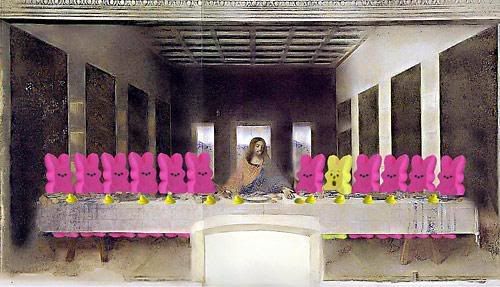
Not exactly the Easter equivalent of that song where Santa Claus visited the baby Jesus in the manger, is it? But get a load of Judas Peepscariot!
Linked from the Photobucket site of Kevin Berth
Thursday, April 21, 2011
Doctor Who RECIPES?
In gathering links for my previous post about Elisabeth Sladen (still very sad), I discovered a "Recipes" section on BBC America's Doctor Who website. The funniest: the Sonic Screwdriver, named for the Doctor's ubiquitous extra-terrestrial "jackknife" of sorts, but with alcohol. The most disturbing: erm, Dalek mini-cakes? "Exterminate" isn't quite the word I would use to describe it.
Wednesday, April 20, 2011
Our Sarah Jane
 Publicity still from The Sarah Jane Adventures, from the BBC Radio Times
Totally not food-related, but I just had to express my sadness and shock over the passing of Elisabeth Sladen, who played Sarah Jane Smith, my most favorite companion on Doctor Who. Sladen appeared in various shows but Doctor Who her claim to fame, not only acting alongside two of the original series' Doctors (Jon Pertwee and Tom Baker) but appearing in two spin-offs (including the recent Sarah Jane Adventures) and in cameos with one more Doctor (David Tennant) in the new series (the newest Doctor, Matt Smith, did a cameo on her show).
This clip of her last regular appearance on the classic series (the last episode of The Hand of Fear) was posted on the Entertainment Weekly website in a tribute by Clark Collis.
'Til we meet again, Sarah.
Tuesday, April 19, 2011
Back in the Garden
 It's refreshing to finally be back in my garden plot at Clifton Park. I found out today that mint really does grow like a weed. It grows EVERYWHERE, man. A month ago when I saw the dead-looking plant I thought "Oh well, that was nice while it lasted". Now the entire raised bed that I planted it in is covered in the stuff, much more so than the oregano that was growing and pulsating like it was alive. Also got a little sage out and planted some basil (too early perhaps) and dill (just right timewise). That and the guy that manages our little communal garden let me have some of his romaine and kale sproutlings.
Monday, April 18, 2011
Quinoa is Kosher for Passover, right?
According to The Atlantic's Uri Friedman, not necessarily. If you want to be absolutely sure, check with the Chicago Rabinnical Council, who say you can use quinoa. As long as it's from Bolivia, where quinoa production is chametz-free. And even then it's a pain in the tuchus:
...[The Chicago Rabbinical Council] recommends inspecting quinoa before Passover by spreading "one layer of quinoa at a time on a board or plate" and checking to be sure that there are no other grains or foreign matter mixed in with the quinoa"--a time-consuming exercise that Jews rushing to prepare seders are unlikely to embrace. [Friedman 2011]And here I was struggling to find creative ways to avoid meat on Fridays. Silly me.
Subscribe to:
Posts (Atom)


