
Tax season bites. Looks like I withheld too little last year because I owed for the first time ever. Wow. I also made more in all of my part time work than I realized, which is great - though it did push me into a higher tax bracket. I'm not complaining about being taxed per se. I'm just kicking myself for not having changed my W4's sooner. Now I'm withholding nothing. Hopefully I'll get something back next year?
Just a few more bites as I recover from tax season.
1. The drive to cut back on my soda consumption has taken a slightly bumpy road, but I'm still on it. I now drink, on average, about two cans of soda a day. That said, I have gotten much more used to using that press-n-seal wrap on the half-empty can and putting it back in the fridge. I've also been a little generous in my definition of what counts as "soda". I haven't been counting it if it's normally caffeine-free, like ginger ale, or "all-natural", like one of those sugary sodas you might find in some of the more upscale natural food stores. The iced tea I keep brewing (thank you, Luzianne) has definitely cut down my soda consumption, that much is certain.
2. About those "upscale natural food stores": I don't have the cash to do all, or even much, of my shopping at places like the Good Life Organic Market in Severna Park or David's Natural Market in Columbia. I do love roaming around them to see the merchandise and hopefully pick up one or two things without breaking the bank. Good Life has hot soups (a small Senegalese Peanut Soup will cost $4), chocolates that I cannot avoid (a quarter pound for about $4.50) and more of those natural sodas. They also sell eggs individually - 35¢ per egg. David's is also a lovely store, and I have become addicted to the individually wrapped Dan's Chocolates that are conveniently located right by the checkout (50¢ each).
3. The Haute Dog Carte has a second location! It's at the Colonnade at Hopkins.
4. Speaking of businesses in Mt. Warshnin', Bansky's is just awesome, a beautiful group of people with awesome food.
5. I'm trying to find some huckleberries in the area! This is for an upcoming Snacking State-by-State post about food from Idaho. Rachel (Coconut & Lime) gave me the head's up that Atwater's at Belvedere Square sometimes sells huckleberry jam, but they have none at the moment. Will probably need to break down and mail order it online, like I almost did with poi for my upcoming Hawaii post.
6. If you didn't know this already: RuPaul's Drag Race (one of my guilty gay pleasures) is on every Monday night at The Hippo. Now I don't have to wait until it's posted online the next day!
Saturday, April 16, 2011
Random Bites: Tax Day Edition
Friday, April 15, 2011
Because Passover is coming up...
The Atlantic has quickly become on of my favorite sources for interesting articles about food, drink and such. Take Yoni Appelbaum's brief but thorough history of Manischewitz sweet Concord grape wine. In "The 11th Plague? Why People Drink Sweet Wine on Passover", the author grapples with the history behind the reality that Manischewitz wine isn't all that good, but people love it anyway. From raisin wine to cheap, easily supervised Concord grape production, through Prohibition and into the present day, Appelbaum lays out the history of Passover wine in America, and the uniquely American drink that Manischewitz became. It's even become a fad among hip young Jews and gentiles alike. For instance, as Appelbaum says:
...a modern bistro attracts a trendy crowd with offerings that include the Drunken Pharaoh, a Manischewitz-and-bourbon cocktail. Concord wine, it turns out, has hipster cred. It is also enjoying a boom in exports to Asia, home to the world's fastest-growing wine markets.Catholic boy here will occasionally buy a canister of kosher macaroons at Giant when he finds them. As for the Manischewitz wine: I haven't tried it, but now I'm gonna have to go out and buy some just to see what Appelbaum is saying.
Tuesday, April 12, 2011
Strawberry Jam!

While in DC this Sunday, I gave a friend a lift home after our weekly soccer game. We stopped in the Harris Teeter for some grocery shopping. He found a sale on four pints of strawberries, and gave me two of them since he would never use them all. Yes, I did tell him he could freeze them. He doesn't cook though. And I am not one to turn down free food from friends.
I had to do something with these strawberries, and fast. I tend to procrastinate. Hell, while cleaning out the fridge today I just threw away a stroopwafel I brought home with me from Amsterdam - three years ago. You can't keep strawberries that long in the fridge.
I thought about cakes, crisps and cobblers, but I eventually settled on a strawberry freezer jam. I followed this recipe from the Gwen's Nest blog. It was surprisingly easy. All I needed were a packet of freezer fruit pectin, 3/4 cup sugar and two pints/pounds of strawberries. You also need about three pint size jars, or five to six half-pint (ie., cup) jars. They can be glass ones, though Bell does make special plastic freezer jars.
First, mix the sugar and fruit pectin (I should have used only half the packet since I halved Gwen's recipe, but I eventually dumped in the whole thing). Then moosh up the strawberries in a bowl, add the sugar-pectin mixture and stir for three minutes. Put into cleaned jars and close, and let sit for half an hour before freezing. And there you go! No need to even cook it.
I have never made a fruit jam. Okay there was that one tomato jam. All I have to do is bust out a jar if I want some fresh strawberry jam.
Sunday, April 10, 2011
Snacking State-by-State: Georgia III - The Many Uses of Coca-Cola
Peaches and peanuts aside, by far Georgia's biggest export is Coca-Cola. First made in Atlanta in 1886, Coke is now bottled all over the world. Is it really any surprise that the Coca-Cola corporation has not just a handful but an entire collection of recipes from enterprising Southern and other'n cooks (not to mention all those chefs in the Coca-Cola test kitchens) using Coke products as ingredients in cooking.  Official Name: State of Georgia
State Nicknames: The Peach State, Empire State of the South
Admission to the US: January 2, 1788 (#4)
Capital: Atlanta (largest city)
Other Important Cities: Augusta (2nd largest), Savannah (4th largest), Columbus (3rd largest)
Region: South, Deep South, Lowcountry (specifically along the coast); South Atlantic (US Census)
RAFT Nations: Cornbread & BBQ, Crabcake, Gumbo
Bordered by: Alabama (west), Tennessee & North Carolina (north), South Carolina (northeast), Atlantic Ocean (east), Florida (south)
Official State Foods and Edible Things: grits (official state prepared food), peach (fruit), Vidalia onion (vegetable)
Some Famous & Typical Foods: again, grits, peaches and Vidalia onions, among many other things, among them: Coca-Cola, boiled peanuts, pecans, pralines, okra, and other typical foods of the Deep South
Elizabeth Candler Graham, direct descendant of Coke founder Asa Candler co-authored the Classic Cooking with Coca-Cola cookbook with Ralph Roberts in a quest to find some recipes, hoping to find 20 or 30.
As the research progressed, we found to our pleasant surprise that in the over one hundred years of its existence, Coca-Cola has inspired a lot of recipes. So instead of just a few, we found literally hundreds of recipes using Coca-Cola or other products of The Coca-Cola Company. In fact, we found ourselves with too many recipes and were forced to leave out some of the lesser ones. [Candler Graham and Roberts 1998, p. 4]I almost considered making an entire meal using Coke as an ingredient, but stuck with an entrée and a side instead. These may have been two of the rejects from the book, though I had great success with one of them.
The recipes: Fruited Coca-Cola Pork Chops with Caramelized Sweet Onions
To make both recipes, you need the following.

The entrée: Fruited Pork Chops
* shoulder or loin pork chops (4 about 1/2" thick - I got a package of 5 leaner, skinnier ones, which I now somewhat regret as I will explain below)
* salt, pepper and ground ginger (got them all)
* one apple and one lemon or orange (each less than a dollar - for the citrus I went ahead and used a tangelo instead, with little change)
* 1/2 cup Classic Coca-Cola (you can get the corn syrupy stuff, or splurge and get a bottle of the Mexican stuff with real sugar for about $1.50. Not too easy to find, but you can get it at Wegman's or Eddie's of Roland Park. Drink whatever you don't use)
* brown sugar and corn starch (got 'em)

Quickly brown the pork chops in a greaseless pan, then sprinkle them the salt, pepper and ginger, set them in your baking dish, and add the following: an apple slice on top of each pork chop, a citrus fruit slice on top of each apple slice, brown sugar over each pork chop, and Coca-Cola around the pork chops.
 Like so.
Bake for about 45 minutes at 350° (the thinness of my pork chops probably necessitated a shorter baking time, which I did not consider at the time). Next stir in the corn starch and put in for about 15 minutes more.
The side dish: Southern Caramalized Vidalias, er, Mayans

For this recipe, you need a liter of Coke, a little A1 and two nice big sweet onions. The recipe, of course, calls for the very Georgian Vidalia onion. I could not find these anywhere at this time of year, so I begrudgingly settled for the not-as-special Sweet Mayan variety from Mexico. It wasn't the same, but it was doable.

Chop the onions into pieces, and pour in enough Coke to cover - the recipe says you will "float" the onion pieces in the Coke.

Next, add A1 Steak Sauce or a reasonable facsimile, cover and microwave on high for 20 minutes. When done you will have a mess of sweet, caramelized onions that you can serve on steak, mashed potatoes or anything else you like. I mixed some with some homemade tomato sauce and ate it on linguine. It wasn't as disturbing as it sounds.

I have to be frank: the onions clearly turned out better here. I could almost see myself just eating them straight out of the bowl. They certainly made the pork chops more interesting. I am largely to blame for how they turned out, since I did not adjust the time for the thinness of the chops, resulting in a drier, less juicy pork chop. Yes, even with all Coke and those fruit juices, the pork chops ended up pretty flat. Not so the onions, which I have eaten with potatoes, taro root and that linguine I mentioned above. I'll be making the onion dish again
 Served with a Coca-Cola-free potato salad
Sources:
Candler Graham, Elizabeth, and Ralph Roberts. Classic Cooking with Coca-Cola. Hambleton Hill Publishing: Nashville, 1998
Coca-Cola Company. "Recipe: Fruited Pork Chops". Copyright The Coca-Cola Company, 2006.
Coca-Cola Company. "Recipe: Southern Caramelized Vidalias". Copyright The Coca-Cola Company, 2006. Originally submitted by Rod Rives of Birmingham, AL.
Deen, Paula. "Boiled Peanuts". Featured on the Paula's Home Cooking episode "Boat Day". Copyright The Food Network, 2010
Fairweather, John. "How to Make Boiled Peanuts in a Slow Cooker". From eHow Food, date unknown.
Georgia Peach Council. "Rich History of GA Peach". Copyright Georgia Peach Council, date unknown.
Hanley, Lucy (editor), and Alice Moffatt (food editor). The Best Basic & Easy Recipes of Savannah. John Hinde Curteich: Savannah, 2000. Distributed by Dixie Postcards & Souvenir Sales.
Yearwood, Trisha, with Gwen Yearwood and Beth Yearwood Bernard. Georgia Cooking in an Oklahoma Kitchen: Recipes from My Family to Yours. Clarkson Potter: New York, 2008.
Some information also obtained from Wikipedia's "Georgia" page and other pages, and the Food Timeline State Foods link to "Georgia".
Snacking State-by-State: Georgia II - That's What I Like About Peaches
Georgia is one of the leading producers of peanuts in America, and it is also a leading producer of peaches. According to the Georgia Peach Council, the peach has been grown by Cherokee farmers since the 1750's, and harvested for sale in Georgia since before the Civil War, started by Raphael Moses in 1851. Georgia sells over 2.5 million bushels of peaches annually - down from an all time high of 8 million in the 1920's, but still a lot (Georgia Peach Council 2011)Official Name: State of Georgia
State Nicknames: The Peach State, Empire State of the South
Admission to the US: January 2, 1788 (#4)
Capital: Atlanta (largest city)
Other Important Cities: Augusta (2nd largest), Savannah (4th largest), Columbus (3rd largest)
Region: South, Deep South, Lowcountry (specifically along the coast); South Atlantic (US Census)
RAFT Nations: Cornbread & BBQ, Crabcake, Gumbo
Bordered by: Alabama (west), Tennessee & North Carolina (north), South Carolina (northeast), Atlantic Ocean (east), Florida (south)
Official State Foods and Edible Things: grits (official state prepared food), peach (fruit), Vidalia onion (vegetable)
Some Famous & Typical Foods: again, grits, peaches and Vidalia onions, among many other things, among them: Coca-Cola, boiled peanuts, pecans, pralines, okra, and other typical foods of the Deep South
Since Georgia is the Peach State, this post needs a good standard peach recipe. And where better to turn than that most famous of Georgia chefs... Trisha Yearwood!? Yes, the Grammy award winner, Grand Ole Opry member, Garth Brooks family member (he's her hubby) and Monticello native. Yearwood now calls Oklahoma home (again, the Garth Brooks thing), but brings America her Georgia family recipes in her book Georgia Cooking in an Oklahoma Kitchen. Yearwood says her family knows her as much for her food as her singing.
As the singer notes, the peach cobbler is an important part of the Southern home cook's repertoire: "You can't be considered a serious southern cook if you don't know how to make peach cobbler" [Yearwood 2008, p,. 192]. Her recipe is quite the easy one, and it worked out well for me.
The recipe: Peach Cobbler
For this peach cobbler you will need:
* peaches (two 15 oz or four 8.5 oz cans, in syrup - Yearwood recommends canned peaches  instead of fresh, which she says work better in recipes such as this. More so, she suggests you use freestone instead of clingstone peaches "because they are tender and tasty" [Yearwood 2008, p. 192]. You would not believe just how difficult it is to find canned freestone peaches here.)
* 1 stick butter (got it)
* self-rising flour, or all-purpose flour mixed with a little baking powder and salt (got 'em all, too)
* sugar and milk (got those)
This recipe is, as Yearwood notes, easy. Melt the butter in a 9 x 13 pan in the oven.
While you melt the butter, dump out the peaches and save half of the liquid (so drain half the peach syrup into a bowl, and the rest of the syrup just dump out). Mix the drained syrup with the milk and dry ingredients.
Next, pour into the pan, and arrange the peach slices in the pan before baking at 350° for an hour.
 Mmmm. Peachy.
What can I say? It was easy, and it was very buttery and luscious. I have to agree: I definitely like freestone peaches better than the clingy variety. And while it is definitely best right out of the oven, especially with vanilla ice cream, it is almost as good after being nuked for a minute in the microwave.

And that's what I like about Trisha Yearwood's cobbler.
Sources:
Candler Graham, Elizabeth, and Ralph Roberts. Classic Cooking with Coca-Cola. Hambleton Hill Publishing: Nashville, 1998
Coca-Cola Company. "Recipe: Fruited Pork Chops". Copyright The Coca-Cola Company, 2006.
Coca-Cola Company. "Recipe: Southern Caramelized Vidalias". Copyright The Coca-Cola Company, 2006. Originally submitted by Rod Rives of Birmingham, AL.
Deen, Paula. "Boiled Peanuts". Featured on the Paula's Home Cooking episode "Boat Day". Copyright The Food Network, 2010
Fairweather, John. "How to Make Boiled Peanuts in a Slow Cooker". From eHow Food, date unknown.
Georgia Peach Council. "Rich History of GA Peach". Copyright Georgia Peach Council, date unknown.
Hanley, Lucy (editor), and Alice Moffatt (food editor). The Best Basic & Easy Recipes of Savannah. John Hinde Curteich: Savannah, 2000. Distributed by Dixie Postcards & Souvenir Sales.
Yearwood, Trisha, with Gwen Yearwood and Beth Yearwood Bernard. Georgia Cooking in an Oklahoma Kitchen: Recipes from My Family to Yours. Clarkson Potter: New York, 2008.
Some information also obtained from Wikipedia's "Georgia" page and other pages, and the Food Timeline State Foods link to "Georgia".
Snacking State-by-State: Georgia I - Boilin' Goober Peas
We head a little farther north, to the capital of the New South and its sister cities throughout the Peach State. I have lots of family in Georgia, and I'll have more once my sister moves there later this year. Maybe this post will help her acclimate a little better.Official Name: State of Georgia
State Nicknames: The Peach State, Empire State of the South
Admission to the US: January 2, 1788 (#4)
Capital: Atlanta (largest city)
Other Important Cities: Augusta (2nd largest), Savannah (4th largest), Columbus (3rd largest)
Region: South, Deep South, Lowcountry (specifically along the coast); South Atlantic (US Census)
RAFT Nations: Cornbread & BBQ, Crabcake, Gumbo
Bordered by: Alabama (west), Tennessee & North Carolina (north), South Carolina (northeast), Atlantic Ocean (east), Florida (south)
Official State Foods and Edible Things: grits (official state prepared food), peach (fruit), Vidalia onion (vegetable)
Some Famous & Typical Foods: again, grits, peaches and Vidalia onions, among many other things, among them: Coca-Cola, boiled peanuts, pecans, pralines, okra, and other typical foods of the Deep South
As its capital, Atlanta, is also "capital of the New South", Georgia is not just the nexus of all edible things Southern but home to great food diversity - again, Atlanta is one of the most cosmopolitan cities in the country. But Georgia also has a few foods that are its own, at least at first. Though I've already discovered that Delaware was a center of peach production on the East Coast at one time, most of us think of Georgia when we think of peaches. Georgia also comes to mind (can you hear me, Georgia?) when sweet, sweet Vidalia onions or the world's most popular soft drink pops up. I will touch a little bit on all of this in the paragraphs that follow.
Driving from Maryland to Georgia a few years ago on a visit to my brother-in-law in Hinesville, I had to stop a few times to abate the hunger. Once I passed into South Carolina I started seeing constantly heated containers of boiled peanuts in every convenience store. No I did not see them in North Carolina, though my cousin's wife, born and raised in the Tar Heel State, fondly remembers them. They are also a staple snack all over Georgia, so states one "postcard cookbook" I picked up in Savannah a few years ago:
Peanuts are Georgia's most valuable crop. Every Southerner knows that "goobers" or "goober peas" is another name for peanuts. This much-loved legume was immortalized in a Confederate ballad, that says, in part, "...But another pleasure enchantinger [sic] than these / Is wearing out your grinders, eating goober peas" ... "I wish this war was over, when free from rags and fleas / We'd kiss our wives and sweethearts and gobble goober peas!" [Hanley and Moffatt 2000; note: I sang that song on stage in fifth grade]No less than the Lady herself Paula Deen gets all giddy over her goober peas in the "Boat Day" episode of her show. I've made them before, and I'll make them again, this time the Lady & Sons way.
The recipe: Boiled Peanuts

For boiled peanuts, all you need are:
* peanuts (these must be raw, not roasted, which is not that easy to find in Baltimore - I figured the North Carolina-based supermarket chain Harris Teeter would obviously have raw peanuts,
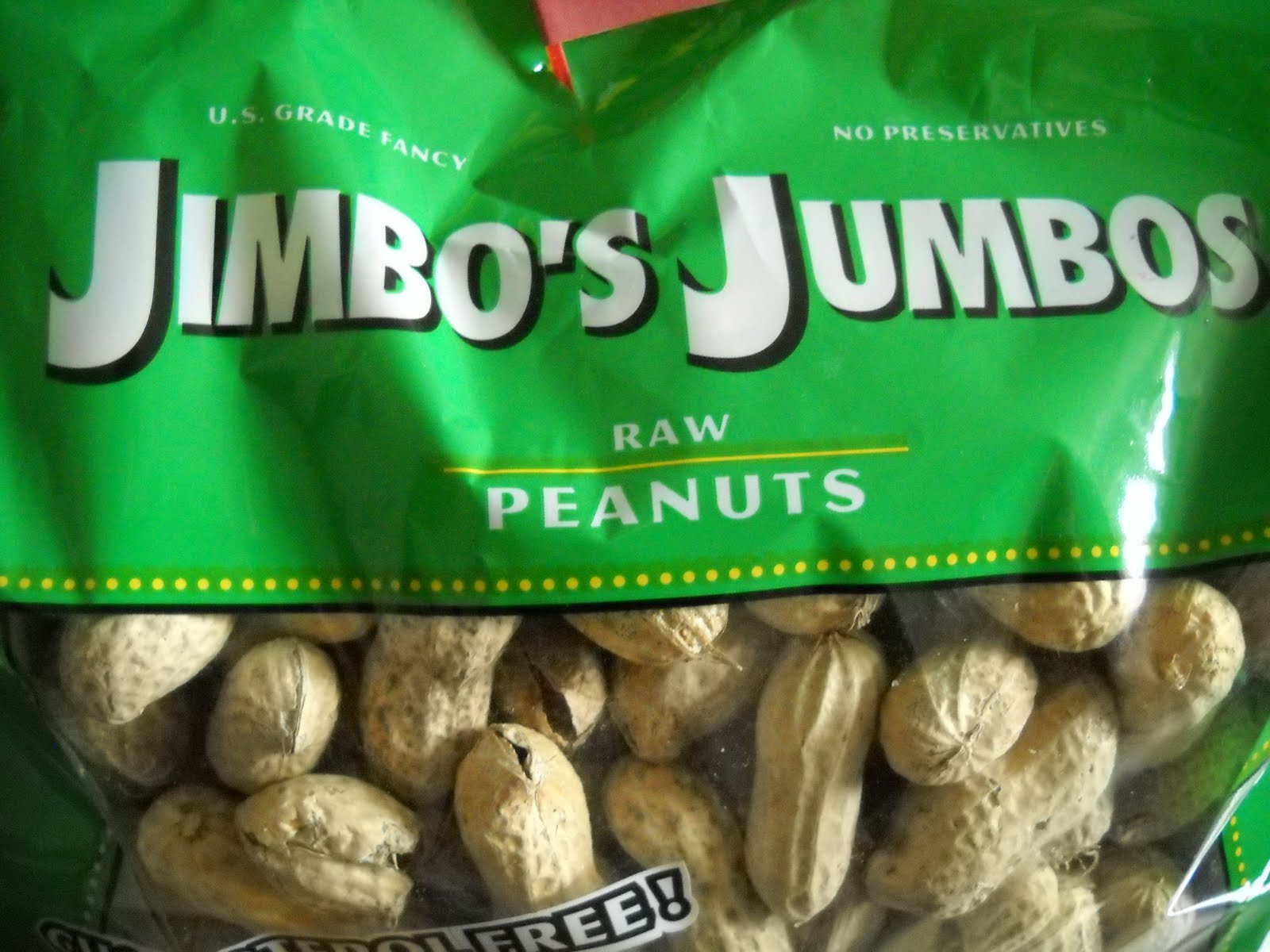 but no - not at their Columbia location, and not at their Arlington location. Fortunately, I remembered that Giant does indeed sell bagged raw peanuts from Jimbo's Jumbos. This is the best we're going to do here unless we grow our own - which I am planning to do this summer. A bag of jumbo raw peanuts cost $4.)
* salt (a lot of it - kosher preferably)
* You don't need any other seasonings, and Miss Paula doesn't use them. But I decided to Ches-ify mine by adding a generous helping of Old Bay (about 2 or 3 tablespoons). Fortunately, Old Bay is well-loved throughout the South, so this may not sound as strange as you might think.

Boiled peanuts are particularly easy to make: take a pound of raw peanuts and about a 1/2 to 3/4 cup salt per pound, boil for a few hours and there you go. But I decided to save myself the need of having to constantly watch over it by throwing them in the slow cooker (okay I lied - I did not do this the Lady& Sons way).

When I threw them in the slow cooker, I should have put them on high for 5 to 7 hours, as this eHow article suggests. I started on low for 4 hours, and then bothered to look up the article (wah waaaaaaah). But what turned into a day of boiling peanuts paid off, as I finally got soft, hot boiled peanuts!
I have to differ with Paula Deen on the salt amount. I know they're supposed to be salty, but these had so much of it! I am not alone on this, as even proper Southerners have told Miss Paula as much in comments to her recipe. My favorite comment comes from "bradfordrb" from Columbia [I assume South Carolina]:
Lord have mercy, Paula! I do declare, there is too much salt in that there recipe of boiled peanuts. You trying to send us all to meet our maker and give us a blazin' heart attack? [comment on Deen 2010]In addition, my attempt to Old Bay-ify these peanuts didn't bear any fruit, er, legumes, as the Old Bay taste completely got washed away by the salt. In the future, I will turn up the Old Bay and turn down the salt. But the peanuts were still good, and I ate some on the way to Rehoboth Beach recently.

Sources:
Candler Graham, Elizabeth, and Ralph Roberts. Classic Cooking with Coca-Cola. Hambleton Hill Publishing: Nashville, 1998
Coca-Cola Company. "Recipe: Fruited Pork Chops". Copyright The Coca-Cola Company, 2006.
Coca-Cola Company. "Recipe: Southern Caramelized Vidalias". Copyright The Coca-Cola Company, 2006. Originally submitted by Rod Rives of Birmingham, AL.
Deen, Paula. "Boiled Peanuts". Featured on the Paula's Home Cooking episode "Boat Day". Copyright The Food Network, 2010
Fairweather, John. "How to Make Boiled Peanuts in a Slow Cooker". From eHow Food, date unknown.
Georgia Peach Council. "Rich History of GA Peach". Copyright Georgia Peach Council, date unknown.
Hanley, Lucy (editor), and Alice Moffatt (food editor). The Best Basic & Easy Recipes of Savannah. John Hinde Curteich: Savannah, 2000. Distributed by Dixie Postcards & Souvenir Sales.
Yearwood, Trisha, with Gwen Yearwood and Beth Yearwood Bernard. Georgia Cooking in an Oklahoma Kitchen: Recipes from My Family to Yours. Clarkson Potter: New York, 2008.
Some information also obtained from Wikipedia's "Georgia" page and other pages, and the Food Timeline State Foods link to "Georgia".
Friday, April 08, 2011
In N Out vs Five Guys?
Erik Hayden writes for The Atlantic about an East Coast-West Coast burger war I did not even know about:
[W]hen Five Guys launched its West Coast expansion in 2008, SoCal-based blogs and local newspapers (the O.C. Register and the Los Angeles Times love fanning the flames of this subject) fretted about the impending war between the two beloved, identical seeming burger franchises. Then, in 2010 came shocking news for area fast-foodies: In-N-Out was "ousted" by Guys as Zagat's Best Burger and Five Guys was deemed a worthy competitor to In-N-Out. [Hayden 2011]As the author points out, the folks in SoCal are intensely loyal to In-N-Out (I should know, having lived there for several years). I've eaten at both, and I knew Five Guys was more widespread than In N Out. What I did not realize was that Five Guys was heading west, unlike In N Out, which will never head our way. But honestly, I don't really have a sense of which one is better or not. I'm heading to SoCal next month. Perhaps it's time for a taste test?
Tuesday, April 05, 2011
Meatless Fridays #3 & #4
My last few weeks of Meatless Fridays have taken me to both familiar and unfamiliar territory. Meatless Friday #3 took me to Columbia's Noodles & Company. Oddly enough, I have never been there before. It is an efficient chain with American, Mediterranean (mostly Italian) and Pan-Asian (mostly Thai) offerings to which you can add meat of your choice. The Friday before last, I decided to add nothing to my pad thai. Though it wasn't remarkable, it certainly was satisfying enough. I would order it again if I had to.
Meatless Friday #4 took me back to Mango Grove on Dobbin Road. I am really starting to both look forward to going for their cheap and ridiculously filling vegetarian buffet and dread it knowing that I will leave full and slightly achy because of all the rich food I just ate. Please don't let PETA tell you that meatless food is not fattening (which they have apparently tried to say before). This is fattening. One remarkable appetizer I hadn't seen before was the bread pakora. Think a small piece of sandwich with potato filling slathered with a tomato chutney inside, then dipped in chickpea batter and deep-fried. It was just beautiful, but it showed me that I can't rely on vegetarian food if I want to lose weight. Mind you I'm not overweight, and I wouldn't mind losing a pound or two. Still, I won't see that happen if I still eat these things!
Sunday, April 03, 2011
Snacking State-by-State: Florida Part 2A (The Southern Half) - Un sandwich simplemente no es un sandwich... si no es cubano
We now head farther south into what is probably considered “Yankee-occupied Florida”. The southern half of the state is home to great cultural diversity and a unique cuisine all its own. It's Key limes, conchs and Cuban sandwiches in this post! First a review of where we are. Official Name: State of Florida
State Nicknames: The Sunshine State
Admission to the US: March 3, 1845 (#27)
Capital: Tallahassee (8th largest city)
Other Important Cities: Jacksonville (largest city), Miami (2nd largest), Tampa (3rd largest), St. Petersburg (4th largest), Orlando (5th largest)
Region: South, Gulf Coast; South Atlantic (US Census)
RAFT Nations: Cornbread & BBQ, Crabcake, Gumbo
Bordered by: Alabama (northwest), Georgia (north), Atlantic Ocean (east), Caribbean Sea (south), Gulf of Mexico (west)
Official State Foods and Edible Things: Key lime pie (pie), orange (fruit)
Some Famous & Typical Foods: Cuban food (southern Florida), Key lime pie, seafood (stone crab, shrimp, conch, crawfish, etc), alligator (northern Florida) typical Deep Southern foods (northern Florida), foods of New York/New Jersey especially Italian & Jewish (southern Florida)
Miami, Palm Beach, Fort Myers and such bring armies of retirees from New York, New Jersey and parts north to settle or vacation. Emigrés from outside the proper South have brought their own rich food traditions with them. For instance, Florida's Jewish community has grown over the past half century mostly due to immigration from the North. Please remember: the history of Jewish Florida begins in the 1760’s, and not in the 1960’s when (according to FloridaJewish.com) the state’s Jewish population grew dramatically from a mere 25,000 two decades earlier, to well over 175,000. Today there are about 750,000 Jewish Floridians, the country’s third largest Jewish community and the largest in any Southern state.
Immigrants also have flooded into Florida from outside parts from many parts of Asia, Latin America and (especially) the Caribbean. Florida’s Cuban community is notable among these, and it has had a major influence over Miami’s cuisine. Florida’s Cuban-American population is close to 900,000 - by far the largest in the US. Like Florida’s Jewish population, its Cuban population predates the 1960’s. However, the turmoil of the Cuban revolution in 1959 spurred much more migration from Cuba to Florida. The influence on Miami’s food is very distinct. Take the famous Cuban sandwich (sandwich cubano or sandwich mixto): ham, roast pork and Swiss cheese, sandwiched into a piece of Cuban bread and fried. I looked at many recipes for the Cuban sandwich, and while they all share those things in common there are enough differences that you cannot just use them interchangeably.
The recipe I finally went with comes from the Three Guys From Miami. Brothers-in-law Jorge Castillo, Glenn Lindgren and Raúl Musibay celebrate all things culinarily Cuban, and their Cuban sandwich, as it exists in south Florida, seems pretty darn authoritative. They give lots of tips about what each component should be like, and a history of the sandwich, dating at least back to the 1930’s if not much earlier.
The recipe: Cuban Sandwich
As the Three Guys suggest, this is a fairly simple sandwich, and well loved - as Glenn Lindgren notes - “it’s a combination of ingredients that are almost universally loved”. The most difficult part is the grilling, which is not at all difficult.
You will need:
* ham lunchmeat, thinly sliced but not shaved (preferably a sweet one. I got a brown sugar one for about $2.50 for a ¼ lb)
* roast pork (again, I got the lunchmeat version, about $3 for a ¼ lb)
* Swiss cheese (baby Swiss if you can get it - I got lacy Swiss cheese, not quite the same, for about $2 for a ¼ lb)
* Cuban bread (this was the difficult thing to find. It’s difficult to find in Baltimore, so I went with a French batard loaf. The Three Guys recommend French bread but specifically say not to get a baguette)
* mustard and pickles (have them both)
* butter (for frying as well as for buttering the inside of the loaf
* The authors specifically state the following: DO NOT USE MAYONNAISE.
In the Three Guys’ recipe, you need to halve and butter the insides of the bread, and then stack everything in the bread in the following order: ham, roast pork, cheese, pickles.
If using mustard, this should probably go on next. Close the thing up and fry in butter in a pan for two to three minutes on each side, until the cheese is melted and the bread is golden brown.
And while cooking, you must not forget this very important step: weight down the sandwich with something heavy. It could be a brick wrapped in aluminum foil, or a bacon press, or another cast-iron skillet like I used. I tended to hold mine down.
 Like so.
Sources:
Castillo, Jorge, Glenn Lindgren and Raúl Musibay (Three Guys from Miami). “Cuban Food Recipe: Sandwich Cubano”, published 2004. Copyright Three Guys from Miami, 1996-2011. Originally from the book Three Guys From Miami Cook Cuban (Jorge Castillo, Glenn Lindgren and Raúl Musibay), Gibbs Smith: Layton, UT: 2004.
FloridaJewish.com. "Florida Jewish History”, publish date 2010. Copyright FloridaJewish.com 2010.
Voltz, Jeanne, and Caroline Stuart. The Florida Cookbook: From Gulf Coast Gumbo to Key Lime Pie. Random House: New York, 1993.
Some information also obtained from Wikipedia's "Florida" page and other pages, and theFood Timeline State Foods link to "Florida".
Snacking State-by-State: Florida Part 2B (The Southern Half) - When life gives you key limes...
Before leaving Florida, we head as far south as we can go in the lower 48 - the Florida Keys. Official Name: State of Florida
State Nicknames: The Sunshine State
Admission to the US: March 3, 1845 (#27)
Capital: Tallahassee (8th largest city)
Other Important Cities: Jacksonville (largest city), Miami (2nd largest), Tampa (3rd largest), St. Petersburg (4th largest), Orlando (5th largest)
Region: South, Gulf Coast; South Atlantic (US Census)
RAFT Nations: Cornbread & BBQ, Crabcake, Gumbo
Bordered by: Alabama (northwest), Georgia (north), Atlantic Ocean (east), Caribbean Sea (south), Gulf of Mexico (west)
Official State Foods and Edible Things: Key lime pie (pie), orange (fruit)
Some Famous & Typical Foods: Cuban food (southern Florida), Key lime pie, seafood (stone crab, shrimp, conch, crawfish, etc), alligator (northern Florida) typical Deep Southern foods (northern Florida), foods of New York/New Jersey especially Italian & Jewish (southern Florida)
The so-called “Conch Republic” has a few of Florida’s unique dishes. Note, for example, conch, which you can make into fritters (grind the conch up first) or use in a salad (as Jeanne Voltz and Caroline Stuart recommend you do). You just have to find it first. It’s not always available this far north. Some well-stocked seafood markets have it (try Lexington Market or DC’s Maine Avenue Seafood Market, or occasionally H-Mart). A far easier thing to find is bottled Key lime juice, which you will need to make that most famous of Floridian desserts, the Key lime pie.
The recipe: Key Lime Pie
To make Florida’s state dessert, I went back to Voltz and Stuart’s bible of Florida foods for the recipe and the history of the pie. Originally it was not even cooked - the citrus in the key lime “cooks” the eggs in the pie so that you’re not eating a raw egg pie. Today many cooks recommend baking it a little. You will need to do this for the meringue and the crust anyway, so just to be on the safe side.
Though this was the most time-consuming dish to make, it is rather simple in terms of the number of ingredients. How you use them makes it not such an easy recipe. Here’s what you need:
* one pie crust, either pastry or graham cracker (I went the latter route, making a crust from graham cracker crumbs, butter and sugar)
* 4 eggs, separated (prices vary)
* a 14 ounce can of sweetened condensed milk (About $2.50. Remember NOT to get evaporated milk. It will not work.)
* ½ cup Key lime juice (even though you can find a bag of Key limes at Harris Teeter for about $3, it’s much easier to get a bottle of Key lime juice. The only brand I could find was Nellie & Joe's "Famous" Key Lime Juice for about $4.50.
Don’t use regular old lime juice if you can help it. Key lime juice has a distinct, more complex flavor. Otherwise, you’re just making plain old lime pie. That’s not such a bad thing, but it isn’t Key lime pie.)
* regular boring ol’ “non-Key” lime (for the juice and the rind. The juice will go into your meringue)
* sugar (to add to the meringue you will put on top of the pie)
First, make the crust if you haven’t already done so.
Next, you will need to mix together the egg yolks (a little beaten), the condensed milk and Key lime juice. Stir until thickened, and then bake in the pie shell for about 15 minutes at 350.
While you do that, whip up the meringue. I’ve rarely made meringues in my life - I had not made one in years actually. This time it did not exactly come back to me, so I had to refresh my memory through the wonders of the internet. Remember that meringues whip up faster and easier with room temperature egg whites. Beat it at a medium setting until foamy, and then add the lime juice (Voltz and Stuart also recommend cream of tartar), beat more, and then a few tablespoons of sugar at a time until stiff peaks form. 
“Seal” the edges of the pie with the meringue - I also put a decorative dollop in the middle - and bake for 15 more minutes. I decided to cover mine with lime rind after I took it out.
 Ready for baking
I have not eaten much in the way of Key lime pies before. In fact, most of my citrus pie experience is of the lemon meringue variety, with those nasty “glop in your mouth” meringues you get on your store bought pies. My meringue was soft and even a bit chewy, a trait I don’t get to enjoy in many meringue pies. I hope to experience this more. The meringue cuts the tang of the Key lime very nicely for a filling and (forgive the term but it really is the most fitting) decadent eating experience.

My visit to Florida is done. Next I head back up I-95 to the home of Coca-Cola and Paula Deen, the ATL and the, er, SAV? Anyway, the Peach State is coming up. I’ve got Georgia on my mind. (By the way, does Augusta have a super-nifty acronym like Atlanta does?)
Sources:
Castillo, Jorge, Glenn Lindgren and Raúl Musibay (Three Guys from Miami). “Cuban Food Recipe: Sandwich Cubano”, published 2004. Copyright Three Guys from Miami, 1996-2011. Originally from the book Three Guys From Miami Cook Cuban (Jorge Castillo, Glenn Lindgren and Raúl Musibay), Gibbs Smith: Layton, UT: 2004.
FloridaJewish.com. "Florida Jewish History”, publish date 2010. Copyright FloridaJewish.com 2010.
Voltz, Jeanne, and Caroline Stuart. The Florida Cookbook: From Gulf Coast Gumbo to Key Lime Pie. Random House: New York, 1993.
Some information also obtained from Wikipedia's "Florida" page and other pages, and theFood Timeline State Foods link to "Florida".


