
I am officially incapable of cooking anything on the stove in a covered saucepan without burning the hell out of it. I do not know why this happens to me, but it does. I set the fire as low as I can, leave it like the recipe says, then come back and find a charred mess on the bottom.
This happens all the time with rice. Tonight I was trying out Lundberg's Brown Rice Couscous, which I found at the Milk & Honey in Mount Vernon. Now y'all might be wondering "Oh my God, how in the world can anyone burn couscous!?" Well, the instructions say to cook the couscous over a low flame for 15 minutes before removing from heat,so it's not conventional couscous. But still, I had to leave it, and of course, it burned.
I have a theory: my stove hates me. I mean, I can only set the flame so low before I turn it off. And still it's not enough. So screw it: I'm microwaving everything - and if not I'm throwing it in the rice-cooker.
Thursday, February 24, 2011
How to Burn a Pot of Anything
Saturday, November 06, 2010
He's BAAAAAAAAAAACK...
The sabbatical is over! It's going to be strangely difficult to get the juices flowing again. So why not just start with a few random, food-related observations that I have had over the last two months:
1) One actually hits oneself in the head when one goes on sabbatical just before the Baltimore City Paper informs one of one's blog's "Best of Baltimore" status. But one still feels very groovy.
2) When you spend four years writing a food blog and then suddenly stop, you start feeling the need to just start writing about your recipes and restaurant visits, only to remember that you're not writing it right now.
3) Drinking more water before you drink soda (which is not something you ought to be drinking anyway) really does cut down your overall desire to drink the caffeinated stuff. I'm drinking less soda now, which is always good.
4) Dad spent a weekend a few months ago in St. Joseph's Medical Center. They don't have many patients (I guess they all went next door to GBMC). In fact, they don't have many of anyone - doctors, nurses, patients or visitors. It's like one of those abandoned hospitals in the Silent Hill game series, only without the monsters and gore on the walls.
4a) I mention St. Joseph's because they do something I've never seen a hospital do: room service for visitors! Yes, you too can order stuff off the menu to eat right alongside dear old Dad, Uncle Bob or Mee-Maw, anything at all for just $5. Even more surprising: it's actually not half-bad. For hospital food, it's quite good. For hospital food.
4b) You do not, however, want to eat the food at your local hospice care facility. Nasty as sin. They want these people to actually eat, right?
5) Graul's Market actually sells bags of pre-baked Maryland Beaten Biscuits! Maybe it's just my bag, but they taste a wee bit freezer-burnt. Must make my own.
6) Over the last few months, my sister tried to put my niece, who has autism, on a gluten-free diet. It didn't work very well, but one plus came out of it: my notoriously picky eater of a niece actually started eating new and different foods. Note that she did not finish all of them. I picked up some gluten-free cupcakes from the Sweet Sin Bakery. Their cupcakes are lovely. I like them a lot and plan to get more for myself. None for my niece, however. You should have seen the face she made when she bit into her gluten-free chocolate cupcake: anticipatory, then immediately plummeting into equal parts confused and none-too-pleased. I felt bad. Oh well. More for me.
7) Marie Louise Bistro has been getting better every time I visit. But remember: if you order their crème brûlée, just keep in mind that it isn't actual crème brûlée.
8) Look what I just made!
Plus, I made a lobster roll for the first time, from a lobster I steamed just a little while before. I was tempted to use my wasabi mayonnaise, but I wanted to do my first one "authentically", the way they do up in New England.
9) My gardening has gotten more adventurous, and next year I am planning to take up a second plot! Some of my successes this year: lettuce galore, lots of Roma tomatoes (grown from seed - so proud of that), chilies out the wazoo, potatoes, kale greens, herbs (basil, rue, sage, rosemary, cilantro that bolted, and more oregano and mint than I will ever be able to use). Failures: garlic, strawberries (a total of four edible berries, and right over an ant nest too), and cauliflower. Don't ask me about it.
10) My friend Eric has fallen in love with the New York Times recipe section. Loved a lamb in parchment recipe he made for a few of us recently. But I will still needle him for not reading ahead to where it said the lamb must stay in the oven for 2 1/2 hours. (Not going to discuss that one time that I did the same thing...)
11) The next time you go to see a friend in a play, make sure you reserve tickets ahead of time.
12) Recent food finds that have become an even more important part of my culinary landscape: the nut-free brownies at Graul's; home-strained, Greekified yogurt; the English Rose and Key Lime flavored cupcakes from Iced Gems Baking; just about anything at the Haute Dog Carte; and at least one beer from each brewery that came to the Wine Source for Baltimore Beer Week 2010.
That is it for now. Over the next week or so I am rolling out my return to the Beltway Snacking series. And stay tuned for a brand new long-term project.
Sunday, August 22, 2010
Gluten-Free Pancakes Wow Local Girl with Autism
My sister and I hit up Mount Washington Whole Foods and the Health Concern in Towson for gluten-free stuff. Cathy wanted me along since I had done some research on this very topic (NB: I'm still playing with the idea of some allergen-free crumb cake again). The reason? My neice has autism, and much research suggests that a person with autism can benefit from a gluten-free diet. AutismWeb.com summarizes the lowdown for parents interested in fighting autism with allergen-free food:
According to one theory, some people with autism spectrum disorders cannot properly digest gluten and casein, which form peptides, or substances that act like opiates in their bodies. The peptides then alter the person's behavior, perceptions, and responses to his environment. Some scientists now believe that peptides trigger an unusual immune system response in certain people. Research in the U.S. and Europe has found peptides in the urine of a significant number of children with autism. A doctor can order a urinary peptide test to see if proteins are being digested properly.Changing the diet of children with autism is particularly difficult due to their often perseverative nature. This will often result in a very limited diet - for example, there are only a few key foods that my niece will eat, such as pizza, chicken nuggets and pancakes. She refuses to eat much else, no matter what my sister offers her. It's easier said than done to say "Well just make her eat it!" This sort of thing is often said by people who don't have autistic children.
Studies are underway to examine the effectiveness of the GFCF diet, which has not gained widespread acceptance in the medical community. One recent study found behavioral improvements in children on a GFCF diet, while another study found no significant effects from the diet.
So Cathy's line of attack is to make gluten-free versions of those foods that her daughter doesn't reject.
She bought all kinds of flours, including cake mixes and brownie mixes, pancake mixes and pizza crust mixes, tapioca and brown rice flours and xanthan gum. Again remember, as the helpful customer at WF reminded us, that the best brown rice flour comes from Authentic Foods, because it's ground really fine. Arrowhead Mills' on the other hand regularly makes for a gritty baked good.
Cathy left a phone message for me today: she made gluten-free pancakes for my niece. At first it looked like she wouldn't eat them, so Cathy sadly put them in the fridge. Her daughter said, "No, please," and wanted to finish them. Hopefully this trend continues, and hopefully the gluten-free diet will actually help!
Tuesday, March 23, 2010
Food Ethnography on a Budget: Allergen-Free III: Crumb Cake
My success at allergen-free baking is continuing, as I made what has to be my favorite dish so far from Cybele Pascal's Allergen-Free Baker's Handbook. This dessert, in the book's muffin and coffee cake section, is an amazing crumb cake that achieves the feat of tasting extremely buttery, without a drop of butter.
The dish: Allergen-Free Crumb Cake
As with all of these recipes, there is a wide variety of ingredients I had to incorporate. The good news is that I already had most of them on hand, thanks to the previous recipes for this project. I only had to make a few extra purchases for this project:
- The one unique ingredient I needed was apple cider vinegar (99 cents). This was used to moisten the cake. My guess is that this mixed with the coconut milk yogurt that is in this recipe to create the buttery taste.
- I needed a cup of coconut milk yogurt. I just assumed I had enough, until I scooped out the last 1/2 cup from my tub of So Delicious plain coconut milk yogurt. Yes, I needed to race out to get some more, another $3. By the way, I found out later that it's cheaper at Towson's Health Concern by half a dollar.
- I also needed to load up again on vanilla, $4 for the McCormick brand.
 Good and crumbly
The cake part of this crumb cake wasn't terribly different from baking a normal cake except for
 the allergen-free ingredients, so I won't go into too much detail about how to bake this cake. It was complicated only due to the many things I had to do: mix the egg replacer and rice milk. Mix the coconut milk yogurt and apple cider vinegar. Mix the shortening, flour and liquid ingredients. The only technical problem I had was to bake it for about 15 minutes beyond the 55 listed in the recipe. This was only due to the use of an 8" square pan instead of a 9" one, leading to a thicker cake.
The end result was just what Pascal suggested it would be: an astoundingly moist and buttery crumb cake whose strange brown rice flour flavor was once again overpowered by the butteriness of the yogurt and cider, and the sweetness and crumbliness of the brown sugar. This is a recipe, even more than those delicious brownies that are still moist and delicious after a week (birthday cake and buttermilk π kept me from finishing them yet and I can only eat so much in sweets in one day). This crumb cake is a definite addition to my baking repertoire.
 The end result, half-finished because I couldn't wait the extra minute to take the photo
There are still recipes I want to try from Pascal's book. This is a cookbook I may have to add to my collection, since the Baltimore County Public Library is only letting me borrow it. Again, I have no real allergies beyond a mild one to walnuts. But with several persons with autism in my own family, and many family members with Crohn's and colitis-related maladies, recipes that are light on the gluten and other allergens could be helpful. The bread doughs and pizza crust alone are worth the extra time spent with this book, which has given me a very useful insight into what an allergen-free lifestyle can be like.
Saturday, March 13, 2010
Food Ethnography on a Budget: Allergen-Free II: Fudge Brownies
My first foray into gluten-/dairy-/soy-/nut-free cooking did not turn out so well. I shared the allergen-free cake I made with that super-gritty Arrowhead Mills brown rice flour with my family. Nobody liked it, and my family LOVES cake. I also realized that another part of it is that we are just not used to the taste of brown rice flour. I mean, for people who eat things made from wheat flour all the time and aren't used to brown rice flour, it just tastes odd. That's not a fault of Cybele Pascal's recipe at all. It's just the product I purchased. And again, she warned her readers not to use the Arrowhead Mills stuff.
But I persevered, and my next recipe turned out much better, if I do say so myself. My next project took me into the wide, wonderful world of allergen-free brownies.
Yes, I admit: unlike most cakes, which I can rarely stomach from a box, I have never made a brownie from scratch. It's always been a box mix. So this bit of the food ethnography is not only my first allergen-free brownie from scratch, but it's my first brownie from scratch at all.
The dish: Allergen-Free Fudge Brownies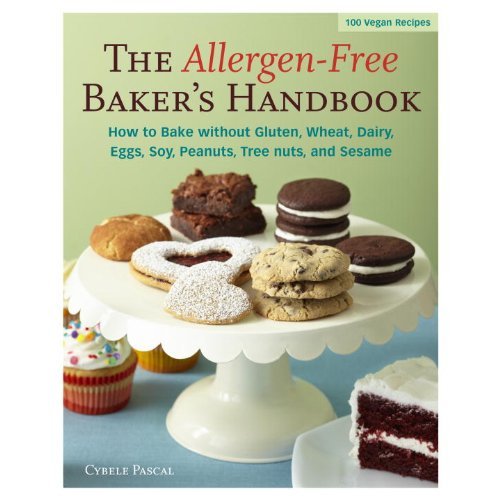 In her Allergen-Free Baker's Handbook, Pascal prefaces this recipe with a confession:
...allergen-free, gluten-free brownies were a bit like the Holy Grail... A chewy, moist brownie with a nice, crusty glossy top remained elusive. Until now, that is. (Pascal, p. 86)In retrospect, she did exactly that: a perfect brownie for anyone who is allergic to just about anything that would normally go into a brownie, save chocolate and sugar. All the chocolate and sugar are real.
For this dish, the first thing I had to do was buy an edible brown rice flour. So out went any remnants of Arrowhead Mills (I HATE wasting food), and in came a much finer bag of Bob's Red Mill. Just tasting the plain flour by itself I could feel the difference. And I mis-remembered the price, because the bag of Bob's Red Mill was actually a few cents cheaper. But it was also a little smaller. As for Arrowhead Mills: I'm sure they make many good flours, but their brown rice flour is not among them.

Pascal's fudge brownie recipe (it's in the "Cookie" chapter of her handbook) uses most of the ingredients from the yellow cake, so there were very few things I needed to buy new - this alone save me a good bit of money that was not saved the last time. However, other than the flour ($3.50) I ended up completely using all or almost all of the things I bought for the brownies:
- The unsweetened baker's chocolate ($5) was fairly easy to find. I went with a box from Baker's.
- The soy-free chocolate chips ($5) were much, much more elusive. Pascal suggests Whole Foods for many ingredients, so I went there for the chips. There were lots of varieties of vegan chocolate chips. But every single one - I mean every single one - used soy as an emulsifier. Dejected, I headed to the Health Concern in Towson. I still had to hunt for them among the many bags of soy-filled chocolate chips, but I did find soy-free chocolate chips made by Enjoy Life. Even better, it said right on the bag that the chips were made in a facility dedicated to allergen-free products. They are a tiny little chocolate chip, and I actually found this chip to be much more intensely chocolaty than others I am used to eating. But again, I had to use almost the whole bag for this recipe.
 The one final ingredient I had to use was puréed prunes. Pascal specifically recommends baby food. I've never used baby food in a recipe before, but it isn't that absurd, really. All it is, is the pure, puréed ingredient. I needed about 10 ounces of baby food, and I used Gerber nifty little 2.5 ounce single-serve containers, bundled into packs of two ($1 each, for a total of $2). This is the first time I have eaten anything with the Gerber label on it since the mid 1970's.


I was almost tempted to just eat it as is, but there were brownies to be made. Whisk together xanthan gum, baking powder and the flour mixture (again, potato starch, tapioca flour and the new brown rice flour) and add to the fudge in batches, and then add those chocolate chips before smoothing out in the pan.
Pascal recommends you leave the brownies in for 55 minutes. Again, this is for a 9" square pan. But I only have 8" square pans, and wasn't going to spend extra money on a larger one. This presented a challenge or two. For one, it made for a brownie that was much thicker than the ones in the photos in Pascal's book. For another, it increased the baking time. After the requisite 55 minutes, I had a pan of half-baked brownie goop. I am the kind of person who has to eat at least one brownie hot out of the oven. Yes, I know they are much softer when you do that, but that's just what I do. But these brownies were much goopier than most are out of the oven. So back in they went. In all, I left them in for an additional 30 minutes, after which they turned out much better when they cooled down.
In the end, I was quite impressed both with myself, for successfully interpreting this recipe and adapting it to a different pan as needed, and with Pascal's recipe, for creating a beautiful brownie that truly mimics a glutenous brownie with butter and milk and eggs (NB: no eggs or Egg Replacer in this recipe). Two things I expected to taste strongly were the brown rice flour, which I hardly noticed, and the baby food prune purée, which I didn't taste at all. It never dawned on me how well prunes blend in with chocolate to make them somehow taste more chocolaty! My family was also much more impressed with these brownies than with that cake. I would make these brownies again, and I can digest gluten like nobody's business.
 Now don't you want one, too?
Next up: at least one more foray into the wide, wonderful world of allergen-free baking, including a most buttery recipe absent of any and all butter or butter substitutes.
Sunday, March 07, 2010
Food Ethnography on a Budget: Allergen-Free I: Classic Yellow Cake with Velvet Frosting
It's been quite a while since I've ventured into the kitchen specifically for the purpose of my food ethnography. I've been quite busy with the start of the semester and, as everyone from new York City to Raleigh to Charleston, WV, will understand, I've been even busier shoveling snow. So I have not had much time to concern myself with ciorbăs or banana wines and such. But even as I have new ideas for projects, I now have the time to ease my way back into kitchen anthropology. Now there's a new turn of phrase.
Sorry, the next paragraph gets somewhat science-y, but it'll end soon.
An ethnography, as any anthropologist or sociologist will tell you, is the study of a culture. But cultures don't have to be related to country, ethnicity or geography. They can be any "subculture" - for example, the Baltimore blogging community, in part because we share some of the same norms - ideas about blogging, subjects (in this case, things related to Baltimore). I could go into the science of ethnography, but you came here for food, not a social science lesson.
I went through that mini-anthropology lesson to explain the subject for my next food ethnography. It isn't an ethnic group or a national cuisine, but a community tied together by a way of eating. A way of eating that most of us, fortunately, do not share. Food Ethnography: Allergen-Free Community
Located: Everywhere
Number of persons living with food allergies in the US: about 12,000,000 *
Number of emergency room visits in the US: about 30,000 per year, with about 200 deaths per year *
Some common allergens: gluten and wheat, milk, eggs, soy, peanuts, tree nuts, sesame, shellfish, seafood
Some common ingredients: gluten-free flours, xanthan gum, non-dairy non-soy replacements for milk, butter and yogurt, sunflower butter, egg replacer
Number of allergen-free restaurants in the Baltimore area: 0, though there are many stores where one can find ingredients for an allergen-free kitchen, such as Whole Foods and most natural food markets.
Number of allergen-free restaurants in the DC area: 0, but see above
Kind of like: vegan cuisine (from a baking perspective at least), but even stricter
* source of statistics from sources quoted by Wikipedia, "Food Allergy"
Though I am quite happy to have no serious food allergies (just a minor allergy to walnuts), I was interested in seeing how foodies with food allergies eat. One enticing cookbook for this project comes from Cybele Pascal, whose Allergen-Free Baker's Handbook has become the source for at least this part of my current food ethnography. Robert Eitches, who contributes a foreward to Pascal's cookbook, points out that food allergies are, disturbingly, on the rise:
The nation has seen a mysterious rise since the 1990s in the number of children with food allergies, now estimated to be three million, or one in every twenty-five children. In the past decade alone, the prevalence has increased by 18 percent. (Eitches, in Pascal pp. vii-viii)Michael Pollan kept popping up in my head as I read on, as it became clear that the increased processing of food is at least one culprit.
Out of most allergen-free cooking, baking seems to me to be the most difficult to do, because it is so dependent upon butter, milk and eggs, and often uses ingredients that incorporate tree nuts and soy by-products. So this is the basis for this food ethnography: not just allergen-free foods, but allergen-free baked goods. My "Bible" for this project: Cybele Pascal's abovementioned cookbook.
The whole basis of baking for people with allergies is baking with none of the following:
- milk or dairy, including butter (NOOOOOOOOO!)
- eggs
- wheat and gluten - it ALL must go
- soy, too - nothing related to soy, soybean or tofu in any way
- anything related to peanuts or tree nuts (this does not include coconut, though a very small handful of people will be allergic to those)
- sesame
You might think "Well, why not just go vegan? Problem solved!" Not so fast: there is nothing inherently non-vegan in wheat or gluten in and of themselves. It's just that most things that contain them also contain animal products. Plus, if you have an allergy to peanuts, tree nuts or - GASP! - soy, you can kiss the peanut butter, the walnuts, macadamias, pecan pies and anything and everything containing tofu goodbye. To live with all these allergies, one has to live with a diet that to me seems far more restrictive than that of your average vegan.
That said, it's definitely possible to eat well, even to bake well, on a diet free of all the things I've mentioned above. But if you also have a shellfish allergy on top of everything else, you can probably scratch Maryland crabcakes off the menu, since pretty much everything inside is an allergen for those with lots of food allergies. And if the day comes when I can no longer eat Maryland crab cakes... Well, I'm only speaking for myself here, but just shoot me.
Note: this allergen-free baking is not exactly budget-friendly, unless you don't do a whole lot of it. There are a few extra ingredients that cost a good bit of money, relatively speaking. But on the plus-side, unless you plan to bake a lot, most of those ingredients may last you a while. That $9 bottle of xanthan gum, for example, would probably last a regular allergen-free baker for a few months, which ain't bad. It's probably going to last me a few years, which is even better.
The dish: Allergen-Free Classic Yellow Cake with Allergen-Free Velvet Frosting
To find allergen-free baking ingredients on a budget, you pretty much have to shop around. Some will be surprisingly close, even surprisingly cheap. But other essential goods will not. To make a simple yellow cake - Pascal's recipe for the classic version, which looks a lot less yellow before going into the oven than coming out - you will need the following ingredients that most allergen-proof bakers don't have on hand. Except me, because now I do:

Instead of Wheat- and Gluten-Filled Flours -there are many flours that have no gluten in them - rice flour, millet flour, quinoa flour, potato flour, tapioca flour, etc. The problem is that you can't really bake by simply replacing wheat flour with any one of these unless you really don't want it to turn out. Instead, you must mix and match some flours together. After much trial and error, Pascal came up with a flour mix that she likes for most of her baking: 4 cups superfine brown rice flour, 1 1/3 cups potato starch (she is adamant that it be potato starch, not flour), and 2/3 cup tapioca starch/flour (these are interchangeable).
After doing a little math, I figured out the ratio: 12 parts superfine brown rice flour to 4 parts potato starch to 2 parts tapioca starch/flour. While any brand of tapioca or potato starch will do, she recommends Authentic Foods superfine brown rice flour, or if that cannot be found then use Bob's Red Mill or Ener-G. She advises against Arrowhead Mills' brand, which is too gritty for her tastes. I couldn't find anything called "superfine brown rice flour" so I settled for the regular kind. Being on a budget, I did in fact go with Arrowhead Mills' brown rice flour. She was right: it was a bit gritty. But at $3.50 per bag, I had to settle. I paired that with Ener-G's potato starch (about $4) and Bob's Red Mill's tapioca starch (again, about $4). While this alone totals about $12, the only thing I would have to buy a lot of would be the brown rice flour. The others are used in small enough quantities that they should last a bit longer.
 Instead of Eggs - The cashier at Whole Foods recommended Ener-G Egg Replacer ($6, surprising, it was cheaper here than anywhere else). This is not a full-on egg substitute. It only replaces eggs in baking.
Instead of Milk - Apparently, you can use non-dairy milks in baking. I just went with Rice Dream ($1.79 at Wegman's)

Instead Butter or Soy-Based Substitute - Spectrum's Organic All-Vegetable Shortening ($6.50) is a must. It tastes nothing like butter, but it works as well.

Instead of Yogurt or Soy-Based Substitute - I had no idea that Turtle Mountain's Soy Delicious also made a non-soy yogurt: So Delicious' coconut milk yogurt ($3 for a large container). The plain one does indeed have a coconut aftertaste.

And to bind it all together - The one final thing that must go into all allergen-free baking is xanthan gum. This is what binds everything else together, and this is what helps a gluten-free baked product act gluten-y. It is also precious, as it is almost impossible to find for under $10. I found a bottle of Now Foods brand of xanthan gum at the Natural Market in Timonium for $9. But as I said above, it will last me for a long while.
Along with these ingredients, I also needed
- fresh lemon juice (the lemon was $1)
- baking soda and double-acting baking powder (check and check)
- granulated sugar (this is allergen-free, not diabetic-friendly) and salt (got that too)
- vanilla extract (I had that, but I checked later and it said it was indeed processed in a plant that processes soy and tree nuts. So, ironically, this cake ended up being unfit for an allergenic eater after all.)
 The complete assortment of ingredients
The one thing that I most noticed while assembling this cake was that it has extra steps that a basic yellow cake doesn't usually have: assemble the flour (normally done ahead of time), Then whisk together the dry ingredients. Then mix the coconut milk yogurt and lemon juice. Next cream the shortening, etc. Eventually, after alternately beating the yogurt and flour mixtures into the shortening-sugar-vanilla-egg substitute mixture, the batter was ready to go. On a nice side note: you can eat as much of the raw cake batter as you want since it has no raw eggs ready
 to make you ill.
After 30 minutes or so the cake was done, and ready to cool down. Something else caught my attention: neither of the cakes rose. Instead they were very flat in the pan. I'm not talking cookies here, but all the same, they didn't need to have the tops trimmed off.
Upon trying the un-frosted cake, I can only say that the flavor was somewhat unexpected. It was mildly citrusy, probably due to the lemon juice. But it also had a flavor I can't really describe. This probably comes from the rice flour. I can't put my finger on it but upon eating it I could definitely tell that this was not a wheat-based cake. It's not a flavor I'm used to, and it's not one I really want to go back and try again. But it's not one that I wouldn't eat if put in front of me. That and the coarseness of the Arrowhead Mills brand of flour (remember, the author warned us) make this cake one that I'm not sure I can finish.
 The finished cake. I've never been that good at frosting cakes, and the bottom layer broke on me. This sometimes happens with me and cakes.
But I will say this: the frosting is quite lovely. It isn't buttery, but it's not meant to be. And again, the basis for this so-named Velvet Frosting is the same soy-free palm oil shortening that I used
 in the cake. The recipe almost parallels a Domino Sugar recipe I use often for Vanilla Buttercream Frosting, but with palm oil shortening in place of the butter, and rice milk instead of the cow milk. Again, this may be wonderfully safe for a person with allergens, but it'll kill a diabetic! There is so much confectioner's sugar in this recipe. To make it, just cream the shortening and add confectioner's sugar - at which point it ends up very crumbly. Next, add the vanilla, lemon juice, salt and rice milk. You have to cream it for a while, and after several minutes it takes on a lovely consistency and is easily spreadable. In fact, I may wind up using Pascal's Velvet Frosting recipe for full-on wheat, milk and butter-based cakes.
 Yes, allergen-free cake!
Note: It just hit me that this is my 1,234th post!
Saturday, November 29, 2008
Gluten-Free Beers

About 99.9999999 with a line over it % of all beers are made with some form of wheat, barley, etc. In other words, they are made from plants that have gluten. I am one of the lucky many that can tolerate gluten. But for the rest of you who want to enjoy a good beer but just can't because, well, you've got Celiac's disease and it would kill you to drink a beer, you are now in luck! Although they are not very common, gluten-free beers are being brewed these days from products such as sorghum, rice and the like. Granted, Japanese sake - that most famous and delicious of rice wines, is technically a beer based on how it's brewed, there are very, very few of these beers.
Okay, technically no grain is gluten-free. But most of the people who need to worry about gluten are those with Celiac's - gluten sensitivity. As Celiac.com notes, most grains have gluten that is toxic to them. Despite what some sources say, that does include any and all beers brewed from wheat, barley, rye, oats and spelt. Strangely enough, the gluten found in corn, sorghum and rice doesn't really bother Celiac patients. And despite some claims from light beer manufacturers (like, ick, Bud Light), the only truly safe route is zero tolerance of any wheat/rye/barley/oat/etc.-based beer product (as suggested by Bella Online).
But the few options are limited. I recently went to the Wine Source and got a few of the sorghum-based beers they had available. One, New Grist Beer, was recommended by someone there. Brewed only from sorghum and rice, New Grist, made by Lakefront Brewery of Milwaukee, is, according to their website:
...brewed from sorghum, hops, water, rice and gluten-free yeast grown on molasses. These ingredients are carefully combined to form a crisp and refreshing "session ale" sure to be popular among those with Celiac Disease, but really brewed for anyone with an appreciation for great tasting, handmade beer.I hate to say it, but I wasn't wow'd by this beer. It had an odd chemically taste that I just couldn't get past, so I ended up dumping it down the drain. I was worried for a bit that all non-gluten beers were like this. So when I grabbed the Redbridge - a sorghum-only beer - off the shelf I had low expectations. Redbridge is brewed by Anheuser-Busch, which is now a Belgian company as we know. I hate to admit, but Redbridge was actually not bad. It was a slightly weak lager, but certainly drinkable. I was able to finish the whole bottle without gagging.
Hopefully I won't end up developing a gluten allergy, so my beer options won't be so limited. But if I do, I know of at least one beer that I could stomach.
Friday, October 31, 2008
Halloween recipe: Puss-Filled Pimples (HUH?!?!?)
Why does Halloween food always have to be so, er what's the word, crappy? Just watch any Sandra Lee Halloween episode or read any Woman's World, Family Circle or little "in-the-candy-aisle-right-by-the-checkout" holiday cookbook to see the proof.
So if they're gonna be crappy, at least go all out (I may have my problems with La Lee, but at least she makes no bones about being as corny as hell. I gotta give her that). Here's a strange one I found from the "Gluten Solution" on Youtube. Not only is it sickening, but it's gluten-free, too!
Okay, they're just cherry-tomatoes filled with cream cheese. Still, that name!


