
I was just making dinner - an East African spinach and coconut milk dish (there's a hint for my next Food Ethnography destination), and it called for a little ghee. That wonderful, nutty clarified butter is not always cheap in the stores (though really, how often will you use it). But thanks to the wonders of modern technology, you can now make ghee as you need it in the comfort of your own kitchen!
Well duh, you could always do that. But it's so much easier in the microwave.
This recipe comes directly from Julie Sahni's Moghul Microwave, which I use eagerly and often. For this recipe, which yields 1/3 cup of ghee, all I needed was a Corningware dish with a lid and one stick of unsalted butter (don't use the salted stuff - please). Just take that stick of butter, slice it up into pats and throw it in the Corningware dish. Microwave it, uncovered, for one minute (assuming a 1000W microwave), and then covered - oh, sweet Jesus, make sure it's covered!!! - for five minutes. For about three or four minutes, it will sputter madly. That is why you need it covered, and why you CANNOT remove the lid. The sputtering is the burning off of the milk solids, which will be the brown bits in the ghee. The liquid left behind is the ghee itself.
When it's done, and not sputtering, take it out, strain it into a small container with some cheesecloth over top it, and that 's it! Easy, pain-free ghee in less than ten minutes. Unless you forgot to leave the lid on, then you probably can't say it's pain free.
Sunday, January 03, 2010
Quick Microwave Ghee
Friday, January 01, 2010
Mary Sues for New Year's!?!?
I went to Giant this morning to buy some bacon. I turned around and saw this. On New Year's Day. Which is not anywhere close to Easter.
I love Mary Sues as much as the next Bawlamoron, but January 1? But I'm more positive about this than I sound. I mean on the plus side, at least we don't have to wait until Lent.
Thursday, December 31, 2009
Best Wishes for the New Year and New Decade
Here's hoping that the new year is going to be better than this one, because it's been pretty dismal for me and mine. So Happy New Year and Happy New Decade. Please drive carefully and soberly tonight.
And don't y'all tell me "Oh the decade ends in 2010." I never hear people describe 1980 as "the seventies" or 2000 as "the nineties" - so "the aughties" end tonight. There, settled. Happy New Decade :)
Food Ethnography on a Budget: Romania III: Mămăligă
To finish out my brief flirtation with Romanian cuisine, I had to make a helping of what most cookbooks and websites I checked have cited as a favorite dish in and around Romania: mămăligă. Mămăligă was probably introduced from Italy, as a lot of influence has gone from Italy to Romania since Roman times (Romania literally means "New Rome" - roma nea - in Latin).
This dish is in the same family with polenta and grits, only with the fat factor kicked up a notch. Ever eaten cheese grits? I have. Ever eaten cheese grits drowning in sour cream and butter? I have not. I'm guessing you haven't either, no matter which side of the Mason-Dixon line you grew up on. But this is a good description of mămăligă - like polenta or grits, but baked and/or topped with sour cream. Mind you, it doesn't have to be sour cream - this Transylvanian version posted on The Austerity Kitchen blog doesn't even mention it, but it does include feta cheese - which is optional. It does seem, however, that Romanians love that sour taste so much, it seems par for the course that mămăligă probably should incorporate some sort of sourness.
I went back to Anisoara Stan's Romanian Cook Book and she had a few different recipes for mămăligă - a traditional version, a modern version, and so on. Doamnă Stan's more narrative recipes don't work too well for an ADD-addled brain such as mine, and in terms of ease in following, her recipe for mămăligă just wasn't working for me. So I turned elsewhere. I first turned to a beautiful new book of Eastern and Central European cooking (this is a mouthful, y'all), The Illustrated Food and Cooking of Poland, Russia and Eastern Europe, edited by Lesley Chamberlain. And that's without the subtitle, which lists cuisines ranging from Ukranian and Hungarian to German and Austrian. And yes, Romanian is also in there. This book has 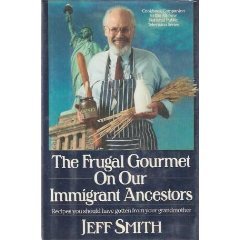 helpful descriptions of each European region's style of cuisine, and every recipe comes with at least a finished photo and an accompanying how-to photo - sometimes several. The Chamberlain book's mămăligă recipe is different from all the others I read about, because it is in bread form. I didn't get the impression that mămăligă was a bread, and wanted something more authentic. I found it in my copy of Jeff Smith's Frugal Gourmet on Our Immigrant Ancestors. Smith just gets giddy over, well, every recipe he writes about in this book, a broader crash course in foods of different parts of the world (his is the semester version, mine is the self-taught over the course of a week version).
Smith tells us quite bluntly that we will all definitely like mămăligă. Well with all that butter and cheese and sour cream I can see why. I just don't know how I will keep from gaining five pounds from eating this stuff.
The meal: Mămăligă
The Frugal Gourmet's incorporates the following ingredients, almost all of which I had laying around. Seriously, this cost me about $2 extra, and all I had to do was head to Whole Foods to buy some of their extra cheese pieces they have in their salad bar section. Use any combo of sharper and less sharp cheeses you have lying around, and if you have feta but no sour cream, all the better for you.
- water (hmmm, I wonder where you're gonna find that? You need 1 1/2 quarts of it)
- yellow cornmeal, the finer the better (had a whole bag of this - you'll only need 1 1/2 cups. It has to be yellow - mămăligă isn't made from white corn meal)
- 1 cup sour cream (left over from the ciorbă)
- 1/2 stick of butter (got it)
- cheese - lots and lots of cheese (for this I had about 0.15 lb of Havarti laying around. I then went out and spent two more dollars on some small pieces of Irish Dubliner and Ohio's own Guggisberg Swiss. I had planned to add some Parmesan, but ended up not needing it.
 Mmmm. Cornmeal mush.
 The process is simple: boil the water, take it off the heat, slowly stir in the cornmeal and put the pot back on the heat, stirring frequently for 20 minutes until the cornmeal mush is the consistency of "thick cake batter" (Smith's words, not mine). While doing that, melt the butter in an 8" square pan in a 350°F oven. Pour half the mămăligă "batter" into the pan, then spread half the sour cream on top and sprinkle half the cheese on top of that. Repeat with the other half of the ingredients, and bake until the cheese is browned on top. I chose to put it under the broiler for a few minutes afterwards.
 The best way to describe mămăligă is rich. All of that cornmeal layered with cheeses and sour cream and butter, and I could not eat very much in one sitting (also some advice: if you're just recovering from a Crohn's or colitis flare up, you might want to hold off on the mămăligă, or else just eat a wee bit). It's a good if heavy accompaniment to ghiveci, and a nice complement to your meatball ciorbă.
On to a new year and a new culture in my quest to better know cuisines I know little about. Since it is cold and snowy here, more so than I ever remember in December, I'm really jonesin' for warmth. So my next stop is taking me to the tropics. Just where I'm not telling yet.
Sources of recipes:
Romanian Cook Book, by Anisoara Stan (1951: Castle, Secaucus, NJ); republished 1969, 1983 - ciorbă de perisoare cu carne, vegetable ghiveci
The Illustrated Food and Cooking of Poland, Russia and Eastern Europe: Discover the Cuisines of Russia, Poland, the Ukraine, Germany, Austria, Hungary, the Czech Republic, Romania, Bulgaria and the Balkans, edited by Lesley Chamberlain (2009: Lorenz Books, London, England, UK) - general background on Romanian cuisine
The Frugal Gourmet on Our Immigrant Ancestors, by Jeff Smith (1990: William Morrow & Company, New York, NY) - mămăligă
Wednesday, December 30, 2009
Because it's Kwanzaa (Day Five)
Habari gani? Well, the news is that there is a surprising dearth of food-related Kwanzaa videos on YouTube. This one from Chow.com's page has Grandma Martha and her grandson sharing her delicious candied sweet potatoes with us, and invites all of us to the celebration.
Tuesday, December 29, 2009
Food Ethnography on a Budget: Romania II: Vegetable Ghiveci
My next foray into Romanian cuisine turned out to be a dish that you might find in many different parts of the world. There didn't seem to be anything particularly Eastern European about roasted vegetables with olive oil, sautéed onions, and soup stock. But as many writers have said about Romania, they love their fresh vegetables.
One of the most common vegetable dishes not just in Romania but in much of Southeastern Europe is ghiveci (/gee-VECH/). Ghiveci can be embellished with meats, fish, etcetera, but it doesn't have to be. In fact, the recipe I used struck me as quite vegan., especially for the 1950's. And you aren't limited in the variety of vegetables or even fruits you add to this dish. Anisoara Stan in her Romanian Cook Book notes that this dish is made in winter or summer out of "all the vegetables you can put your hands on" (p. 33). While she gives a set list of vegetables to use in her ghiveci, one can feel free to vary them here and there.
What all the ghiveci dishes share in common is the dish in which they are roasted. The recipe itself is named not for the ingredients but for the dish in which they are cooked: a ghiveci is a very large, usually ceramic cooking vessel. I don't have one of these, so I went with the next best thing: my slow cooker, which had the added benefit of my being able to just leave it cooking while I was out. I'm sorry, but the idea of leaving my oven on while I'm out running errands doesn't sit quite well with me.
The meal: Vegetable Ghiveci
 I only used about 2/3 of these ingredients - they wouldn't all fit in the slow cooker
Stan has a set list of ingredients, as I have said before. I improvised on some of them not only because I didn't have the freshest ones available that Doamnă Stan recommended, but also because I couldn't fit them all in my slow cooker. I will say that I bought some vegetables specifically for this project, and others to use in a few recipes.
The ones she recommends, and my substitutions:
- 1 bunch carrots (I had two mammoth ones left over from the ciorbă)
- 4 large potatoes (I had lots of potatoes - a box at the I-83 Farmers' Market for only $2)
- 1 turnip (had two for $1)
- 1 eggplant (didn't buy one - not in season)
- 1 cup green peas (bought a can at Wegman's for 70¢, used half of it)
- 1 green pepper (didn't use one, but I did throw in a Thai chili I had lying around)
- 2 celery roots (my friend Jim recently got rapturous over the phone about his first experience with celery root. I'll use it next time; I just used leftover celery)
- 1 squash (acorn squash, one for 50¢)
- a bunch of leeks (replacement? 1 bunch of green onions)
- 2 bunch mixed herbs (I threw in some parsley)
- 1 bunch of grapes (had some green grapes in the fridge)
- 1 cup lima beans (I didn't use any, though it was due more to space than to lack of desire)
- other veggies left out: 3 parsley roots, 1 cup green beans, 1 small cabbage, 1 small cauliflower, a handful or two of okra, and about 10 tomatoes. In their place, I used a bunch of kohlrabi ($2) and a sweet potato and white mushrooms I had laying around.
- 4 heads of garlic (I just used 1 1/2 heads, a rare thing for me since I usually go overboard with the garlic)
- 4 or 5 onions (a large box of onions for $2 at the farmers' market)
- 1/2 cup olive oil, plus an extra cup (had it)
- 2 cups soup stock (instead I used white wine)
- salt and pepper
 The recipe is simple to adapt to the slow cooker: just keep on cutting, prepping and chopping whatever vegetables and fruits you have until you just about fill your slow cooker. This includes the green onions and whole garlic cloves. They all get thrown in. You should have at least a few of the vegetables that Stan lays out in her recipe, but the one you absolutely must have is the onion (you should have the leeks/green onions and the garlic, but you must have the onion). You don't just throw these in with everything else; instead, you need to prep these in a specific way. Instead of throwing the onions in with everything else, you fry these up in 1/2 c of olive oil until browned (mine isn't completely vegetarian - I added a smidge of butter). then you add 2 cups of stock, or white wine in my case (I had it laying around). Let it boil while you heat up that last cup of olive oil by itself until it is boiling. Dump the boiling oil on the screaming vegetables (MU-hahahahaha!) and then follow it up with the onions.
Next, Stan gets a little vague on her cooking instructions. Here is what she tells you to do next:
Cover and bake in a moderate oven, until the juice has been absorbed. Serve hot or cold. (p. 35)
 Yes, that's all it says. I need a wee bit more guidance than this - like what temperature I roast it at, or for how long I leave it in the oven. This is why I chose to use the slow cooker: I just set it on LOW for 5 hours. Perfect.
Of course, there is just one problem: how am I going to eat all this? Even after giving some to family or friends, I'll have a lot for one single man to eat. I could try to freeze some of it, but honestly I think it will become mushy. But this problem is mitigated by the ghiveci's versatility. It can be your entrée, or a nice side to turkey and stuffing, or ham, or chicken - just about anything. You can eat it in a large tortilla, or with another type of flat bread. Or you can eat it over cornmeal mush such as mămăligă (see below). I had it with some wild rice and a glass of that Hungarian wine Egri Bikavér (Bull's Blood).
 It would look prettier if I wasn't just using my camera phone.
I'm starting to feel like a Romanian housewife now! And to really get into that vibe I have to tackle one of the most common dishes in all of Romania: that first cousin of polenta and grits and second cousin to cornbread - mămăligă.
Monday, December 28, 2009
Baltimore Magazine's Best Restaurant of 2010 Poll
Baltimore Magazine has its poll up for the Best Restaurants for 2010. I'm voting now but y'all have until 11:59PM on January 15 to vote. So vote!
And stay tuned for my annual wrap-up of the year in food and restaurants, from my little neck of the woods.
Saturday, December 26, 2009
Because it's Boxing Day
No, we don't celebrate Boxing Day in the US. In fact, many of us would be hard-pressed to even define it. This day after Christmas is celebrated in many other parts of the English-speaking world, including Canada, the UK, etc. and so on, as a public holiday. It started out as a day to give to those less fortunate than (and/or subordinate to) you - because the poor would traditionally go from door to door with empty boxes for people to fill with goodies. Today it's basically a day to indulge in post-Christmas Day sales, watch sports, discuss last night's Doctor Who (airing tonight on BBC America, by the way - the first time an episode has ever aired so soon after it did in the UK) and have people over for buffets. This video from the UK's Tesco grocery chain makes an oven-baked salmon look fairly easy, especially on a cucumber-watercress salad.
Just remember: when he says 200 degrees, he's talking in Celsius. We would do 400 degrees Fahrenheit.
Friday, December 25, 2009
Because it's Christmas (Day 1)
Having once lived for several years in SoCal, I am quite familiar with the Southwestern, Mexican and generally Mesoamerican tradition of making tamales for Christmas (that is, I know of it, although I myself have never had the good fortune to partake in the tradition). Even though this is not a tradition my ancestors took part in, or even really knew about, I have wanted to do this for some time. For various reasons, this was just not going to be the year.
But leave it to the folks at the Food Network and their online-only show The Power of Food - the same guys who brought us a Hanukkah brisket from Bawlmer earlier this month - to head to the Southwest and set up shop in a cheery abuela's kitchen on Christmas Eve. This woman, along with two or three generations after her, do it all from scratch - from the roasting of the chiles to the soaking, nixtamalizing and grinding down of the corn to make the masa. God, I could use some tamales right now. ¡Feliz Navidad, y qué comas muchos tamales en el año nuevo!*
*Happy Christmas, and may you eat many tamales in the new year!
Monday, December 21, 2009
A Blue Christmas Message
The blog is going dark for a few days. My sister's dog has passed after 12 1/2 years of eating, running, playing in the snow and smelling the cat's behind. Rudy was my sister's dog, but the whole family loved him. I'll miss giving him the occasional piece of bacon whenever I was visiting in the morning, and I will miss shooing him away from the cat when he was feeling a little too friendly. He lived a very long life for a dog, and was surrounded by loving faces when he went. It's comforting to think that he's not gone - he's just everywhere. Rest in peace, big dog.


