

My old secondhand Regal bread maker had to be replaced. The bread pan was so buckled in on itself that bread no longer comes out easily. Even worse, the paddle is missing somewhere around my apartment. So after much window shopping and internet surfing for $90 bread makers, I threw up my hands and went to the Goodwill, where I found a simple, low-end second hand bread maker from Zojirushi for all of eight bucks. It has four settings, one being a dough only one. That's good enough for me. 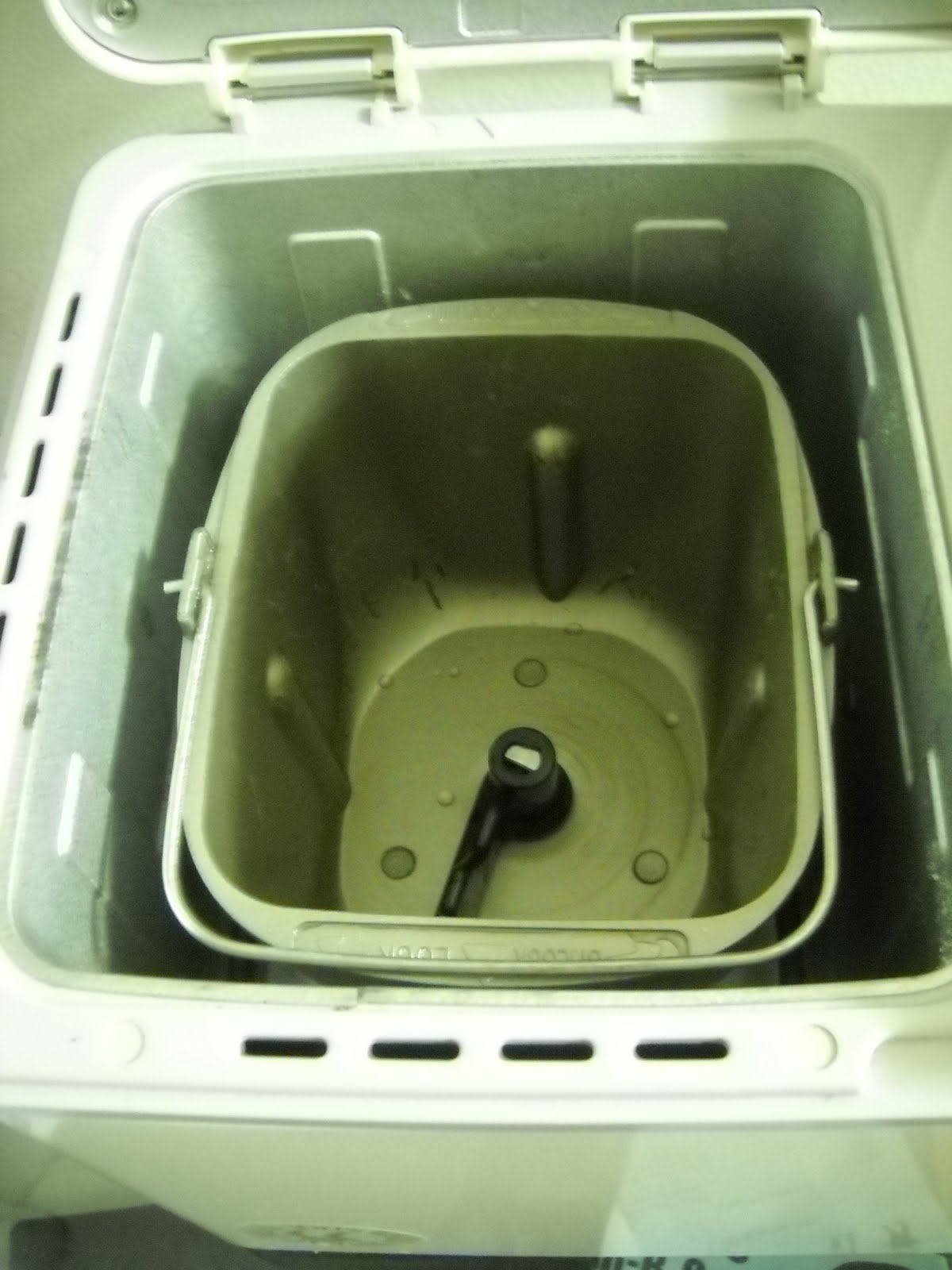
I tested it on one of my State-by-State series recipes, which you will read about in a few weeks. The bread came out beautifully. Sure it's just a one pound loaf, but I don't eat that much bread anyway.
Showing posts with label kitchen gadgets. Show all posts
Showing posts with label kitchen gadgets. Show all posts
Monday, June 20, 2011
The "New" Bread Maker
Tuesday, January 25, 2011
Asparagus pot?
A friend on a very large social network recently posted this question: "Is an asparagus pot a necessary kitchen item, or am I being seduced by more gadgets?"
I guess I'm not a "foodie" after all. I've never even heard of this contraption!
This makes me wonder: what are some of the useless kitchen devices we have in our cupboards? I had a difficult time answering this question because, to be honest, I don't usually bring kitchen utensils into my home unless I need them. That marble mortar and pestle? Hardly mere decoration, I've been grinding spices with that thing for almost 15 years. And my bread maker is just as useful today as a rice cooker. Don't even get me started on all the ways I use my strainer.
The closest one I could come up with was my over-the-flame sandwich pie maker. Perhaps this was a more useful a device, oh, 90 years ago than today. Apparently my mother's grandmother had the one resting in my kitchen. It's a device that looks somewhat like two sticks each with half a flying saucer stuck to the inside, so that when you press it together it looks like a flying saucer stuck between two sticks.
 See? Flying saucer between two sticks.
This seemingly useless device was used to turn plain old sandwiches into delicious flame-roasted pies. Just lightly butter each side of a sandwich - say, apple butter - and roast it in this device over an open flame for about five to ten minutes, equal time on each side. You will get a warm, delicious and gooey sandwich pie for your troubles. Today it might be a new and different way to make a grilled cheese.
The only other thing I could think to put on this list is my pasta maker. You may wonder what rube would put such a wondrous device on such a list. This one. I bought it at a markdown when Linens & Things shut down. Yet, I haven't had the chance to use it yet. I know, I will, eventually. But for now, it's still sitting in its box, waiting...
How about you all? Do you have any kitchen gadgets that actually are useless? Or maybe ones you want to get some more use out of?
Sunday, December 05, 2010
Snacking State-by-State: Alaska I - From Home Depot to Your Table
When we think of Alaska, we usually think of salmon. True, it is much more than that: it's moose, it's king crab, it's halibut, it's herring, it's pemmican. But salmon really is one of the most important foods - if not the most important. Even the Alaska Department of Fish and Game has created a resource for teachers to instruct students on just how important salmon is to the culture and cuisine of the state. It is so quintessentially Alaskan that for this state's dish, I really had little choice.
Snacking State-by-State: Alaska
 Official Name: State of Alaska
State Nickname: The Last Frontier
Admission to the US: January 3, 1959 (#49)
Capital: Juneau (3rd largest city)
Other Important Cities: Anchorage (largest), Fairbanks (2nd largest), Sitka (4th largest)
Region: West (Northwest, Pacific); Pacific (US Census)
RAFT Nations: Salmon
Bordered by: Arctic Ocean (north); Yukon Territory & British Columbia (Canada) (east); Gulf of Alaska (south); Bering Sea, Chukchi Sea & Chukchi Peninsula (Siberia, Russia) (west)
Official State Foods: King Salmon (fish)
Some Famous & Typical Foods: salmon, halibut, herring, Alaska king crab, moose, caribou, pemmican, northern Alaskan berries - and not Baked Alaska
Perhaps the biggest misconception - that I may unintentionally be helping to spread - is that Alaska is all salmon, all the time. Granted, salmon is important, but it is more than that. This isn't the only misconception. Journalist and author Kin Severson writes in her The New Alaska Cookbook about the reaction she got from her fellow San Franciscans when she talked about her many years reporting from Alaska:
Here in San Francisco, a place many argue is the epicenter of the American food scene, people find that funny. "Lots of whale blubber recipes?" they ask. [Severson, p. xi]Whale blubber - that is, the Inuit dish muktuk - is, actually, something I used to think they ate a lot in Alaska. Of course, not many people eat it there anymore - no more than do many Californians eat things made out of acorns. As to Alaska's many culinary riches, Severson notes:
Nearly round-the-clock daylight in the summer produces an abundance of herbs, greens, and other vegetables, including cabbages so big a single one might easily keep a restaurant in cole slaw for weeks. In the state's interior, morel mushrooms can grow as big as your hand. Unusual game meats, such as caribou and moose, present themselves in the fall and winter... Any serious eater who has visited Alaska leaves pleasantly surprised by the quality of the cuisine served in both city restaurants and remote fishing lodges. [Severson, p. xii]Long story short: it ain't all muktuk.
What Severson offers in her tome is what, to me, seems like a haute Alaskan cuisine, since the various contributors to The New Alaska Cookbook have many innovative takes on Alaska's native ingredients. They often prepare and plate their unique mixture of Northwestern and international ingredients and flavors in various ways that we in the Lower 48 would find familiar: Southwestern, Southern, New England, Tex-Mex, Creole, California-style, and so on. They even have mini-Baked Alaskas in there. By the way, just to get it out there: no, Baked Alaska is not from Alaska; it was made by chefs at Manhattan's Delmonico in the 1870's to celebrate the acquisition of Alaska from Russia. And yet, despite the innovations of many of Alaska's top chefs (now that is a show I'd like to see: Top Chef: Anchorage), I still wanted less haute Alaska and more traditional Alaska.
One recipe that seemed simple and easy (enough) comes to us from Chef Jens Hansen of Jens' Restaurant and Bodega in Anchorage. His recipe for alder plank-roasted salmon is similar to what Native Alaskans have been doing with either alder or cedar for thousands of years to prepare their salmon. As you probably know, grilling salmon, halibut or other seafood on the wood imparts a mid taste of the wood. And not only can you grill it, you can also bake it in the oven. This is Hansen's preferred method, and it was mine too. There were just three problems for me. One, I could only find cedar, not alder. Two, The cedar planks at the grocery stores were pretty damn pricey. And three, most people recommended that I not use it in my oven. The first was easily solved by buying cedar. The second was almost as easy: with some research I was able to find out how to make my own, much, much cheaper cedar roasting plank. The last one just took a little prep and some careful watching.
The prep work: How to prep a cedar plank for cooking

User "zoetical" from eHow.com gives some useful instructions for making your own cedar cooking plank. All you need is the cedar plank, a saw, sandpaper and a dab of olive or vegetable oil. And if you go to Home Depot or Lowe's, you can omit the saw because they will saw it for you! Just be persistent about finding cedar. One guy at the Home Depot I went to had no idea that they even sold cedar. In fact, he was fairly certain they did not. Thankfully his coworker led us both right to it.
One thing that is absolutely critical: the wood must be untreated. Think about it: if you're baking on grilling salmon on a piece of wood that's been coated with chemicals to help preserve it, the least of your worries is that the chemicals will get into the food. Beyond the flavor and the, um, toxicity, you also have to worry about the fumes and possibly the ensuing explosion, depending on what the wood was treating with. Please don't let this happen to you! Fortunately, the oils in the cedar act as a natural preservative, so cedar is by and large untreated anyway. The Home Depot guy was pretty certain of this. I imagine the same can be said for alder, but don't quote me on this.
Home Depot sells 8' x 1" cedar planks for about $6. Pretty sweet if you're using it for cooking, since a cedar plank in the stores will run you at least $15 to $20. That's for a whole foot of wood that you might get one use out of if you grill it, two or three if you bake it. I am able to get eight cedar planks out of mine - at $6 for 8 feet, that runs about 75¢ a foot. 1,500¢ vs 75¢. I think I know which one I'm going with.

The tough part was the sanding, which wasn't tough at all. You just need to get out all the splinters, lest you get one in your tongue (that almost happened to me with one of those cheap wooden chopsticks). So sand it, season it (one tablespoon per usable side), and soak it for an hour before using it. That's it.
Sources:
Severson, Kim, with Glenn Denkler. The New Alaska Cookbook: Recipes from the Last Frontier's Best Chefs. 2001 : Sasquatch Books, Seattle.
Zoetical (eHow user). How to Make Cedar Cooking Planks That Are Reusable. Posted date unknown.
Some information also obtained from Wikipedia's "Alaska" page and the Food Timeline State Foods webpage link to "Alaska". It's a lot of info for the enterprising Lower 48'er to process.
Sunday, August 09, 2009
Don't Buy This

Wegman's sells the Taylor Classic Instant Thermometer ($7.99), which has "instant" (meaning about a minute to get to the actual temperature) digital reads ranging from between -58°F to 302°F. It also comes with an extra "long-life" battery. They didn't mention that the "long-life" part was in fruit fly terms. I used it to make mozzarella. I was making some more just now and it died half way through the process (yes, I left it on for about five extra minutes, which I admit was a mistake). No problem: just change the battery! After that it would never work again. So what to do? Well, I just got back from Giant with a Farberware analog instant read thermometer for just a dollar more. At least this one needs no batteries. Something told me I should've spent that extra dollar.
Subscribe to:
Posts (Atom)


