Showing posts with label Chinese. Show all posts

Sunday, March 10, 2013

Revisiting the Beltway: One Last Trip around 695 (for the blog, that is)

As you may know, I finished the State-by-State project I've been posting up here every Sunday morning for the last few years.  For my final Sunday post, I have decided to revisit a previous project one last time: my Snacking around the Beltway series.  Due to crazy gas prices (which haven't really abated) and a total lack of time - in part exacerbated by said new project that lasted the last couple of years - I stepped away from it after examining every few exits around the Glen Burnie section of the Beltway (more or less Exits 1 - 8).

For this post, I summarize a few key spots I have visited throughout the rest of the Beltway.  Yes, I'm squeezing Exits 9 through 44 into one longish post.  This is, I admit, an inadequate way to finish it up, but it is better than nothing.

As I did in my January 18, 2009, Final Assessment post of the original series, I will again divide the Beltway up into six sections:
  • the "Glen Burnie" section of the Beltway (south, Exits 1 through 8A) - I've already explored this one in more detail, so I'm not really coming back to it in this post.
  • the "Catonsville" section (southwest, Exits 9 through 16B)
  • the "Pikesville" section (northwest, Exits 17 through 22)
  • the "Towson" section (north, Exits 23A through 30B)
  • the "Essex" section (northeast, Exits 31A through 38B)
  • and the "Dundalk" section (southeast, Exits 39 through 44)
This will not be a sweeping assessment of eats around the Beltway - I am exploring one, maybe two at the most, restaurants in each aforementioned section.  But these few restaurants hopefully do show the diversity of old and new eats off the Beltway, and will encourage you to further explore for ones I left off on your own.

The Glen Burnie Section (south, Exits 1 through 8A)

As I said, I have a few posts about Beltway eats in Anne Arundel County.  I will refer you to those, with one caveat: the Afghan place across the street from the Glen Burnie MVA is now a Hip Hop Chicken (map here).  I haven't visited it yet.

The "Catonsville" section (southwest, Exits 9 through 16B)

It's kind of silly to say I've "revisited" this part of the Beltway.  This is where I grew up: Lansdowne, which was home for my first 20-odd years, and Arbutus, Catonsville and such, where I got to (and still go to) frequently.  That said, I haven't really visited the newish eating establishments here lately: the new Middle Eastern place in Arbutus (Punjab Kabab & Sweets, map here), the frozen yogurt place along Maiden Choice (And what is up with this new fro yo trend?  Seriously, I don't get it), and the new Lansdowne Station shopping center, home to a Boardwalk Fries, an Italian place (Three Brothers of Lansdowne, the only Baltimore location of sixteen across the state; map here) and, notably, a new Chinese/American/sushi buffet.  That last part - sushi buffet - should send shivers down anyone's spine.


The place in question is the Teppanyaki Grill Supreme Buffet (map here) off Exit 10, near the Office Depot.  My mother told me that she took my sister here a few months ago and thought it would be a nice place to go get a sit-down meal.  Not nice as in "dressy" nice, but nice as in "Oh, you don't see us so often, it would be nice to spend some more time with you, and your sister liked this place" (full disclosure: my youngest sister, in her 30's, has autism, and it's not easy to find places that she likes beyond a set few places, so for her to like any place with Chinese food is in itself amazing to my family).

The place isn't my idea of "inviting": despite the many tables and booths, it seems quite crowded.  The mostly dimly lit interior doesn't help on that score.  Certainly though, the people there seemed to enjoy themselves, particularly the children's birthday party in the separate (and loud) meeting room next to the dessert buffet.

The Teppanyaki Grill has a bevy of the stuff you'd expect to find at a Chinese/Japanese buffet: various fried "Chinese" things, some maki rolls on ice which seemed freshly made at least (with massive amounts of wasabi sitting next to them), a section of "American things" just in case your stubborn Uncle Floyd won't eat "Asian" stuff, and large salad and dessert bars in case you are ever-so-slightly tempted to eat something healthy.


Yum.

For the price, however, this can't really be beat: all-you-can-eat for all of $7.19 plus tax ($10.39 for dinner instead of lunch; kids eat for less and very young kids eat for even less).  That said, it is a buffet, and as massive buffets go it is pretty average.  You may be thinking "Well what did you expect?" In a word: this.  I expected what I got, so I wasn't exactly disappointed.  But all the same, I don't usually enjoy this sort of thing, so I probably won't head back.  It didn't make me sick - that was a plus.


Thank God, that had me worried for a second.

The "Pikesville" section (northwest, Exits 17 through 22)


So much to choose from, so little time... And money...

Unfortunately I don't get around to Pikesville much these days.  The last time I visited was to hit up the Seven Mile Kosher Supermarket off Exit 20 (map here) for some matzah meal a year or so ago.  A few years before that, I was a panelist at the Great Tastes food show, as one of many panelists discussing food blogging in Baltimore.  I had mentioned that I was hopeful that Baltimore would see an increase in the number of West African restaurants in the area, since Charm City is fortunate to have a relatively large and increasing Nigerian-American (and overall West African) community.  Afterwards,  somebody suggested to me that I try out Peju's Kitchen and Lounge off Exit 17 in Woodlawn (map here).  I hadn't gotten the chance until recently, when I finally made the trip for take out one night.  Actually, it ended up being the very last restaurant I will have visited for this blog.  I mean, I don't exactly do these in order here.

Peju's with its large black awning occupies the large corner in the Security Plaza strip mall across from Woodlawn High School.  The plaza also features a South Asian clothing store and several halal buffets and groceries, plus a store-front Islamic center, a driving school, a handful of store-front churches and a halal Chinese restaurant (I've heard of kosher Chinese places, but a halal one is new to me, and certainly fills a niche needing to be filled).  The slightly rusty (not rustic) exterior of the whole building complex belies the gorgeous warm amber interior of Peju's, which serves not just West African specialties like jollof rice (of course), fufu and puff-puff (the West African answer to the donut.  Mmmm, donut), but various Caribbean specialties.  The warmly-lit bar and lounge area open onto the main seating area in the interior.  In other words, this ain't Teppanyaki Grill Supreme Buffet (see above).


Since I was out running errands and had to get home, I opted for take-out.  Though my eyes alighted on Caribbean specialties like jerk chicken and curry vegetable dishes ($10 each, more if during dinner), I eventually opted for the more Nigerian jollof rice with beef (also $10, also more if during dinner).  The jollof rice was certainly better than my one attempt to make it a few years ago, and I loved the thick tangy, slightly spicy tomato sauce that went with it. The two slightly tough pieces of beef I got had a nice flavor, but clearly they were a side if anything: the star of this meal was the big, heaping mound of soft, tangy jollof rice.  A few sweet fried plantain pieces finish off this meal. I will have to go back for more.

The "Towson" section (north, Exits 23A through 30B)

While I hardly get to Pikesville or Woodlawn, I often pass through Towson since I live so close by.  The problem here is that I never get a chance to stop anywhere.  The downtown Towson area has seen a few new places pop up over the last few years even as places like Towson Commons have shut down.  Yes, many old favorites like Kyodai, Kathmandu and Strappazza (just to name a few) are all still in that downtown area.  One that has been around for a while but I haven't had the chance to visit until not long ago was the Towson Hot Bagels (map here), recently voted Best Bagel in Baltimore.  Is this the influx of New Jersey and New York kids at the University making this assessment?  Seriously though, it's an efficient set up.  It has to be, since there are so many of these college kids in there!  The bagels are indeed good: chewy and filling and lovely.  I got an everything with cream cheese the one time I went there with some friends from out of town.


A few storefronts have seen some changes across the street from the library on York Road (map here: they're all close by): the Indo-Chinese place is now straight up Indian (India Cuisine), and I still haven't gotten to the Chinese place next door (The Orient Restaurant) or the 7 West Bistro Grille around the corner, all conveniently nestled not too far from Exits 26 and 27.  One place I have gotten to is the Phò Dat Thành (map here), the phò place near the Melting Pot, and one of three in the Baltimore area (with locations in Laurel and Columbia).  This once was a "pan-Asian" restaurant serving Chinese, Japanese and Thai food.  It finally settled on Vietnamese.  While they have various stir fry options available, you will probably want to go for the phò: a good, large standard bowl of phò at not a very steep price.

The "Essex" section (northeast, Exits 31A through 38B)

Sadly, I don't get around to this part of the Beltway that often anymore either.  I really should just stop between Exits 38B and 39 off North Point Blvd at the Prima Foods (map here).  This is Baltimore's premier stop for all your Greek ingredient needs, including their barrels of olives that you scoop yourself.  Closer to Route 7 and CCBC Essex lies places I have yet to get to, notably the Pizza Rustica (map here) at the intersection of crazy and crashy, er, Rossville Blvd and Pulaski Hwy near Exit 35 (seriously, why is that intersection so accident-prone?).

Ever since I last visited for the Beltway Snacking project a few years ago, I knew that Baltimore's favorite pit beef joint - and apparently the über-annoying Guy Fieri's - was in this area.  It did not dawn on me just how much closer Chaps Pit Beef (map here) is to 895 than the Beltway, so much so technically it shouldn't really be in this post.  But screw it, it's only a few miles away from Exit 35, so it's going in anyway.


For the few Bawlamorons who haven't been to this place - I admit, I was one of them until I went for this post - and for those outside the city who still aren't quite sure what "pit beef" really is, Chaps is not all big and flashing, and is even kind of easy to miss if you're not paying attention.  Plus, there isn't a large parking lot.  It is one of those places that stays small and puts out a quality product.  Okay, a lot of quality products: it's not just pit beef but various types of barbecue.  The menu is as complicated as any BBQ joint I've seen in this or other parts of the country.  But I went specifically for the pit beef sandwich, medium rare (about $6).  The meat is smoky, soft and juicy, and yes, you must bite down to get the slices of pit beef off the sandwich (but hey, that's pit beef for you).  Don't forget the many toppings along the window: horseradish, tiger sauce (horseradish mayonnaise), hots and a pickle chip belong on any pit beef sandwich.  I can't imagine eating pit beef without horseradish.  I just don't want to.


Isn't it better to imagine a nice juicy pit beef sandwich slathered with a big ol' blob of horseradish instead?


The "Dundalk" section (southeast, Exits 39 through 44)

Since family, work and friends are all in other parts of the area, I almost never get to Dundalk anymore.  And like with the Rosedale / Hamilton area it is easy to find pit beef in Dundalk.  Even easier since Merritt Blvd lost the wondrous Weenie World, one of my favorite hot dog places around the Beltway.  In its place is the Bullpen (map here), with the tagline "You can't beat our meat" (errrrrmm...).  Like Chaps and the nearby Bada Bing Bada Beef (which I did get to last time), this is also a pit beef and BBQ joint, and I will have to try it out next time I'm back down that way.

As with my much-delayed visits to Peju's and Chaps, I did finally get to the Boulevard Diner (map here).  Guy Fieri also stopped by here (my God, how many of these places has Guy Fieri infected with his presence anyway!?) for his DD&D show.  The Boulevard is your quintessential diner - nothing much different about that, except for the massive illustration of Ray Lewis (W0000000000T!!!!!) in the entryway.  Inside, it's no-nonsense but friendly and quick service.  And it has all the diner classics: the Mediterranean stuff, the burgers, the meatloaf, the desserts, and the all-day breakfasts.  I hadn't eaten lunch that day but was in the mood for pancakes - not many, but pancakes all the same.


I have my fat group, my carb group and my sugar group!


I got the short stack of two massive pancakes ($5) with two sausage patties (an extra $2).  I can't think of much else to say: they were typically tasty diner pancakes. The sausage was a little gristly but nothing I haven't enjoyed eating before.  And of course, I bathed the whole thing in butter and syrup, as you are supposed to do with diner pancakes.  Yum.


Post-Script

Had I decided to continue the blog - and had gas prices fallen again - I might have liked to get around the Beltway again.  I'm not sure I would've had the time, though: the one thing I remembered while doing the research for this post was how much time it took the first time around. So revisiting these various joints around 695 is just something I will have to leave to others.  Every exit has something worth eating (and probably something that is best left alone).  Search it out, folks.  I may not be writing about it, but I will certainly be searching for it nonetheless.

Places I visited

Boulevard Diner (diner) - 1660 Merritt Blvd, Dundalk, MD 21222; Phone: (410) 285-8660
  • Would I eat there again? Yes
  • Would I go out of my way to eat there again? Yes, why not?
Chaps Pit Beef (pit beef & BBQ) - 5801 Pulaski Hwy, Baltimore, MD 21205; Phone: (410) 483-2379
  • Would I eat there again? Yes
  • Would I go out of my way to eat there again? Yes, and I'd have to
Peju's Restaurant and Lounge (Nigerian / West African / Caribbean) - 1724 Woodlawn Drive, Wodlawn, MD 21207; Phone: (410) 277-9779
  • Would I eat there again? Yes
  • Would I go out of my way to eat there again? Sure, especially since it's the only Nigerian restaurant in the area.
Phò Dat Thành (Vietnamese) - 510 York Rd, Towson, MD 21204; Phone: (410) 296-9118
  • Would I eat there again? Yes
  • Would I go out of my way to eat there again? Maybe
Prima Foods (market / Greek) - 51 Kane St  Baltimore, MD 21224; Phone: (410) 633-5500
  • Would I shop there again? Yes
  • Would I go out of my way to shop there again? Sure!
Teppanyaki Grill Supreme Buffet (buffet / Chinese / Japanese / American) - 3551 Washington Blvd, Lansdowne, MD 21227; Phone: (410) 242-5887
  • Would I eat there again? Probably not
  • Would I go out of my way to eat there again? Um, no
Towson Hot Bagels (bagels / breakfast) - 16 Allegheny Ave, Towson, MD, 21204, with locations in Timonium and Canton
  • Would I eat there again? Yes
  • Would I go out of my way to eat there again? Hmmm...
Places to visit later (though I must leave others to write about them)

The Bullpen (pit beef & BBQ) - 1099 Merritt Blvd, Dundalk, MD 21222; Phone: (410) 288-3529

Hip Hop Fish & Chicken (fried chicken / fast food) - 6604 Ritchie Hwy, Glen Burnie, MD 21061, with various other locations in the area; Phone: (410) 766-1515

India Cuisine (Indian) - 321 York Rd, Towson, MD 21204; Phone: (410) 583-7770

The Orient Restaurant (Chinese / Japanese) - 319 York Road, Towson, MD 21204, with locations in Bel Air and Perry Hall; Phone: (410) 296-9000

Pizza Rustica (pizza / Italian) - 8805 Pulaski Highway, Rosedale, MD 21237; Phone: (410) 682-8640

Punjab Kabab & Sweets (Pakistani / Indian) - 5313 East Dr, Arbutus, MD 21227; Phone: (410) 737-7773

Seven Mile Supermarket (kosher / Jewish) - 201 Reisterstown Rd,  Pikesville, MD 21208; Phone: (410) 653-2000

7 West Bistro Grille (American / bar) - 7 W Chesapeake Ave, Towson, MD 21204; Phone: (410) 337-9378

Three Brothers of Lansdowne (pizza / Italian) - 3611 Washington Blvd, Lansdowne, MD 21227, with sixteen locations statewide; Phone: (410) 536-1080

Sunday, February 24, 2013

State-by-State Redux: IX of X - Americanized Chinese Cuisine Revisited - Tso many dishes, Tso little time...

Chinese food in the United States is typically, at best, "Chinese" food.  This is changing, of course, as more Chinese immigrants are opening more restaurants with authentic Chinese cuisine (or maybe they've been here all along, but everyone else is now patronizing them more often).  But "Chinese" food has evolved into something uniquely American, shaped by the first immigrants to the West Coast in the 19th century, and to points all over America today (mostly from Fujian province).  And different communities from the Chinese diaspora master different food feats in different parts of the world - shredded beef in the UK, for example, or ma po tofu in Japan [Lee 2008].  In the US of A, that Chinese dish that's gripped the nation is named after General Tso.

Snacking State-by-State Redux IX of X: Americanized Chinese Cuisine

What is it? Traditionally, a unique mix of Chinese cooking techniques and American ingredients, here since the 1840's.  Since then it has evolved into something not terribly recognizable in China, but instead is peculiarly American.  More recently, actual "Chinese" Chinese food has crossed the Pacific in the form of dim sum and other dishes that a Chinese tourist would actually recognize.
Where did it come from? See above


General Tso's chicken is not a real thing in China, but that doesn't stop Jennifer 8. Lee from seeking it out.  In her book The Fortune Cookie Chronicles: Adventures in the World of Chinese Food [2008], Lee analyzes the origins and state of Chinese food in America, from fortune cookies (actually based on a Japanese cookie) to chop suey to the ubiquitous General Tso's chicken.  Lee's quest to find this last dish took her all the way to a remote village in Hunan Province to find the origins of this dish, one which few Chinese chefs - scratch that, no Chinese chefs - had actually heard of.  As Lee notes:
The refrain was consistent: "We don't have General Tso's chicken here" or "We've never heard of it."  Even after I showed them pictures of the dish on my digital camera, they would frown and look at me blankly, then helpfully suggest another chicken dish, often  the local specialty, mala or kung pao.  One waitress at a three-hundred-year-old restaurant pressed me to try another dish associated with a famous Hunan personage: "This is what Mao Zedong and his circle ate when they used to come here."
But nothing they offered ever resembled our crispy General Tso's, nor his American cousins: sesame chicken, lemon chicken, sweet-and-sour chicken.  In fact, any batter-dipped, stir-fried chicken dish was hard to come by in this urban corner of Hunan. [Lee 2008: 68-69]
The closest Lee ever got was the home village of Zuo Zongtang, the 19th century local leader and statesman for whom this dish - the same one that has nothing to do with him whatsoever - is related.  There a distant modern relative to Zuo was befuddled by the photos Lee had of General Tso's - Zuo's - chicken on her phone.  Her informant did offer to cook dog, however - the kind "raised for eating" and not for pets.  Lee was, of course, taken aback: "I pictured how Americans would react to General Tso's puppy on their take-out menus" [2008: 73].

Lee never finds what we call General Tso's chicken, but that hasn't stopped Chinese-American chefs from trying to recreate this uniquely American dish.  How "American" is it?  Lee's schoolmate from Beijing University, Wang Wei, tells her why it's so American:
"It has broccoli.  Americans looove broccoli.  They add broccoli with everything."  She continued: "Americans like chicken.  You can go to a supermarket and you buy chicken breast, chicken legs, chicken drumsticks, chicken wings, boneless chicken.  All different types of chicken," she said, gesturing to various parts of her body..."It's very American.  It's all-American: very big pieces of chicken, fried and sweet." [Lee 2008: 74]
Since Lee can find no recipe for General Tso's chicken, I had to look elsewhere.  After finding many much healthier and more typically Chinese-style General Tso's chicken (Ching-He Huang's recipe being the most notable), I wanted something more typical of the Chinese fast food takeouts that Jennifer 8. Lee and myself are more familiar with.  I found that in Diana Kuan's Appetite for China blog (which she just turned into a cookbook).  Kuan is also familiar with Lee's aforementioned book, and tried to find out more about it herself.  Kuan tries out various versions of the dish before perfecting one that is as authentic as she can get it, deep-frying those chicken pieces with a whole lot of cornstarch.

It is Kuan's version of the General's chicken that I interpret below.  Unlike most recipes I have done, this time I am pretty much following this one to the letter, save for the addition of broccoli, which she doesn't specifically mention in her recipe.

The Recipe: General Tso's Chicken

To make Kuan's version of Zuo's chicken, assemble the following:


* chicken (Kuan calls for a pound of chicken thighs, boneless; I went for 1.5 lbs of chicken thighs, bone-in, and went from there.  I don't buy a lot of chicken, so I justified the expense of the less expensive thighs at the Whole Foods.  Actually I don't think they had boneless)
* cornstarch (I bought a new canister, about $1.50, because I needed a lot of it - about  a cup and a half, instead of the usual one or two teaspoons)
* sugar, salt & pepper (had them all)
* dried chiles (had this too)
* garlic (this too)
* sesame seeds (yup)
* green onions (getting pricier these days, about $1.50 a bunch)
* oil for frying (I had some of that high heat point rice bran oil from H-Mart)
* Though not pictured, I also added broccoli, as Jennifer 8. Lee's friend mentioned.  Because Americans LOVE broccoli!  Okay we don't all love it, but I am used to broccoli in my General Tso's chicken, so in it goes.

You will also need to marinade the chicken.  For that, assemble:
* sesame oil (had it in the fridge)
* soy sauce (I had this too)
* egg whites (discard those yolks, folks)

And for that famous sauce, assemble:
* chicken stock (I used that Better Than Boullion in the fridge)
* soy sauce
* hoisin sauce (got a new jar for about $2)
* rice vinegar (same)
* chile paste (I used the garlic chile paste from that Washington Dungeness crab recipe)
* more sugar, more soy sauce, and more cornstarch


It takes about six chicken thighs to yield one pound of meat.  Remember that when shopping.


Mix the marinade ingredients - the sesame oil, the egg whites and the soy sauce.


Marinade the meat for at least ten minutes.


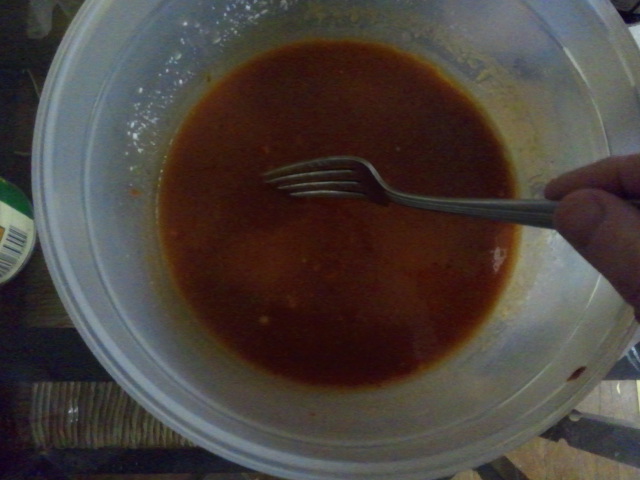
Next, assemble the sauce ingredients.


Mix together in a bowl and set aside.


And mix salt and pepper into the massive amount of cornstarch.  You will coat the chicken in this.,


Heat your oil in a wok until at deep frying temperature


To prepare your marinated chicken for frying, plop each piece in the cornstarch mixture...


...and shake off the excess.


Fry several at a time for about five minutes, turning once.


Drain on a paper towel.


When done frying, reserve the oil (okay, dump it somewhere to cool down until you can just dispose of it), wipe out the wok and quickly fry your chiles and garlic in oil.


Add your sauce for a minute or so...


...and then your chicken to coat.


I added the broccoli bits until no longer frozen (I did also nuke it in the microwave to expedite the process).  Serve with scallions and rice.


Granted, the next time I may just be lazy and buy it ready-made.  Still, now I can make General Tso's tasty chicken at home.  It wasn't as sweet as I'm used to, but I've actually found orange chicken to be the really sweet one.  When I order Chinese I usually go back and forth between orange and General Tso's chicken.  What's good about this one is that it isn't stringy and all "mystery meat"-ish like the kind you sometimes buy at a Chinese take-out place.  It's tender, somewhat crispy (less so when you reheat it - pop it in the oven and not the microwave if you are concerned about that), and just sweet enough.  Plus, it's satisfying to know that you made it yourself without opening a packet of seasoning or a big-ass can labeled "Chun King".

- - - - -

Well, this feels pretty strange, y'all, but the next State-by-State post is it - THE LAST one!  I thought for a while about how to sum this up.  Unlike my Beltway Snacking series a few years ago, where I wrote a long summary, for this I'm just making an all-American meal instead.  Next week you will find out what it is, but more importantly who wrote the recipe: the most quintessentially American of chefs herself.

Also: as noted yesterday, look at the blog on Tuesday morning (February 26).  I have a big announcement to make about what I'm up to next, now that this State-by-State series is fast approaching its end.

Sources:

Kuan, Diana.  "General Tso's Chicken".  Appetite for China, posted August 30, 2011.

Lee, Jennifer 8.  The Fortune Cookie Chronicles: Adventures in the World of Chinese Food.  Twelve Books: New York, 2008.

Some information also obtained from the Food Timeline State Foods webpage.

Tuesday, April 03, 2012

Seven Seas Restaurant

While much of Maryland is on spring break, I am busy working - my spring break was a few weeks ago.  Even though I had had big plans, eventually I just stayed home and traveled locally.  One of those days I got down to DC - which I do often, but this was some me-time in the museums and around the Tidal Basin to see the cherry blossoms.  However, I started out my day in Rockville, seeking out a restaurant I have been meaning to get to for about a year now.

The Seven Seas Restaurant was featured on WAMU's Kojo Nnamdi Show about a year ago.  Owner Corinna Shen tells Kojo that she wants to bring authentic Chinese cooking to DC area diners.  Ever since, I wanted a taste of that.

I arrived in the middle of a large bus of older people, maybe from a retirement community or something, and got ushered to a separate table.  Their lunch deal immediately drew me: two tapas-sized appetizers from a list of many (some "Americanized" Chinese, some more authentic), two tapas-sized entrées (same), a tea and a dessert - all for $13! Even though it was half an hour before the lunch deal began, they let me have that.

After bringing out my rose green tea, I rather quickly got my appetizers, some of which I chose were then recommended by the staff at the restaurant .  One was a cold shellfish in a hot chile sauce.  It wasn't really hot to me, but it had a nice tang to it and a lovely flavor.  The other was a fried turnip (daikon radish) cake.  One man from the restaurant talked to me about the food and gave me recommendations about sauces to eat - specifically, he brought me a hot chile sauce that he likes to eat some of these dishes with.  He also said he likes to put a little soy sauce into it for his turnip cake, a favorite of his.  I found myself doing that.

Next came the entrées.  One was a fried crispy squid on a bed of shredded lettuce, onion and red bell pepper bits - that is, fried calamari, which was part of the draw.  It was some of the best fried calamari I've had in a while.  The other, another recommendation, was the yam, wolfberry and chicken.  I had no idea what wolfberry was but they are supposed to be good for eyesight.  This was also very good.

Finally dessert: a little bit of red bean ice cream.  It wasn't a big heaping bowl, but was just enough to finish off a delicious lunch capped off with excellent service.  Plus, Seven Seas is very close to the Twinbrook Metro, so I just drove there and hopped on for a day in the District.  I left satisfied and full, but not belly-aching full.  The next time I'm in Rockville, I will be going back.

Sunday, December 11, 2011

Snacking State-by-State: Missouri III - Meet Me in St. Paul, Louie!

Whenever I look at Midwestern states, I keep on finding strange (to me) sandwiches: Horseshoe sandwiches from Illinois.  Breaded pork tenderloin sandwiches from Indiana.  Loosemeats from Iowa.  Coney Island dogs from Michigan.  And though they aren't sandwiches, there was enough in the way of bread from Kansas (honey sunflower) and Minnesota (wild rice frybread).  So why not continue the trend with perhaps one of the stranger sandwiches I've read about in a long time.

Official Name: State of Missouri
State Nicknames: The Show-Me State
Admission to the US: August 10, 1821 (#24)
Capital: Jefferson City (15th largest)
Other Important Cities: Kansas City (largest), St. Louis (2nd largest), Springfield (3rd largest), Independence (4th largest)
Region:
 Midwest, South; Wet North Central (US Census)
RAFT Nations: Corn Bread & BBQ; Bison
Bordered by:
  Iowa (north); Illinois and the Mississippi River (east); Kentucky and Tennessee (southeast); Arkansas (south); Oklahoma (southwest); Kansas (west); Nebraska (northwest)
Official State Foods and Edible Things: Eastern black walnut (tree nut); channel catfish (fish); Norton/Cynthiana grape (grape); bobwhite quail (game bird); crayfish (invertebrate)
Some Famous and Typical Foods: Midwestern and German foods to the north, Southern and Ozark foods to the South and in the center of the state; Kansas City BBQ (sweet BBQ sauce, with dry rub before barbecuing), gooey butter cake

The St. Paul sandwich is found - of course - in St. Louis, and nowhere else.  It is not only unique among Midwestern sandwiches, but unique among Chinese restaurant dishes.  For you see, the St. Paul sandwich is an egg fu yung pancake between two slices of bread, with tomato, lettuce and onion slices, dill pickles and mayonnaise.  Jennifer 8. Lee, that authority on all things related to Americanized Chinese food (NB: her book The Fortune Cookie Chronicles) notes on her blog what one reader told her about it:
According to local legend, the St. Paul Sandwich was named by Steven Yuen at Park Chop Suey in St. Louis for his home town of St. Paul. It’s considered a fast food snack that is really cheap < $2. [Lee 2009]
She also notes that it isn't "as crunchy as the chow mein sandwich" [Lee 2009], but I should have done that one back when I was looking at Massachusetts.

The Recipe: St. Paul Sandwich

If you want to make the egg fu yung yourself, there are many recipes out there: pork, chicken, shrimp, beef, vegetarian, combinations thereof (this St. Paul sandwich recipe from STLToday makes a nice one with shrimp, chicken and beef).  Just follow whichever recipe you choose but ignore the sauce.  Or if you don't have the time or the energy to make your own egg fu yung just go to your local Chinese take out and buy some.

In addition to the egg fu yung you will need:


* two slices of white bread
* mayonnaise
* lettuce (most use iceberg but I'm no fan, so I used some of the tastier variety from the bulk lettuce at the supermarket)
* tomato and onion
* pickle chips (normally dill, but I used some of those pickles I made way back in my Kansas pickle post)


The sandwich is simple: start with lettuce and slices of tomato (mine was Roma).


Add onion slices.


Then add your pickles and mayonnaise.


And finally the egg fu yung.


How to describe this unusual little sandwich?  One person said it was surprisingly heavenly: the most unusual fried egg sandwich.  My egg fu yung was fresh from the Chinese restaurant, but I could not really describe it as crispy.  But it was certainly a substantial sandwich, and a most unusual way to eat egg fu yung.  It's a pretty easy sandwich, but if I want my fried food crispy I guess I'll just have to fry it myself.  I did get a nice crunch from the onion though.

Sources:

Adams, Marcia. Heartland: The Best of the Old and the New from Midwest Kitchens. Clarkson Potter: New York, 1991.

Bittman, Mark.  "For a Smoky Taste in Oven Ribs".  The New York Times website.  Published: December 4, 2009.

Goldwyn, Craig "Meathead".  "A taxonomy of American barbecue sauces".  Amazing Ribs website.  Last revised September 12, 2011.

Lee, Jennifer 8. "St. Paul Sandwiches (in St. Louis), Made with Egg Foo Young Patties".  The Fortune Cookie Chronicles website.  Published April 8, 2009.

"noahw" (Instructables.com user).  "Oven Smoked Ribs".  Instructables.com website.  Copyright 2011.

Oland, Sydney.  "Sunday Brunch: St. Louis Gooey Butter Cake".  Serious Eats website.  Published May 28, 2011.

Raichlen, Steve.  How to Grill: The Complete Illustrated Book of Barbecue Techniques.  Workman Publishing: New York, 2001.


STLToday.  "St. Paul Sandwich (Fortune Express)".  STLToday website.  Published August 17, 2011.

Stradley, Linda. "Gooey Butter Cake". What's Cooking America website.  Copyright 2004.

Some information also obtained from Wikipedia's "Missouri" page and other pages, and the Food Timeline State Foods link to "Missouri".

Saturday, October 01, 2011

Asian Court

My oil was low today.  I stopped at the Midas to get it changed, and headed along Route 40 to find something to eat.  I didn't want to spend too much, but the promise of dim sum drew me in to Asian Court.  It's tucked away from the Baltimore National Pike so you have to know where to find it - namely, somewhere in the Giant shopping center.

Apparently, I am the last food blogger in the area to have found out about this place.  No worries.  I know about it now.

No menu is posted, but you will be filled up on about $15 of dim sum.  The warm colored dining room is covered with murals that evoke China, excepting the bar which has a flat screen TV playing Chinese telenovelas (when I was there anyway).  The place was pretty busy, and filled mostly with Chinese-American diners, a sign that this is probably a good place to be.  There wasn't a whole lot of room for the wait staff to navigate around the tables with their dim sum carts.  The first waitress to come to me had to stop across from my table, and I needed to get up to choose my plates (small ones are $3, with higher prices ranging from $4 for medium plates to $8 for the largest ones).

I don't remember exactly what I ordered, but the waitress was very keen on recommending the rice (I've had better, especially with the thin and chewy prawns, but it was still flavorful and I ate most of it).  I also got some fried pork dumplings (very tasty - my favorite thing), another type of steamed dumpling whose contents I can't quite place (also tasty, though I came back to this plate less often) and a set of taro dumplings with a delicious and delicately crispy fried batter on the outside.  They were just beautiful but difficult to pick up with a set of chopsticks - easier to cut in half with them, and then pick up each half.  By the time the second cart had come around with shu mai - my most favorite type of dim sum - I was regretting having ordered so much.  They will let you take home the leftovers, however, so if you order too much you won't be wasting it.  I was going to be adventurous and order the chicken feet, but with so much food in front of me, I needed to conserve what was in my bank account and not stuff myself.

With all that dim sum plus a pot of piping hot jasmine tea, my total came to $17.50, a pricier lunch than I had planned to get today, but about right for all the food that I got.

Asian Court on Urbanspoon

Wednesday, February 09, 2011

Sampling Ethnic DC, One Cuisine at a Time

I often go back and forth between Dan Rodricks on our own WYPR (88.1 FM) and his noon-to-two counterpart Kojo Nnamdi on WAMU (88.5 FM), partly due to subject matter, partly due to reception. Today was a Kojo day, and I was lucky to hear Corinna Shen, owner of Rockville's Seven Seas Restaurant, and Todd Kliman, food critic for Washingtonian Magazine. Shen is a big proponent of mixing the Americanized "Chinese" menu with the "real" menu, so that non-Chinese patrons will be more willing to see what Chinese patrons are actually eating - dishes made with loofah and duck blood and frog, that non-Chinese patrons might be reluctant to order, and Chinese restaurant owners may be even more reluctant to give to non-Chinese diners. Kliman gives some tips on how to get those "real" Chinese menu items - show that you respect the cuisine, that you have heard of some of these not-so-Western ingredients, and that you really are willing to eat anything. It still will not always work, but when it does, be prepared for dishes that look nothing like General Tso's chicken.

This is just the latest in a string of shows that Nnamdi has done about the varied ethnic food landscape of Washington, DC and the Maryland and Virginia suburbs. This Local Restaurant World Tour, as he dubs it, is by all means a go-to source for ethnic eating in Montgomery & PG Counties, Northern Virginia and the District. Just one look at the map on the Kojo Nnamdi Show website shows a map of the DC metro area splattered with maps of China, Greece, Thailand, Korea, Trinidad, Italy, Ethiopia and several other countries, some as far away from DC as Frederick and - yes - Baltimore (Da Mimmo's is currently the only Baltimore restaurant on the map). If you are in or around the DC region, and you know you will be eating, you must check out this map.

Sunday, January 23, 2011

Snacking State-by-State: California Part 2B - the Northern Half (The Best Little Shiu Mai in Chinatown)

To finish with California, I head back to the big city: this time San Francisco, home to sourdough, fog, and the thriving Chinese and LGBT communities of Chinatown and the Castro, respectively (related note: the Castro was the home of Harvey Milk, gay rights activist and the first openly gay politician to be elected to public office in the US). While we don't, alas, think of the gay community's contributions to San Francisco's culinary landscape, Chinatown fortunately has an extensive food history.

Snacking State-by-State: California


Official Name: State of California
State Nickname: The Golden State
Admission to the US:
September 9, 1850 (#31)
Capital: Sacramento (7th largest city)
Other Important Cities: Los Angeles (largest, & 2nd largest in the USA), San Diego (2nd largest), San Jose (3rd largest), San Francisco (4th largest)
Region: West, Pacific (small sections of the state can be considered Northwest or Southwest in terms of its food and culture); Pacific (US Census)
RAFT Nations: Acorn, Chile Pepper, Pinyon Nut, Salmon
Bordered by: Baja California, Mexico (south), Arizona & Nevada (east), Oregon (north), Pacific Ocean (west)
Official State Foods and Edible Things: golden trout (fish), California Valley quail (bird), grizzly bear (animal)
Some Famous & Typical Foods: Where to begin? "New California cuisine", diversity of ethnic cuisines, especially Asian, Latin American and Mediterranean (Mexican, Chinese, Japanese, Filipino, Thai, Salvadoran, Korean, Italian), citrus (especially in the south), wine (especially in the center and north), seafood, dates, and so much else

One of the oldest Chinatowns in North America, it survived the massive earthquake of 1906 to grow bigger and better than ever. If you ever visit San Fran's Chinatown, as I did a few years ago, don't spend time in any one restaurant. I mean, sure, go ahead and do that, but I had more fun trolling up and down the streets on my own dim sum crawl.

When we usually think of Chinese food, we think specifically of things that nobody eats in China - I mean nobody. Chop suey, for example, is not Chinese food. It was actually just stuff that a Chinese immigrant in California threw together for some white patrons, as New York author Jennifer 8. Lee points out in her fascinating must-read book The Fortune Cookie Chronicles (note: fortune cookies aren't Chinese either - they're of Japanese origin). As for General Tso's chicken? Nope, not Chinese either. Lee gives us the scoop on her search for it in the Hunan province home town of General Tso (aka Zuǒ Zōngtáng) himself:
Unlike kung pao chicken, which nearly every self-respecting Chinese chef can make, a request for General Tso's chicken left many cooks, waitresses, and restaurant owners [in Hunan] scratching their heads.

The refrain was consistent: "We don't have General Tso's chicken here" or "We've never heard of it." Even after I showed them pictures of the dish on my digital camera, they would frown and look at me blankly, then helpfully suggest another chicken dish, often the local specialty, mala or kung pao. [Lee, p. 68]
Out of all the foods Americans are familiar with that actually are Chinese, perhaps the most popular is dim sum. PBS mainstay Martin Yan writes in his Martin Yan's Chinatown Cooking about the place of dim sum in China's varied cuisines:
Dim sum is to China what hors d'oeuvre are to France or tapas are to Spain. Dim sum is social food, meant to be enjoyed with family, friends, and business associates along with plenty of conversation.

Dim sum has evolved into an art form over the past eleven centuries since its origins in Guangzhou. The majority of Westerners are only now beginning to realize the elegant simplicity of popular dim sum dishes like
char siu bao and maw mai gai. [Yan, p. 1]
Yan starts his cookbook with dim sum, and it's where I end my trip back to California.

The recipe: Surefire Shu Mai (Pork Version)

One of my favorite types of dim sum is the popular steamed version of the pork and shrimp shu mai dumpling, native to Guangdong (Canton) in southern China. Yan swaps out the traditional pork and shrimp for ground chicken. Never a fan of ground chicken, I followed his recipe but put the pork back instead of the chicken, and left out the shrimp.


As with the California roll, there were many varied ingredients. However, most of those ingredients were far more easily assembled than the sushi. Usually I halve the recipes but I love shu mai so much, I made the whole thing.

* dried mushrooms (about $2 or $3 at H-Mart - I only needed two of them)
* ground pork (I used about a pound, $5 at Whole Foods)
* sliced bamboo shoots (one can was less than a dollar at H-Mart)
* an egg (I did buy a dozen for this, but I knew I'd be using a lot of eggs in the near future)
* green onion (just one - a bunch is a buck)
* soy sauce, salt, cornstarch, white pepper and sugar (got it all)
* fresh ginger (same)
* sesame oil (almost out)
* shu mai or dumpling wrappers ($1.75 at H-Mart, in the freezer section)
* one carrot and about a 1/3 cup of frozen peas (decoration)
* lettuce leaves or parchment paper to line the bamboo steamer (I tried both. I had better luck with the latter)

In addition, you will need a wok with a steamer rack, and a bamboo steamer. If you do not have these, you just have to find some other way to steam the shu mai.

Yan also has a recipe for an excellent dipping sauce of powdered mustard, white vinegar, soy sauce, honey, rice vinegar and chili sauce. Make it while the dim sum is steaming and refrigerate.


The first part is the easiest: mix all of the above ingredients, rehydrating the mushrooms and mincing them along with the bamboo shoots and the ginger. Yan says to mix it all until spongy.

The next part is the tedious part. Here you will need two moist washcloths or kitchen towels, one to cover the wrappers while you work with them, the other to cover the dumplings that you have made but not yet steamed.

To assemble each shu mai dumpling, take a sheet of dumpling wrapper and put about a tablespoon and a half of the filling in the middle


Next, fold the sides around the filling like a purse, puffing some out until it bugs out of the middle a little bit.

Fold those sides around

Line them up like little shu mai soldiers

Top each dumpling with some shredded carrot and a few frozen peas if you like. I did that. Yan also suggests that you can smooth out the sides with wet fingers to make it look neater. I didn't do that.

Next, prepare your wok for steaming by placing the steamer rack in the center of the wok and filling the wok with enough water to almost come up to the rack. Once it sets to boiling you will set the bamboo steamer onto the rack. While the water builds up to a boil, place the shu mai into the bamboo steamer, making sure they don't touch.


Set them on either lettuce leaves or parchment paper, cover the steamer, and steam for about 20 to 25 minutes.

And of course, put the bamboo steamer lid on the top steamer tray.

I had better luck with the latter, as the shu mai that I set on (albeit small, piddly little) lettuce leaves wound up having goopy, sticky wrappers at the end of steaming, while the parchment paper produced a far more stable dumpling. Note that at no time did any of the filling fall apart. The steaming will make that pretty solid.
I had to steam about five rounds of shu mai altogether. Martin Yan says his recipe will yield anywhere from 24 to 30 dumplings. I eked out 35, so maybe mine were a wee bit smaller than they should have been.

Apart from the goopiness of the first round of shu mai, this recipe turned out very well. The filling tasted about the same as any I have had out. Only the dumpling wrappers left something to be desired, and I have to find out if that is due to their having been frozen but not quite thawed, or if the water level in the wok was too high, or if I just left it to steam too long. The next time I make this type of dim sum I will have to experiment to see what yields a less soft wrapper in the end. These are easy to heat up and eat up. After heating in the microwave for about 30 seconds (I did it in stages, 15 seconds each), it was quite good, in fact slightly better than when I first took them out of the steamer.


I leave California having learned about some foods I had never eaten until I lived in the Golden State: California rolls (and by extension, sushi), shu mai (and by extension, dumplings) and California cuisine (as opposed to, say, California's cuisine). And I made my own date shake on top of that! It is not meant as a put-down to say that Colorado, the next state on my list, will be easier to handle. It will - there just aren't as many people. And there are a few key dishes that just scream "COLORADO"! None of them, I might add, involve Coors. Yekhkhkh.

Sources:

Lee, Jennifer 8. The Fortune Cookie Chronicles: Adventures in the World of Chinese Food. Twelve Books: New York, 2008.

Waters, Alice, and the Cooks of Chez Panisse. Chez Panisse Vegetables. HarperCollins Publishers: New York, 1996.

Yan, Martin. Martin Yan's Chinatown Cooking: The Companion Cookbook to the Public Television Series. William Morrow: New York, 1995.

Some information also obtained from Wikipedia's "California" page and the Food Timeline State Foods webpage link to "California".

Monday, December 13, 2010

Amazing what salvage archaeology will unearth

Chinese archaeologists have found what they believe to be bone soup, as reported by the BBC:

Tests are being carried out to identify the ingredients. An odourless liquid, believed to be wine, was also found.

The pots were discovered in a tomb being excavated to make way for an extension to the local airport.

"It's the first discovery of bone soup in Chinese archaeological history," the newspaper quoted Liu Daiyun of the Shaanxi Provincial Institute of Archaeology as saying.

"The discovery will play an important role in studying the eating habits and culture of the Warring States Period (475-221BC)."

This would be the world's oldest soup ever unearthed. Eagerly waiting for the archaeologists to discover the chemical composition of the liquid so they can figure out what exactly went into it.