Showing posts with label fried chicken. Show all posts

Sunday, February 24, 2013

State-by-State Redux: IX of X - Americanized Chinese Cuisine Revisited - Tso many dishes, Tso little time...

Chinese food in the United States is typically, at best, "Chinese" food.  This is changing, of course, as more Chinese immigrants are opening more restaurants with authentic Chinese cuisine (or maybe they've been here all along, but everyone else is now patronizing them more often).  But "Chinese" food has evolved into something uniquely American, shaped by the first immigrants to the West Coast in the 19th century, and to points all over America today (mostly from Fujian province).  And different communities from the Chinese diaspora master different food feats in different parts of the world - shredded beef in the UK, for example, or ma po tofu in Japan [Lee 2008].  In the US of A, that Chinese dish that's gripped the nation is named after General Tso.

Snacking State-by-State Redux IX of X: Americanized Chinese Cuisine

What is it? Traditionally, a unique mix of Chinese cooking techniques and American ingredients, here since the 1840's.  Since then it has evolved into something not terribly recognizable in China, but instead is peculiarly American.  More recently, actual "Chinese" Chinese food has crossed the Pacific in the form of dim sum and other dishes that a Chinese tourist would actually recognize.
Where did it come from? See above


General Tso's chicken is not a real thing in China, but that doesn't stop Jennifer 8. Lee from seeking it out.  In her book The Fortune Cookie Chronicles: Adventures in the World of Chinese Food [2008], Lee analyzes the origins and state of Chinese food in America, from fortune cookies (actually based on a Japanese cookie) to chop suey to the ubiquitous General Tso's chicken.  Lee's quest to find this last dish took her all the way to a remote village in Hunan Province to find the origins of this dish, one which few Chinese chefs - scratch that, no Chinese chefs - had actually heard of.  As Lee notes:
The refrain was consistent: "We don't have General Tso's chicken here" or "We've never heard of it."  Even after I showed them pictures of the dish on my digital camera, they would frown and look at me blankly, then helpfully suggest another chicken dish, often  the local specialty, mala or kung pao.  One waitress at a three-hundred-year-old restaurant pressed me to try another dish associated with a famous Hunan personage: "This is what Mao Zedong and his circle ate when they used to come here."
But nothing they offered ever resembled our crispy General Tso's, nor his American cousins: sesame chicken, lemon chicken, sweet-and-sour chicken.  In fact, any batter-dipped, stir-fried chicken dish was hard to come by in this urban corner of Hunan. [Lee 2008: 68-69]
The closest Lee ever got was the home village of Zuo Zongtang, the 19th century local leader and statesman for whom this dish - the same one that has nothing to do with him whatsoever - is related.  There a distant modern relative to Zuo was befuddled by the photos Lee had of General Tso's - Zuo's - chicken on her phone.  Her informant did offer to cook dog, however - the kind "raised for eating" and not for pets.  Lee was, of course, taken aback: "I pictured how Americans would react to General Tso's puppy on their take-out menus" [2008: 73].

Lee never finds what we call General Tso's chicken, but that hasn't stopped Chinese-American chefs from trying to recreate this uniquely American dish.  How "American" is it?  Lee's schoolmate from Beijing University, Wang Wei, tells her why it's so American:
"It has broccoli.  Americans looove broccoli.  They add broccoli with everything."  She continued: "Americans like chicken.  You can go to a supermarket and you buy chicken breast, chicken legs, chicken drumsticks, chicken wings, boneless chicken.  All different types of chicken," she said, gesturing to various parts of her body..."It's very American.  It's all-American: very big pieces of chicken, fried and sweet." [Lee 2008: 74]
Since Lee can find no recipe for General Tso's chicken, I had to look elsewhere.  After finding many much healthier and more typically Chinese-style General Tso's chicken (Ching-He Huang's recipe being the most notable), I wanted something more typical of the Chinese fast food takeouts that Jennifer 8. Lee and myself are more familiar with.  I found that in Diana Kuan's Appetite for China blog (which she just turned into a cookbook).  Kuan is also familiar with Lee's aforementioned book, and tried to find out more about it herself.  Kuan tries out various versions of the dish before perfecting one that is as authentic as she can get it, deep-frying those chicken pieces with a whole lot of cornstarch.

It is Kuan's version of the General's chicken that I interpret below.  Unlike most recipes I have done, this time I am pretty much following this one to the letter, save for the addition of broccoli, which she doesn't specifically mention in her recipe.

The Recipe: General Tso's Chicken

To make Kuan's version of Zuo's chicken, assemble the following:


* chicken (Kuan calls for a pound of chicken thighs, boneless; I went for 1.5 lbs of chicken thighs, bone-in, and went from there.  I don't buy a lot of chicken, so I justified the expense of the less expensive thighs at the Whole Foods.  Actually I don't think they had boneless)
* cornstarch (I bought a new canister, about $1.50, because I needed a lot of it - about  a cup and a half, instead of the usual one or two teaspoons)
* sugar, salt & pepper (had them all)
* dried chiles (had this too)
* garlic (this too)
* sesame seeds (yup)
* green onions (getting pricier these days, about $1.50 a bunch)
* oil for frying (I had some of that high heat point rice bran oil from H-Mart)
* Though not pictured, I also added broccoli, as Jennifer 8. Lee's friend mentioned.  Because Americans LOVE broccoli!  Okay we don't all love it, but I am used to broccoli in my General Tso's chicken, so in it goes.

You will also need to marinade the chicken.  For that, assemble:
* sesame oil (had it in the fridge)
* soy sauce (I had this too)
* egg whites (discard those yolks, folks)

And for that famous sauce, assemble:
* chicken stock (I used that Better Than Boullion in the fridge)
* soy sauce
* hoisin sauce (got a new jar for about $2)
* rice vinegar (same)
* chile paste (I used the garlic chile paste from that Washington Dungeness crab recipe)
* more sugar, more soy sauce, and more cornstarch


It takes about six chicken thighs to yield one pound of meat.  Remember that when shopping.


Mix the marinade ingredients - the sesame oil, the egg whites and the soy sauce.


Marinade the meat for at least ten minutes.


Next, assemble the sauce ingredients.
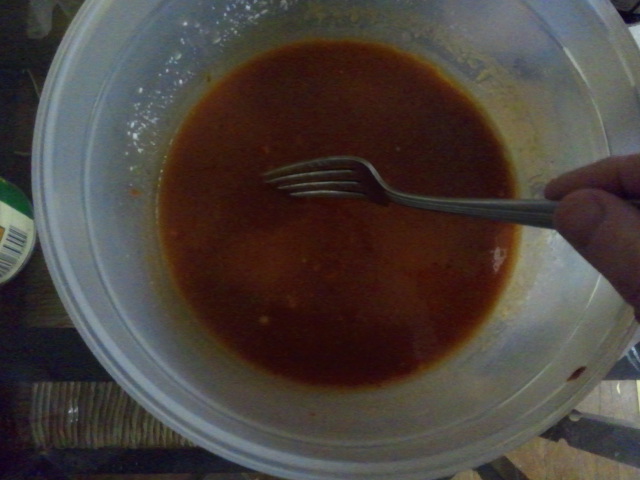

Mix together in a bowl and set aside.


And mix salt and pepper into the massive amount of cornstarch.  You will coat the chicken in this.,


Heat your oil in a wok until at deep frying temperature


To prepare your marinated chicken for frying, plop each piece in the cornstarch mixture...


...and shake off the excess.


Fry several at a time for about five minutes, turning once.


Drain on a paper towel.


When done frying, reserve the oil (okay, dump it somewhere to cool down until you can just dispose of it), wipe out the wok and quickly fry your chiles and garlic in oil.


Add your sauce for a minute or so...


...and then your chicken to coat.


I added the broccoli bits until no longer frozen (I did also nuke it in the microwave to expedite the process).  Serve with scallions and rice.


Granted, the next time I may just be lazy and buy it ready-made.  Still, now I can make General Tso's tasty chicken at home.  It wasn't as sweet as I'm used to, but I've actually found orange chicken to be the really sweet one.  When I order Chinese I usually go back and forth between orange and General Tso's chicken.  What's good about this one is that it isn't stringy and all "mystery meat"-ish like the kind you sometimes buy at a Chinese take-out place.  It's tender, somewhat crispy (less so when you reheat it - pop it in the oven and not the microwave if you are concerned about that), and just sweet enough.  Plus, it's satisfying to know that you made it yourself without opening a packet of seasoning or a big-ass can labeled "Chun King".

- - - - -

Well, this feels pretty strange, y'all, but the next State-by-State post is it - THE LAST one!  I thought for a while about how to sum this up.  Unlike my Beltway Snacking series a few years ago, where I wrote a long summary, for this I'm just making an all-American meal instead.  Next week you will find out what it is, but more importantly who wrote the recipe: the most quintessentially American of chefs herself.

Also: as noted yesterday, look at the blog on Tuesday morning (February 26).  I have a big announcement to make about what I'm up to next, now that this State-by-State series is fast approaching its end.

Sources:

Kuan, Diana.  "General Tso's Chicken".  Appetite for China, posted August 30, 2011.

Lee, Jennifer 8.  The Fortune Cookie Chronicles: Adventures in the World of Chinese Food.  Twelve Books: New York, 2008.

Some information also obtained from the Food Timeline State Foods webpage.

Wednesday, September 05, 2012

Snacking State-by-State: Tennessee II - Fryin' Hot Hot Hot

With fried chicken such a ubiquitous part of American cooking in general, and Southern cooking in particular, I am surprised I haven't made more of it.  I did investigate my own home state's legendary Maryland fried chicken with its cream gravy.  But one variation on the fried chicken theme I was hitherto unfamiliar with was something unique not just to Tennessee, but specifically to Music City itself.  Nashville is ground zero for hot, hot fried chicken.

Official Name: State of Tennessee
State Nickname: The Volunteer State
Admission to the US: June 1, 1796 (#16)
Capital: Nashville (2nd largest, but is the largest metropolitan area)
Other Important Cities: Memphis (largest), Knoxville (3rd largest), Chattanooga (4th largest)
Region: South, Middle South or Mid-South; East Central South (US Census)
RAFT Nations: Cornbread & BBQ; Chestnut
Bordered by: North Carolina (east), Mississippi, Alabama & Georgia (south), Arkansas, Missouri & the Mississippi River (west), Kentucky (north), Virginia (northeast)
Official State Foods and Edible Things: bobwhite quail (game bird); channel catfish (commercial fish); Eastern box turtle (reptile); honeybee (agricultural insect, for the honey); raccoon (wild animal); smallmouth bass or bronzeback (sport fish); tomato (fruit - no, not vegetable)
Some Famous and Typical Foods: Southern foods, including fried chicken, cornbread and so on; Memphis style barbecue (both dry and wet); hot chicken (particular to Nashville); smoked hams; ham and red-eye gravy; Appalachian foods (Brunswick stew, stack cake, etc); anything eaten by Elvis (sure, not many Tennesseeans eat fried peanut butter and banana sandwiches, but "the King" would want me to mention it, no?)

Hot chicken is a Nashville specialty, along with the "meat and three sides" combination popular all over Music City restaurants.  But hot chicken is one of Nashville's native recipes, showcased in one of the (literally) hottest food festivals in America.  Kim Severson in the New York Times (2012) gives its very simple description in a piece about the Nashville food scene:
The latter comes in the form of hot chicken, a dish unique to Nashville, made in cast-iron pans in the back of cinder-block buildings and strip-mall storefronts where cooks fry big pieces of cayenne-coated chicken, sometimes infusing even the oil itself with pepper. You eat the dish with white bread and pickle slices. It is ecstasy and torture, a culinary expression of the pleasure-pain principle. [Severson 2012]
The place best known for hot chicken in Nashville is Prince's Hot Chicken Shack, a family run business currently owned and operated by André Prince Jeffries.  His great uncle Thornton founded the business, and according to legend his girlfriend got so tired of his womanizing that she cooked up a special, extra spicy version of fried chicken to teach him a lesson.  It backfired, though I don't think the Prince family minds since it has brought them fame throughout the city (For more info see Malcom Bedell's post on Nashville Hot Chicken [2012] from his Maine-based Far Away blog.  I bet he was on vacation in Nashville.  I wish I had seen his blog when I was looking at Maine, but oh well).

Many hot chicken experts in Nashville will swear that the heat is added before the frying, never after.  However, the recent award-winning hot chicken recipe from the aforementioned Hot Chicken Festival breaks that very rule.  A few years ago, the Nashville Scene website [2008] wrote Justin Jones, whose recipe was crowned 2008's best hot chicken in the city, asking for the recipe.  To their surprise, he sent it!   Jim Ridley writes for Nashville Scene
A few considerations. First, we haven't tried it for ourselves (but O my readers and only friends, you can bet we will). Second, this is not the Prince's recipe, and Justin makes no claim that it is. Third, it's bound to cause some controversy on one front: all the heat is added after the chicken is cooked.e-winning-hot-chicken-recipe [Ridley 2008; author's emphasis]
Nashville Scene even got a nice letter from Jones about his version, which is heated up through a thick paste that is about 3 parts cayenne to 1 part lard.  Jones concludes his letter (the complete version is available on the Nashville Scene website) with a paean to Nashville hot chicken:
I offer this recipe to the city of Nashville as our best available weapon against the tide of ignorance, our best chance to vanquish the timid, the half-hearted, and the destroyers who would bastardize the delicacy we love. For anyone who has ever attempted to recreate Hot Chicken in his or her kitchen, this is my contribution to the solution of that mystery; I do not claim that it is the answer to all of our questions, but I do believe that it is at least a good start. It is offered also as a challenge, with the understanding that whoever undertakes it will improve upon it. I hope any worthwhile improvements will be shared with me. [Jones, in Ridley 2008]
I use Jones' recipe for my attempt at hot chicken below, with one change: since I had no lard on hand, and was not keen on using Crisco, I grabbed the closest thing I could find to fill in: bacon grease.

The Recipe: Nashville Hot Chicken (done in an unconventional fashion by Justin Jones of Nashville, Tennessee)

For Justin's Hot Chicken, I assembled the following:


Justin gives no directions for frying up chicken, which really you should know how to do already.  So I just made a simple shake and bake fried chicken using flour (bread flour in this case), cornmeal and, of course, Old Bay.

* I went lazy and just got a few whole chicken legs, about $3 per lb at Whole Foods (I felt like the quality stuff this time).

For Justin's "not-Prince's" hot chicken spicy paste, assemble the following:


* cayenne pepper (I needed 3 tablespoons, or 1/8 cup, of this)
* lard (or if you don't have this on hand, bacon grease - it's the closest flavor to lard that I had in my kitchen, plus I like bacon grease.  Only 1 2/3 tablespoons of this)
* salt, sugar and garlic powder
* It's also handy to have a pastry brush on hand to brush on this hot chicken paste.

To get as close to the real thing as possible, make sure to have plain white bread and pickle chips on hand.

First, heat up your oil for frying the chicken.


I mixed my cornmeal, flour and Old Bay in a ziploc bag...


...and threw in the chicken.


Shake away...


...and fry up for about 20 minutes, turning once.


Meanwhile, make the hot chicken paste: put your fat in a bowl.


Smother it in cayenne pepper and the other dry ingredients.


Mix it all together.  You will be brushing this on your chicken once it's done.


Mmmm, the smell of someone fryin' chicken.


Drain the chicken and prepare to kick up the heat.


Take a boring old piece of plain white bread.  This thing won't know what hit it in a minute.


Put a piece of chicken on it, and brush each side of the chicken with the hot chicken paste.


Stab it with a toothpick and spear some pickle chips on it.  Eat and sweat away.


He wasn't fooling around with this stuff: this is hot. But hot in such a great way!  I swear my tongue was burning for a good 10 minutes after I finished eating, and I had to keep a few paper towels around: one to wipe my hands, one to blow my nose (that happens when I eat very hot food), and one to wipe the sweat off my brow.  And was it worth it?  Hells to the yeah, it was!  Many commenters at Nashville Scene say that this tastes very much like Prince's, although they acknowledge that this is not how Prince's makes its hot chicken.  But the paste does a beautiful job of heating the chicken, and creates the grease that had not started sopping into the bread all that much when I took this photo.  By the time I was done, I couldn't find the bread.  It was just a dark red blob of bready goodness smooshed somewhere into the middle of the plate.

Sources:

Bedell, Malcolm.  "Nashville Hot Chicken". Far Away: Cooking and Eating in Maine, posted April 3, 2012.  Copyright 2010-2012, FromAway.com  All rights reserved.

Jones, Justin.  Personal correspondence to Nashville Scene website.  Published in "Bites Exclusive: Winning Hot Chicken Recipe!" by Jim Ridley, Nashville Scene, posted July 31, 2008. Copyright 1995-2012, City Press LLC.  All rights reserved.

Neely, Gina, and Patrick Neely, with Paula Disbrowe.  Down Home with the Neelys: A Southern Family Cookbook.  Alfred A. Knopf: New York, NY, 2009.

Raichlen, Steve.  "Memphis Dry Rub Ribs".  Food & Wine Magazine website, 2012.  Copyright 1997 - 2012, American Express Publishing Corporation. All rights reserved.

Ridley, Jim.  "Bites Exclusive: Winning Hot Chicken Recipe!" Nashville Scene, posted July 31, 2008. Copyright 1995-2012 City Press LLC.  All rights reserved.

Severson, Kim.  "Nashville’s Rising Stars: The Kitchen Is Their Studio" New York Times, published June 18, 2012.

Smithsonian Center for Folklife and Cultural Heritage.  "Appalachian Foods".  From "Appalachia: Heritage and Harmony" Resources Page for the 2003 Smithsonian Folklife Festival, 2003.  Copyright 2003 by the Smithsonian Instution.

Tennessee Gen Web (TNGenWeb.com). "Stack Cake".  From "The Table of Our Ancestors, Old Time Southern Recipes".  Family recipe from the family of Hilda Marsh, Knoxville, TN.  Date unknown.

Some information also obtained from Wikipedia's "Tennessee" page and other pages, and the Food Timeline State Foods link to "Tennessee".

Wednesday, August 31, 2011

Snacking State-by-State: Maryland II - Finger Lickin' Good, with Gravy

My late Great Great Aunt Florence had a few recipes for crab cakes, as I discussed in the previous Maryland post.  She also had a recipe for "Southern Fried Chicken" which reads an awful lot like another classic Maryland recipe: chicken, fried in a covered pan.

Official Name: State of Maryland
State Nicknames: The Free State; The Old Line State; America in Miniature
Admission to the US: April 28, 1788 (#7)
Capital:
Annapolis (24th largest city)
Other Important Cities: Baltimore (largest); Columbia (2nd largest); Germantown (3rd largest); Frederick (8th largest)
Region:
Mid-Atlantic, South, Northeast; South Atlantic (US Census)
RAFT Nations: Crabcake; Clambake; Chestnut; Maple Syrup
Bordered by:
The Mason-Dixon Line (north and east); Pennsylvania (north); Delaware and the Atlantic Ocean (east), Virginia and the Potomac River (south and southwest); District of Columbia (southwest); West Virginia (west and southwest)
Official State Foods and Edible Things: blue crab (crustacean); rockfish, aka striped bass (fish); Diamondback terrapin (reptile); Smith Island cake (dessert); milk (drink)
Some Famous & Typical Foods: Chesapeake Bay foods, especially based on blue crab, oyster, clam, shrimp & fish; historically, foods of the Upper South (especially fried chicken, stuffed ham, beaten biscuits & Brunswick stew); cuisines that reflect a broad multicultural landscape closer to Baltimore (Italian, Polish, Ukranian, German, etc) and Washington (Latin American, West African, Southeast Asian, Korean, etc)

Fried chicken is a classic Southern dish that has spread all over the country and the world.  It was poverty food, as poor Southerners rarely had access to any more expensive meats than the chickens they grew themselves.  As Mobile, Alabama native Eugene Walter pointed out in the Time-Life Book American Cooking: Southern Style (from the classic Foods of the World series, available in many thrift stores if you look in the right ones), fried chicken is perhaps the iconic Southern dish
In Maryland - as throughout the South - the great classic dish is, of course, fried chicken.  Southern fried chicken is such a byword that it produces a conditioned reflex: mention it and the mouth waters and Pavlov's ghost smiles.  It probably comes as close to being the ideal all-purpose, all-occasion dish as anything in this country...

Any attempt to prescribe the best way to prepare fried chicken is likely to start the Civil War all over again, or it may, at best, lead into a storm of prolonged arguments, widely diverse local and even neighborhood differences, not to say family bickerings.  [Walter 1971: 34-35]
Among the many variations - Walter lists Maryland fried chicken, Kentucky fried chicken, oven-fried chicken, and the generic "Southern fried chicken" for example - is the shake and bake variety from the Middle South: soak it in buttermilk, put it in a flour mixture in a bag and shake it until coated, then dip it in cream and then flour again, and then fry.  Maryland fried chicken stops with the first shaking, but then gets fried in hot oil in a covered pan.  It is then served with a cream gravy.  This gravy, according to John Shields, is what truly makes it "Maryland fried chicken".

Mind you, passing through the Southeast on your way to Florida many a weary traveler may come across a "Maryland Fried Chicken" restaurant.  This is not the same thing, and to be honest I am not exactly sure why they call it this since the franchise was made popular by Delaware native Albert Constantine.  There are none in Maryland - most of the franchises are in Florida and South Carolina.  From what I understand it is tasty chicken.  It just isn't what Maryland based cooks mean when they say "Maryland fried chicken".

Also note that if you are researching "fried chicken" on Wikipedia, they get the definition of "Maryland fried chicken" wrong.  It is not characteristically baked in the oven.  I don't know where they got that info.  Maybe they should just take a cue from John Shields himself, who in June appeared on WYPR's Midday with Dan Rodricks show with Foodnerd blogger and City Paper writer Henry Hong, for a "fried chicken contest" (link to the MP3 of the broadcast here).  For this installment of Maryland cooking, and for my first of a few fried chicken recipes over the next year, I am delving into my well-worn copy of Chesapeake Bay Cooking for a taste of Shields' Maryland fried chicken - or as he titles it, "Maryland Panfried Chicken" (for the recipe, see pages 131 and 132 of Chesapeake Bay Cooking)

Recipe: Maryland Panfried Chicken with Cream Gravy
 

For Maryland fried chicken you will need the following:


* one 3 to 4 lb chicken, cut up (or just cut it up yourself - don't know how?  There are many great videos on YouTube and more than a few tutorials online)
* buttermilk (this is what Eugene Walter says is iconic of the Middle South, which is farther south than Maryland.  You will need one whole quart)
* fresh garlic, chopped
* salt and pepper to taste (for the marinade and shake-and-bake)
* a lemon
* Old Bay (you will need this for both the marinade and the shake-and-bake)
* Tabasco sauce
* flour (this is the basis of the coating, and part of the roux for the cream gravy)
* thyme, cayenne pepper and rubbed sage (I could only find ground sage, but this works)
* milk (you will need this for the cream gravy at the end)
* oil (and lard - plan on using one whole bottle of oil.  You aren't sautéing the bird after all.  Shields recommends adding three parts oil to one part lard for flavor if you like.  I added a few spoonfuls of lard.  Maybe I should have added more?)

The process has a few steps, and takes a while, but it isn't terribly complicated.  If you haven't cut up your chicken, you might want to go ahead and do that before this next step. Skin on, please.  This isn't going to be healthy no matter what you do so just go all in.

 Prepare the marinade: start with your buttermilk...

Next add your other marinade ingredient: the Old Bay, Tabasco, garlic, salt, pepper...

 ...and lemon juice.

Pour over the chicken pieces and marinade overnight.  At first I was going to be my typical impatient self, but eventually I just let it marinate overnight.

It ended up marinating for a whole day.  I go to extremes.

After your chicken is finished marinating, prepare the shake and bake: mix flour, Old Bay, salt, pepper and your dry spices.

Transfer the mixture to a strong paper bag or sealable plastic bag and get ready to shake it.

 Dip each piece of chicken into the bag - a few at a time works - and seal and shake the bag.

Make sure you have your oil (and lard?) heating up until it is at deep frying temperature.

Place a few at a time into the hot oil.  Shields warns not to crowd the pan.

I crowded the pan.  It still turned out in the end.  Turn your pieces until browned, and then...

Cover with a lid.  The only lid I could find that would cover my 12" cast iron skillet was the lid to my crab pot.

Occasionally turn, and after 20 to 25 minutes you will have pan fried chicken.

But wait - that's not all!  What makes it Maryland fried chicken is the gravy, which you will make while the fried chicken is draining.

For the gravy, you will need flour, milk, salt and pepper and about 1/8 cup of the oil from the pan.

Make a roux from the drippings and the flour

Then add the salt, pepper and milk, and whisk for several minutes until thick.  It will thicken well after a while.


I must confess: this isn't the first time I have made this.  It is the first time I have made this successfully.  Rewind to California about 8 or 9 years ago.  A homesick Marylander invites some friends over for some fried chicken, and I decide to go all Maryland on them.  I didn't bother to cover the pan, since I didn't have a lid that would fit, so I left it out.  The result was not terribly crispy.  Fast forward to now: I actually follow John Shields' directions, and lo and behold: crispy chicken that is moist in the middle!  The coating is not typically salty like many fried chickens you will order out, and the coating stays crispy.  Even when you reheat it, the coating is still somewhat crispy (even if not as crispy as when you took it out of the pan).  The chicken is tender, and the gravy adds just enough salt to the chicken.  All in all, a worthy recipe to undertake.  Shields recommends serving this with mashed potatoes and greens - a fine way to accompany this lovely dish. 

Sources:

"Crab Cakes".  Recipe from the author's family.

Fowora, Simbo.  "Jollof Rice".  Featured on the episode "Nigerian Dinner" of the show Sara's Secrets (Sara Moulton, host).  Food Network, 2006.

Gibbon, Ed.  The Congo Cookbook.  1999-2009.  Available as a downloadable book from lulu.com and reprinted on the website http://www.congocookbook.com.

Hafner, Dorinda.  A Taste of Africa.  Ten Speed Press: Berkeley, CA, 1993.

Kitching, Frances.  "Smith Island Ten-Layer Cake-Mrs. Kitching's Original Recipe". Reprinted on the "Fun Stuff" page at the website VisitSomerset.com (website for Somerset County, Maryland).  2007-2010 Somerset County Tourism.

Shields, John. Chesapeake Bay Cooking. Broadway Books: New York, NY, 1998

Shields, John. "Foreward".  In Dishing Up Maryland by Lucie Snodgrass.  Storey Publishing: North Adams, MA, 2010.

Snodgrass, Lucie.  Dishing Up Maryland.  Storey Publishing: North Adams, MA, 2010.

Walter, Eugene.  American Cooking: Southern Style.  From the series Foods of the World.  Time-Life Publications: New York, NY, 1971

Some information also obtained from Wikipedia's "Maryland" page and other pages, and the Food Timeline State Foods link to "Maryland".