Sunday, October 30, 2011

Snacking State-by-State: Mississippi III - The War Between the States, Installment I

As most US history buffs know by now, we are in the 150th anniversary of the Civil War.  On a very related tangent to this State-by-State project, I will save two recipes in this series to recipes from the Civil War.  The latter, Yankified one will come when we cross back over the Potomac and traverse the Mason-Dixon.  The first is more of the Secesh variety.

Official Name: State of Mississippi
State Nicknames: The Magnolia State; The Hospitality State
Admission to the US: December 10, 1817 (#20)
Capital: Jackson (largest)
Other Important Cities: Gulfport (2nd largest); Biloxi (5th largest), Tupelo (7th largest)
Region:
 South, Deep South, Gulf Coast; East South Central (US Census)
RAFT NationsCorn Bread & BBQGumbo
Bordered by:
 Tennessee (north); Alabama (east); Gulf Coast (south); Louisiana (southwest); Arkansas (northwest); the Mississippi River (west)
Official State Foods and Edible Things: white-tailed deer (land mammal); wood duck (waterfowl); largemouth/black bass (fish); honeybee (insect - the honey is what you eat, of course); oyster (shell - again, you eat what lives inside it)
Some Famous and Typical Foods: typical Southern foods, with Cajun foods (gumbo, étouffée, etc) in the southern part of the state; seafood along the Mississippi River and the Gulf Coast (especially crawfish, shrimp, oyster and blue crab)

There are so many websites with Civil War era recipes, from hoe cakes to hard tack and so much more (check out the Civil War Interactive website for more recipes from the War and the era).  In his cookbook A Gracious Plenty, John T. Edge lists among the first recipes an easy dish that works today as a Civil War-era hors d'oeuvre.  Edge quotes Bethany Ewald Bultman, who provided the recipe to the recipe collection Cook with a Natchez Native, who says that she found the recipe in an 1873 Natchez, MS, cookbook:
"...handwritten in the margin [next to the recipe] was 'It got us through the WAR'.  it didn't say which war." [Edge 1999: 13]
The recipe: Confederates on Horseback


* oysters (pre-shucked or not - it's cheaper for me to buy them unshucked.  All of the local oysters at Wegman's were from the Chesapeake - yay!  I got some Chincoteague oysters: briny and strong but still delicious, each for 99¢.  One died on the way home so I had three to shuck.)
* slices of bread (one for each oyster)
* slices of bacon (again, one for each oyster.  I was out of bacon but instead of buying a whole package, I went ahead and had them slice some bacon at the deli counter.  Yes, Wegman's has its very own charcuterie section.  I got a 1/5 pound for about $1.50, which wound up being much cheaper than buying a whole pound)
* butter (unsalted, to spread on the bread)
* horseradish (to spread on the bacon.  The recipe as reprinted by John T Edge calls for anchovy paste, though other, perhaps more modernized versions call for either anchovy paste or horseradish.  I only had one of those on hand.)

Preheat your oven to 400°F and proceed with the recipe below.


Cut each slice of bread into rounds - a cookie cutter or glass will work wonders with this step.


Lightly toast the rounds of bread.


Next, shuck those oysters.  The guy at the fish counter wasn't kidding: these Chincoteagues are strong.  I mean that in two ways: by the briny smell, and by the way they simply refused to let me pry them open.  That last part is strange, considering that it was relatively easy to find an opening into these oysters to shuck them, but once I did, they hung the hell on.


Butter each toasted round of bread and set aside.


Next, take each slice of bacon - raw - and spread it with the horseradish or anchovy paste.  Note: I liked this ready sliced bacon.  It was not stringy or extra slippery like the bacon I usually get from the sealed packages. Since I don't eat a whole lot of bacon all at once, I think I may buy bacon like this more often: a few slices here or there as needed, unless I'm in need for a whole bunch of bacon grease all at once.


Wrap each oyster up in a slice of bacon.


Secure each oyster with a toothpick, unless you're like me and only have multicolored plastic toothpicks, that will melt in the oven and make your oysters taste funny, on hand.


Bake for five to eight minutes in your 400° oven, and then place each oyster-bacon-horseradish thing on its own round of buttered toast.


This is such a ridiculously easy thing to make, and certainly Chesapeake cooks have thought of this at some point (maybe even called it "Confederates on Horseback" for all I know).  It's best to bite enough of the bread so that you get the entire oyster in your mouth, otherwise it will squish all over.  Next time, maybe I will try it with anchovy paste?

- - - - -

Why do so many states along the Mississippi River follow each other in alphabetical order?  Minnesota.  Mississippi.  Missouri.  Hold up!  That's where the next few State posts take us: to the land of Kansas City BBQ, St. Louis' own gooey butter cakes, and more strange sandwiches.

Sources:

Civil War Interactive & Blue Gray Daily.  "Welcome to the Civil War Interactive Cookbook: Articles and Recipes for your 19th Century Cooking", date of publication unknown.  Copyright 2011 Civil War Interactive.

Edge, John T. A Gracious Plenty: Recipes and Recollections from the American South. An Ellen Rolfes Book. For the Center for the Study of Southern Culture at the University of Mississippi. G. P. Putnam's Sons: New York, 1999.

Jackson, Irvin.  "Biloxi Bay Potato Salad".  Mississippi Department of Marine Resources (recipe card) copyright Mississippi Department of Marine Resources, 2011.  Also published in Mississippi Seafood Recipes by the Mississippi Department of Marine Resources, copyright Mississippi Department of Marine Resources, 2003.

Wilson, Charles Reagan. "Introduction: The South: Who, Where, and What's for Dinner".  In A Gracious Plenty: Recipes and Recollections from the American South by John T. Edge. An Ellen Rolfes Book. For the Center for the Study of Southern Culture at the University of Mississippi. G. P. Putnam's Sons: New York, 1999.

Some information also obtained from Wikipedia's "Mississippi" page and other pages, and the Food Timeline State Foods link to "Mississippi".
Friday, October 28, 2011

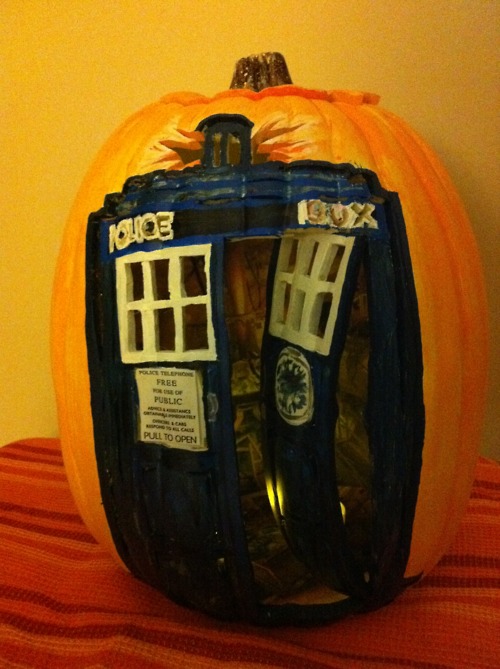
But is it bigger on the inside?

This from Marissa Brassfield at Foodista: the TARDIS O'Lantern (image from imgfave):


This is just awesome!

Thursday, October 27, 2011

Snacking State-by-State: Mississippi II - A potato salad fit for a shrimp

When we think of the Gulf Coast, we think of seafood.  Though Louisiana and Florida usually get the lion's share of the nation's attention when it comes to Gulf oysters, crabs, crawfish and shrimp we would be remiss to leave out the marine resources right off the coast of Gulfport and Biloxi.


Official Name: State of Mississippi
State Nicknames: The Magnolia State; The Hospitality State
Admission to the US: December 10, 1817 (#20)
Capital: Jackson (largest)
Other Important Cities: Gulfport (2nd largest); Biloxi (5th largest), Tupelo (7th largest)
Region:
 South, Deep South, Gulf Coast; East South Central (US Census)
RAFT NationsCorn Bread & BBQGumbo
Bordered by:
 Tennessee (north); Alabama (east); Gulf Coast (south); Louisiana (southwest); Arkansas (northwest); the Mississippi River (west)
Official State Foods and Edible Things: white-tailed deer (land mammal); wood duck (waterfowl); largemouth/black bass (fish); honeybee (insect - the honey is what you eat, of course); oyster (shell - again, you eat what lives inside it)
Some Famous and Typical Foods: typical Southern foods, with Cajun foods (gumbo, étouffée, etc) in the southern part of the state; seafood along the Mississippi River and the Gulf Coast (especially crawfish, shrimp, oyster and blue crab)

The Mississippi Department of Marine Resources has made it incredibly easy to find recipes to choose from when exploring Magnolia State seafood.  They've done this through a line of cookbooks, all completely available for free on their website, from their 2010 Mississippi Seafood Cookoff Cookbook (we have such things here too) to books of recipes for shrimp, oysters and even southern Mississippi-specific recipes, for that more Cajun-flavored part of the state.   I must add that the MS DMR didn't make choosing a recipe all that easy.  There were just too many tempting ones to choose from.  But I finally settled on a simple but delicious Southern potato salad, accentuated with Gulf shrimp throughout.

The recipe: Biloxi Bay Potato Salad

Irvin Jackson, Directorate of the Mississippi Department of Marine Resources, provides the recipe that I ended up making.  It's in the "Shrimp" section of their 2005 "Mississippi Seafood Recipes" cookbook (no page numbers, but it helps to know that the same recipe is featured on cards 3 and 4 of their Shrimp Recipe Cards, with a helpful photo of the dish on card 3).  Once you assemble everything, putting it all together is pretty simple.


* potatoes (any potato salad needs potatoes - in this case half of a $5 quart of spuds from the I-83 farmers' market)
* shrimp (Rock shrimp from the Gulf - these were about $14 per lb.  I got half a pound)
* green onions and celery (about $3 total - you will need them raw)
* eggs (hard boiled)
* sweet relish (a little more than a dollar)
* yellow mustard (had it)
* salad dressing (I just used mayonnaise - many a Southern potato salad is coated with mustard and mayo.  Since Hurricane Irene took my previous jar of mayonnaise, I needed a new one.  In this case, I splurged on a jar of Duke's Mayonnaise, that Richmond-based classic and favorite of Southern cooks for almost a century)
* Cajun seasoning (or in lieu of that, Old Bay, which is also quite popular throughout the South)


You will need to boil three things: the potatoes, the eggs and the shrimp.


Yes, we prefer to steam those shrimp here, but that's not how they do it in Mississippi, and since this is a Mississippi recipe I figured I would stick with the spirit of their shrimp.  A quick way to do it is to follow the instructions for steaming shrimp that you find on the side of the Old Bay can, only with enough water to boil it.


Boil, peel and cut up the potatoes, and mix them with the chopped green onions and celery.


Mix into the veggies the boiled shrimp, sliced eggs, relish, mustard, mayo and Old Bay.  And that's pretty much all you need to do.


Like the Mississippi mud cake, this shrimp filled potato salad was quite easy to make - a running theme in these specific Mississippi recipes I chose, it seems.  Add salt, Old Bay and Cajun seasonings to taste (I like mine slightly saltier than this) and serve with just about anything, or eat it on its own.  It's substantial enough after all.

Sources:

Civil War Interactive & Blue Gray Daily.  "Welcome to the Civil War Interactive Cookbook: Articles and Recipes for your 19th Century Cooking", date of publication unknown.  Copyright 2011 Civil War Interactive.

Edge, John T. A Gracious Plenty: Recipes and Recollections from the American South. An Ellen Rolfes Book. For the Center for the Study of Southern Culture at the University of Mississippi. G. P. Putnam's Sons: New York, 1999.

Jackson, Irvin.  "Biloxi Bay Potato Salad".  Mississippi Department of Marine Resources (recipe card) copyright Mississippi Department of Marine Resources, 2011.  Also published in Mississippi Seafood Recipes by the Mississippi Department of Marine Resources, copyright Mississippi Department of Marine Resources, 2003.

Wilson, Charles Reagan. "Introduction: The South: Who, Where, and What's for Dinner".  In A Gracious Plenty: Recipes and Recollections from the American South by John T. Edge. An Ellen Rolfes Book. For the Center for the Study of Southern Culture at the University of Mississippi. G. P. Putnam's Sons: New York, 1999.

Some information also obtained from Wikipedia's "Mississippi" page and other pages, and the Food Timeline State Foods link to "Mississippi".

Tuesday, October 25, 2011

Using a can to boost your wifi

This from Discovery.com: I have to try this.  I totally admit that I don't enjoy the taste of canned beer (bottles for me please).  But I have a few soda cans in the recycling bin.  And when I fish one out I must let blog author Jerry James Stone (Twitter: @jerryjamesstoneknow how it worked.

Sunday, October 23, 2011

Snacking State-by-State: Mississippi I - Thick like Mississippi mud...

Heading down the length of the Mississippi River from Minnesota, we slog through the Mississippi mud to hit the Gulf Coast at the other end.  Food wise, it doesn't really get much more Southern than this.

Official Name: State of Mississippi
State Nicknames: The Magnolia State; The Hospitality State
Admission to the US: December 10, 1817 (#20)
Capital: Jackson (largest)
Other Important Cities: Gulfport (2nd largest); Biloxi (5th largest), Tupelo (7th largest)
Region:
 South, Deep South, Gulf Coast; East South Central (US Census)
RAFT NationsCorn Bread & BBQGumbo
Bordered by:
 Tennessee (north); Alabama (east); Gulf Coast (south); Louisiana (southwest); Arkansas (northwest); the Mississippi River (west)
Official State Foods and Edible Things: white-tailed deer (land mammal); wood duck (waterfowl); largemouth/black bass (fish); honeybee (insect - the honey is what you eat, of course); oyster (shell - again, you eat what lives inside it)
Some Famous and Typical Foods: typical Southern foods, with Cajun foods (gumbo, étouffée, etc) in the southern part of the state; seafood along the Mississippi River and the Gulf Coast (especially crawfish, shrimp, oyster and blue crab)

Foodwise, Mississippi has a lot to claim on the culinary landscape.  Like much of the Deep South, its influences are both standard Southern foods and, in the southern part of the state, Cajun foods.  Seafood is also important here, as is seen in the many fish and shellfish dishes from the state.  It is also important to note that Mississippi is home to some of the South's most notable chefs and food writers: Iron Chef Cat Cora (Jackson), cookbook author and sometimes Atlantic food blogger Regina Charbonneau (Natchez), the late Craig Claiborne (Sunflower) and John T. Edge (Oxford), food writer, scholar and member of the Southern Foodways Alliance.

Edge is notable for his many writings on food around the country, including many books, among them compendia on various American classics: fried chicken, apple pie, donuts and hamburgers.  He is also author of the authoritative Southern cookbook A Gracious Plenty.  This book collects typically Southern recipes from all over the proper South.  The book tackles exactly what the South and its foods are, and notes the varieties of definitions, opinions and experiences, as Charles Reagan Wilson notes in his Introduction to Edge's A Gracious Plenty:
...[C]elebrating the [South's] foodways became a way to express Southern pride.  Woe to the non-Southerner who would disparage grits or collards.  Not everyone who lives in the South today, though, has a self-identity as a Southerner.  American homogenization has blurred regional boundaries, through national networks of communication, transportation, and consumer marketing... [Yet] Southerners continue to nurture their sense of Southernness through festivals, sporting events, popular culture, and even political attitudes. [Wilson, in Edge 2000: xvi]
Edge's compendium is a collection of recipes from various Southern community cookbooks.  Edge is a champion of the genre.  While community cookbooks are hardly confined below the Mason-Dixon Line, Edge suggests they are
as Southern as sweet tea.  They may get comparatively little critical respect, but they are much relied upon in Southern kitchens... 
...[W]e believe that the collected recipes reflect a greater Southern community, one that is neither black nor white, rich nor poor, but united in the love of good food and fellowship.  [Edge 2000: 3]
One classic Southern dessert, Mississippi mud pie/cake, comes more from the Mississippi River than Mississippi the state.  Still this recipe, originally from The Pastors Wives Cookbook from out of Memphis (and reprinted on pages 272 and 273 of Edge's A Gracious Plenty), certainly merits inclusion here.  If you do it right, as another famous Southern chef Nathalie Dupree once noted, "this cake should be cracked and dry-looking, like Mississippi mud in the hot, dry summer" (Edge 2000: 272).  Or at least Mississippi mud when it's covered in melted marshmallows.

The recipe: Mississippi Mud Cake

For this recipe - easier than the pie version since you don't need a crust - you will need:


For the cake part:
* butter (the recipe calls for margarine, but I don't have that and I've got a whole lot of butter laying around, so there's that.  Plus, why spend money when you don't need to?)
* eggs (a dozen for less than $2)
* cocoa (had it)
* granulated sugar (same)
* flour (Had it.  Use the soft kind if possible - here, White Lily)
* salt and vanilla (had them)
* mini marshmallows (about $2 at Harris Teeter.  I didn't realize they were so pricey)

For the frosting:
* more butter (again, the recipe calls for margarine)
* confectioner's sugar (a whole box)
* milk
* more cocoa powder


First make the cake.  You will cook together the butter, cocoa and sugar in a saucepan until melted together.


Add to this the flour and salt.


In a separate bowl, mix the eggs and vanilla, and then add to the saucepan.


Stir together everything over heat until mixed.


Pour the batter into a greased pan and bake at 350°F for about 30 minutes.


While the cake is baking, prepare the frosting by mixing the milk, melted butter, cocoa and granulated sugar.  No need to heat it.  Just mix it all up.


Keep mixing it.  You should do this about 10 minutes before you pull out the cake.


Once the cake is finished, start by spreading mini marshmallows on the top of the cake.


Follow the marshmallows up with the frosting.


Edge's source suggests that this dessert should look like the hot parched mud by the banks of the Mississippi. It certainly looks muddy (hence the name), but it doesn't taste it.  This is one of the easiest, messiest, gooiest cakes I have made in a long time.  Almost as sweet as the whoopie pies from Maine, and far more of a mess, I had to share this with people.  Thank God they ate most of it because I would've developed diabetes had I eaten the whole beautiful pan's worth of cake.

Sources:

Civil War Interactive & Blue Gray Daily.  "Welcome to the Civil War Interactive Cookbook: Articles and Recipes for your 19th Century Cooking", date of publication unknown.  Copyright 2011 Civil War Interactive.

Edge, John T. A Gracious Plenty: Recipes and Recollections from the American South. An Ellen Rolfes Book. For the Center for the Study of Southern Culture at the University of Mississippi. G. P. Putnam's Sons: New York, 1999.

Jackson, Irvin.  "Biloxi Bay Potato Salad".  Mississippi Department of Marine Resources (recipe card) copyright Mississippi Department of Marine Resources, 2011.  Also published in Mississippi Seafood Recipes by the Mississippi Department of Marine Resources, copyright Mississippi Department of Marine Resources, 2003.

Wilson, Charles Reagan. "Introduction: The South: Who, Where, and What's for Dinner".  In A Gracious Plenty: Recipes and Recollections from the American South by John T. Edge. An Ellen Rolfes Book. For the Center for the Study of Southern Culture at the University of Mississippi. G. P. Putnam's Sons: New York, 1999.

Some information also obtained from Wikipedia's "Mississippi" page and other pages, and the Food Timeline State Foods link to "Mississippi".

Saturday, October 22, 2011

Aunt Sandy is at it again, people.

Awake the Dormouse, folks, Sandra Lee is having a tea party.


When I find some video I will post it.

Photo from post by Charles Runnette at NewNowNext, via Oh No They Didn't.  Want a compilation of Aunt Sandy crazy?  Us Weekly catches us up.

Thursday, October 20, 2011

The Baltimore Dog

Many of you have eaten this, I know.


My mother made this all the time after a family trip to Attman's for hot dogs, corned beef, bologna and so on.  And it is ridiculously easy to make:

Take an all-beef (preferably kosher) hot dog and fry it - split it in half if it's a big one - and fry a slice of bologna (again, preferably kosher).

Wrap bologna around hot dog, stick in bun.  Serve with ketchup and/or mustard.

The Baltimore Dog seen here was a kosher (Hebrew National).  The bologna was not (Wegman's).  The result is simple and delicious.  Maybe bacon next time?  Of course, then that's the makings for a Tijuana Dog.

Wednesday, October 19, 2011

Snacking State-by-State Mashup 6: Surf and Turf Hotdish

The "hotdish" is better known outside of the Upper Midwest as the "casserole".  At least, that's the closest analogy I can make here in the Mid-Atlantic.  An excellent way to use up leftovers, Midwest Living has a bevy of "hotdish and casserole" recipes on its website.  Since this mashup is all about using up leftovers, and since I didn't really get to explore the hotdish for Minnesota, a hotdish sounded like a good idea.  Just don't throw everything into it all at once, like I did with my hotdish that was part Upper Midwest, part New England and part Chesapeake Bay.

The mashup recipe: Surf and Turf Hotdish


Makes 6 to 8 servings

Ingredients (state flag indicates State-by-State post where ingredient was featured. Ingredients with no flag were not specifically used for any one post.)


Hotdish:

1/2 lb beef, cubed

1/2 lb ground pork

1 cup wild rice

5 to 6 clams (or 1/2 can baby clams) chopped

1/2 cup blue crab meat (or 1/2 small or 1 large crab cake - in this case, uncooked)

1 to 2 small potatoes, cubed

1 to 2 carrots, sliced

1 onion, sliced or chopped

1/4 cup tomato paste (or more to your liking)

generous dash (or more) Old Bay

generous dash (or more) Tabasco sauce


generous dash (or more) Worcestershire sauce


Topping:


4 slices bread (or in this case, 2 slices bread plus......

1 hot dog roll)

1 small bunch fresh dill, stems removed

1/4 cup roasted peanuts, salted or unsalted


1 small bunch fresh parsley, stems removed


butter

Note: even though they appear in the photo, I ended up not using the morel mushrooms or heavy whipping cream.  I will save those for something else.


Mix your ingredients in a bowl.  No, I did not.  In retrospect I'm not sure why exactly, but I just didn't.  It will all mix together better if you do that.  That said, at least this way you can see what to add.  It doesn't really matter what order you add your ingredients.  But I started with the onion.


Then the ground pork.


I continued with the cubed beef...


And then the potatoes and carrots.


Then I added the crab cake (broken up) and clams.


Mix in the tomato paste.  No, I did not do that.  I was lazy.  Don't be lazy like I was.


Also add the wild rice.


And finally the condiments - the Worcestershire, the Old Bay, the Tabasco.


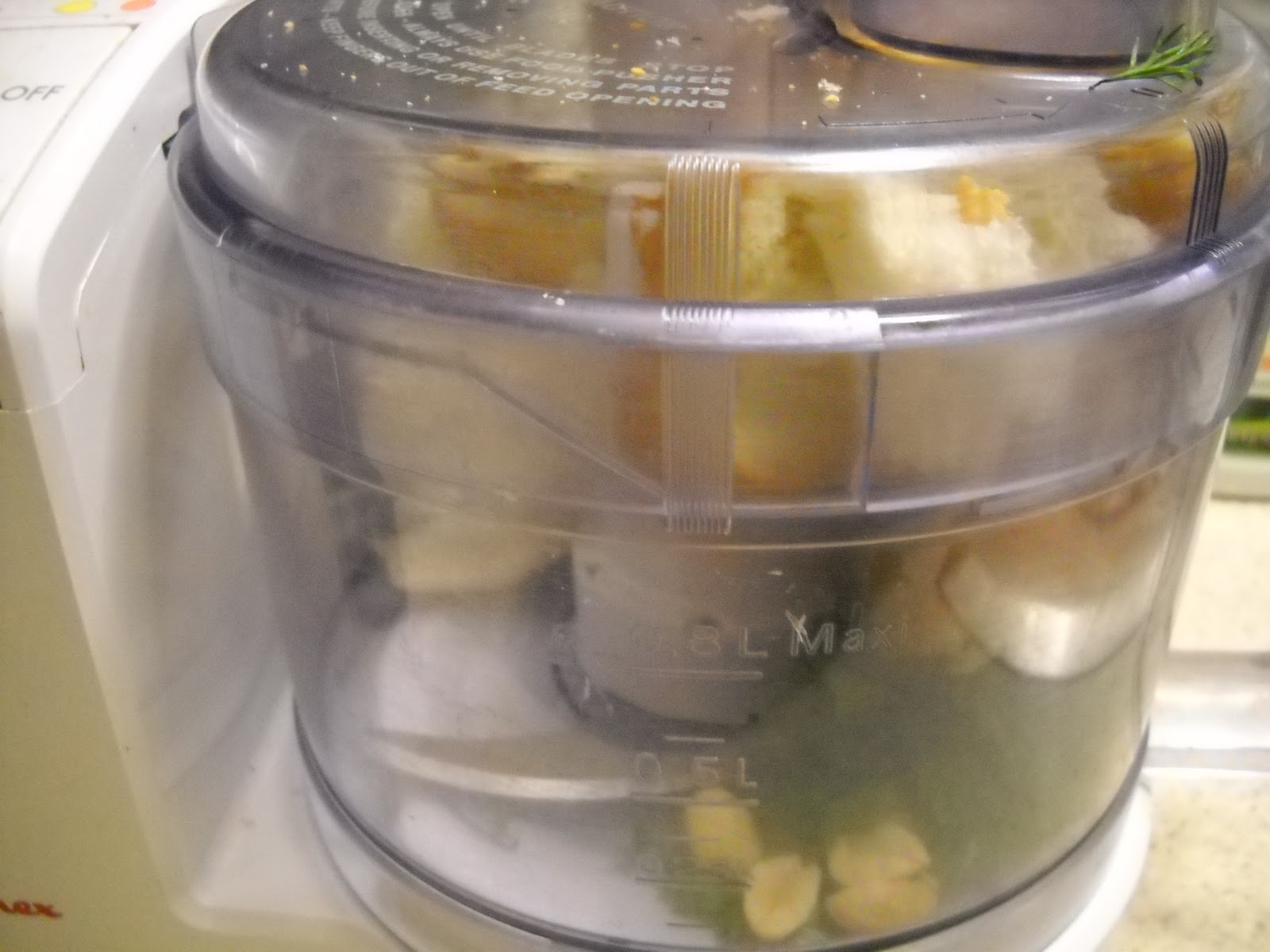
For your topping, throw fresh bread (and hot dog roll) in to the food processor with the peanuts and herbs.


Process until ground up into coarse crumbs.


Top the hotdish with the crumbs.


And dot with pieces of butter.


Bake in a 350°F oven for an hour (most hotdish recipes I saw called for that time and temperature.


This was a filling, hearty and I dare say slightly bland dish.  With every bite, I should have tasted pork and beef and crab and clam, instead of pork or beef or crab or clam.  My two mistakes in this dish were as follows: 1) mix the hotdish filling in a bowl instead of layering the ingredients in your casserole dish like I did - it will all mesh better together that way; 2) more Worcestershire sauce, more Old Bay and more Tabasco sauce!  Again, a little on the bland side.  But these Midwesterners sure know how to use up a bunch of leftovers with this "hotdish" recipe, that's for sure!  And I didn't even need any tater tots (which seems to be a popular filling for these type of dishes) - even Midwestern Senator Amy Klobuchar (D-MN) has her favorite recipe.