
I stuck a taro root that I got from H Mart into some potting soil & put it on my porch about a month and a half ago. Just in the last week, it's started shooting up.
This was completely non-existent a week ago:
Showing posts with label Papuan/New Guinean. Show all posts
Showing posts with label Papuan/New Guinean. Show all posts
Monday, June 07, 2010
Taro Update
Thursday, May 06, 2010
Food Ethnography on a Budget: Papua New Guinea II: Bava Bona Taro
My next foray into cooking it up Melanesian-style brings me, coincidentally, right to my own back door. As many people in Papua New Guinea rely on the surrounding seas for their food, fish, shrimp and crabs are common throughout the coasts and outside the highlands. We here in the Chesapeake are no stranger to crabs, of course, so a crab dish was unquestionable.
The dish: bava bona taro (crab with taro) There was just one little catch to Anne MacGregor's recipe in the Papua New Guinea Cookbook: the crabs in question needed to be boiled. Now, I have no problem with murdering crabs - I have steamed many a blue in my lifetime, and eaten many, many, many more victims of callinecticide (yup, made up my own word). But I cannot bring myself to boil a crab. They boil their seafood up in New England, and they boil their seafood down in the Deep South. But we do not do that to our crabs in the Chesapeake. It's just sacrilegious. So, instead of boiling my own crabs, I got 'em steamed for me - in the same Old Bay that they just do not have in Papua New Guinea - and picked the crabs instead.
The crabs are just one of many ingredients for this dish. I had to make a substitution here or there, and I had to do some multitasking in the kitchen in the process, as there are two parts of this recipe, a sort of crab and coconut milk stir-fry, and the mashed taro itself:
- Of course, the crabs were a vital part. That trip to Richard's Crabs in Churchville? That was for this project. I needed 2 large or 4 small crabs. Three females and a smallish male gave up their lives for this experiment (plus another small male, just because I was hungry). Again, Tuesdays is $1-$2 crab day at Richard's. Each female was a dollar, and each small male was half a dollar more. Total spent: $4.50.
 Of the other ingredients that went into this recipe, the pumpkin tops were difficult to find. The recipe calls for tomato, scallion (or as they call them in Oceania, shallots), coconut milk, and pumpkin tops. I truly have no idea what they mean by "pumpkin tops" but as far as plain old "pumpkins" go, in Australia and Oceania, pumpkins refer to any winter squash. I had an acorn squash lying around (paid about $1 for it) and just cut up and used half of that.
- Two Roma tomatoes went into the dish, about $1.50 per lb - or about 75¢ for the two.
- About three scallions, roughly 50¢ to $1 for those.
- One can of coconut milk, which set me back $1.50. It was cheaper and more hassle-free than buying and processing my own coconut meat (one coconut would run at least $3). Though the recipe calls for two coconuts, I did just fine with one coconut's worth of coconut milk - based on recipes for processing coconuts into milk, the ratio is roughly one coconut to one can of milk. I still bought a second just in case.
- And of course, there was the taro root. I had never worked with taro before. It's tough to find unless you go to H-Mart, where it is easy as anything to find. I bought three taro roots, which set me back about $1 at the very most.


The part I had the most trouble with turned out to be the taro. On the surface, it's quite easy to prepare: just boil, peel and mash. But once you start the prep work, you realize just how tough it really is. Fir st, you need to remove the hard, hairy fibers on the outside of the taro. You will not get all of them off. Just try to remove as many as possible.
 I'm gonna wash that hair right outta my taro
Next you can go one of two ways, either boil the taro until tender (about 30 minutes) or microwave it for about 4 to 5 minutes (this post from Just Hungry.com tells you how to nuke it effectively). I took the more conventional route and boiled it. Since I had also read that taro can be poisonous if undercooked, I wanted to take no chances, and cooked it longer than I probably should have. After boiling and peeling each taro root, I mashed it up and then nuked the slightly-purplish taro for about two minutes. The end result was a much drier product than I should have gotten. At least it wasn't slimy like taro can sometimes be.
 Mashed taro
The dryness of my overcooked taro was still adequately masked by the rich coconut milk, drenching the succulent crab, squash and tomato. This dish also goes well with rice, by the way. The one thing I was most concerned about was how the Old Bay from the steamed crabs might alter the taste. Surprisingly, the coconut milk overpowered the Old Bay, not viceversa. But after all, it's not like a dumped a whole cup of Old Bay into the stir fry. So don't be afraid to use steamed crabs instead of boiled ones like MacGregor's recipe calls for. They will work just fine. Of course.
 What's Tok Pisin for "Bon Appetit"?
 What's Tok Pisin for "Bon Appetit"?
Sunday, April 25, 2010
Food Ethnography on a Budget: Papua New Guinea I: Kaukau na painap
My next Food Ethnography takes me somewhere that few Americans have ever heard of - at least those who aren't anthropologists. My first exposure to Papua New Guinea was, yes, as a lowly undergrad taking my very first anthro class. Several years and student loans later, I probably know more about the place than most people I know! Most of us, however, know Papua New Guinea - the eastern half of the island of New Guinea, just north of Australia - for two things:
- its coffee beans: just go to Zeke's for coffee from all over the world, and you will probably find their sustainable single-origin Papua New Guinea blend.
- Discovery and Travel Channel-worthy shows such as Living with the Mek with gorgeous Brit adventurers Mark and Olly.
 Even though Papua New Guinea has no easy-to-pin-down "cuisine", some have tried to find one. The University of Papua New Guinea just put out a cookbook last month of the Papua New Guinea Cook Book. Edited by Louise Shelly, many recipes are in English, and a few are in another one of the country's common tongues, Tok Pisin, Before that, one notable cookbook among them is by Australian author Anne MacGregor, who penned the extremely rare (and now extremely expensive) Papua New Guinea Cookbook. It's not available in libraries, and the only ones you can buy cost $100 used. Maybe easier to find in Australia or, say, Papua New Guinea. But as a grad student out in Cali, I found a copy of MacGregor's cookbook in the voluminous University of California library and made a photocopy of a few recipes here and there. This is pretty much the only way I can try these recipes, much less share them with anyone.
Food Ethnography: Papua New Guinea
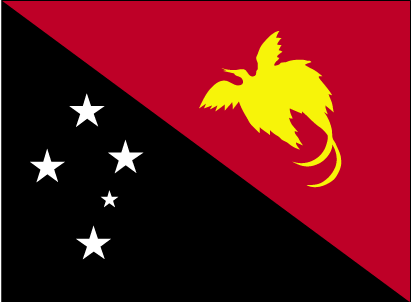 Located in: Melanesia in the Pacific Ocean, nestled snugly between Indonesia (to the west) and Australia (to the south)
Some common ingredients: yams, sweet potatoes (kaukau), taro root, pig, coconuts, yucca, fish and shellfish on the coast
Number of Papua New Guinean restaurants in the Baltimore area: You're kidding, right?
Number of Papua New Guinean restaurants in the DC area: 0, though there is one embassy (for all of the Americas) near Dupont Circle.
Kind of like: Hawaiian but heavy on the yams
The dish: Kaukau na Painap (Sweet Potato with Pineapple)
 This is it. This is all I needed.
- I got some sweet potatoes cheap at the produce stand on Joppa Road for all of 75¢, and ended up using only a few of them. I am now up to my eyeballs in sweet potatoes.
- The pineapple was only $2.50. I bought it pre-cut because, for some reason, it looked like Wegman's was selling whole pineapples for $7! Maybe I misread something, because I later saw one at Whole
PaycheckFoods for half the price. Maybe Wegman's pineapple was organic? - Since I had butter on hand (note to self: buy more butter), the only other thing I had to buy was a package of skewers, which set me back $2 at Giant.
The preparation for this recipe is very easy, so easy in fact that I don't have to repeat MacGregor's recipe word-for-word for you (which would violate some sort of copyright anyway). Basically, here's what you do:
- Partially boil (I did mine for 10 minutes - the key is to undercook them), peel and cube the sweet potatoes. I did it a little bass-ackwards, first peeling, then cubing and finally boiling them. I didn't do perfect cubes, but cubes will make it easier for them to fit on the grill.
- Next, skin and cube the pineapple (or buy it pre-cubed like I did, as noted above).
- Skewer the sweet potato and pineapple - and remember to soak those skewers first! Next, melt the butter and brush it over the skewers. Or you could go bass-ackwards again, and dip everything in butter before skewering. It's messier but I didn't have a brush so it was a bit easier for me.
- Grill until the sweet potatoes are nicely browned. I was impatient so I didn't do it as long as I wanted.
 I added a little salt to one and a little chili pepper to the other.
 And here's the final product.
Perhaps this should be a no-brainer sort of recipe, but it wasn't. I hadn't really considered pairing sweet potatoes and pineapples together. Despite the textural differences, the flavors blend nicely. In fact, what I may do with the remaining sweet potatoes and pineapple cubes is to purée them together with some butter and a wee bit of salt. I'd guess it's been done before, but I haven't seen it yet.
Monday, March 31, 2008
Pig and Pandanus in West Papua

I just discovered this show on the Travel Channel Living with the Mek: The Adventures of Mark and Olly. The latter are Mark Anstice and Olly Sheeds, two British adventurers who spend three months with the former, the 3,000-strong Mek tribe of West Papua province, Indonesia (though the Mek are culturally more similar to the tribes next door in Papua New Guinea). Among the things these two do: get initiated, along with a 9-year old, as "men" in the village (even though they are both in their 30's); get their brand new penis gourds - and have to introduce themselves to the village wearing nothing but them (It was not dirty, but I still gott say: these two blokes fill out a penis gourd pretty well.); trying to intervene when a young woman was accused of being a witch, by trying to convince her to leave before "the village" took things into their own hands; and witness the funerary rites of an elderly man who died while they were in town. One thing that Olly (who blogs about life with the Mek here) mentioned after that funeral stuck with me. These folks don't get a lot of flavor in their food, which consists of things such as potatoes, taro, yams, and (only on special occasions) pig. But the prep isn't too flavorful, so whenever they have a reason to inject flavor they do so.
The very somber day after the funeral, where the Mek burned the corpse in a pyre, they were much happier and threw a wake. Olly was one of the guys that was charged with the task of preparing bright red pandanus fruit* for the meal. This stuff is just about the only flavor the Mek, and many New Guineans, get at all. It comes in many different forms. The pandanus they used looked long and smooth; the one pictured at Wikipedia looks like a durian.
I found a Papua New Guinea Cookbook a very long time ago when I lived in California - it was in the cookbook section of the local university library (!). It's not the same one that's here, but I did xerox the hell out of it when I found it some eight or nine years ago. I have long since broken that New Year's Resolution to cook something from a different one of my cookbooks every week. Maybe I'll try this one next. I can get Mark and Olly and the Mek to mix the pandanus fruit for me. I'll just keep my eyes away from those penis gourds!
 The top picture is of Olly and Mark with the Kombai, another New Guinean tribe. Below are gentlemen wearing penis gourds. Ow. UPDATE: Jeff at Tropical Designs just left a comment, asking to give credit where it is due. I got the photo of the pandanus from the Tropical Designs web site, http://tropicaldesigns.com/ipm.htm. Not sure why I didn't already because I usually do. Speaking of which: the penis gourd pic comes from http://www.westpapuatrekking.com and our buffed British blokes are from the Discovery Channel Asia web site for "Living with the Kumbai"
Subscribe to:
Posts (Atom)


