Wednesday, September 28, 2011

Snacking State-by-State: Michigan II - I am the Falafel King!!! (not)

As noted in the previous post, Michigan is home to large immigrant populations from Wales, Poland, Russia, and all over the Arab world (and probably a few Canadians that filtered in from Ontario).  Arab-American cuisine - especially brought by Lebanese immigrants among others - enjoys a strong presence in Detroit and nearby Dearborn, the latter of which enjoys the largest Arab-American community in the United States.

Official Name: State of Michigan
State Nicknames:The Wolverine State; The Great Lakes State

Admission to the US: January 26, 1837 (#26)
Capital:
Lansing (5th largest)
Other Important Cities: Detroit (largest); Grand Rapids (2nd largest); Ann Arbor (6th largest)
Region:
Midwest; Great Lakes; East North Central (US Census)
RAFT Nations: Wild Rice
Bordered by:
Lake Michigan (west and southwest); Indiana & Ohio (south); Lakes Erie & Huron (east); Ontario (Canada) (north and east); Lake Superior (north); Wisconsin (northwest)

Official State Foods and Edible Things: brook trout (fish); whitetail deer (game mammal)
Some Famous & Typical Foods: immigrant cuisines, especially German, Irish, Welsh and Middle Eastern/Arabic; Coney Island dog; pasty (in the Upper Peninsula); morel mushrooms

ArabDetroit.com notes the diversity of the Middle Eastern community in the Midwest: 22 nationalities (including Palestine) represent the Detroit area's vast Arab-American community.  Starting in the late 19th century, Syrian and Lebanese Christians flooded into the area looking for work, followed in the early 20th century by Muslim Arabs (specifically Yemenis and Palestinians) and Chaldeans - from what would later become Iraq) who came to work in the burgeoning auto industry.  Over a century later there are anywhere from 400,000 to 500,000 Arab Americans in Michigan, most in the Detroit metropolitan area [ArabDetroit.com 2011]

Middle Eastern food - popular not just in the Arab world but in Israel as well - has become a popular staple in the United States.  Today you can find hummus, falafel, tabbouleh and a host of other Middle Eastern foods in any supermarket in the US - foods that were at best specialty items twenty years ago.  And usually, these recipes are easy to make yourself.

The recipes: Hummus and Falafel

I tried two hummus recipes.  The first one, from Madelain Farah's Lebanese Cuisine, did not turn out so well for me.  The second, recipe #2 of My Cooking Class: Middle Eastern Basics by Marianne Magnier-Moreno, was what really worked.


The recipe: Hummus


* garbanzo beans (i.e., chickpeas - canned is fine for this.  If you want a smoother hummus, try removing the skins.  I learned this while listening to Splendid Table on NPR  Even at Whole Foods, chickpeas aren't that expensive.  Surprisingly, one can of the cheap ones costs about as much as a can of Goya chickpeas at Food Lion - about 85¢ for a can.  If you go with dried, remember that one pound of dried chickpeas eventually yields the equivalent of about four 15 oz cans)
* tahini (this sesame paste is a vital component to your hummus.  I bought Asmar's brand out of Lebanon, which was a little less expensive than the other ones, at about $3.50.  Probably the easiest one to find is Brooklyn-based Joyva's tahini, which is in a lot of supermarkets)
* lemon juice (I used both a fresh lemon and juice from the bottle)
* garlic (had it)
* olive oil (same)
* parsley flakes, paprika and pine nuts (these are garnishes for your hummus - use whatever ones you like)

Also consider eating this with pita bread, tabbouleh and maybe some nice homemade falafel (see below)
 

Using Mangier-Moreno's recipe (each step beautifully photographed by Frédéric Lucano in My Cooking Class: Middle Eastern Basics), you will drain the chickpeas, reserving some of the liquid.


Combine all of the ingredients except for the chickpea liquid and the olive oil.  Just throw them all into your food processor.


When I made the first go-round, using a different recipe in Maria Khalifé's The Middle Eastern Cookbook (page 21 - the Lebanese Hummus bi Tahini), I got what you see above: a lot of tahini dissolved in water and lemon juice.  Maybe I added too much (well duh).  Regardless, hummus soup was not what I was going for.


Round two worked much better (in fact most of the hummus photos are from my second, successful attempt at hummus-making).  Here, add the chickpea liquid a little at a time, until you get the desired consistency.


To wit, the desired consistency.  Mine was a little chunky, but it worked for me.


Even though it was a bit chunky, I liked this hummus more than any store-bought I have had, and about as much as any I've had in a restaurant.  Perhaps it was because making it was so much easier than I had anticipated, or maybe it was the freshness.  I don't know, but it was a nice one.

For a more complete (and, I might add, vegetarian-friendly) Middle Eastern feast, fry up some falafel.

The recipe: Falafel

The falafel is popular in both the Arab world and in Israel, where it is considered a national dish, and both Arab and Jewish immigrants from the Middle East brought the falafel to the United States.  The recipe I used was one of the rare ones I could find that was chickpea-exclusive.  Most if not all falafel recipes call for fava beans - falafels that use them come out with that distinct green hue.  This is especially common in Lebanese recipes.  This one I used, from Madelain Farah and showcased on Sara's Secrets, is different from one I saw in her book Lebanese Cuisine.  That recipe also calls for fava beans and chickpeas.  The fava-free recipe is better if you suffer from favism (which I do not seem to).  Since fava beans are not nearly as easy to find in the US, this one seemed like a no-brainer.


* chickpeas - this time I used two cans.  Yes, I should have gone the dried route.  Falafels seem to turn out better when you use the dried stuff, again skinned)
* onion, coarsely chopped
* baking soda (had it)
* cumin, chili flakes and coriander (had them)
* garlic, chopped (also on hand)
* flour (Farah's recipe does not call for much flour, but as I found out, I would need a good bit more just to keep it from falling apart)
* oil for frying


If using dried, soak overnight.  Otherwise, drain the chickpeas, but this time do not save the liquid - you won't need it.  Remove as many of the skins as you can.


This won't be a particularly quick process, but it's worth it if you are using the canned stuff.  If using fava beans, you will need to soak them overnight as well and skin them.


Add the onion and process.


Throw in the rest of the ingredients except for the oil (duh) and process until crumbly and mixed together.


Form into small balls, or patties.  I eventually found patties to work best, though the problems I had probably did not have so much to do with the shape of the falafel so much as the lack of flour.  These little beauties disintegrated as soon as I put them in the oil.  So what I did was use the Google to find out how to stop this.  The answer: flour.  Add more and more flour, which will help to bind the falafels and keep them from being vaporized in the pan.


These much better bound falafels held together better, though there were still some bits boiling off.

Drain and serve, preferably in pitas though this is not necessary.  I may have pulled them out too early, but again, I was afraid of seeing yet another series of falafels disintegrating into chickpea dust in the pan, so I took them out when I could.

Farah also gives a quick recipe for a tahini dipping sauce: smoosh garlic and chop with salt.


Mix with water and tahini, and then slowly add lemon juice.  Eventually it will thicken.


My falafels were a little softer than I would have liked.  Again, this may be due to my pulling them out of the oil sooner, or perhaps because I used canned instead of dried and soaked chickpeas.  I still had a good experience with the falafels that actually did turn out, though I ended up putting the pitas aside and just eating them and these lovely tomatoes with my hands.


With the hummus I made earlier, this turned out to be a most filling meal.

Sources:

ArabDetroit.com.  "Arab Americans".  Much information contributed by Rosina Hassoun, (Arab Americans in Michgan, 2005). Copyright ArabDetroit.com, 2011.  All rights reserved.

Adams, Marcia. Heartland: The Best of the Old and the New from Midwest Kitchens. Clarkson Potter: New York, 1991.

braniac (eHow user).  "How to Make a Detroit-Style Coney Island Hot Dog".  eHow article, post date unknown.  Copyright 1999-2011 eHow.

Dooley, Beth, and Lucia Watson.  Savoring Seasons of the Northern Heartland.  Alfred A. Knopf: New York, 1994.

Farah, Madelain. "Falafel: Chickpea Patties".  Featured on the episode "Late Night Sandwiches" of the show Sara's Secrets (Sara Moulton, host).  Food Network, 2004.

Farah, Madelain.  Lebanese Cuisine: More than 200 Simple, Delicious, Authentic Recipes.  Twelfth edition. Self-published: New York, 1997.

Magnier-Moreno, Marianne, with Frédéric Lucano (photographer).  Middle Eastern Basics: 70 Recipes Illustrated Step by Step.  From the series "My Cooking Class".  Firefly Books: Buffalo, NY, 2010.

Some information also obtained from Wikipedia's "Michigan" page and other pages, and the Food Timeline State Foods link to "Michigan".

Tuesday, September 27, 2011

This week in culture shock...


Three thoughts on a recent visit to H-Mart:

1) Ew.

2) People actually eat this. Stop being so ethnocentric.

3) So... should I try to eat this at some point?

Monday, September 26, 2011

It's the most wonderful time of the year! (2011 Edition)


Peeps aren't just for Easter anymore, but we've known this for some time.  Still, chocolate-flavored cat peeps?  (Taken at the Columbia Harris Teeter about a week ago. Love those ghost peeps, too.)

Sunday, September 25, 2011

Snacking State-by-State: Michigan I - You look a little pasty

Now I am heading back into the Great Lakes, and asking myself what makes Michigander munchies unique in their own right. But which Michigan will I investigate: the mitten part of the Southern Peninsula, or the forests of the U.P.?  You all can guess the answer: both.

Official Name: State of Michigan
State Nicknames:The Wolverine State; The Great Lakes State

Admission to the US: January 26, 1837 (#26)
Capital:
Lansing (5th largest)
Other Important Cities: Detroit (largest); Grand Rapids (2nd largest); Ann Arbor (6th largest)
Region:
Midwest; Great Lakes; East North Central (US Census)
RAFT Nations: Wild Rice
Bordered by:
Lake Michigan (west and southwest); Indiana & Ohio (south); Lakes Erie & Huron (east); Ontario (Canada) (north and east); Lake Superior (north); Wisconsin (northwest)

Official State Foods and Edible Things: brook trout (fish); whitetail deer (game mammal)
Some Famous & Typical Foods: immigrant cuisines, especially German, Irish, Welsh and Middle Eastern/Arabic; Coney Island dog; pasty (in the Upper Peninsula); morel mushrooms

Michigan, like much of the Upper Midwest, has strong Native American and immigrant food traditions.  Wild rice is fairly important here, as are the foods that various immigrant groups brought with them.  In her Heartland cookbook, Marcia Adams discusses various waves of immigration into the Wolverine State, and how they shaped the cuisine there.  The first wave, with the Erie Canal, brought New Englanders, along with German, Irish and (with their Cornish pasties) Welsh settlers and their traditions; the second wave swept in more immigrants to work in logging.  The third wave was the most diverse, bringing not only African Americans during the Great Migration but also Eastern Europeans and Middle Easterners - especially Arabs (As will be noted in a future post, Detroit has the largest concentration of Arab-Americans in the United States). [Adams 1991: 94]

As noted above, there are two peninsulas to Michigan: the southern one plastered with farms, and the upper one, with pine forests and trout [Adams 1991: 93].  Many immigrants settled in both areas, and their immigrant traditions took a strong hold.  Look at the Upper Peninsula, for example.  UPers (as they like to be called) have been influenced by their Welsh foremothers and forefathers with that most British/Welsh/Cornish of pastries, the pasty (pronounced PASS-tee, not PACE-tee).  Pasties are very common not just in the Upper Midwest - Minnesota has its own version, for example.  Beth Dooley and Lucia Watson give some background on the pasty in their book Savoring the Seasons of the Northern Heartland, a most thorough cookbook for the Upper Midwest.

The Cornish who came to work on the Iron Ranges of Michigan's Upper Peninsula and northern Minnesota in the late 1800s introduced the pasty..., a meat-and-potato-filled pastry turnover, to their Finn, Czech, Irish, Italian and Yugoslavian co-workers, who made it their standard noon meal.  A miner's lunch pail held hot coffee or soup in the bottom to warm the pasty in the top compartment.  Early pasty makers would bake a whole meal into the crust, filling one end with meat and the other with apples or cherries.  Made with a firm, lard dough that would not crumble, a good pasty was supposed to hold up if dropped down the mine shaft. [Dooley and Watson 1994: 180]

There are local variations: the Minnesotan one can be made with all beef, and eaten with ketchup.  But to make a truly Michigander pasty, it more likely than not should include pork and beef.  And do try to track down some actual suet for your pasties if you can.  I didn't, but the Michiganders seem to love it.

The recipe: Pasty (Upper Peninsula Version)

For my pasties (again, read that as PASS-tees - PASS-tees!!!), I consulted Beth Dooley and Lucia Watson's Savoring the Seasons of the Northern Heartland, the only Upper Midwestern cookbook I have ever found down here in the Mid-Atlantic.  While their recipe for Ellen Ostman's Pasty (on page 181) clearly comes from Minnesota, the authors (and probably Mrs. Ostman) give some important tips on turning this into a Michigan-style pasty: instead of using all beef, use equal parts of beef and pork.  Marcia Adams' recipe, again in Heartland, calls for ground pork and chunks of beef, so I went with that.


* equal parts beef and pork (you will cube the steak, and here I used ground.  I used flank steak because it was on sale, and I didn't need as much - in fact, I only needed one of these steaks).
* equal parts turnip, potato, onion and carrots (I had only the carrots on hand, from the garden.  I don't usually buy turnips so I was surprised at how cheap this one was.)
* thyme and nutmeg (had them)
* garlic (same)
* salt & pepper
* two pie crusts (the amount you would need for a covered pie - I had planned for the longest time to make a pie crust, but I have been very busy these last few weeks, and eventually I just gave up and bought ready-made pie crusts at Giant.  Don't look at me that way.  Store-bought is fine once in a while, even if it doesn't taste as good)
* butter (Mrs. Ostman's recipe calls for this - as she says [Dooley & Watson 1994: 181], her mother "was a great believer in butter.  Others add suet.")


The assembly is actually pretty easy: first, peel the veggies and dice them into small cubes.


Do the same to the steak.  I found it easiest to use cooking shears.


Mix the meat, vegetables, smashed and chopped garlic, and spices together.  I was also surprised at how little meat there was, but I shouldn't be: the Welsh and Cornish miners that brought the pasty into the field wouldn't have had a lot of money to buy meat anyway).


Roll out your pie crusts on a floured surface, and put a massive mound in the center of one side of the pie crust.  Dot the filling with butter. (I ended up with enough to make a third pasty, but didn't have an extra pie crust.  Pasty filling stir-fry anyone? It was actually quite good.)


Fold over and crimp the edges.  If holes form, patch them with little pieces of leftover dough.


Bake the pasties in the oven for about an hour at 375°F.


They should look like this.


The one thing pasty lovers agree on, according to Dooley and Watson [1994: 180], is that the pasty is correctly made "'when the juice runs off your elbow as you eat it'".  I didn't have a lot of juice - not enough butter or meat? - but since I ate it on a plate, that didn't seem to matter.  This is definitely comfort food that is an easy way to pack a bunch of leftovers - in fact a whole meal - inside a pie crust.  Many sources point out that dessert would be packed into one corner for the original Welsh TV dinner-slash-pot pie.  It is filling and rich, and is something I will try with an actual homemade pie crust next time.

Sources:

ArabDetroit.com.  "Arab Americans".  Much information contributed by Rosina Hassoun, (Arab Americans in Michgan, 2005). Copyright ArabDetroit.com, 2011.  All rights reserved.

Adams, Marcia. Heartland: The Best of the Old and the New from Midwest Kitchens. Clarkson Potter: New York, 1991.

braniac (eHow user).  "How to Make a Detroit-Style Coney Island Hot Dog".  eHow article, post date unknown.  Copyright 1999-2011 eHow.

Dooley, Beth, and Lucia Watson.  Savoring Seasons of the Northern Heartland.  Alfred A. Knopf: New York, 1994.

Farah, Madelain. "Falafel: Chickpea Patties".  Featured on the episode "Late Night Sandwiches" of the show Sara's Secrets (Sara Moulton, host).  Food Network, 2004.

Farah, Madelain.  Lebanese Cuisine: More than 200 Simple, Delicious, Authentic Recipes.  Twelfth edition. Self-published: New York, 1997.

Magnier-Moreno, Marianne, with Frédéric Lucano (photographer).  Middle Eastern Basics: 70 Recipes Illustrated Step by Step.  From the series "My Cooking Class".  Firefly Books: Buffalo, NY, 2010.

Some information also obtained from Wikipedia's "Michigan" page and other pages, and the Food Timeline State Foods link to "Michigan".

Friday, September 23, 2011

Wedding in Provincetown Part II: Back to Boston


Say, I think that's Boston in the distance...

Again, my trip to Provincetown a few weekends ago took me through Boston, and I deliberately scheduled a late flight on Sunday (September 11, no less) just so I could explore the city a wee bit.  Just a few points on my stop from the dock to the airport (where awaited another, somewhat irritating adventure):

* On the Bay State Cruise Company's lovely ferry ride back between Provincetown and Boston, you can buy somewhat overpriced foods ($3 for popcorn is not out of the question though).  Or you can smuggle a Long Trail IPA, straight out of Vermont, on the boat with you.  Bring a bottle opener.  It's probably rude to ask them to open it for you. Oh, and still not seasick, though the bay was much calmer than before.

* The last time I was in Boston - on that eight hour layover before my IcelandAir flight to Amsterdam via Reykjavik - I made it to Faneuil Hall for an extremely overpriced and fairly boring lobster roll at one of the many vendors in the Quincy Market complex.  I swore that the next time I hit Boston, I would head to the Wagamama in Quincy Market, and that's what I did. 


Wagamama has been considering opening a location in Washington, DC (they better damn well do it soon, too), but for now the only stateside Wagamamas are all in and around Boston.  For $15 I got their "Absolute Wagamama" combo, which came with chicken ramen (or yaki soba - your choice), three chicken dumplings and a beverage: soda, juice or - yes!!! - beer.  I went with the beer, a Tiger Beer from Singapore.  It was refreshing, but it didn't wow me.  The meal, however, was memorable, especially after I ordered the side of Japanese pickles ($1).  I enjoyed my filling and slightly spicy meal, with chicken that wasn't even dried out like at so many other places, while watching a scrawny shirtless man covered in tattoos outside the window squeeze himself through a tennis racket (!) while juggling chain saws, to the awe of many.


Uhhhhh...

* After finding out that the Faneuil Hall Marketplace was closed, I wandered around the markets for a bit, contemplating some raw oysters and clams at one of the several seafood establishments nearby.  I finally swooped over to the legendary Durgin Park, one of the oldest restaurants in the US, which serves "Yankee Cuisine".  While the service was slow at first, once they saw me they quickly got over to me (you don't stay in business for two centuries with bad service, mind you).  I got a slice of Boston Cream Pie and a Harpoon ($12.50 altogether).

I left for Boston Logan early, and checked in with my boarding pass all ready to go!

Then I get to the gate, seeing a big line at the gate counter.  I found myself in that line when I suddenly got a text from Southwest saying that my 7:20 flight was now canceled, and that I should make other arrangements.  Apparently, BWI had chosen September 11 as their day to do massive maintenance to all but one of their runways.  Perhaps they thought nobody would be flying that day.  They were wrong, and a lot of travel plans were screwed up.  At least I was lucky, for the ticket agent was able to get me on a flight going out later, but originally scheduled to have departed already, so I wouldn't have to do stand-by, which most people did (good choice, too, since hardly anyone was on that plane).  While commiserating with all the people missing or barely making connections at BWI, I went to the terminal E bar to get a beer, a Bunker Hill Back Bay IPA, while some drunk guy from who knows where trash talked the Patriots.  Oh, his waitress was not amused, though she took it in stride - again, that Yankee heartiness on display.  After that and a cheap slice of cheese pizza from the Sbarro's in the international terminal, I finally boarded the plane for home, fuller, more tired, and ready to get up very early for work.

Wednesday, September 21, 2011

Dining Out for Life 2011

It's that time again: many area restaurants are getting together with Moveable Feast for the annual Dining Out for Life, to raise money for the organization that delivers meals to housebound people with HIV/AIDS and breast cancer.  I work that night but I'm still making my plans to eat afterwards. Check out the DO4L website for more information.

Tuesday, September 20, 2011

Wedding in Provincetown I: Civil Marriage is a Right

To bring my musings on Massachusetts full circle, I must take this blog back to Provincetown, the first place I deliberately visited in New England.  I probably would not have gone (any time soon anyway) had my friends Eric & Alan (hey guys) not married there last weekend.  Why not DC?  Well, yes it is closer, but they wanted to give a nod to the state to legalize same-sex marriage before any other.  Plus, Provincetown is a lovely place for a wedding.  And with over 50% of the full-time residents identifying as gay or lesbian, it's not like this sort of thing is unexpected.

I met several of my friends and fellow wedding guests at BWI by sheer coincidence (all out on the same flight).  Once in Boston we ran into a woman going to another P'town wedding that same weekend!  So the five of us hopped on the mass transit to the World Trade Center station, headed to the docks for our ferry tickets, and sought out food.  Our destination was a non-descript sports bar, Jerry Remy's Sports Bar and Grill.  Or at least I think it was Jerry Remy's, as the photograph suggests.  Apparently their website suggests there is only one, and it's at Fenway Park.  Unless the Red Sox have started playing out by the World Trade Center, we definitely weren't eating at Fenway Park.  Anyway, we all had some lovely microbrews from Western Massachusetts and some massive burgers.  They tout their fried dough burger, which the waitress warned us was at least 1200 calories.  I wasn't goin' anywhere near that.  One of us did order it, but on a brioche instead.  I got a filling and satisfying burger ($14) with a side order of sweet potato fries.  As far as sports bars go, it was pretty decent food.


We headed out to Provincetown, on the tip of Cape Cod, on the Fast Ferry - courtesy of the Bay State Cruise Company (only about $85 round trip from Boston to Provincetown).  I didn't get sick, even with the rough seas.  Perhaps I have a built-in Dramamine supply.


Once in Provincetown, we settled into our various B&B's - the Cape, apparently, is full of them.  Mine was the Admiral's Landing, a lovely place on Bradford Street with friendly proprietors that serve homemade muffins and raisin bread for breakfast.  Do check it out if you're up there.

Later that evening the cocktails began.  Not long after that came the food - lots of it.  Before the wedding guests convened on Friday night, I went exploring Commercial Street to get a taste of the place.  Along the way I stopped in the Provincetown Portuguese Bakery for some cheap eats (cash only): a lovely lemon tart, and a bacalhau, that famous Portuguese codfish cake (total: less than $4).  Still not a fan, though I don't blame the bakery - it's not their fault I don't like coddies.  But I liked the tart.


After cocktails we split off into our own separate ways for dinner.  I went with the groom and groom and a few more of us to the Karoo Kafe, perhaps Cape Cod's only South African restaurant.  Once there, I had to confer with Alan, one of our handsome grooms, who is from South Africa, to find out just what to order that would be authentic.  After he conferred with the owner - he had a long conversation with her in Afrikaans - he told me to order the lamb curry ($14), which after tasting mine he said was pretty authentic: a little bit sweeter than a typical curry.  Another one of us ordered the antelope burger ($10), but found it unremarkable.  Yes, I almost ordered it.  I've never eaten antelope.

The next day was filled with little nibbles here and there, some cheap, some relatively pricey, but most good.  A note about Provincetown: it is not difficult to find cheap and good food if you know where to look.  But it is much much easier to find very expensive food.  I was more of the "Where can I get a super-cheap lobster roll that is actually worth eating?" mentality.  That's how I roll when I don't get paid until the next weekend.


I needed to wander out that morning for some toothpaste and hair spray.  Instead, I found myself meandering  up and down the breath-taking Pilgrim Monument and through the Provincetown Museum ($8) - near the site of the first landing of the Pilgrims before heading to Plymouth, I might add.  Then my day of eating began.

And oh, all the eating I did:

* The aptly-named Burger Queen was recommended to me by my innkeeper.  For just $10 you can get a classic and decent lobster roll, complete with the toasted buttered roll, and both small and large chunks of lobster.  They also had a Maryland crab cake (!) available for $16.  I didn't bother with it.  I wasn't sure how P'town Yankees, God love 'em, would do making a crab cake.


* Since whoopie pies have crossed the Mason-Dixon Line, I have been eating my fair share of them.  The one I had at Deja Vu for $2.50 was not one of the better ones I've had, though it wasn't all that bad.

* More than making up for it was the White Russian flavored ice cream from Lewis Brothers ($3.75 for a small cup).  Filling.

* I stopped in the Provincetown Portuguese Bakery for more stuff, some meringues to take home for family.  I regret that I didn't get to explore more of Portuguese-American culture while there.  That will be the next time I visit Provincetown, whenever that may be.

* A friend from Maine recommended Mojo's among other places, and Mojo's was the only one I could make it to.  Their onion chunks (for about $4.50) were fried in some sort of light batter.  Very crispy, and I love the take on onion rings, but they were not the best fried onions I've had.  Again, not bad.

* Scott Cakes, however, is a local institution.  They do their own laid-back take on the national cupcake craze by making just one type of cupcake: yellow buttery cake with pink buttercream frosting.  It is an unbelievably wonderful cupcake - either regular size ($3) or small ($2).  Do they put crack in these?  The innkeeper said she asked about a chocolate one hopefully soon, but Scott hasn't yet found a chocolate cake recipe he's happy with.  I was perfectly happy with the ones I bought, and even tried to bring some home.  By the time they got to Baltimore the icing was not so much on the cupcakes anymore as all over the insides of the box.  Oh well.  I ate it off the insides of the box anyway.

Finally: the wedding at the lovely Crown & Anchor, usually manned by a few drag queens telling passersby what's going on that night.  It was a lovely ceremony on the beach at sunset, with delicious appetizers and an open bar.  That and so many spectators in the balconies, all strangers to us, applauding from the balconies.  I am hoping for that when I land me a husband.

 
The happy couple.  Congratulations, Alan & Eric!

After post-wedding hors d'ouevres and cocktails, we headed into the dining room for dinner.  We had several choices, if I remember correctly: seafood pasta (this is what I ordered), scallops (this is what I should have ordered) and steak.


Dessert was an array of gourmet cupcakes.  Guys, you outdid yourselves.  I hope you can pay it off.  Though they tell me, as weddings go, it was a lot cheaper than a typical straight wedding might have been.

The next morning I headed back to Boston on the Fast Ferry.  You will read about my eats there later this week.

Other photos:

Oh he's leavin
On that midday boat to P'town
The view from atop the Pilgrim Monument

What ah ya lookin' at?
Oh Varla, when will you missionize at the Hippo again?

She was standing there, all day...

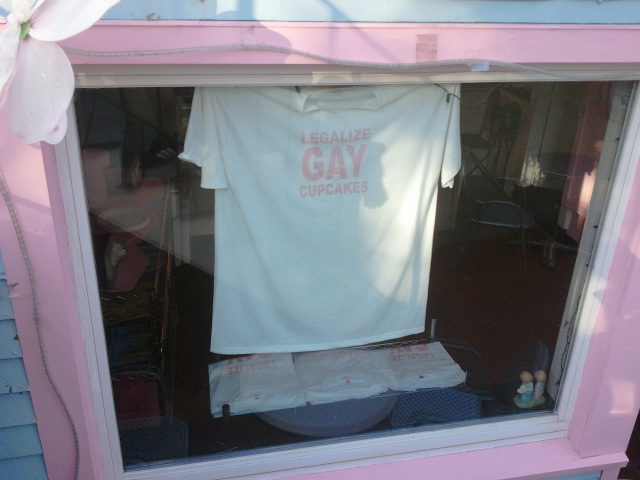
Next thing you know they'll be letting gay cupcakes marry!

The First World War Veterans' Monument in the center of town

 
Heterosexuals are also welcome in Provincetown

 
Apparently, they love the whale watching.